Can You Register a Car with a Salvage Title?
Usually, no. A salvage title by itself is usually not enough to register a car. Most states require the vehicle to be repaired, inspected, and retitled through the state’s salvage-to-rebuilt process before standard road registration will go through. Until then, the vehicle may be limited to the state process and not eligible for normal on-road registration.
Why repair work alone may not clear a salvage title
Usually, not yet. A salvage title means the vehicle was declared a total loss under the state’s title system, but that does not automatically make it registrable for road use. In most states, registration depends on passing the required repair, inspection, and retitling steps before the DMV will issue normal plates or road registration.
That means the title brand matters as much as the repairs. A car can run and still be blocked from registration if the state wants a rebuilt title, a safety inspection, VIN verification, emissions testing, or another filing step before it accepts the application.
When a salvage vehicle is not ready for road use
Until the required salvage-to-rebuilt steps are complete, road use is usually restricted by state process, not just by the car’s condition. California DMV and other state agencies treat salvage status as a title stage that must be cleared before standard registration can be issued.
For example, a vehicle that was flooded or collision-damaged may be mechanically repaired but still fail registration because the title is still branded salvage and the state has not yet accepted the rebuild paperwork, inspection result, or VIN confirmation.
Salvage to rebuilt title path
A rebuilt title is usually the post-repair title status that comes before normal registration. In many states, the sequence is repair first, then inspection and title conversion, then registration. The exact filing order is state-specific, and some states require a rebuild inspection before any registration step can move forward. [California DMV; New York DMV; Texas DMV]
That path often includes proof of repair, title application forms, inspection paperwork, and insurance. If the state requires a rebuilt title or equivalent post-repair designation, the DMV may not accept a registration filing while the vehicle remains branded salvage.
Why repairs usually come first
If you buy a salvage car, the vehicle usually needs documented repairs before the state will accept a rebuild filing. Receipts, parts lists, repair photos, and a repair summary help show what changed from total loss to roadworthy condition. Those records also help the inspector and DMV compare the vehicle against the title brand.
Without repair documentation, the application can stall even if the car appears complete. State agencies commonly want a paper trail that matches the VIN, title brand, and current condition before they move the vehicle out of salvage status.
When a rebuilt title is still not enough
A rebuilt title does not always end the process. Some states still require emissions testing, VIN verification, or a separate safety inspection before registration will be issued. If the car fails one of those checks, the DMV can hold the filing until the issue is fixed and the vehicle returns for reinspection.
What the DMV usually requires
The DMV or motor vehicle agency usually wants the title, ownership documents, repair proof, identity verification, and any required inspection results before it will process a salvage-related filing. The exact forms, fees, and order of steps vary by state, but the agency’s goal is the same: confirm ownership, confirm identity, and confirm the vehicle meets the state’s requirements for road use. [State DMV and motor vehicle agency requirements vary by state]
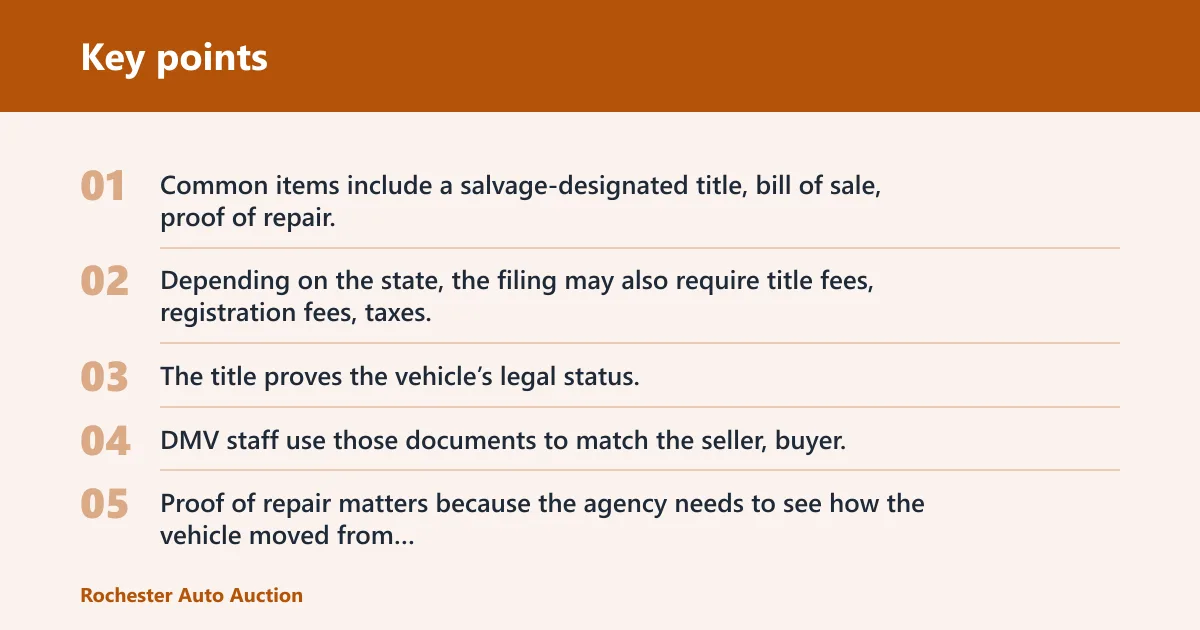
Common items include a salvage-designated title, bill of sale, proof of repair, proof of insurance, VIN verification, and odometer disclosure. Depending on the state, the filing may also require title fees, registration fees, taxes, and inspection charges.
Title and ownership paperwork
The title proves the vehicle’s legal status, and the bill of sale supports the transfer trail. DMV staff use those documents to match the seller, buyer, and VIN before they accept a salvage-to-rebuilt or registration filing.
Proof of repair and bill of sale
Proof of repair matters because the agency needs to see how the vehicle moved from salvage condition to roadworthy condition. Receipts, parts lists, repair photos, and a written summary create the record inspectors and title clerks use to verify the rebuild.
Insurance, VIN verification, and fees
Insurance is often required before registration, but the timing can vary by state and insurer. Some carriers limit coverage options for rebuilt or branded-title vehicles, and some may ask for an inspection before binding a policy. VIN verification confirms the vehicle identity and helps prevent title fraud or paperwork mismatches. Fees can include title, registration, tax, and inspection charges depending on the state.
Inspection steps before registration
Do salvage title cars need an inspection before registration? Often, yes. Many states require a rebuild inspection, safety inspection, VIN verification, emissions test, or a combination of those steps before the DMV will process a normal registration. Official state rules are the best source because the inspection type and order can change by vehicle and by state. [California DMV; New York DMV; Texas DMV; Florida DHSMV]
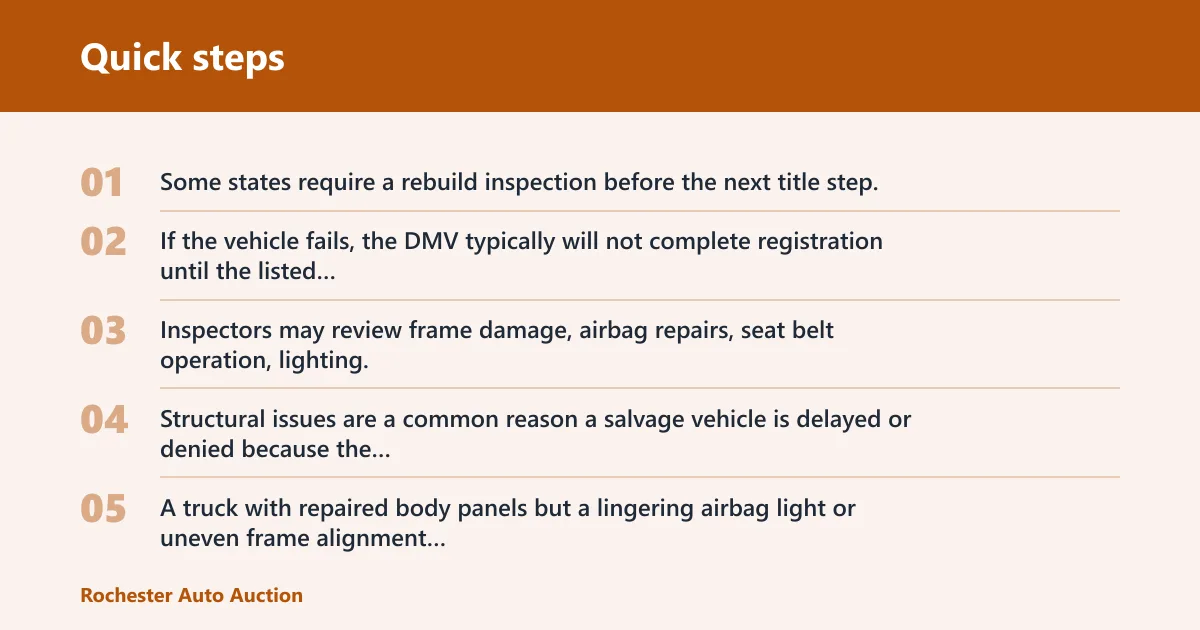
Some states require a rebuild inspection before the next title step, while others add emissions or VIN checks later in the process. If the vehicle fails, the DMV typically will not complete registration until the listed problems are corrected.
Safety and structural checks
Inspectors may review frame damage, airbag repairs, seat belt operation, lighting, steering, and brake condition. Structural issues are a common reason a salvage vehicle is delayed or denied because the state must be satisfied that the repaired car is safe enough for road use.
A truck with repaired body panels but a lingering airbag light or uneven frame alignment may look finished, yet still fail the state inspection. The title process depends on the safety result, not just the appearance of the repair.
Lights, brakes, airbags, and emissions
Lighting, brake function, and airbag status are common inspection points. In emissions-testing states, the vehicle may also need to pass the emissions program before title conversion or registration. A clean repair file does not override a failed emissions result.
VIN verification and common failure points
VIN verification may be required to confirm the car matches the salvage title, bill of sale, and repair records. Common failure points include a VIN mismatch, missing repair receipts, incomplete photos, unresolved damage, or an inspection result showing the vehicle still does not meet the state’s road-legal standard.
State rules for salvage registration
State rules differ, so the answer changes by location, vehicle history, and filing order. The comparison below gives a compact snapshot of common state process differences, but the official DMV or motor vehicle agency should be the final source for forms, inspection type, and filing sequence.
| State | Salvage-only registrable? | Rebuilt title required? | Inspection type | VIN verification | Insurance timing | Common filing blockers |
|---|---|---|---|---|---|---|
| CA | No, typically not for normal road registration | Usually yes | Brake and lamp inspection may be required, plus CHP or DMV-related verification in some cases | Often yes | Usually before registration filing | Missing title paperwork, inspection failure, VIN mismatch, incomplete proof of repair |
| NY | No, typically not for normal road registration | Usually yes | Rebuilt salvage inspection through the state inspection process | May be required | Usually before registration filing | Missing MV-50 or ownership docs, failed inspection, incomplete repair records |
| TX | No, typically not in salvage status | Usually yes | State safety inspection and title/branding-related review | May be required | Before registration | Title brand issues, incomplete repair history, inspection failure |
| FL | No, typically not in salvage status | Usually yes | VIN verification and title/registration review; inspection can vary by vehicle type and process | Often yes | Before registration | Missing title transfer documents, verification issues, unresolved branding |
| GA | No, typically not in salvage status | Usually yes | State title branding and verification steps; emissions may apply by county | May be required | Before registration | Emission failure where applicable, title mismatch, incomplete paperwork |
| MA | No, typically not in salvage status | Usually yes | Reconstruction inspection and RMV review | Often yes | Before registration | Missing receipts, failed inspection, incomplete reconstruction evidence |
| NJ | No, typically not in salvage status | Usually yes | Rebuilt inspection and MVC paperwork review | Often yes | Before registration | Paperwork gaps, failed inspection, VIN mismatch |
| NC | No, typically not in salvage status | Usually yes | Safety inspection and title review | May be required | Before registration | Safety failure, missing ownership proof, branding issues |
| CO | No, typically not in salvage status | Usually yes | VIN verification and title inspection steps | Often yes | Before registration | VIN discrepancy, document mismatch, incomplete title file |
| NH | No, typically not in salvage status | Usually yes | VIN and title verification; inspection requirements can depend on vehicle and transaction type | Often yes | Before registration | Missing paperwork, title-brand issues, verification failure |
California and New York
California and New York are both process-heavy states for salvage-branded vehicles. California DMV salvage and rebuilt procedures can involve inspection-related steps and VIN confirmation, while New York DMV requires a rebuilt salvage inspection process before the vehicle can move toward road registration. In both states, salvage status alone is not the end of the filing path. [California DMV; New York DMV]
For these states, the important question is not just “can it run?” but “has it cleared the state’s rebuild and verification steps?” If the title is still branded salvage, the DMV may stop the filing until the vehicle passes the required checks.
Texas, Florida, and Georgia
Texas, Florida, and Georgia all use state-specific branding and verification rules, so the correct filing path depends on the title history and the vehicle’s current status. Texas and Florida generally require the vehicle to clear the salvage-to-rebuilt process before normal registration, while Georgia’s process can also turn on title-brand handling and county-level emissions rules where applicable. [Texas DMV; Florida DHSMV; Georgia DOR]
In these states, the usual blockers are paperwork gaps, verification issues, and inspection results that do not match the repaired vehicle. Insurance timing also matters because many registries want coverage in place before the registration transaction is completed.
Massachusetts, New Jersey, North Carolina, Colorado, and New Hampshire
These states also put weight on verification and inspection order. Massachusetts and New Jersey are known for rebuilt or reconstructed vehicle inspection steps, North Carolina uses inspection and title review, and Colorado and New Hampshire can require VIN or title verification before registration proceeds. [Massachusetts RMV; New Jersey MVC; North Carolina DMV; Colorado DMV; New Hampshire DMV]
For all five states, the common failure points are the same: missing documents, mismatched VIN data, incomplete repair proof, or an inspection result that does not satisfy the agency’s rebuild standard.
What registration can fail
Registration can fail when the paperwork does not match the vehicle’s title history or when the car has not cleared the required inspection path. Missing documents, inspection failure, emissions failure, VIN mismatches, or insurance problems can each stop a salvage-related filing before the DMV issues registration.
Missing or inconsistent paperwork
If the title brand, bill of sale, repair summary, or odometer disclosure does not line up, the agency may pause the file. Even small gaps can cause a delay if the DMV cannot confirm ownership, repair history, and the current vehicle identity.
Inspection or emissions failure
An inspection failure usually means more repair work and another appointment. In emissions states, a failed emissions result can also block registration even when the bodywork is complete and the title paperwork is otherwise ready.
Insurance limits or VIN mismatches
Proof of insurance is often required before registration, but some rebuilt or branded-title vehicles may face policy limits. If the VIN on the car does not match the title or inspection records, the DMV may reject the application until the discrepancy is corrected and verified.
Salvage title registration checklist
Use this checklist before you go to the DMV. It turns the salvage-to-registration process into a quick decision path so you can see what still needs to happen before the vehicle is ready for filing.
| Vehicle status | Required next step | Likely DMV filing | Inspection needed | Insurance needed | Common failure reason |
|---|---|---|---|---|---|
| Salvage title only | Repair the vehicle first | Title application for rebuild path | Usually yes | Often not yet, but state rules vary | Vehicle not suitable for registration yet |
| Salvage title with repairs completed | Schedule inspection and gather proof of repair | Rebuilt title or equivalent state filing | Usually yes | Often yes | Missing receipts, photos, or repair summary |
| Rebuilt title issued | File registration with DMV or motor vehicle agency | Registration application | Sometimes, depending on state | Usually yes | Insurance limits or unpaid fees |
| Rebuilt title with VIN mismatch | Correct the identity record before filing | Corrected title or inspection record | Yes, often VIN verification | Usually yes | VIN does not match title or inspection documents |
| Rebuilt title, failed emissions | Repair emissions issue and retest | Registration after pass | Yes, emissions retest | Usually yes | Emissions failure |
Before you go to DMV
- Confirm the title brand and current vehicle status.
- Collect the salvage-designated title and bill of sale.
- Save repair receipts, parts lists, photos, and a short repair summary.
- Check whether your state wants a safety inspection, rebuild inspection, emissions test, or VIN verification.
- Get proof of insurance that fits rebuilt or salvage-branded vehicles.
- Confirm the filing method, fee list, and whether the DMV wants an in-person visit.
Frequently asked questions
Can you register a car with a salvage title?
Usually, no. A salvage title means the vehicle has been declared a total loss, and most states require repairs, inspection, and a rebuilt or equivalent title status before normal registration. The exact rules come from the DMV or motor vehicle agency, so the state process matters more than the title brand alone.
Can you register a car with a salvage title in California?
Usually, not as a standard road vehicle until the car has been repaired and moved through California’s salvage/rebuilt process. California DMV procedures can involve inspection-related steps and VIN verification before registration can proceed. Check the state’s official requirements before filing because the order of documents matters. [California DMV]
Can you register a car with a salvage title in New York?
Usually, no, not with salvage status alone. New York generally expects the vehicle to be repaired and to pass the state’s salvage/rebuilt inspection process before it can move toward road registration. The DMV may also require specific forms and identity checks, so the salvage title by itself is not enough. [New York DMV]
What do you need to register a salvage title car?
You usually need the salvage-designated title, proof of repair, bill of sale, proof of insurance, and sometimes VIN verification and an odometer disclosure. Depending on the state, you may also need an inspection report, title application forms, and fee payment before the DMV will process the file.
Do salvage title cars need an inspection before registration?
Often, yes. Many states require a rebuild inspection before the next step, and some also require safety, structural, lighting, brake, airbag, emissions, or VIN verification checks. If the vehicle fails inspection, the DMV usually will not complete registration until the problems are fixed. [State DMV requirements vary]
What is the difference between salvage title and rebuilt title for registration?
A salvage title means the vehicle was declared a total loss and is usually not ready for normal road registration. A rebuilt title is the post-repair status that usually comes after the required inspection and before legal registration. In most states, rebuilt status is the practical path to road use.
Will insurance be required to register a rebuilt salvage vehicle?
Usually, yes. Proof of insurance is often required before registration, and some insurers may limit coverage options for rebuilt-title vehicles. In some cases, the insurer may also ask for an inspection before offering coverage, which can affect the timing of the DMV filing.
What states have the strictest salvage title registration rules?
There is no single nationwide ranking because the process varies by state and by title brand. California, New York, Massachusetts, New Jersey, and North Carolina often require more steps than a simple title transfer, while other states may focus more heavily on inspection or verification. Always check the local DMV before buying.