Do You Pay Seller Fees If Your Car Does Not Sell at Auction?
Yes. If a car does not sell, you may still owe a run fee, re-run fee, or no-sale fee; some charges come out only of sale proceeds, so a true no-sale can still leave you with a bill. Missing the fee rule can wipe out your expected payout or create an invoice you did not plan for. This guide maps the common no-sale outcomes, so you can tell what is owed, what is withheld from proceeds, and when you can rerun the vehicle.
What counts as a no-sale?
A no-sale happens when the vehicle is offered in the lane or online sale and does not complete a sale. In auction-specific terms, that can happen when bidding never reaches reserve, no one bids, or the seller refuses the top bid. The label matters because fee rules often turn on whether the car sold, not just whether it appeared in the sale.
Reserve not met
Carwow defines a reserve price as the minimum amount the seller will accept, and if bidding does not reach that figure, the car will not be sold. That is the clearest no-sale outcome. Depending on the auction house, the listing may still count as an entry for fee purposes even though the sale did not close.
No bids received
If no one bids, the car also ends as a no-sale. The vehicle may still have been inspected, photographed, and listed for the sale, so the auction house may still apply a run fee or a no-sale charge. Pickup timing then depends on the house’s release, storage, and gate rules.
Seller rejects the top bid
Sometimes the top bid is below the seller’s comfort level, even if reserve was not formally stated. In that case, the seller can refuse the bid if the auction rules allow it. The result is still a no-sale, and the fee treatment usually follows the house’s rejection and rerun policy.
Seller fees vs. run fees
Seller fees and run fees are not the same charge. A seller fee is the auction-house fee tied to a completed sale and may be deducted from proceeds; a run fee is the amount paid to place the vehicle in the sale. A car can fail to sell and still leave you owing the run fee, while seller fees often matter only if the car sells and money changes hands.
How each fee is charged
Seller fees are often deducted from auction proceeds when the car sells. That means the auction first records the sale amount, then subtracts the fee before issuing the check or payout. By contrast, a run fee may be owed just for entering the vehicle in the sale, even if no buyer takes it.
When fees come out of proceeds
When the car sells, the seller does not usually receive the full hammer price. The auction pays the seller net proceeds, which means proceeds minus fees. Burlington’s published example is explicit: if the car sells, it deducts both the run fee and the selling fee from the check. That is the clearest sold-versus-no-sale split to watch for in house policies.
When a fee can still be owed after no-sale
A no-sale does not always erase charges. Some auction policies still require payment after a failed reserve or a no-bid listing. Burlington’s public-seller example allows a no-sale car to be taken back with a $40 running fee, and some sale formats still invoice separately even when there is no payout. Those examples show why the answer depends on the house, the sale channel, and the exact no-sale reason.
Quick fee checklist
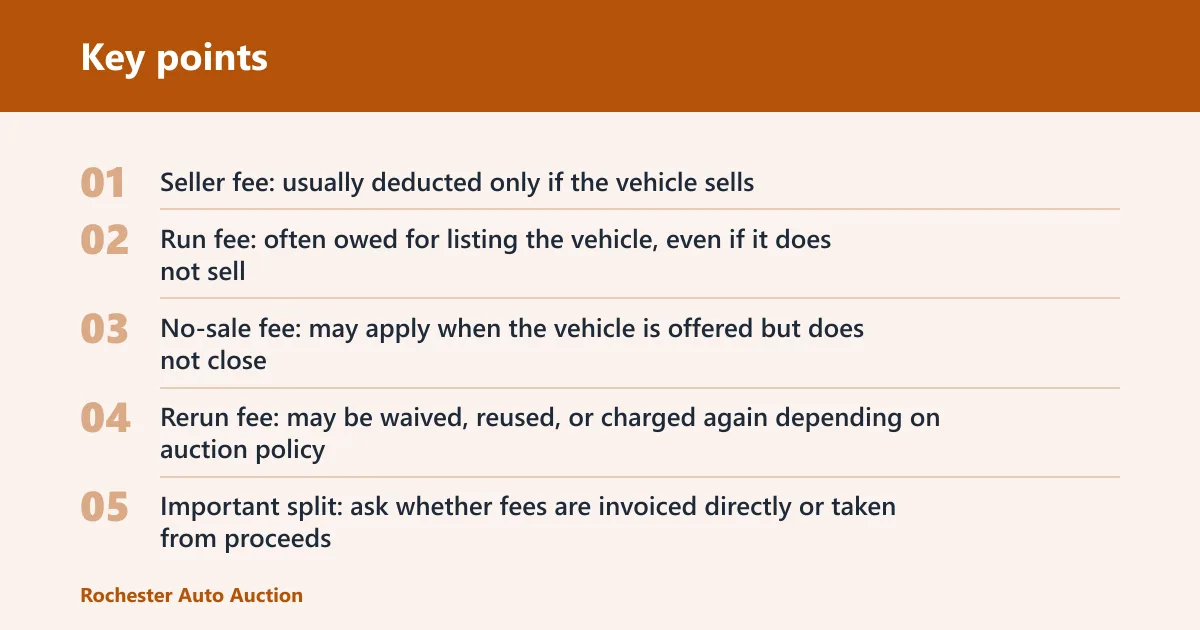
- Seller fee: usually deducted only if the vehicle sells
- Run fee: often owed for listing the vehicle, even if it does not sell
- No-sale fee: may apply when the vehicle is offered but does not close
- Rerun fee: may be waived, reused, or charged again depending on auction policy
- Important split: ask whether fees are invoiced directly or taken from proceeds
Pay seller fees checklist
- Confirm the reserve price and whether the seller can accept a missed-reserve bid
- Confirm the rerun window, including the next-sale timing if the car does not sell
- Confirm the pickup deadline and whether storage charges begin after a set time
- Confirm title and release paperwork required for pickup or rerun
- Confirm whether the vehicle must pass an inspection before it can be relisted
- Confirm whether fees are invoiced directly or deducted from proceeds if the car sells
Pay seller fees decision table
The matrix below separates the four no-sale paths sellers ask about most often. Use it as a policy guide, then confirm the auction’s own rules before you list or rerun.
| No-sale scenario | Fees owed now | Deducted only if sold | Take-back allowed | Rerun timing | Common documents needed on release |
|---|---|---|---|---|---|
| Reserve not met | Run fee or no-sale fee may still be owed; seller fee usually is not yet due from proceeds | Seller fees are usually deducted only if the car later sells | Usually yes, subject to release and pickup rules | Often the next sale cycle if the house allows it | Title, gate pass, seller ID, and any release form the auction requires |
| No bids | Run fee or no-sale fee may still apply; no seller fee is deducted from proceeds because there are none | Seller fee would only be deducted if the vehicle later sells | Usually yes, after the auction confirms the vehicle is released | Depends on policy; rerun may keep the original fee in place or require a new entry | Title, pickup authorization, ID, and any storage-clearance paperwork |
| Seller rejects the top bid | Possible no-sale fee, and the auction may treat it like an active withdrawal or a failed sale under its rules | Seller fee is usually not taken unless a sale is later completed | Usually yes, if the seller chooses not to accept the bid | Depends on whether the car is rerun in the same cycle or listed again later | Title, withdrawal or release form, and seller authorization |
| Rerun next sale | Some auctions reuse the original run fee; others charge again if the car is relisted under a new sale entry | If it later sells, seller fees and any agreed run charge may come out of proceeds | Yes, if the vehicle stays at the auction or is returned for the later sale | Often not charged again when the auction offers a free rerun; Burlington allows rerunning a no-sale car on the next Tuesday without repaying the run fee | Prior sale paperwork, re-entry confirmation, title, and pickup/release paperwork if the vehicle moves |
What happens if reserve is not met?
If reserve is not met, the car does not sell. That is the basic rule, and Carwow states it plainly. The reserve is the minimum acceptable sale price, so bids below that figure do not close the deal. Whether the seller can still accept the bid, rerun the car, or owe a fee depends on the auction’s own reserve policy.
Whether the seller can accept the bid anyway
Some auctions let the seller accept a strong bid after reserve is missed. Others treat the sale as closed only if the reserve is met. That policy difference is why the missed-reserve result is not enough by itself to predict fees. If the seller rejects the bid, the auction can mark the car no-sale and move it into a rerun or return process.
How reserve affects fee treatment
Reserve status can affect fees, but it does not guarantee a free exit. Carwow warns that fees may still apply even when reserve is not met. That means a seller should ask two separate questions: whether the car sold, and whether the auction charges a no-sale or run fee after a failed reserve.
Say your sedan opens at about $7,000 and bids stop at about $6,400 with a reserve set above the final bid. The car does not sell, but the auction may still charge a run or no-sale fee and may let you rerun it at the next sale if its policy allows that.
Can you take the car back or rerun it?
Many auctions let the seller take a no-sale car back, but that does not guarantee a free exit. Some charge a run fee, some charge a no-sale fee, and some waive the original fee if the car is rerun quickly. The exact outcome depends on the auction house, the seller type, and the sale format.
Typical take-back outcomes after no-sale
Public sellers can take a no-sale car back at Burlington and pay a $40 running fee. That is a concrete take-back example, not a universal rule. Other auctions may require pickup by a deadline, a gate release, or a storage check before the car leaves the lot.
How rerun policies usually work
A rerun policy decides whether the vehicle can be offered again and whether the first fee still counts. Burlington allows rerunning a no-sale car on the next Tuesday without repaying the run fee. That means a rerun can be cheaper than starting over, but only when the auction clearly says so.
When a run fee may be reused or charged again
If the rerun is treated as part of the original listing, the run fee may carry over. If the auction treats it as a new entry, a new charge may apply. The rule changes with public sales, dealer-only sales, and online sales, so confirm the rerun timing before you leave the lane.
Picture a dealer-only online sale where the reserve is missed on Friday. If the auction lists the car again the following week under the same entry, the original run fee may be reused. If the auction starts a fresh listing instead, the seller could face a second charge.
Net payout when a car does sell
When the car sells, the auction first records the proceeds, then subtracts the seller-side charges. Burlington says both the run fee and the selling fee come out of the check when the car sells. That means the seller’s net payout is the sale amount minus those deductions, not the gross hammer price.
Proceeds before deductions
Auction proceeds are the sale amount before fees. That is the starting point for the payout calculation. If the car brings a solid bid, the gross number still is not the amount the seller receives, because the auction will subtract the applicable seller fee and any agreed run charge.
Simple sold vs. no-sale comparison
Sold car: the auction pays from proceeds and subtracts fees from the check. No-sale car: there may be no proceeds at all, so any run fee or no-sale fee can become a direct charge. That is why a failed sale can feel more expensive than a weak sale with a small net check.
How much are seller fees if my car sells versus doesn’t sell?
If the car sells, seller fees are often taken from the proceeds before payout. If the car does not sell, seller fees may not be deducted from a sale check because there is no check, but a run fee or no-sale fee can still be owed. The only safe answer is the auction’s own fee schedule.
What to confirm before you list
Before you list, confirm the auction’s registration rules, title requirements, inspection process, and sale channel limits. Public sellers may need to register first, while dealer-only events may accept only licensed buyers and sellers. Online sales can follow different pickup and fee rules than a live lane sale, so the same vehicle can face different treatment in different formats.
Registration and title paperwork
Most auctions require basic seller registration and proof that you can sell the vehicle. That usually means the title or other ownership paperwork the auction requires for your state. Do not assume a UK-style document or a public-sales form applies; the right paperwork depends on the auction and your location.
Inspection and listing rules
Many auctions inspect the vehicle before sale and may create a description and photos for the listing. Those materials can affect whether the car is accepted, how it is marketed, and how the auction handles a no-sale. Listing access can also differ by audience, especially between public, dealer-only, and online-only sales.
Public, dealer-only, and online sale limits
Not every auction lets private sellers use every sale format. Some events are dealer-only. Some online platforms restrict who can list or buy. Buyers may also need a deposit, and Burlington requires a $500 security deposit from public buyers. That does not determine seller fees by itself, but it shows how sale rules can differ by audience and sale type.
Frequently asked questions
Do you pay seller fees if your car does not sell at auction?
Sometimes. A no-sale can still trigger a run fee or no-sale fee, and some auctions still charge those amounts even when the car does not sell. Seller fees are often deducted from sale proceeds, so if there is no sale, the key question becomes whether the auction charges a separate fee for listing the car.
What happens to auction fees if my reserve price is not met?
If the reserve is not met, the car does not sell. That does not guarantee a free exit. Some auctions still charge a fee, while others may let you rerun the car without paying again. The fee outcome depends on the house rules, the sale format, and whether the car is collected or relisted.
Can I take my car back if it doesn’t sell at auction?
Often, yes. Many auctions let you collect a no-sale vehicle after the sale ends, but pickup rules can apply. Burlington’s public-seller example allows take-back after no-sale with a $40 running fee. Always ask when and where the car can be released, because storage or gate rules may apply.
Do auction houses charge a run fee even if the car doesn’t sell?
They can. A run fee is the cost of placing the vehicle in the sale, so it may still be owed even if the car does not sell. Burlington’s example shows a no-sale car can still carry a $40 running fee for public sellers. Other auctions may use a different structure.
Can I rerun a car at auction without paying the fee again?
Sometimes. A rerun policy may let the vehicle appear in a later sale without repaying the run fee. Burlington allows a no-sale car to rerun on the next Tuesday without repaying the run fee. Other auctions may charge again if the car is entered as a fresh listing.
Does a no-sale still count as an auction listing?
Yes, in most auction systems it still counts as a listing or entry, even though it did not sell. That matters because listing-related charges can still apply. It also matters for rerun policy, since the auction may treat the second appearance as a continuation of the first listing or as a new entry.