
How to Schedule a Salvage Inspection Appointment in Your State
Book your salvage inspection with the authority your state uses: DMV in title-based states, state police or highway patrol in enforcement states, or an approved inspection site if the state routes appointments there. Book it wrong, and you can lose time, miss required paperwork, and delay registration or a rebuilt title. This guide maps the booking path state by state and lists the documents to have ready before you schedule.
What you’ll need
- Salvage title
- Salvage inspection application form, if your state requires one before booking
- Repair receipts and invoices
- Bill of sale for the vehicle and, where required, major parts
- VIN documentation and any supporting vehicle records
- Valid driver’s license or government-issued ID
- Proof of insurance or transport paperwork, if your state asks for it
- Vehicle access plan for the inspection site
How salvage inspection scheduling works
A salvage inspection appointment is the booking step that gets your repaired vehicle in front of the correct state authority for identity checks, paperwork review, and VIN verification. In California, for example, the Salvage Vehicle Inspection Program uses DMV or CHP inspection channels, and a successful inspection leads to a CHP 97C.
The booking path changes by state because the title process changes by state. Some states keep salvage work inside the DMV. Others send it to state police or highway patrol. A few route the inspection through an approved inspection facility instead of a normal DMV counter.
When repairs should be finished before you book
Complete the repair work first. You usually need the vehicle presentable for inspection, the VIN visible, and the repair file ready before the appointment slot matters. MyAirbags says to gather the salvage title before scheduling and to collect repair receipts and invoices before booking.
Say your sedan has a replaced front clip and a clean dashboard VIN plate. If the receipts are still in a glove box folder and the bumper cover is off, the inspector may not accept the vehicle as ready. Book only when the repair record is complete.
What you’ll need before you book
Use the booking stage to collect the paperwork that proves ownership, repair work, and vehicle identity. Some states want this file before they let you pick a slot. Others ask for it at the appointment, but the same documents still matter.
Salvage title
The salvage title is the key ownership document in many states. MyAirbags says to have it before scheduling. If the title is missing, the appointment desk may stop the booking because the vehicle status is not clear enough for the inspection file.
Salvage inspection application form
Many states require a salvage inspection application form before the appointment. Complete it before you call or submit the online request if the state asks for the form number in the booking system. Keep a copy with the vehicle file.
Repair receipts and invoices
Repair receipts and invoices show what was replaced and who did the work. MyAirbags says to collect them before scheduling. Keep parts invoices, labor invoices, and any major component bills together so the inspector can match the repairs to the damaged areas.
Bill of sale
A bill of sale may be needed for the vehicle, major parts, or both, depending on the state. It helps connect the repair parts to the rebuilt vehicle and can answer questions about where key components came from.
VIN and supporting vehicle records
The VIN must match the paperwork. Bring any prior registration, insurance, or repair documents that show the vehicle identity clearly. If the state checks the engine, frame, or body numbers, keep those records in the same packet.
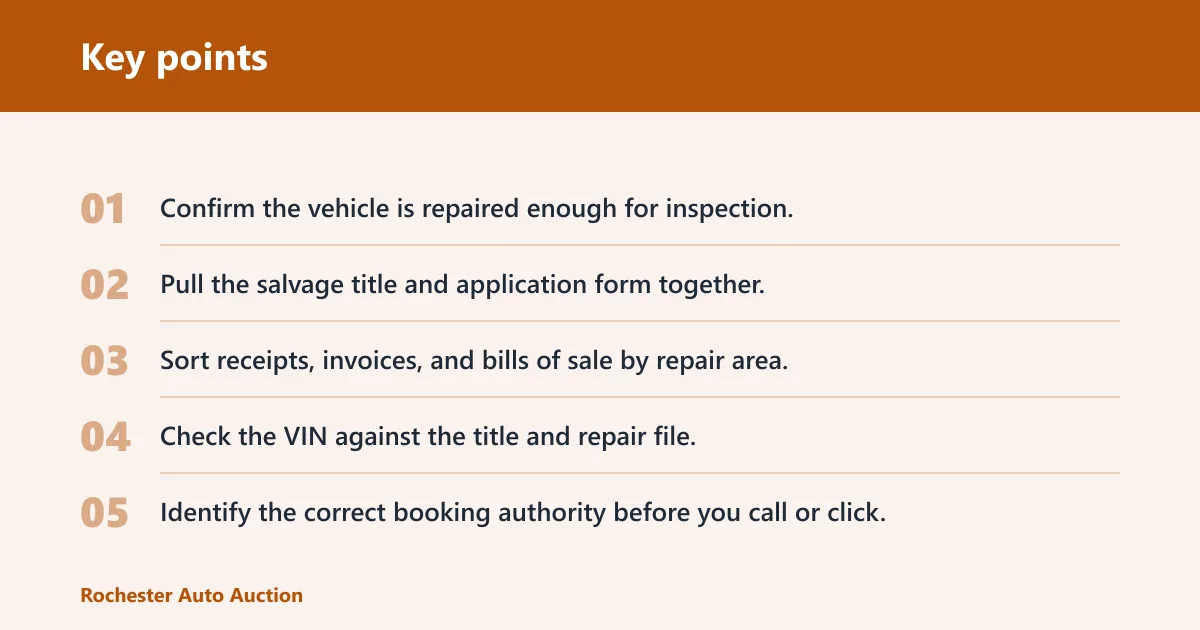
- Confirm the vehicle is repaired enough for inspection.
- Pull the salvage title and application form together.
- Sort receipts, invoices, and bills of sale by repair area.
- Check the VIN against the title and repair file.
- Identify the correct booking authority before you call or click.
Which office do I contact for a salvage inspection appointment in my state?
Contact the office your state assigns to salvage inspections, not the nearest office on a map. That may be the DMV, a state police or highway patrol inspection unit, or an approved inspection facility. The correct contact channel depends on who actually books the appointment in your state.
DMV or equivalent agency
Many states keep the process inside the DMV or a similar title agency. In those states, the DMV may take the appointment, review the title status, and send you to a designated inspection site. MyAirbags says many states allow online scheduling through the DMV website.
State police or highway patrol inspection unit
Some states route the appointment through state police or highway patrol. California requires salvage vehicles to be inspected by DMV or CHP, and California applicants may contact CHP offices to schedule salvage inspections. California CHP provides office phone numbers and email contacts for scheduling. (chp.ca.gov)
Approved inspection facility
Some states use an approved inspection facility rather than a normal DMV counter. That means the booking confirmation may name a specific shop, station, or field office that has state authorization. Check that the site is approved before you drive there.
How do I book the inspection?
Use the channel your state lists for salvage inspections. That may be an online form, a phone line, an email address, or an in-person counter. MyAirbags says some states allow online scheduling through the DMV website, while other states require phone scheduling or in-person scheduling.
Online booking
Online booking usually asks for the title number, VIN, contact details, and sometimes the salvage inspection application form number. Use the exact state portal for salvage inspections, not a general service appointment page, because general DMV slots often do not accept salvage vehicles.
Phone scheduling
Phone scheduling is common where the state wants a clerk or trooper to assign the inspection site. Have the salvage title, VIN, and contact details ready before you call. If the office asks for repair records up front, note what to bring.
Email scheduling
Some states use email appointment systems for salvage inspections. Send only the details the office requests: VIN, title number, plate number if still assigned, contact information, and the documents named in the email instructions. California CHP provides email contacts for scheduling.
In-person scheduling
MyAirbags says some states require in-person scheduling. If so, bring the title, application form, and ID to the correct office window. Ask whether the vehicle must be present at booking or only at the inspection itself.
State booking checklist by authority and channel
| Authority type | Booking method | Required pre-booking documents | Appointment contact channel | Vehicle may need to be transported or trailered? |
|---|---|---|---|---|
| DMV or equivalent agency | Online or phone | Salvage title, VIN, salvage inspection application form, repair receipts | State DMV portal or appointment line | Sometimes, if the inspection is at a separate state site |
| State police inspection unit | Phone or email | Salvage title, repair invoices, bill of sale, ID | State police office phone or inspection email | Often yes, if the site is a troop or barracks location |
| Highway patrol inspection unit | Phone or email | Salvage title, application form, repair records, VIN paperwork | Highway patrol office contact line or email inbox | Often yes, if the vehicle cannot be legally driven yet |
| Approved inspection facility | Online, phone, or in person | Salvage title, assignment letter, parts invoices, bill of sale | Facility scheduling desk or state approval contact | Sometimes, if the facility is not in a normal registration office |
How to prepare the vehicle for the appointment
Prepare the vehicle so the inspector can confirm identity, repairs, and equipment without delay. The VIN must be visible and match the title. The body, frame, and major repaired areas should be accessible. Bring the document packet in one folder.
Match the VIN to paperwork
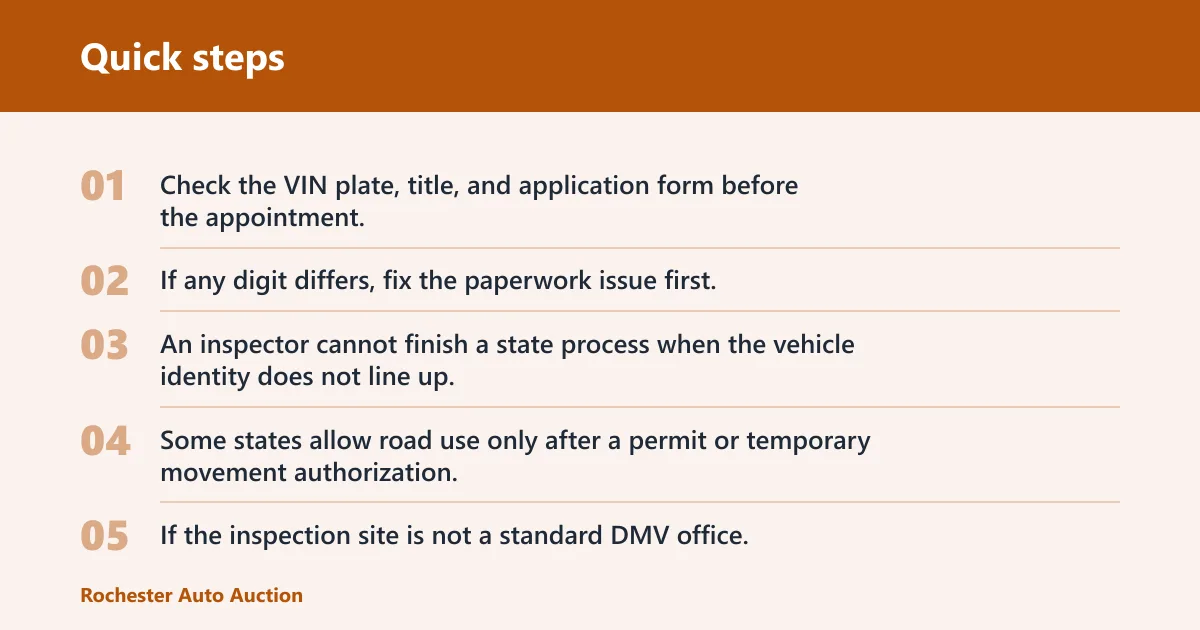
Check the VIN plate, title, and application form before the appointment. If any digit differs, fix the paperwork issue first. An inspector cannot finish a state process when the vehicle identity does not line up.
Plan legal transport to the site
Do not assume you can drive the car there. Some states allow road use only after a permit or temporary movement authorization. Others expect towing or trailering. If the inspection site is not a standard DMV office, confirm whether the vehicle must be transported.
Suppose a coupe is repaired but still lacks active registration. The safest plan may be a trailer to the inspection site, especially if the booking notice names a highway patrol lot rather than a public DMV branch. That avoids a roadside stop before the appointment.
Make the car accessible for inspection
Open areas that hide the VIN or repaired structure. Remove loose cargo from the trunk, cabin, and engine bay. A clean inspection path saves time when the inspector needs to verify the body, major parts, or labels.
What happens after the inspection is approved?
After approval, the state issues the document that lets you complete the rebuilt-title or registration step. In California, that document is the CHP 97C. Take the approval paper to the DMV or equivalent office named by your state and finish the title or registration filing.
If the vehicle fails
If the vehicle fails, ask for the exact correction list before you leave. Then fix the cited items, keep the repair receipts for the next appointment, and reschedule with the same authority if the state requires it. Ask whether the same inspection location can handle the return visit.
Common mistakes
Most delays come from booking too soon or booking with the wrong office. A second common problem is bringing the vehicle to an unapproved site because the address looked like a normal DMV location. Avoid both by confirming the authority, channel, and location before you pick a slot.
Booking before the paperwork is ready
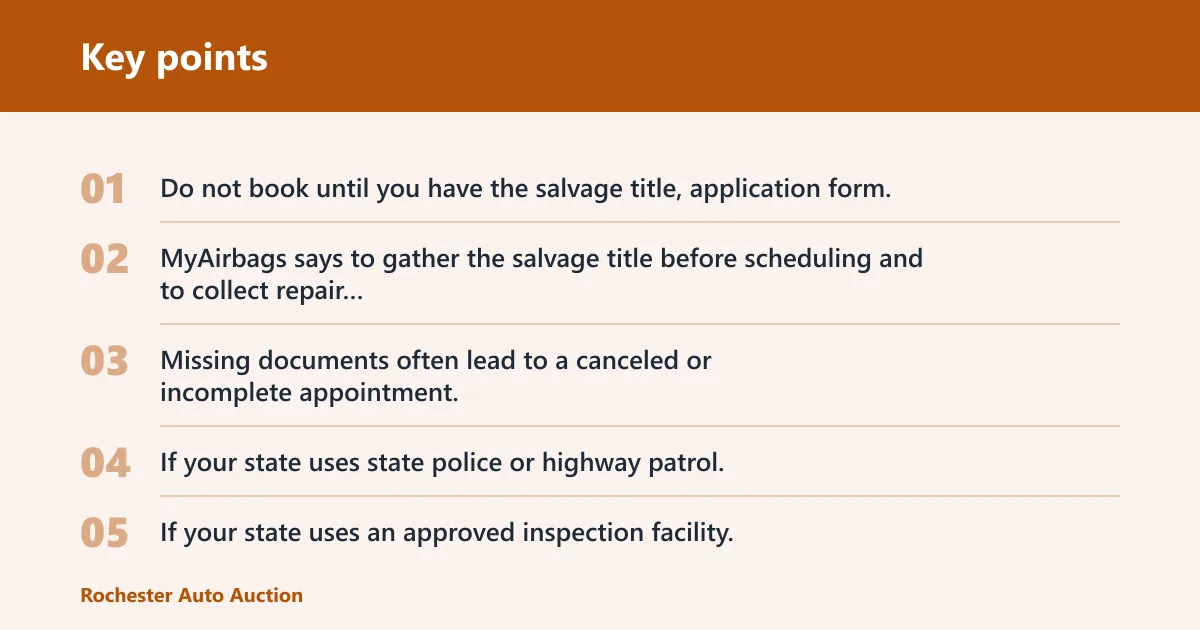
Do not book until you have the salvage title, application form, and repair records organized. MyAirbags says to gather the salvage title before scheduling and to collect repair receipts and invoices. Missing documents often lead to a canceled or incomplete appointment.
Choosing the wrong authority
If your state uses state police or highway patrol, a DMV clerk may not be able to assign the inspection. If your state uses an approved inspection facility, a normal DMV branch may only redirect you. Confirm the booking authority first.
Going to an unapproved location
Do not assume any inspection bay qualifies. Some states approve only certain offices or facilities. Verify that the location is listed for salvage inspections and that it can issue the document your DMV needs after approval.
Arriving without repair evidence
Bring repair receipts, invoices, and a bill of sale when those items are required. MyAirbags says to bring a valid driver’s license or government-issued ID and to arrive a little early for the appointment. That gives the clerk time to check the packet before the vehicle is called in.
Frequently asked questions
How do I schedule a salvage inspection appointment?
Start with the state authority that handles salvage work, then use its booking channel. That may be an online form, a phone line, an email address, or an in-person desk. Have the salvage title, VIN, and repair documents ready before you contact the office.
Do I need to schedule salvage inspection online or by phone?
Use whichever channel your state lists for salvage appointments. MyAirbags says many states allow online scheduling through the DMV website, while some states require phone scheduling and some require in-person scheduling. Check the exact salvage inspection page, not the general DMV appointment menu.
What documents do I need before I book a salvage inspection?
Have the salvage title ready first, then gather the salvage inspection application form if your state uses one, along with repair receipts and invoices, a bill of sale, and VIN records. MyAirbags says the title should be gathered before scheduling, and the repair paperwork should be collected too.
Can I schedule a salvage inspection with the DMV or police?
Yes, depending on the state. Some states book through the DMV, while others book through state police or highway patrol. California requires salvage vehicles to be inspected by DMV or CHP, and California applicants may contact CHP offices to schedule salvage inspections.
What happens after a salvage inspection appointment is approved?
The state issues the approval document that moves the vehicle to the next title or registration step. In California, that document is the CHP 97C. Take it to the DMV or equivalent office named in your state process and finish the rebuilt-title or registration filing there.
Do salvage inspection appointments require a specific inspection location?
Often yes. Some states use a designated DMV site, a police or highway patrol unit, or an approved inspection facility rather than a normal branch office. Confirm the exact address before you transport the vehicle, because the booking channel and the inspection location are not always the same place.