Why Was a Rebuilt Title Issued Without an Accident?
A rebuilt title can follow a non-collision total loss, such as flood, fire, theft recovery, hail, or mechanical damage. If you ignore that, you may misread the car’s history, overpay, or miss corrosion, wiring faults, or repair issues. This guide shows how to trace the brand back to the original loss and verify it.
What a rebuilt title means
A rebuilt title means a totaled vehicle was repaired and then passed a state inspection before it could return to road use. It stays tied to the earlier salvage brand, and states may use different names for the same status, such as reconstructed, restored salvage, prior salvage, or revived salvage. Once branded, it does not return to a clean title.
Rebuilt title versus salvage title
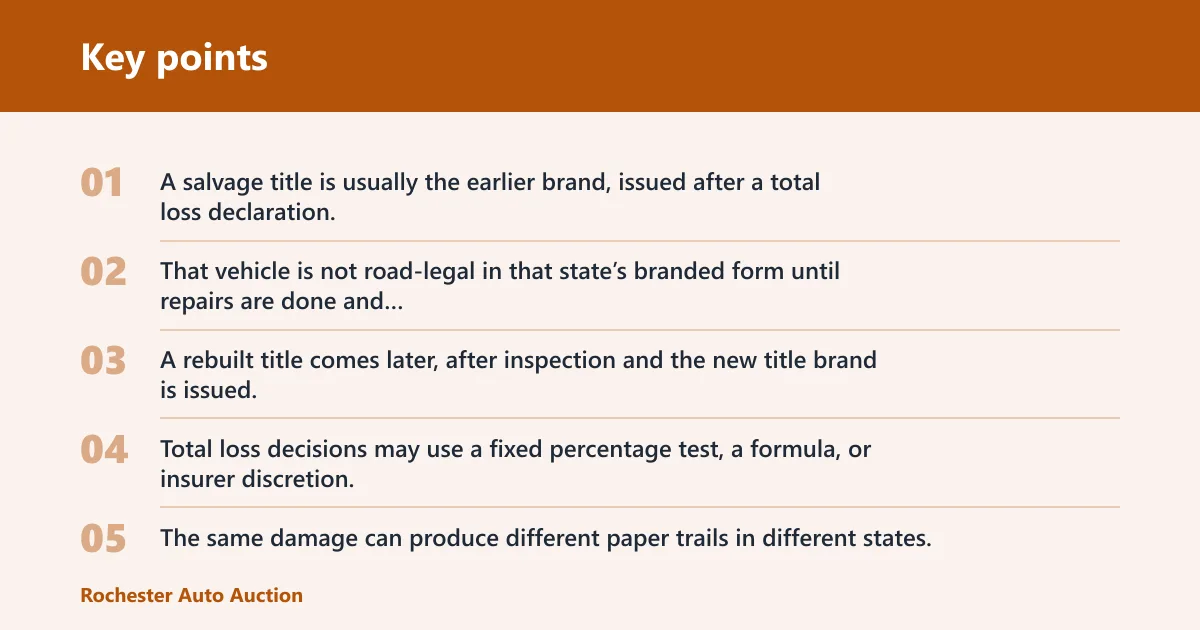
A salvage title is usually the earlier brand, issued after a total loss declaration. That vehicle is not road-legal in that state’s branded form until repairs are done and the car passes the required inspection. A rebuilt title comes later, after inspection and the new title brand is issued.
Why state rules matter
Branding rules differ by state. Total loss decisions may use a fixed percentage test, a formula, or insurer discretion, and the rebuilt inspection can be narrow in one state and broader in another. The same damage can produce different paper trails in different states.
When a car becomes road legal again
After repair and inspection, a rebuilt title car is legally drivable again in the state that issues that brand. That does not mean the car is clean history. It means the state has accepted it back into service under the branded title.
How a car gets branded total loss
A rebuilt title starts with a total loss declaration. Insurers usually compare repair cost with the vehicle’s actual cash value, which is the pre-damage market value. When repair costs approach that value, the car may be declared a total loss. Thresholds vary by state and commonly range from 60% to 80%, though some states let insurers decide and some use formulas instead of a fixed percentage.
Actual cash value and repair cost
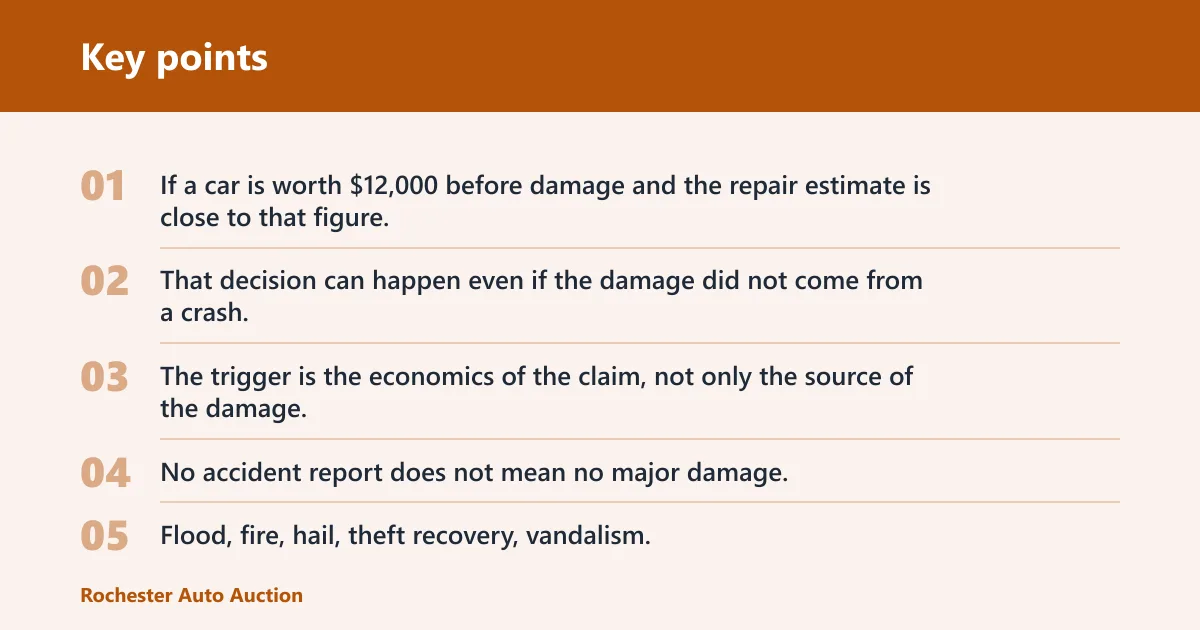
If a car is worth $12,000 before damage and the repair estimate is close to that figure, the insurer may choose total loss handling instead of repair. That decision can happen even if the damage did not come from a crash. The trigger is the economics of the claim, not only the source of the damage.
Why no crash can still equal total loss
No accident report does not mean no major damage. Flood, fire, hail, theft recovery, vandalism, and severe storm damage can all create losses large enough to reach total-loss handling. A car can be branded because the repair bill, parts loss, or cleanup cost was too high relative to actual cash value.
Say your sedan has roof dents across every panel after a hailstorm, cracked glass, and damaged trim. If the estimate climbs high enough compared with actual cash value, the insurer may total it even though no collision ever occurred.
Can hail or storm damage total a car?
Yes. Hail damage can cause a rebuilt title, and it does not have to be catastrophic to matter. Light hail may be cosmetic only, while severe hail can crush panels, break glass, damage sensors, and push repair costs above the vehicle’s value. In that case, the car may be totaled without any crash history.
Cosmetic hail versus severe hail damage
Cosmetic hail usually means dents with limited functional impact. Severe hail is different. Roof panels, hood, trunk lid, windshield, rear glass, and sunroof components can all be affected, and repeated impacts can leave expensive repair or replacement work. That is the kind of hail damage that often leads to total loss handling.
Roof, glass, and body-panel clues
Look for a patched roof skin, replaced glass, paint mismatch on horizontal panels, or a long list of hail-related body repairs. Hail records may mention roof dents, glass replacement, and paintless dent repair. If the damage was severe enough to total the car, auction notes and insurer records often say so.
What records usually mention hail
Paperwork may include salvage paperwork, insurer settlement records, auction condition reports, and repair invoices listing hail-specific work. Before-repair photos are especially helpful because they show whether the damage was broad and shallow or concentrated on a few panels. That difference affects both value and risk.
Can flood or fire damage lead to rebuilt branding?
Yes. Flood damage and fire damage can both lead to salvage branding and later rebuilt branding if the car is repaired and inspected. Flood loss matters because water can affect wiring, modules, bearings, upholstery, connectors, and corrosion points long after the visible damage is gone. Fire can damage heat-sensitive parts, insulation, and harnesses even when the car still looks complete.
Flood clues to look
Check for water lines, silt under trim, musty odor, fogged lamps, corrosion in fasteners, rust in seat tracks, and mismatched interior parts. Flood damage can be hidden under carpets, inside door cavities, or within electrical connectors. The car may drive normally at first and still carry long-term electrical or corrosion risk.
Fire damage and hidden repairs
Fire can leave soot in vents, heat damage on plastic parts, brittle insulation, melted connectors, or replaced harness sections. If the engine bay was involved, repair bills can climb fast. A rebuilt title from fire damage may look tidy after repair, but the prior loss can still matter for reliability and resale.
Why these losses raise risk
Flood and fire are not only cosmetic events. They can affect systems that are expensive to inspect or replace. Ask for repair invoices, parts receipts, and inspection records, then compare them with the visible condition of the car.
Can theft recovery cause a rebuilt title?
Yes. A theft recovery can lead to salvage branding and later rebuilt branding even when collision damage is absent. A stolen car may be recovered after parts removal, ignition damage, broken glass, trim loss, or extensive mileage during the theft period. Some states and insurers treat those cases as total losses depending on the claim details.
Why theft recovery can still become salvage
Theft recovery can be tied to a total loss declaration if the loss cost is high enough. The issue may be missing components, damage during forced entry, or accounting rules applied by the insurer. A salvage title can be issued for theft recovery, and the rebuilt brand can follow after repair and inspection.
What the paperwork may say
Records may mention theft recovery, recovered stolen vehicle, missing equipment, or parts replacement after theft. Auction documents sometimes list key, lock, glass, or column damage. That wording matters because it helps separate theft-related branding from collision damage.
How to spot recovery-related branding
Check for lock changes, non-matching keys, replaced ignition parts, missing factory audio or electronics, or a history record that mentions recovery without crash damage. A rebuilt title from theft recovery may still carry a long brand trail even if the body panels are straight.
Why a rebuilt title was issued with no accident report
This table shows how a rebuilt title can appear even when there is no accident report. The key is to trace the original brand back to the damage type, not assume the car was wrecked. A “no accident” record may still hide hail, flood, fire, theft recovery, vandalism, or severe storm damage.
| Non-accident cause | Typical clues | Likely paperwork | Inspection focus | Buyer risk level |
|---|---|---|---|---|
| Hail | Dents on roof, hood, trunk, and glass damage | Hail estimate, insurer settlement, auction condition report | Panel repair quality, glass replacement, VIN match | Moderate |
| Flood | Water lines, corrosion, silt, musty odor, electrical faults | Flood loss record, salvage paperwork, repair invoices, photos | VIN verification, wiring, modules, interior corrosion | High |
| Fire | Heat-damaged plastics, soot, melted connectors, harness repairs | Fire claim file, salvage paperwork, parts receipts | Engine bay, wiring, safety systems, VIN verification | High |
| Theft recovery | Missing parts, broken locks, ignition damage, replacement keys | Theft recovery record, salvage title, repair invoices | VIN verification, anti-theft systems, repaired components | Moderate |
| Vandalism | Broken glass, slashed seats, paint damage, stolen trim | Claim records, repair estimates, parts receipts | Interior damage, glass, body work, VIN verification | Moderate |
| Severe storm | Wind damage, fallen debris marks, crushed panels, water intrusion | Storm claim, photo set, auction report, salvage paperwork | Structural check, panel alignment, water intrusion, VIN match | Moderate to high |
What paperwork and history clues should you ask for?
Ask for the salvage paperwork, repair invoices, parts receipts, photos from before repair, the inspection record, and any auction or insurer documents tied to the brand. Those records help you trace the title back to the original damage type. They also show whether the rebuilt work matches the loss claimed on paper.
Salvage paperwork and auction records
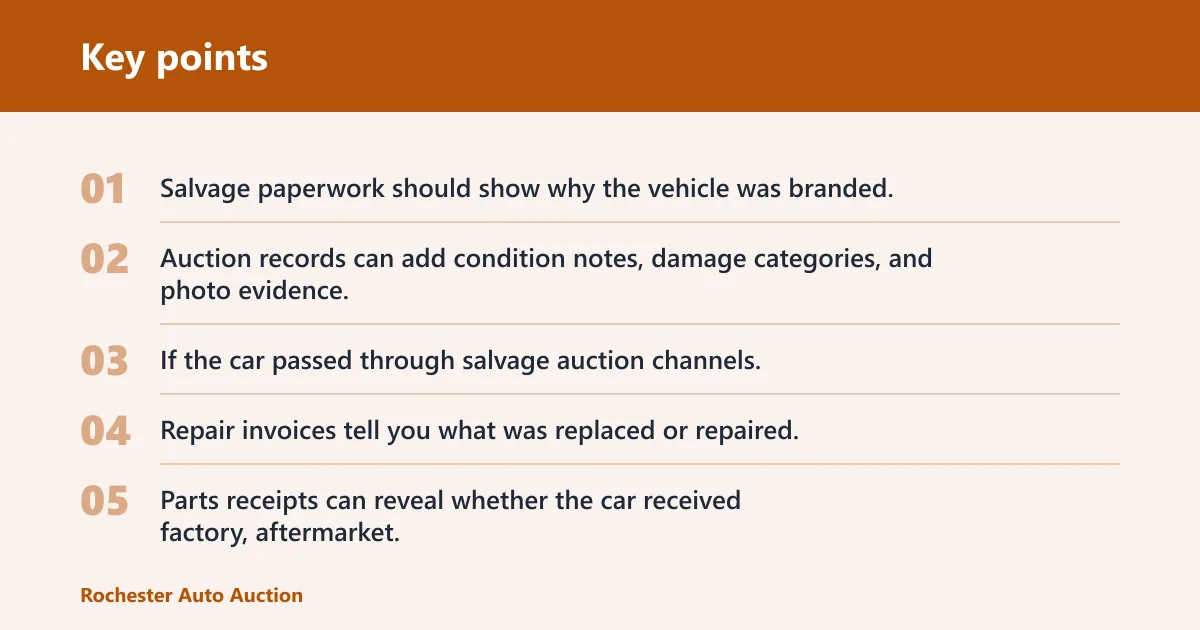
Salvage paperwork should show why the vehicle was branded. Auction records can add condition notes, damage categories, and photo evidence. If the car passed through salvage auction channels, those records may be the clearest path back to the original loss.
Repair invoices and parts receipts
Repair invoices tell you what was replaced or repaired. Parts receipts can reveal whether the car received factory, aftermarket, or used components. In a flood or fire case, those documents may show electrical parts, harnesses, airbags, glass, interior trim, or mechanical components that were replaced.
VIN checks, photos, and inspection records
Use a VIN history check plus any available inspection record. State inspection may require VIN verification, and some states also ask for receipts or before-repair photos. If the paperwork is thin, the risk is higher because you cannot confirm the original loss or the quality of the rebuild as easily.
Suppose a compact SUV shows no accident entries, but the title trail includes a salvage record, a flood auction photo set, and a receipt for carpet, module, and seat replacement. That combination fits flood branding far better than a crash story.
How to check for title washing
Title washing is the illegal hiding of a brand by moving a vehicle across state lines and exploiting record gaps. To reduce that risk, check NMVTIS and state title records, then compare every title event with the VIN history, auction trail, and inspection record. A missing link deserves extra scrutiny.
Using NMVTIS and state records
NMVTIS can help reveal prior brands that may not show on a single state title printout. Use it with current and prior state records, not instead of them. The goal is to confirm that the branded history follows the VIN through each title transfer.
Cross-state gaps and brand hiding
Watch for unexplained jumps between states, missing mileage events, or a title that changes from salvage to clean and back again. That pattern can signal brand hiding. If the chain is incomplete, ask the seller for earlier title copies and inspection paperwork before you move forward.
Warning signs in the title trail
Be cautious if the current title looks clean but the VIN report shows a salvage event, a branded auction entry, or an insurance total loss. Also watch for mismatched dates between repair invoices and title issuance. Those gaps often point to a story that was edited, not removed.
Frequently asked questions
Why would a car get a rebuilt title if it was never in an accident?
Because “no accident” does not rule out a total loss. Flood, hail, fire, theft recovery, vandalism, or severe storm damage can trigger salvage branding and later rebuilt branding. The key is the loss type behind the brand, not whether another vehicle was hit.
Can hail damage cause a rebuilt title?
Yes. Hail can total a car when the damage is severe enough relative to actual cash value. Light hail may stay cosmetic, but roof dents, broken glass, and broad panel damage can push a claim into total-loss territory and later rebuilt branding.
Can theft recovery lead to a rebuilt title?
Yes. A recovered stolen vehicle can receive salvage branding even without collision damage, then rebuilt branding after repair and inspection. The paperwork may mention recovery, missing parts, ignition damage, or replaced locks instead of crash damage.
Does a rebuilt title always mean structural damage?
No. A rebuilt title means the vehicle was once totaled and later repaired and inspected. That history does not automatically prove structural damage. It does prove the car had enough prior loss history to be branded, which is still important for value and risk.
What paperwork should I ask for on a rebuilt title car?
Ask for salvage paperwork, repair invoices, parts receipts, before-repair photos, the inspection record, and any insurer or auction documents tied to the loss. Those items help identify whether the brand came from hail, flood, fire, theft recovery, or another cause.
Will insurance treat a rebuilt title differently if it was not from an accident?
Usually yes, because insurers focus on title history, repair quality, and state branding, not only on whether the loss came from a crash. Coverage options can be limited, and full coverage terms may be different. The original loss type still matters for underwriting.