Are Salvage Title Cars Worth Buying?
Yes, if the salvage car still lands at least 30% to 40% below an equivalent clean-title car after repairs, inspection, insurance, and resale loss. Skip that margin, and a low sticker price can turn into a large repair bill, limited coverage, and weak resale. This guide shows when a salvage title is a bargain, when it is merely cheap, and when it is a trap.
What a salvage title means
A salvage title means an insurer has branded the vehicle as a total loss. Title rules vary by state, and the brand stays in the vehicle history. In many cases, a salvage car cannot be driven until it is repaired and inspected under state rules.
Why insurers brand a total loss
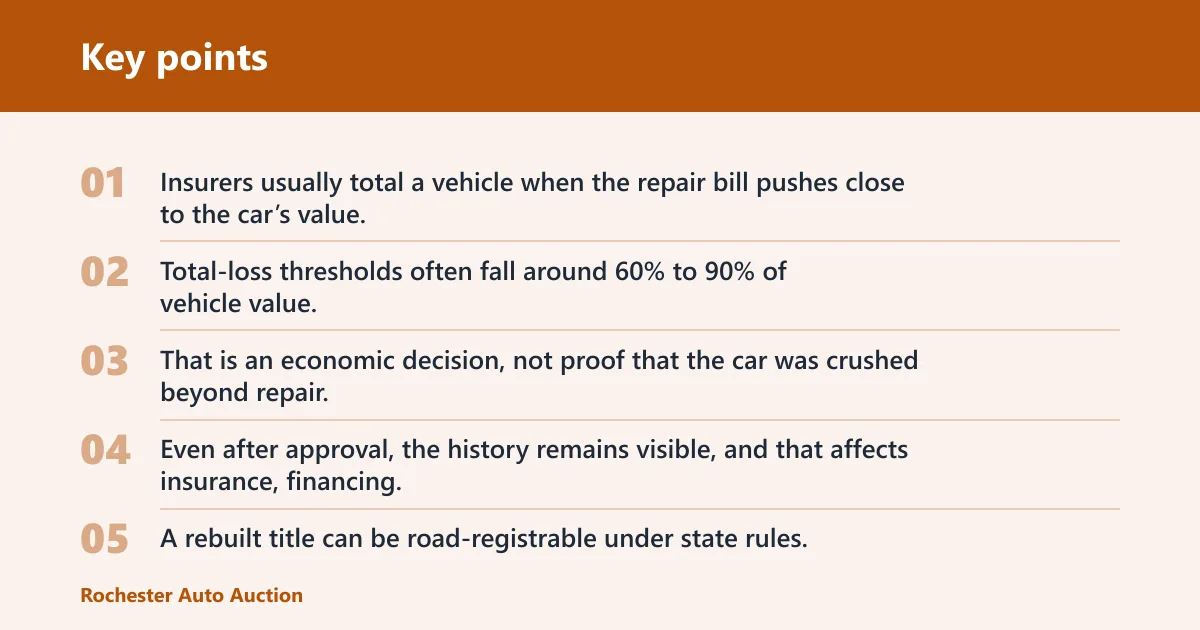
Insurers usually total a vehicle when the repair bill pushes close to the car’s value. Total-loss thresholds often fall around 60% to 90% of vehicle value, depending on the state and insurer; some states sit around 75% to 90%. That is an economic decision, not proof that the car was crushed beyond repair.
Why the title history stays on the record
The brand does not disappear after repairs. Even after approval, the history remains visible, and that affects insurance, financing, and resale. A rebuilt title can be road-registrable under state rules, but it is not a quality guarantee.
Are salvage title cars worth buying?
Sometimes, yes. A salvage car can be worth buying when the damage is clear, the repair estimate is written, and the all-in price still leaves room for the lower resale value. If the savings vanish after fees, transport, taxes, and contingency, the car is only cheap on paper.
When the discount is deep enough
Salvage-title vehicles are typically sold 20% to 50% below comparable clean-title cars. That gap can create value for a buyer who can verify the damage, budget the repairs, and live with a smaller resale pool. It is most attractive when the car’s structure is intact and the repair list is short.
When repairs erase the savings
Repair cost is not just parts. Add labor, paint, and diagnostics, then compare that total with the post-repair market value, not the auction sticker. One worked example shows a rebuilt salvage vehicle with an $18,000 completed value, a 25% brand discount, $4,200 in repair cost, and $2,100 for fees, delivery, tax, inspection, and registration. The deal only works if the numbers still leave a margin.
Who should skip salvage listings?
Daily-driver buyers who need dependable transportation with normal insurance choices should be cautious. So should shoppers who cannot inspect the car before bidding, cannot document repair quality, or cannot absorb surprise costs. If you need quick resale, a salvage vehicle is usually the wrong fit.
Damage types that change the risk
Damage type matters because hidden cost risk is not the same across every salvage car. Collision, flood, fire, theft recovery, hail, and mechanical damage each point to different failure points, and some are far harder to verify before purchase. Do not treat them as equal.
Collision damage and structural checks
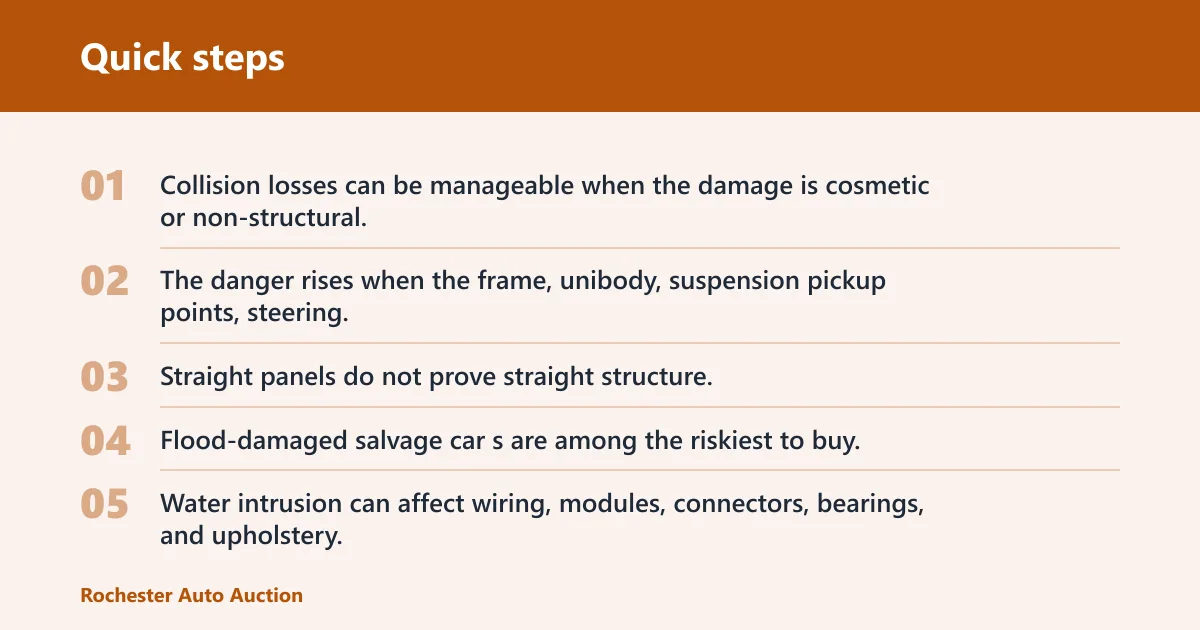
Collision losses can be manageable when the damage is cosmetic or non-structural. The danger rises when the frame, unibody, suspension pickup points, steering, or airbag system was hit. Straight panels do not prove straight structure.
Flood, fire, and airbag concerns
Flood-damaged salvage cars are among the riskiest to buy. Water intrusion can affect wiring, modules, connectors, bearings, and upholstery, and those problems can surface later. Fire damage can weaken wiring insulation and nearby plastics. Airbag deployment also demands close checking of modules, sensors, belts, and dash repairs.
Theft recovery, hail, and mechanical loss
Theft recovery cars can be decent buys when the only damage is from the theft process or from stripping. Hail often points to cosmetic loss, though roof and glass repairs still add up. Mechanical loss is a mixed category; a bad engine or transmission can be easier to price than hidden structural damage, but the repair bill can still erase the discount.
Picture a 2018 sedan with hail dents only. If the roof skin, glass, and airbags are untouched, the risk profile is much lower than a flood car with corroded connectors and damp carpet under the rear seat.
Salvage title worksheet
Use this before you bid. It turns a bargain story into a ceiling price, and it keeps fees from hiding in the background.
| Line | Worksheet item | Example value | Notes |
|---|---|---|---|
| 1 | Clean-title market value | $18,000 | Use local comparable sales, not the seller’s asking price. |
| 2 | Brand discount | $4,500 | Example uses 25% of clean value. |
| 3 | Auction fees | $850 | Buyer fee, gate fee, and any bid fee. |
| 4 | Transport | $400 | Tow or carrier cost to your repair site. |
| 5 | Repair estimate | $4,200 | Written estimate for parts, labor, paint, and diagnostics. |
| 6 | Inspection and titling | $250 | Pre-purchase inspection plus rebuild paperwork. |
| 7 | Taxes | $500 | Local tax and title fees vary by state. |
| 8 | Contingency reserve | $1,000 | Set aside for hidden damage or parts delays. |
| 9 | Target margin | $1,500 | Minimum buffer you want to keep. |
| 10 | Maximum bid / go-no-go | $0 to $-450 | 18,000 – 4,500 – 850 – 400 – 4,200 – 250 – 500 – 1,000 – 1,500 = -$1,200. No-go. |
How to use the worksheet: if the result is zero or negative, skip the car. If it is positive but small, the car may still be too risky because one surprise repair can erase the margin.
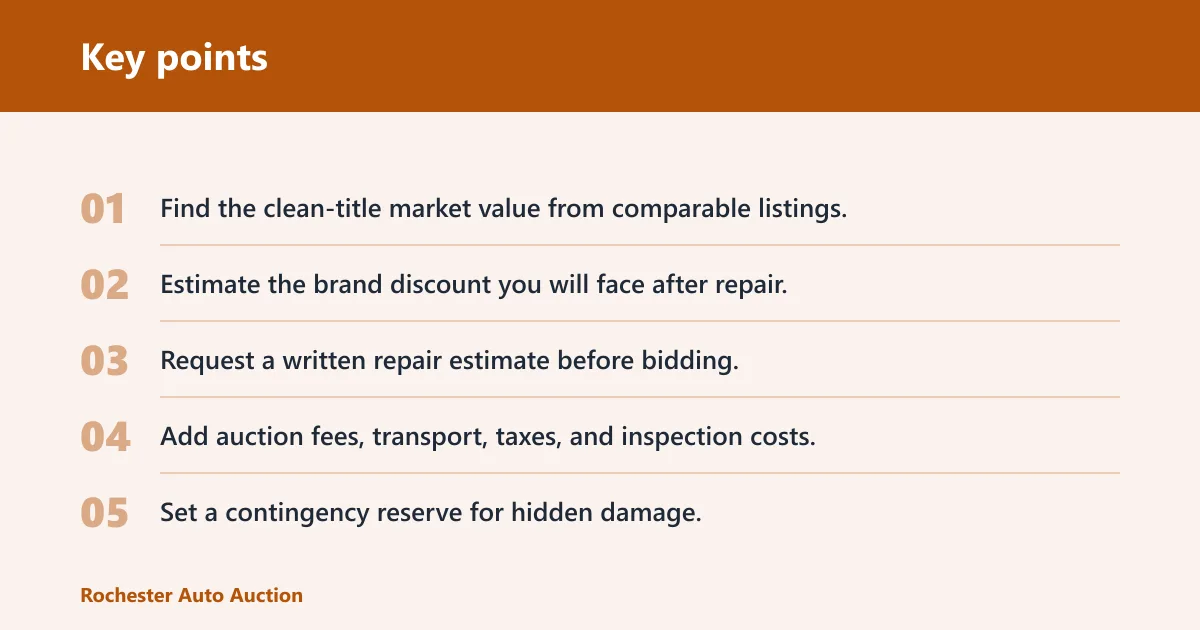
- Find the clean-title market value from comparable listings.
- Estimate the brand discount you will face after repair.
- Request a written repair estimate before bidding.
- Add auction fees, transport, taxes, and inspection costs.
- Set a contingency reserve for hidden damage.
- Add a target margin for the risk you are taking.
- Subtract every cost from the clean-title value.
- Set that number as your maximum bid.
- Walk away if the auction price climbs above it.
A common first-timer mistake is assuming a flooded sedan is a bargain because the asking price is low and the interior only looks damp. The buyer sees a $3,850 lot median price in a guide and assumes there is room to spare, then gets hit with transport, diagnostics, and parts that push the total past the clean-title value.
Are rebuilt title cars worth buying?
A rebuilt title car can be worth buying when the repair record is clear, the inspection is clean, and the price still reflects the title history. Rebuilt status means the vehicle passed a state process after repair, but it does not prove the work was done well. Treat it as road-registrable, not as a quality seal.
What rebuilt status does and does not mean
Rebuilt-title vehicles are often road-registrable under state rules. That is useful, but it is only a legal step. The state is confirming the car met a process, not that every panel, connector, sensor, and weld is top quality.
Why the repair record still matters
Ask for photos, invoices, and a written estimate. A rebuilt car with documented cosmetic repairs is different from one with missing paperwork and vague explanations. If the repair history does not show what was replaced, you are buying uncertainty.
When rebuilt makes more sense than salvage
Rebuilt can make sense for a budget buyer who needs a road-legal car and can verify the repair path. It can also suit an exporter or a parts buyer who already knows the exit strategy. For a daily-driver buyer, the car still needs the same inspection discipline.
Inspection, insurance, and registration limits
Insurance limits are common, and many carriers avoid salvage vehicles or restrict them to liability-only coverage while the title is still branded. Registration rules also vary by state, so do not assume a rebuilt car can be titled the same way everywhere. Check the local process before you bid.
What an independent mechanic should check
The inspection should include frame or structure checks, airbag systems, and flood-damage signs. A good mechanical review also looks at suspension mounting points, steering alignment, seat-belt pretensioners, warning lights, and moisture in connectors or under carpet. If the car has collision damage, ask for a straightening and weld review. If it has flood history, inspect harnesses, modules, and corrosion points.
Common insurance limits after a salvage brand
Expect narrower choices. Some carriers will not write comprehensive or collision coverage on a salvage-branded car, and some will not insure it at all until the vehicle is rebuilt and retitled. Even then, premiums can be higher and coverage options thinner than for a clean-title car.
State inspection and titling steps to confirm
Confirm whether your state requires receipts, photos, brake or safety checks, or a separate rebuilt inspection. Also confirm whether transport on a trailer is required before approval. Title rules vary by state, so a car that is legal in one place may face a different process elsewhere.
When should you walk away?
Walk away when the paperwork is thin, the damage story does not match the car, or the cost stack leaves no room for error. A salvage car should not be bought on hope. If the numbers and inspection do not support the bid, skip it.
Missing repair records or no written estimate
No estimate means no ceiling. Without a written repair quote, you cannot calculate true cost, and the cheapest bid can become the most expensive car on the lot. Missing invoices are a second warning sign, especially when the seller cannot explain major component replacement.
Flood signs, frame damage, or airbag gaps
Flood signs, structural distortion, and unresolved airbag issues are the strongest walk-away signals. These problems can lead to hidden electrical faults, alignment issues, or safety-system failures that are expensive to confirm and fix. One bad module can turn a budget car into a project you cannot finish.
A bid that leaves no margin after fees
If the worksheet leaves little or nothing after fees, transport, repair, taxes, contingency, and your target margin, stop. Salvage pricing can look attractive until every line is added. The right number is the one that still works after the surprise costs show up.
Frequently asked questions
Why should you not buy a salvage title car?
Do not buy one when you need simple insurance, easy financing, or a quick resale. Also walk away if the damage is flood-related, the frame was hit, or the repair history is missing. Those are the situations where hidden cost usually outruns the discount.
Is it smart to buy a salvage title car?
It is smart only for a buyer who can inspect carefully, price the repairs in writing, and cap the bid. For a daily-driver shopper with little tolerance for surprises, the better move is often a clean-title car with a larger upfront price and fewer unknowns.
Why are salvage title cars so cheap?
They are cheaper because the market prices in damage history, title branding, repair uncertainty, insurance limits, and lower resale demand. Salvage-title vehicles are typically sold 20% to 50% below comparable clean-title cars, and rebuilt cars still trade about 20% to 40% below clean-title value.
What extra costs come with buying a salvage title car?
Expect auction fees, transport, repairs, inspection, titling, taxes, and a contingency reserve. Those costs can erase the initial discount fast. A salvage car is only a good deal if the all-in number still comes in well below the clean-title market value.