Are Rebuilt Title Cars Reliable Enough for Daily Driving?
A rebuilt-title car can be reliable enough for daily driving if the prior damage was limited, repairs are documented, and inspection does not show hidden structural or electrical issues. Skip it when poor repairs turn a cheap buy into repeated downtime, towing bills, and fast resale loss. This guide explains the failure risks, the records that matter, and how commute length, weather, and highway use change the decision.
Why daily commuting exposes hidden rebuilt car faults
Yes, sometimes. The title alone does not tell you whether the car will handle repeated starts, stop-and-go traffic, rain, heat, or highway miles without problems. Reliability depends on what caused the salvage title, how well it was repaired, and whether the inspection report and test drive show hidden faults.
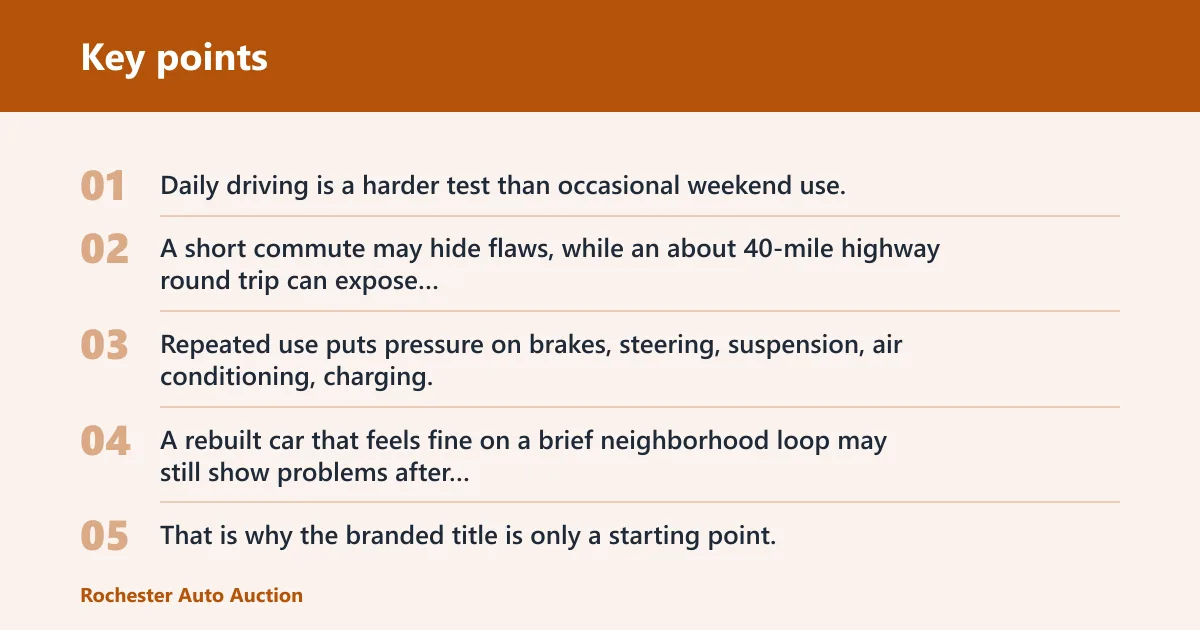
Daily driving is a harder test than occasional weekend use. A short commute may hide flaws, while an about 40-mile highway round trip can expose alignment drift, cooling issues, wind noise, fault codes, or a weak transmission, especially if the repair missed something structural or electrical.
What daily use exposes first
Repeated use puts pressure on brakes, steering, suspension, air conditioning, charging, and safety systems. A rebuilt car that feels fine on a brief neighborhood loop may still show problems after a cold start, a wet commute, or a long run at highway speed.
That is why the branded title is only a starting point. The real question is whether the vehicle has stable geometry, clean electronics, sound crash repairs, and service records that fit its mileage.
When a commute is low risk versus high risk
A low-risk commute is usually short, predictable, and close to home. That does not make the car problem-free, but it gives you less exposure if a warning light appears or a repair slips.
High-risk use means long highway miles, rough roads, winter salt, deep puddles, or a long daily route where a breakdown becomes expensive fast. If the car has flood history, incomplete records, or any sign of electrical trouble, daily commuting is a poor match.
Rebuilt title basics
A rebuilt title is state-issued branding after a salvage vehicle passes inspection and is repaired. The rules vary by state, and the inspection standards vary too. The brand signals prior major damage, not current condition, so you still need to judge the actual repair.
It also affects insurance, financing, and resale. Some carriers limit coverage options, some lenders avoid branded titles, and resale value is usually lower than for an otherwise similar clean-title vehicle.
How salvage becomes rebuilt
A vehicle typically becomes salvage after a major loss event such as collision damage, flood damage, theft recovery, hail, or another insurer-level loss. After repair and inspection, the state can issue a rebuilt title if the car meets that state’s requirements.
That process does not erase the damage history. It only means the vehicle was put back into road-legal condition under that state’s rules.
Why state rules matter
One state may require a detailed inspection of structure, lights, and paperwork. Another may focus more on paperwork and basic roadworthiness. The title brand can look similar across states while the underlying inspection standard is different.
That is why you should read the inspection report, not just the title label.
Damage type and failure risk
The reason the car was branded matters as much as the repair itself. Collision, flood, theft recovery, and hail each create different long-term risks, and some are far more likely to cause hidden failures than others.
Collision damage
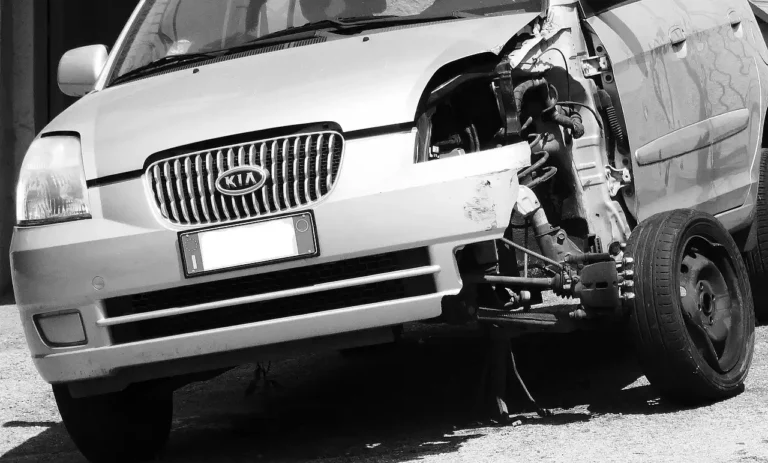
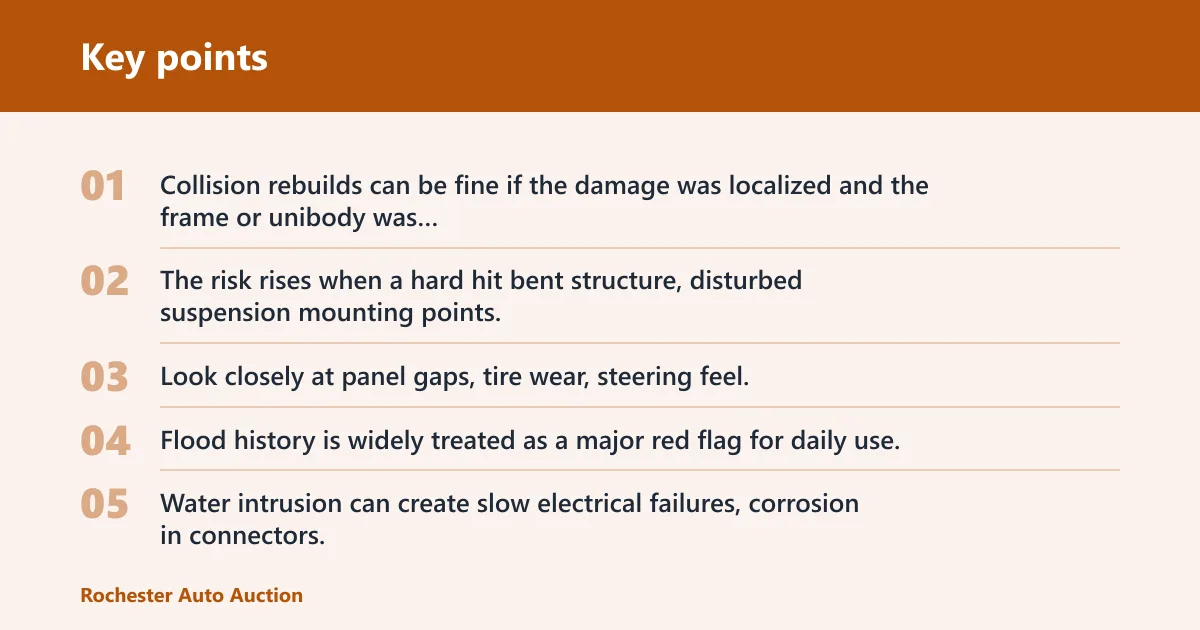
Collision rebuilds can be fine if the damage was localized and the frame or unibody was repaired to spec. The risk rises when a hard hit bent structure, disturbed suspension mounting points, or damaged the airbag system and wiring.
Look closely at panel gaps, tire wear, steering feel, and the repair documents for signs that the body shell was measured after the repair.
Flood damage
Flood history is widely treated as a major red flag for daily use. Water intrusion can create slow electrical failures, corrosion in connectors, sensor errors, bad switches, and recurring warning lights long after the car looks clean.
Even if the cabin looks dry, hidden corrosion can remain inside wiring harnesses, modules, seat connectors, and under-car metal. That kind of damage is hard to predict and expensive to unwind.
Theft recovery and hail cases
Theft recovery can be less risky if the car was taken and later found with limited damage. Hail often affects panels and glass more than structure or electronics, so it may be a better candidate than flood or heavy collision.
Still, you should check whether the theft event included stripped wiring, broken trim, or damaged locks, and whether hail repairs were cosmetic only or involved more than body panels.
Repair quality signals
Reliable daily use depends on repair quality. OEM parts, correct aftermarket parts, and proper assembly all matter, but so do structural measurements, electrical integrity, and evidence that the work was completed in the right order.
OEM versus aftermarket parts
OEM parts usually make fit and function easier to verify, especially for sensors, airbags, lights, brackets, and body panels. Aftermarket parts are not automatically bad, but they need to fit correctly and not interfere with safety systems or panel alignment.
Ask which parts were replaced, which were repaired, and whether the invoices identify the source and part numbers.
Frame and unibody alignment
A car can look straight and still be out of alignment underneath. That matters because poor geometry can cause pull, uneven tire wear, steering drift, and stress on suspension parts.
Ask for an alignment sheet or measurement report if one exists. If the seller has no proof of structural measurement after a major collision, treat that as a warning sign.
Wiring, sensors, and airbag system work
Modern cars rely on sensors, modules, and harnesses that can fail after water exposure or poor repair. Airbag warning lights, intermittent camera faults, and random electrical glitches often point to damage that was not fully corrected.
Suppose a rebuilt SUV starts fine but the lane camera drops out in rain and the passenger airbag light flickers on rough roads. That combination is not a small annoyance. It suggests a repair problem that can grow into a safety issue.
Daily-driver pass/fail checklist
This checklist is meant for the final decision, not casual curiosity. If several items are no, the car is not a good commuter even if the price looks tempting.
| Check | Yes | No |
|---|---|---|
| Damage type was collision, theft recovery, or hail, not flood | Pass | Walk away |
| Repair photos, parts invoices, and inspection report are available | Pass | Caution |
| Frame or unibody alignment was measured after repair | Pass | Walk away |
| Airbag light stays off and the scan shows no airbag faults | Pass | Walk away |
| Scan-tool check shows no stored or pending codes | Pass | Caution |
| Road test feels stable at city and highway speeds | Pass | Walk away |
| No corrosion appears on connectors, underbody metal, or fasteners | Pass | Walk away |
| Tires wear evenly and match side to side | Pass | Caution |
| No clunks, rattles, or suspension noise over bumps | Pass | Caution |
| Warning lights stay off after a full drive cycle | Pass | Walk away |
| Service records show normal maintenance, fluids, brakes, tires, and battery care | Pass | Caution |
| Commute length and weather exposure fit the car’s repair history | Pass | Walk away |
Recommendation: if 10 to 12 checks are yes, the car is a possible daily driver. If about 7 to 9 checks are yes, proceed only with caution and a qualified mechanic’s signoff. If about 6 or fewer checks are yes, walk away.
What to inspect before you buy
A pre-purchase inspection is essential. Use a qualified mechanic who will scan for codes, inspect the airbag system, measure panel gaps, check underbody condition, and road-test the vehicle at both city and highway speeds.
Pre-purchase mechanic inspection
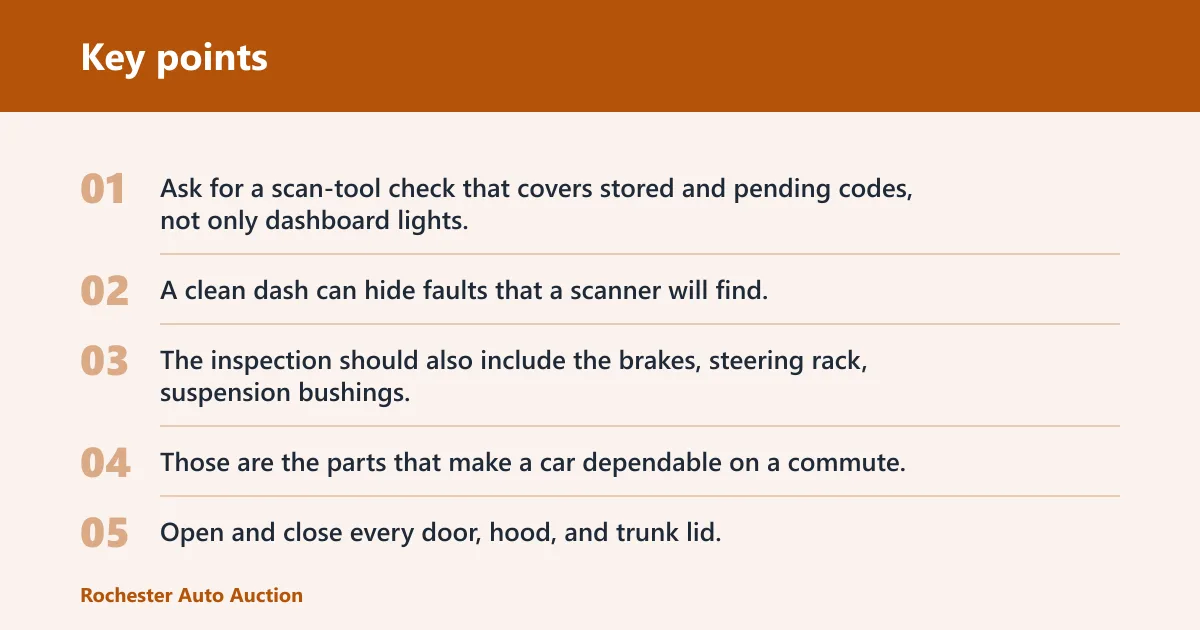
Ask for a scan-tool check that covers stored and pending codes, not only dashboard lights. A clean dash can hide faults that a scanner will find, especially after flood damage or partial electrical repair.
The inspection should also include the brakes, steering rack, suspension bushings, wheel bearings, charging system, and cooling system. Those are the parts that make a car dependable on a commute.
Panel gaps and body alignment
Open and close every door, hood, and trunk lid. Uneven gaps, hard latching, or scraping edges can point to bent structure or poor reassembly.
Check whether the headlights and bumper sit evenly and whether one tire looks more tucked in than the other. Small visual differences can reveal a larger alignment problem.
City and highway test drive
City driving shows brake feel, steering response, low-speed clunks, and transmission behavior. Highway speed reveals vibration, pull, wind noise, and temperature stability.
Say your daily route is 12 miles each way with one interstate merge and a long stoplight section. That is enough to expose a weak wheel bearing, a drifting alignment, or a sensor that fails when the car warms up.
Record review and parts invoices
Ask for repair photos, invoices, and the inspection certificate tied to the rebuilt title. The best records show what was damaged, what was replaced, and whether the shop used OEM or aftermarket parts.
Service records matter too. Oil changes, brake work, tire replacements, battery age, and recurring repair notes tell you more about daily-use reliability than the title brand alone.
How much does insurance and resale matter?
It matters a lot. Insurance coverage can be harder to place, especially for comprehensive and collision coverage, and underwriting rules vary by carrier. Some companies want a photo inspection or appraisal before they bind the policy.
Financing can also be more limited, and resale value is usually lower because many buyers avoid branded titles. If you expect to sell the car soon, that loss matters more than it does for a long-term keeper.
Coverage availability by carrier
Liability coverage may be easier to find than full coverage, but that still depends on the carrier. Some insurers will write rebuilt-title vehicles only after a detailed review, while others may decline them outright.
Get insurance quotes before you buy. Do not assume the policy will be cheap simply because the purchase price is low.
Lower resale value and financing friction
Branded titles tend to shrink the buyer pool. That does not make the car undrivable, but it does make exit timing more important. If the car develops a recurring fault, your repair bill and resale loss can stack up quickly.
That is why the right buyer is usually someone who plans to keep the car, accepts the documentation burden, and can live with tighter resale terms.
How long do rebuilt title cars usually last?
There is no single lifespan for rebuilt-title cars. A well-repaired vehicle with clean records can last for years, while a poorly repaired one can fail quickly. Longevity depends on the original damage, the quality of the repair, the maintenance schedule, and whether corrosion or electrical problems were ever fully corrected.
If the car has solid service records, passes a thorough inspection, and shows no hidden faults, its remaining life may be comparable to a similar clean-title car of the same age and mileage. If any of those pieces are missing, the risk rises fast.
What repairs fail most often on rebuilt title cars?
The most common trouble spots are alignment drift, airbag or sensor faults, corrosion, wiring issues, and recurring suspension noise. Those problems often come from incomplete structural repairs, water intrusion, or reused components that were damaged in the original loss.
Electrical faults are especially common after flood damage. Collision rebuilds more often show steering pull, uneven tire wear, and loose trim or bracket issues. Hail rebuilds usually fail less often on structure, but poor cosmetic repair can still create leaks and wind noise.
Does a rebuilt title affect reliability or just resale value?
It affects both, but not in the same way for every car. The title brand itself does not make the vehicle unreliable. The real reliability hit comes from the damage behind the brand, especially if the car had flood exposure, structural repair, or electrical work that was not done well.
Resale value is usually lower regardless of repair quality because many buyers treat branded titles as higher risk. That means a rebuilt-title car can be mechanically sound and still cost you more at trade-in time.
Should I buy a rebuilt title car for commuting?
Only if the commute is modest, the damage source is understandable, the repairs are documented, and the inspection is clean. A rebuilt-title commuter can work well for short, predictable trips, but it is a poor fit for long highway mileage, harsh weather, or a route where downtime creates real strain.
A common first-timer mistake is choosing the lowest asking price and assuming the rest will sort itself out. If the car lacks photos, invoices, alignment proof, or a clean scan, the commute will become the test bench.
What mileage is too high for a rebuilt title daily driver?
Mileage alone is not the cutoff. High mileage matters most when it combines with weak records, poor repair evidence, or wear on the parts that keep the car safe and predictable. A well-documented car with higher miles may be a better choice than a low-mileage one with flood history and no paperwork.
Use mileage as a stress check, not a verdict. If the car already shows tire wear, suspension noise, warning lights, or repeated repairs, higher mileage makes daily use less attractive because the margin for failure is smaller.
Frequently asked questions
Are rebuilt title cars reliable enough for daily driving?
Sometimes, yes. Reliability depends on the original damage, the repair quality, and the inspection results. A rebuilt title is state-issued branding after a salvage vehicle passes inspection and is repaired, so the label alone does not prove a problem. It does mean you should verify the work before trusting it every day.
Can a rebuilt title car be a safe daily driver?
Yes, if the structure is straight, the airbags and warning lights check out, and the road test is clean. Safety depends on the repaired vehicle, not the brand on the title. Flood history, bad wiring, or incomplete crash repair can turn a deal into a daily risk.
What problems should you check before buying a rebuilt title car?
Check for structural alignment, airbag faults, scan-tool codes, corrosion, uneven tire wear, suspension noise, and poor panel fit. Also review repair photos, parts invoices, and service records. A clean title history does not matter here; you need proof that the car was repaired correctly.