Salvage Title vs Clean Title: What Changes for Buyers?
A salvage title is worth buying only when the price cut still pays for inspection, insurance, financing, and the lower resale later; otherwise, a clean title is the safer pick. A bad buy can bring denied coverage, loan rejection, delayed registration, and a sharp hit at resale. This guide compares salvage and clean titles at each buyer checkpoint so you can judge whether the discount is real.
| Factor | Salvage title | Clean title | Winner |
|---|---|---|---|
| Purchase price | Usually much cheaper than a clean-title match | Higher sticker price | Salvage title |
| Registration eligibility | Not legally driven on public roads until repaired and issued a rebuilt title | Can usually be registered normally, subject to DMV rules | Clean title |
| Insurance friction | Can be harder to insure; some carriers restrict coverage | Usually easier to insure | Clean title |
| Financing friction | Can be difficult to finance | Usually easier to finance | Clean title |
| Resale value | Usually lower and harder to sell later | Stronger resale position | Clean title |
| Inspection steps | Needs repair verification and a state inspection before rebuilt status in many states | Usually no salvage-specific inspection path | Clean title |
Salvage title vs clean title at a glance
A clean title means the vehicle has never been declared a total loss by an insurer. A salvage title is issued when an insurance company deems a vehicle a total loss, often after major damage, theft recovery, or a natural disaster. That split changes more than the sticker price, it changes what you can do next.
Clean title does not mean the vehicle has never had an accident. Salvage title does not mean the vehicle is unusable forever. The buyer difference is road use, paperwork, risk, and exit value.
Where state law changes the answer
State law and the DMV control title branding, inspection requirements, and registration rules. Total loss thresholds also vary, and the repair-cost trigger is often 50% or more of the vehicle’s value, depending on the state. That is why two similar cars can get different title brands in different states.
Because the rules change by state, the title alone is not enough. A VIN check or vehicle history report helps verify the title brand and can reveal details the paper title will not show, such as prior total-loss branding, odometer issues, or title transfers.
Salvage title comparison table
This is the buyer-impact view. The lower price matters only if the rest of the stack does not erase the savings.
| Checkpoint | Salvage title | Clean title | Simple decision rule |
|---|---|---|---|
| Purchase price | Much cheaper than a clean-title equivalent | Higher upfront cost | Buy salvage only if the discount still covers later friction |
| Registration eligibility | Cannot be legally driven on public roads until repaired and issued a rebuilt title | Usually eligible for normal registration | Hard no if you need immediate road use |
| Insurance friction | Can be difficult to insure | Usually easier to insure | Hard no if your carrier will not write the policy you need |
| Financing friction | Can be difficult to finance | Usually easier to finance | Hard no if you need a standard auto loan |
| Resale value | Lower and harder to sell later | Stronger resale position | Buy salvage only if you plan to keep it and accept weaker exit value |
| Inspection steps | Repair verification plus a state inspection in many states | No salvage-specific inspection path | Hard no if you cannot document repairs |
Purchase price
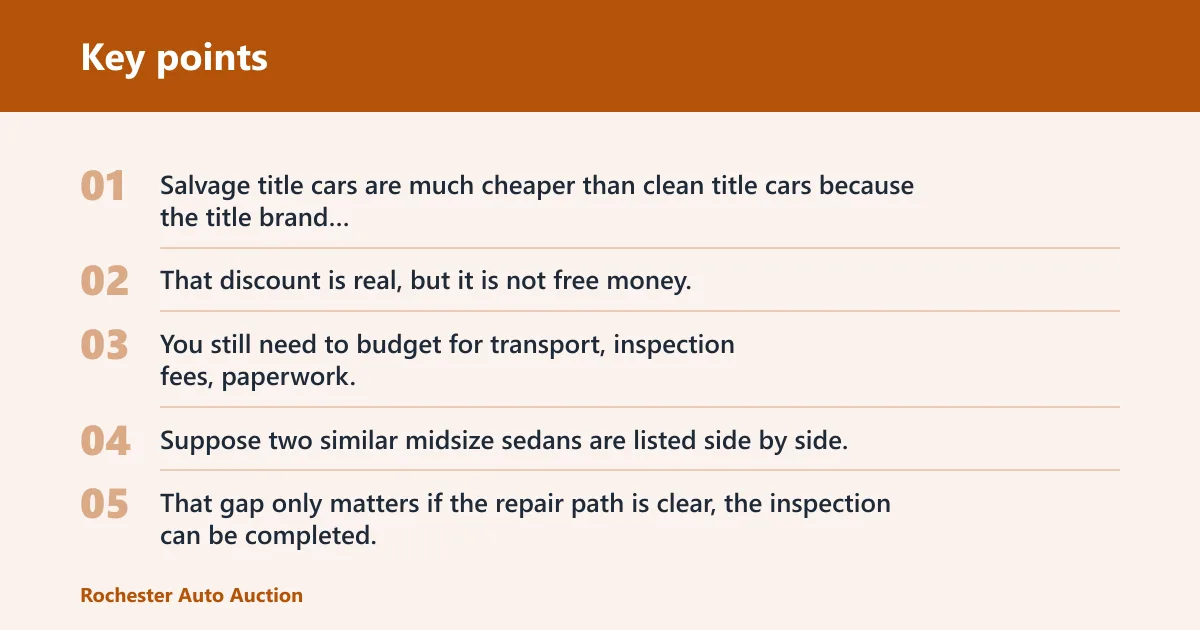
Salvage title cars are much cheaper than clean title cars because the title brand signals extra work and extra risk. That discount is real, but it is not free money. You still need to budget for transport, inspection fees, paperwork, and repair verification after the sale.
Suppose two similar midsize sedans are listed side by side, and the salvage car is several thousand dollars cheaper. That gap only matters if the repair path is clear, the inspection can be completed, and the car can later be insured and registered without surprise costs.
Registration eligibility
Clean title cars can usually be registered normally. Salvage title cars cannot be legally driven on public roads until they are repaired and issued a rebuilt title. That means the buyer impact starts before the first mile.
If you need a car to commute next week, salvage is a hard no. If you are buying for a project, parts recovery, or a long repair timeline, salvage may still make sense, but only after you confirm the DMV path in your state.
Insurance friction
Salvage title vehicles can be difficult to insure. Some carriers limit coverage, and some may decline the vehicle outright until it becomes rebuilt and meets their underwriting rules. Clean title cars are usually easier to place with standard insurers.
The practical rule is simple: if you need broad coverage quickly, choose clean title. A salvage car makes sense only when you already know which insurer will write it and what coverage it will allow.
Financing friction
Financing is usually easier on a clean title because lenders prefer vehicles with clearer collateral value. Salvage title vehicles can be difficult to finance, which pushes the buyer toward cash or a specialty lender. That difference changes the real price because a cheap listing can become an expensive borrowing problem.
Cash buyers have more flexibility, but they do not escape the title brand. If the resale market, insurance options, or repair documentation are weak, cash only makes the purchase possible; it does not make it wise.
Resale value
Clean title usually holds value better because future buyers face fewer roadblocks. Salvage title cars are harder to sell later, and the title brand keeps part of the market away even after repairs. That lower exit value is part of the true cost of buying salvage.
A common first-timer mistake is focusing on the discount and ignoring the exit. If the car is likely to be sold within a year or two, a salvage title often creates more friction than the upfront savings can absorb.
Inspection steps
A rebuilt title is given to a salvage vehicle after it has been repaired and passed a state inspection. In many states, that inspection checks whether the vehicle appears safe enough for legal road use and whether the repairs were documented well enough to move the title forward.
That process can take time, and time has a cost. If you cannot verify the repair path, the vehicle history report, and the state’s rebuilt-title rules before purchase, the discount is not yet proven.
What changes when you buy a car with a salvage title?
You are not just buying a cheaper car. You are buying a vehicle with a total-loss brand, a possible inspection path, and more uncertainty around legal road use, insurance, financing, and resale. That is why the title status changes the deal even before you talk about condition.
Total-loss branding
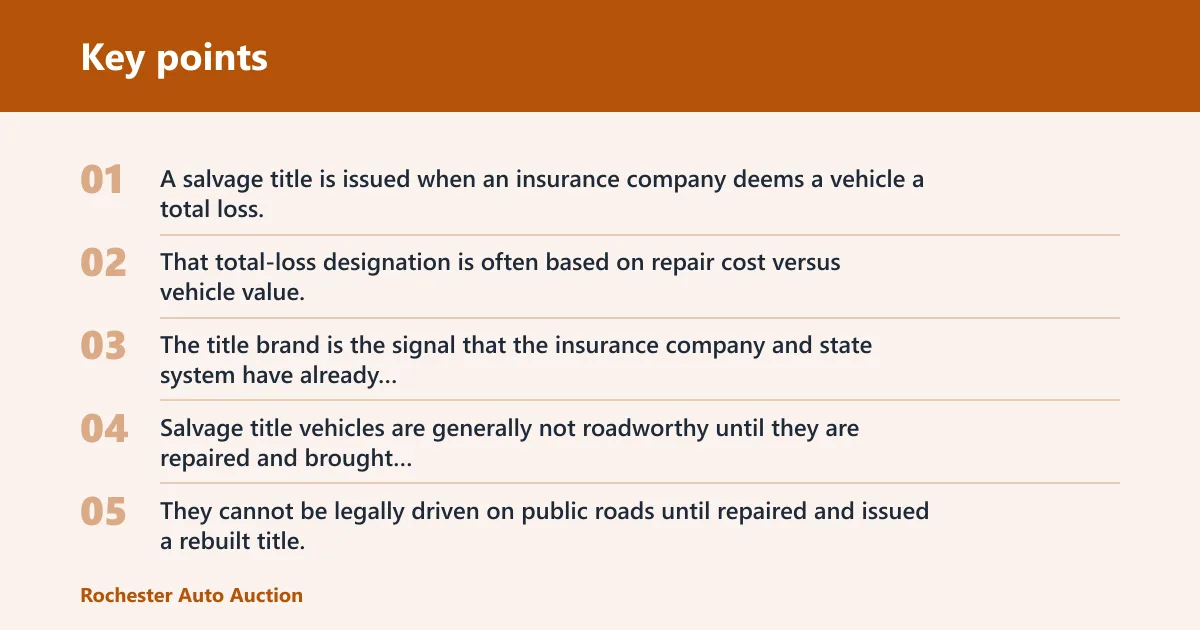
A salvage title is issued when an insurance company deems a vehicle a total loss. That total-loss designation is often based on repair cost versus vehicle value, and the threshold can vary by state. The title brand is the signal that the insurance company and state system have already stepped in.
Road use limits before repair
Salvage title vehicles are generally not roadworthy until they are repaired and brought into compliance. They cannot be legally driven on public roads until repaired and issued a rebuilt title. That single rule changes towing, storage, and delivery costs right away.
Hidden costs after purchase
The sticker price is only part of the bill. Add transport, state paperwork, inspection fees, repair verification, and any reinspection if the first pass fails. If flood, theft recovery, or structural repair is involved, the hidden cost risk tends to rise because the seller may not have full clarity on what was rebuilt.
Can you drive and register a salvage title car?
Not as a salvage title vehicle on public roads. In most states, the car must be repaired and moved through the rebuilt-title process before it can be legally registered for normal road use. The DMV and state law control the exact steps, so the answer depends on where the car will be titled.
Public road registration
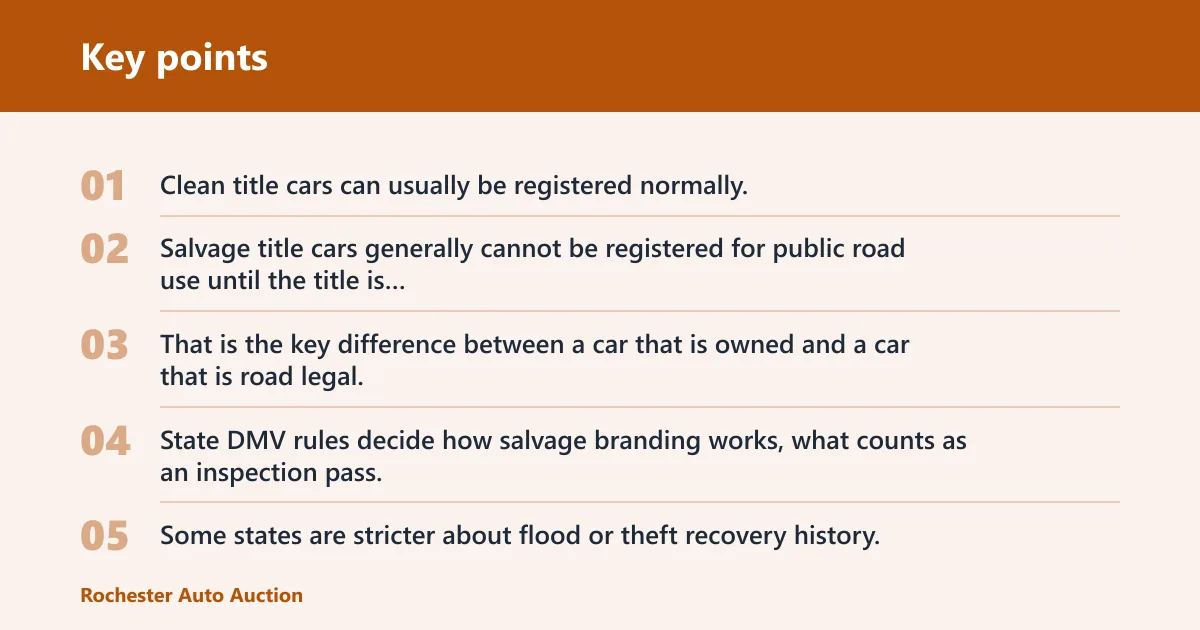
Clean title cars can usually be registered normally, assuming there are no other legal blocks. Salvage title cars generally cannot be registered for public road use until the title is converted appropriately. That is the key difference between a car that is owned and a car that is road legal.
State DMV rules
State DMV rules decide how salvage branding works, what counts as an inspection pass, and what documents the buyer must file. Some states are stricter about flood or theft recovery history. Others may require detailed repair receipts or a lane inspection before rebuilt status is issued.
When rebuilt title becomes the next step
After repair and inspection, a rebuilt title follows in many states. That is not the same as a clean title. It means the car is back on the road legally, but the salvage history stays attached to the record.
What changes with insurance and financing?
Insurance and financing usually favor clean title cars. Salvage title vehicles can be harder to place with an insurer and harder to finance with a standard lender, which changes the total cost of ownership even if the purchase price is low. For many buyers, that friction is the deciding factor.
Insurance approval and coverage limits
Some insurers may cover a rebuilt vehicle, but the coverage options can be narrower and the underwriting more selective. A clean title car usually faces fewer obstacles because the title brand does not signal prior total loss. If coverage is uncertain, that is a warning sign before the sale, not after.
Loan approval friction
Lenders care about collateral value and easy liquidation. A salvage title car can be difficult to finance because the title brand makes resale uncertain. If you need a loan, the clean title option often wins on speed, approval odds, and terms.
Cash buyer vs financed buyer
Cash buyers can tolerate more title friction because they are not depending on a lender’s rules. Even then, the title brand still affects insurance, registration timing, and future resale. Financed buyers should treat salvage as a much narrower purchase case, not a default bargain.
Choose Salvage title if… / Choose clean title if…
Choose Salvage title if the discount is large enough to cover inspection, towing, paperwork, possible reinspection, and a lower future resale price. It is the better pick when you can wait for the rebuilt-title process, pay cash, and verify the repair history through a VIN check or vehicle history report.
Choose clean title if you need normal registration, easier insurance, standard financing, and a cleaner exit later. It is the safer pick if the seller cannot document repairs, the vehicle may have flood or structural history, or the savings disappear once the hidden costs are added.
If the car is your only transportation, clean title is usually the better choice. If the car is a project and the numbers still work after every checkpoint, salvage can be reasonable.
Frequently asked questions
What changes when a car has a salvage title instead of a clean title?
The buyer gets a car with a total-loss brand, more legal steps, and more friction around insurance, financing, and resale. A clean title has never been declared a total loss by an insurer, but that does not prove the car has never been wrecked. The title status changes the buying risk more than the badge on the hood.
Can you drive a salvage title car on public roads?
Not legally, until it has been repaired and issued a rebuilt title. Salvage title vehicles are not roadworthy in that state. The DMV rules in your state control what must happen first, and those rules can include inspection, proof of repair, and paperwork that confirms compliance.
What is the difference between salvage title and clean title when buying a used car?
A clean title usually gives you easier registration, insurance, and financing. A salvage title usually means a lower purchase price, but it also brings road-use restrictions, more inspection steps, and weaker resale. The right choice depends on whether the discount still survives those extra costs.
Does a clean title mean the car has never been in an accident?
No. A clean title only means the vehicle has never been declared a total loss by an insurer. It can still have had prior accident repair, repainting, or body work. That is why a vehicle history report or VIN check matters even when the title looks normal.
What happens after a salvage title car is repaired?
After repair, the car typically needs a state inspection before it can receive a rebuilt title in many states. That inspection is the gate between salvage status and legal road use. Only after that step can the vehicle usually be registered for public roads.
Can a salvage title car be insured or financed easily?
Usually no. Salvage title vehicles can be difficult to insure or finance because carriers and lenders see more risk and weaker collateral value. A clean title is typically easier for both. If the salvage car cannot clear those hurdles in advance, the discount may not be worth it.