Rebuilt Title vs Salvage Title: What Changes After Repairs?
After repairs, a salvage title can become a rebuilt title only if the vehicle passes the required state inspection and gets a new title status; the old salvage history usually stays on record. Miss a step, and you can face registration denial, weak insurance options, or a lower resale price. This guide explains what changes, what stays permanent, and which documents prove a rebuilt car is road-ready.
| Factor | Rebuilt title | salvage title | Winner |
|---|---|---|---|
| Legal status | Road-legal after state approval and retitling | Not legal to drive or register before rebuilding | Rebuilt title |
| Registration | Can be registered after paperwork and approval | Registration usually denied until retitled | Rebuilt title |
| Insurance | May be insurable, but carrier rules and pricing vary | Coverage is usually limited while the car remains salvage branded | Rebuilt title |
| Resale | Higher than salvage, but still marked by prior damage | Usually lower because the car is not yet road-ready | Rebuilt title |
| Buyer risk | Lower than salvage if repairs and records check out | Higher because the car has not cleared retitling | Rebuilt title |
What a rebuilt title actually changes legally
The main difference is legal status, not the amount of bodywork on the car. A salvage title usually means the vehicle was written off after severe damage or theft loss, while a rebuilt title is generally issued after repairs and state approval.
What each title brand means
A salvage title flags a car that has already crossed the total-loss threshold in a prior claim or theft event. A rebuilt title means the state has accepted that the vehicle was restored to roadworthy condition and that the paperwork matches the repair history.
What the brand changes legally
Once the rebuilt brand is issued, the car can usually be registered and used on the road. That is the key legal change. Before that point, the salvage brand blocks normal road use in many jurisdictions.
What the brand does not erase
The rebuilt title does not wipe out the salvage history. VIN-based vehicle history reports often show the title change, prior damage, and mileage record entries tied to the car. Buyers should treat that history as permanent.
What changes after repairs?
Repairs change the car’s condition, but they do not change its legal status until the state approves a rebuilt title. That approval can open the door to registration and road use, yet the damage history remains part of the record and still affects insurance and resale.
Legal status after state approval
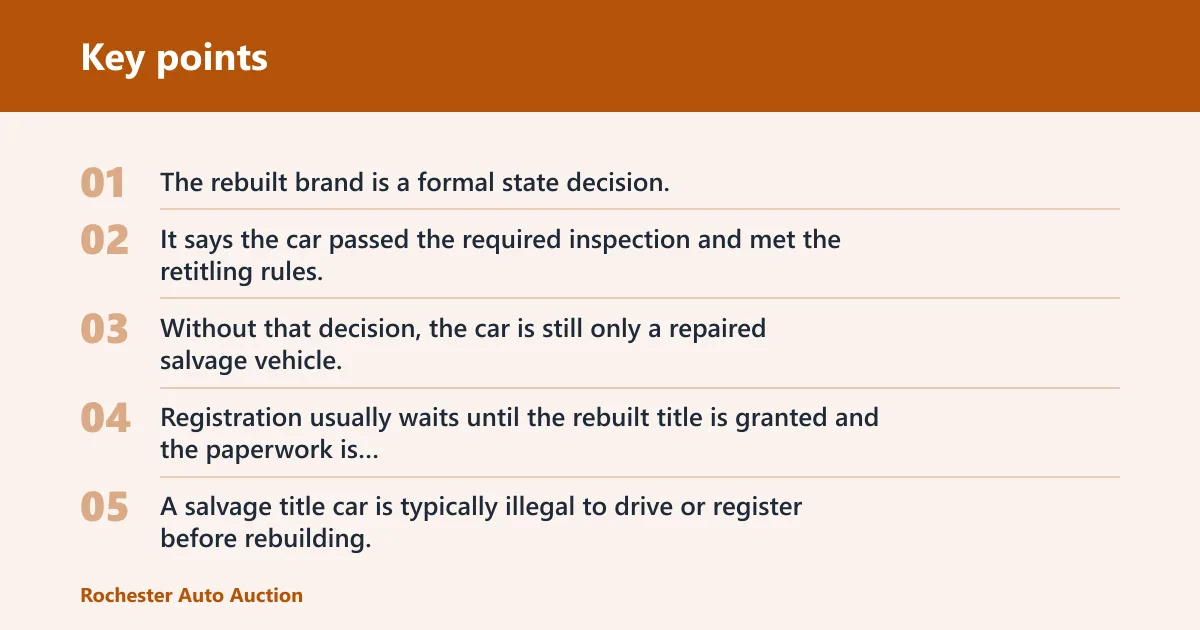
The rebuilt brand is a formal state decision. It says the car passed the required inspection and met the retitling rules. Without that decision, the car is still only a repaired salvage vehicle, not a rebuilt one.
Registration and driving rights
Registration usually waits until the rebuilt title is granted and the paperwork is complete. A salvage title car is typically illegal to drive or register before rebuilding. That is why the retitling step matters as much as the repairs themselves.
Insurance and resale effects
Rebuilt title insurance may be available, but carrier rules vary and coverage can be more limited than for a clean-title car. Resale also changes, because the rebuilt brand stays on the record and many buyers discount a car with prior structural damage or major safety repairs.
Say your sedan had front-end damage, then received a new bumper, radiator support, and airbag module. If the owner has no inspection report or parts receipts, the car is still just a repaired vehicle with a salvage past. The rebuilt brand comes only after the state paperwork clears.
Title change matrix
This decision matrix separates legal status from practical ownership effects. That split matters because a car can look repaired long before it is formally retitled, and the paperwork outcome controls what you can do next.
| Stage | Legal status | Registration | Insurance | Resale | Buyer risk |
|---|---|---|---|---|---|
| Salvage title | Not road-legal in normal use | Usually blocked | Limited or unavailable | Lowest | High |
| Repairs completed, not retitled | Still salvage branded | Usually blocked | Uncertain | Low | High |
| Rebuilt title granted | Road-legal after approval | Allowed after paperwork | May be available | Higher than salvage, still discounted | Moderate |
Legal status and registration
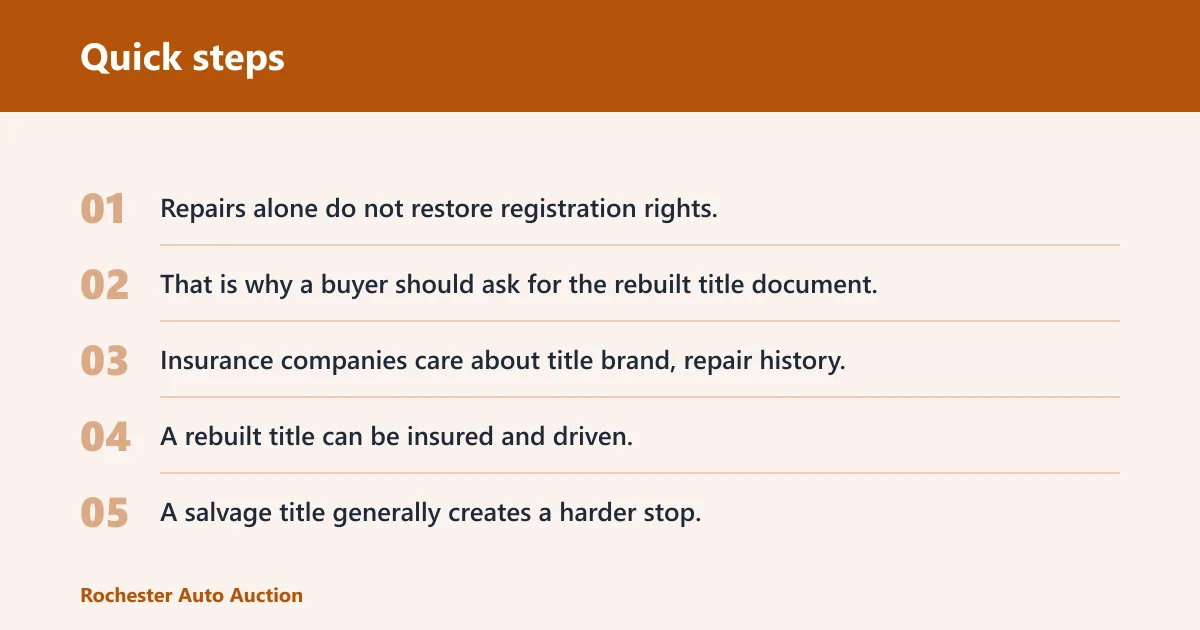
The legal change happens only at retitling. Repairs alone do not restore registration rights. That is why a buyer should ask for the rebuilt title document, not just a repair invoice packet.
Insurance and buyer risk
Insurance companies care about title brand, repair history, and the quality of the rebuild. A rebuilt title can be insured and driven, but some carriers limit coverage or price it conservatively. A salvage title generally creates a harder stop.
Resale value and record history
Rebuilt cars usually sell for less than clean-title versions because the title brand is permanent. The record remains visible on vehicle history reports, so the market keeps discounting the prior damage even after the car passes inspection.
What paperwork proves the rebuild?
You need more than a repaired car and a verbal explanation. Repair receipts, parts invoices, proof of ownership, salvage paperwork, and a VIN-based history report are commonly the main documents that connect the repairs to the title application.
Repair receipts and parts invoices
Receipts show what was replaced and when. Parts invoices help confirm whether the repairs involved structural pieces, safety systems, or other major components. Gaps in those records make the rebuild harder to trust.
Proof of ownership and salvage documents
State offices typically want a paper trail from salvage brand to retitled vehicle. That means the salvage title, the ownership document, and any state forms used during the inspection process should line up with the VIN.
VIN history report review
A vehicle history report tied to the VIN should confirm title changes, mileage records, and damage history. If the report shows one brand and the seller’s documents show another, stop and compare every page before moving ahead.
- Collect the salvage title and ownership document.
- Gather repair receipts and parts invoices.
- Match every major repair to the VIN and the car’s current condition.
- Compare the documents with a vehicle history report.
- Confirm the rebuilt title application includes the required inspection report.
What inspections and checks matter?

A rebuilt title usually depends on a state inspection that verifies repairs and road safety. The exact process varies by jurisdiction, but the inspection normally focuses on repair quality, structural integrity, and the safety systems that were affected in the loss.
State inspection requirements
State inspection is the formal checkpoint before retitling. Some states emphasize body and frame repair quality. Others require a broader review of lights, brakes, airbags, or other safety items before the rebuilt brand can be issued.
Structural repair review
Structural damage is one of the most important rebuild issues because it can affect alignment, crash protection, and long-term durability. A buyer should look for visible welds, uneven panel gaps, mismatched fasteners, or signs that the repair was rushed.
Safety systems and roadworthiness
Airbags and other safety components matter because they are part of the vehicle’s crash response. A rebuild inspection should confirm those systems function properly. A warning light on the dash or a missing diagnostic record is a reason to pause.
Suppose a compact SUV had water and side-impact damage, then received new seat belts and an airbag module. If the dashboard still shows a fault light or the scan tool reveals stored crash codes, the repair story is not complete even if the exterior looks clean.
Choose rebuilt title if… / Choose salvage title if…
Pick the rebuilt path only when the car has passed the required inspection, the records are complete, and you need a vehicle that can be legally registered and insured. Stay with salvage status only if you are still in the repair phase or the state has not approved retitling yet.
Choose rebuilt title if…
Choose Rebuilt title if the state has already approved the retitle, the VIN history matches the paperwork, and the car passes a careful mechanical and visual review. It is also the better fit if you need normal road use, registration, and a realistic path to insurance.
Choose salvage title if…
Choose salvage title if the vehicle is still in repair, if the paperwork is incomplete, or if the damage is so severe that the rebuild cannot be verified cleanly. It is also the safer call when the car has structural questions, missing receipts, or unresolved safety-system faults.
What should buyers verify before purchase?
Buyers should verify the VIN history, the title brand, the repair record, and the current mechanical condition before they buy a rebuilt car. The rebuilt label helps, but it does not prove the car was repaired well or that every weak point was corrected.
VIN history and title brands
Start with the VIN-based vehicle history report. Confirm the salvage event, the rebuilt brand, the mileage trail, and any damage notes. If the seller cannot explain a title gap, treat that as a warning sign.
Evidence gaps in repair records
Missing receipts are not a small detail. They can hide poor parts choices, incomplete structural work, or skipped safety repairs. A clean story should include receipts, invoices, and inspection records that connect the rebuild to the current car.
Test drive and diagnostic scan
A test drive should be paired with a diagnostic scan, not used as a substitute for one. The buying tips specifically recommend checking computer modules with diagnostic software or a workshop scan. That step can reveal hidden crash codes, sensor faults, or airbag issues that a quick road test may miss.
Frequently asked questions
What changes after a car goes from salvage title to rebuilt title?
The biggest change is legal. A salvage title car is generally not legal to drive or register before rebuilding, while a rebuilt title car can usually be registered and used on the road after approval. The salvage history still stays attached to the VIN and record.
Can you legally drive a salvage title car before it is rebuilt?
Usually no. A salvage title means the vehicle has not yet cleared the state’s retitling process, so it is typically illegal to drive or register. Some states may allow limited transport for repair or inspection, but normal road use waits for rebuilt approval.
What inspections are required before a salvage car becomes rebuilt?
State inspection is required before retitling, but the exact checklist varies. Inspectors normally verify repair quality, roadworthiness, structural work, and safety systems such as airbags or related controls. The first step is usually a thorough inspection before the paperwork moves forward.
What paperwork do you need to get a rebuilt title?
Expect to keep detailed records of all repairs and parts used, plus proof of ownership and salvage paperwork. After passing inspection, the owner typically submits repair receipts, inspection reports, and the title application to the state office handling the retitle.
Does a rebuilt title mean the car is safe to buy?
No. A rebuilt title means the car passed the required state process, not that every repair is perfect or every hidden fault is gone. Buyers should still inspect the structure, safety systems, and electronic modules, then compare the car against the VIN history and repair records.
How do repairs affect a rebuilt car’s resale value?
Repairs help the car regain road use, but they do not restore clean-title value. The rebuilt brand remains on the record, so resale usually stays below an equivalent clean-title car. Better repair documentation and a clean inspection result can narrow that gap, but not erase it.