How to Get a Salvage Inspection After Repairs
Book the salvage inspection only after repairs are complete, then bring the salvage title, repair receipts, parts bills, proof of ownership, and photos of the damage and repairs if your state asks for them. In many states, there is no single standard “salvage inspection” after repairs, and the process, purpose, and authority differ enough that local instructions matter more than generic ones. Many states also require a rebuilt-title application and a VIN verification. Missing paperwork or hidden damage can delay approval, trigger a failed inspection, and force you to pay for a second appointment. This guide lists the post-repair steps, documents, and check points to prepare before you book.
What a salvage inspection checks
A salvage inspection is usually part of the rebuilt-title process after repairs, where that process exists. In many states, the DMV or a state licensing office reviews your paperwork, checks the vehicle identity, and confirms that the car now meets the state’s rebuilt-title path, which some states call a reconstructed title.
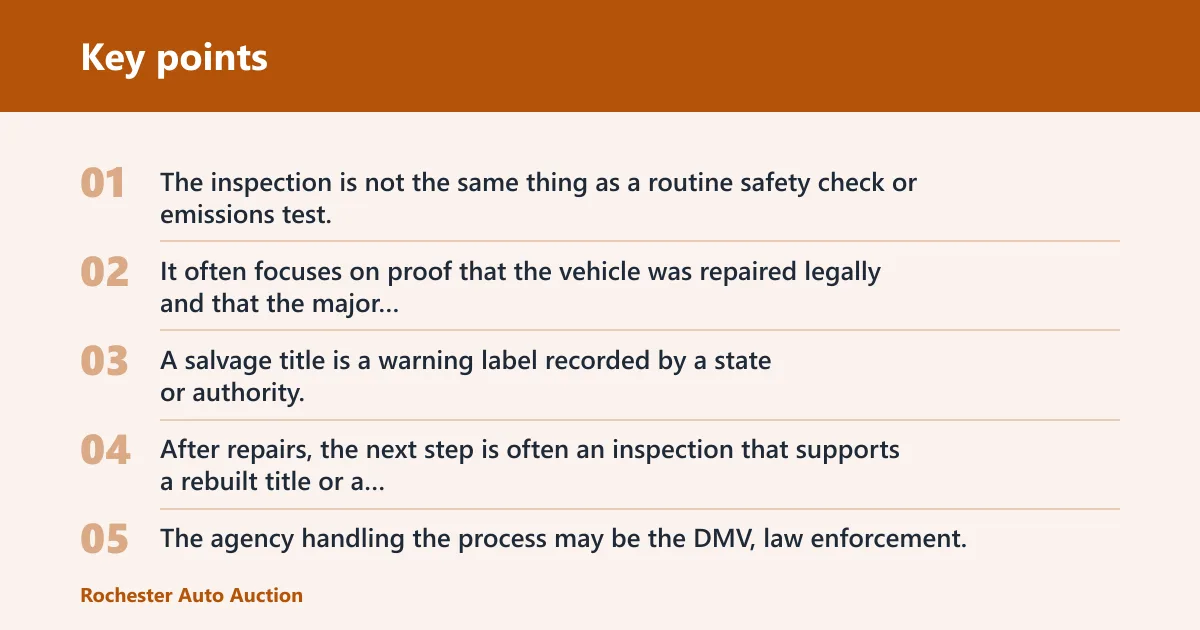
The inspection is not the same thing as a routine safety check or emissions test. It often focuses on proof that the vehicle was repaired legally and that the major damage was corrected, with special attention to the VIN, structure, airbag system, and major replacement parts.
Salvage title, rebuilt title, and DMV review
A salvage title is a warning label recorded by a state or authority. After repairs, the next step is often an inspection that supports a rebuilt title or a similar title path, though the exact sequence and authority differ by state. The agency handling the process may be the DMV, law enforcement, or a certified inspection facility, depending on the state.
That is why the same vehicle can face different paperwork and different booking steps from one state to another. Some states may require a rebuilt-title application before inspection. Others review the file after the inspection. You need the local sequence, not a generic one.
How inspection paths differ by state
Rules differ on who inspects, which proof counts, and whether extra checks apply. Texas, for example, may have rebuilt-title or safety steps that depend on local requirements and county emissions rules. Some states also require a DMV VIN inspection for a reconstructed title.
Do not assume the salvage inspection covers everything. Your state may split the process into title review, VIN verification, salvage inspection, and then emissions or safety inspection. If you prepare for the wrong path, you risk a return visit.
Where NMVTIS fits into the review
NMVTIS, the federal vehicle history database, helps the agency confirm that the branded-title history follows the vehicle across states, where the agency uses it and where consumer access is available. That matters when a salvage car was moved, retitled, or repaired in a different state than the one that issued the brand.
Use NMVTIS as a cross-check, not as a replacement for your title packet. A mismatch can slow the file before anyone even inspects the car.
What documents do you need first?
Start with the documents that prove the repair story is complete and the vehicle identity is consistent. The strongest file usually includes receipts, a parts list, title paperwork, and any state forms the agency asks for before the appointment.
Receipts and invoices for major repairs
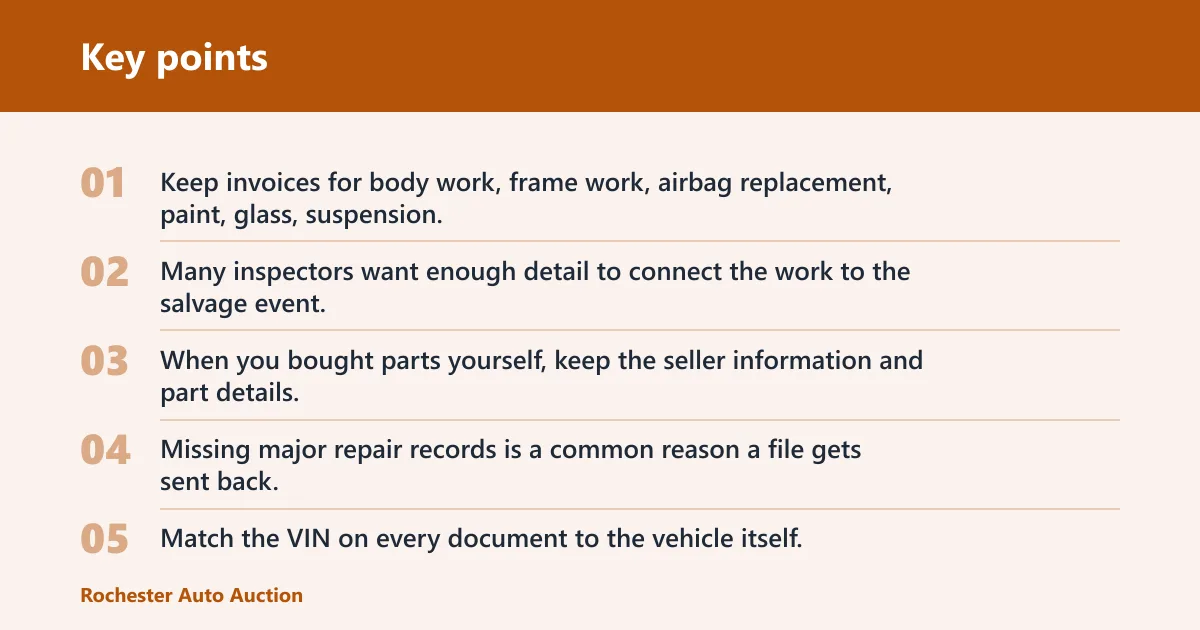
Keep invoices for body work, frame work, airbag replacement, paint, glass, suspension, and any other major repair tied to the damage. Many inspectors want enough detail to connect the work to the salvage event, not a vague line that says “repairs completed.”
When a shop did the work, the invoice should identify the business and the repair scope. When you bought parts yourself, keep the seller information and part details. Missing major repair records is a common reason a file gets sent back.
VIN verification and title matching
Match the VIN on every document to the vehicle itself. Inspectors and title clerks look for consistency across the dash plate, door-jamb sticker, title, and supporting papers. If the VIN on the title does not match the car, the process can stop.
Bring the salvage title, any prior title paperwork, and the VIN verification form if your state uses one. This step helps rule out title fraud, cloning, and simple clerical errors before the inspection result can move forward.
Lien release, if the vehicle had a loan
If the vehicle carried a loan or lien, bring the lien release when your state asks for it. The agency needs proof that the lender no longer claims an interest in the vehicle before it changes the title path.
Do not wait until the appointment to sort this out. A missing lien release can block the rebuilt-title process even if the repairs are perfect.
State forms and any reconstruction affidavits
Some states require a rebuilt-title application, reconstruction affidavit, or similar form before inspection. Others ask for those papers after the vehicle passes. Either way, have the correct state forms ready and filled out as far as the instructions allow.
If your state asks for a notarized statement or shop affidavit, use the exact form name the agency lists. Guessing at the document type is a common way to lose time.
Post-repair salvage inspection prep table
| Step item | Who issues it | What it proves | Most common rejection reason |
|---|---|---|---|
| Receipts and invoices | Repair shop, parts seller, or parts counter | Which major repairs were completed and when | Missing dates, vague descriptions, or no seller identity |
| VIN verification | DMV, law enforcement, or certified verifier | The vehicle identity matches the title and paperwork | VIN mismatch on the title, dash, door jamb, or forms |
| Lien release | Lender or lienholder | The loan claim has been cleared | No release on file for a vehicle that had a lien |
| Photos of completed repairs | Owner or repair shop | The car was restored after the damage event | No before-and-after record, or photos do not match the damage |
| Parts list with part numbers | Owner, repair shop, or parts supplier | Which major components were installed | No part numbers, no seller info, or missing major component records |
| State-specific forms | DMV or equivalent authority | The file follows the state’s rebuilt-title path | Wrong form, missing signature, or skipped pre-approval step |
Suppose you replaced a deployed airbag module and both front belts after a crash. If your packet includes the invoice, the parts list, and photos of the finished dashboard, the inspector can trace the repair record much faster than if the file only says “interior work completed.”
A common first-timer mistake is mixing loose receipts with no part numbers. That can be enough to fail a file review even when the vehicle itself looks finished.
How do you book the inspection?
Book through the agency your state uses, which may be the DMV, law enforcement, or a certified inspection facility. Some states require pre-approval before the appointment, while others let you schedule once the paperwork is complete.
The safest move is to confirm the booking method, required forms, and whether the inspection is by appointment only. Also ask whether the same visit covers VIN verification, or whether that step must happen separately before the salvage inspection.
What to confirm before you go
Ask three things before you leave home: what the agency wants in the packet, whether the car must arrive towed or can be driven, and whether a safety or emissions inspection follows later. A separate emissions county rule can change the order even when the rebuilt-title process is otherwise ready.
If the state requires pre-approval, do not skip it. An inspection slot without the right paperwork can become a wasted trip.
What inspectors usually check on the vehicle
Inspectors usually focus on identity, structure, and visible completion of the repairs. They are looking for evidence that the vehicle matches the title history and that the major damage was corrected, not only that the car starts and moves.
Structural and frame integrity
Frame rails, unibody areas, panel gaps, welds, and alignment are common review points. A repaired salvage car should show repair evidence that fits the damage claim. If the frame was straightened, a body-shop note or frame-rack documentation can help support the file.
Uneven gaps, bent mounting points, or fresh welds with no paperwork are red flags. Inspectors do not need a perfect showroom finish, but they do need a repair path that makes sense.
Airbag system and warning lights
The airbag system is a major checkpoint. Missing bags, fault lights, or incomplete SRS repairs often stop approval. Some states or inspectors may also ask for diagnostics or other proof that a warning lamp is not active, but that requirement is not universal.
If airbags deployed in the crash, document the replacement parts and the completed work. A file with no airbag receipts can look incomplete even when the interior panels are back in place.
Panel alignment, welds, and repair consistency
Inspectors often compare the finished car to the paperwork. If the photos show front-end damage but the repair record only lists a fender, bumper cover, and paint, the file may not explain the actual repair scope.
Picture a sedan with a replaced hood, radiator support, and left headlamp. If the panel gaps look even and the invoices name those parts, the file is easier to approve than one that only shows a paint receipt.
Safety and emissions inspection add-ons
Some states add a safety inspection or an emissions inspection before or after the rebuilt-title step. That is separate from the salvage inspection itself. Texas, for example, may have emissions-related steps that apply in some counties.
Check county rules if your state uses them. A car can pass the salvage inspection and still fail a later emissions or safety check.
Why salvage cars fail inspection
Most failures come from paper gaps or repair evidence that does not match the vehicle. The common problems are missing receipts, VIN mismatches, incomplete airbag work, weak frame repair proof, and missing records for major parts.
Missing or incomplete repair proof
If the inspector cannot trace the repairs, the file usually stalls. That includes missing invoices, no seller information for major parts, or photos that do not show the completed work clearly.
Proof of repairs can include receipts, affidavits, reconstruction paperwork, or shop statements, depending on the state. The exact mix matters more than the label.
VIN mismatches or branded-title discrepancies
A mismatch between the title VIN and the vehicle VIN can stop the process quickly. The same problem appears when the branded-title history in NMVTIS does not match the paperwork trail you present.
That is why the dash plate, door-jamb sticker, and title should agree before you book. Fix the paperwork first if anything does not line up.
Frame damage that does not match the repair record
Frame or structural problems that are still visible will raise questions, especially if the file has no body-shop verification. Inspectors look for signs that the repaired area matches the claimed repair work.
Excessive panel mismatch, poor weld finish, or obvious straightening without documentation can trigger a rejection. The vehicle does not need to look new, but the repair story must hold together.
Airbag faults or missing components
Missing airbags, seat-belt pretensioner issues, or illuminated warning lights often cause a fail. If the crash involved the restraint system, the repair packet should show the replacement parts and the completed installation.
Airbag defects are hard to overlook because they speak directly to safety. If the warning light is on, repair that problem before rebooking.
How much does a salvage inspection cost?
Costs vary by state, agency, and vehicle path. Some published guides, including Wheels Away, list an overall U.S. average cost, but the local fee can differ sharply: Florida inspections in the guide are listed at $100-$200, Georgia’s salvage inspection cost is listed at $118, and Indiana’s salvage inspection cost is listed at $5.
Do not budget only for the inspection fee. Towing, notary charges, copies, replacement receipts, and reinspection fees can add to the total. If your state needs emissions or safety testing too, those are separate costs.
How long does a salvage inspection take?
Appointment time varies by state and line length. Some published guides, including Wheels Away, list an overall U.S. average time, but the state examples can differ: Connecticut’s inspection time is listed at 20-40 minutes, and Delaware’s inspection time is listed at 15-30 minutes.
The real clock includes more than the on-site check. Filing time, waiting for appointment slots, and any follow-up request for missing paperwork can stretch the process well beyond the inspection itself.
What happens after I pass a salvage inspection?
After a pass, the agency usually moves the vehicle toward a rebuilt title or the state’s equivalent title path. Some states issue the title after the inspection file clears. Others require one more administrative step, such as a final DMV review or a separate safety or emissions result.
Keep every approval paper you receive. If you later sell the vehicle, the rebuilt-title brand and the supporting records can matter to the next buyer and to the next state authority.
Frequently asked questions
What is a salvage inspection?
A salvage inspection is a state process used after repairs to confirm that a formerly salvage vehicle now follows the rebuilt-title path in that state. The DMV or another authority may review the VIN, repair records, and vehicle condition before issuing the next title stage.
How do I get a salvage title inspection after repairs?
Finish the repairs first, then gather receipts, title documents, and any required state forms. Book through the DMV, law enforcement, or a certified facility, depending on the state. If your state needs pre-approval or VIN verification first, complete that step before the inspection date.
What documents do I need for a salvage inspection?
Bring the salvage title, proof of ownership, repair receipts and invoices, a parts list with part numbers, lien release if needed, and any state-specific forms or reconstruction affidavits. Your state may also require VIN verification paperwork or an application for a rebuilt title.
Can I drive a salvage car to the inspection legally?
Maybe, but only if your state allows it and the vehicle is legally registered, insured, and safe to operate. Many repaired salvage vehicles are towed to avoid registration, insurance, or safety problems. Confirm the rule with the DMV or inspection office before moving the car.
Why do salvage cars fail inspection?
Common failures come from incomplete repair proof, VIN mismatches, frame work that does not match the paperwork, and airbag faults or missing components. A file can also fail when parts receipts lack part numbers or seller details. The repair story and the car itself need to agree.
How do I schedule a salvage inspection appointment?
Start with the agency named by your state, which may be the DMV, law enforcement, or a certified inspection facility. Confirm whether you need pre-approval, which forms to bring, and whether the vehicle must be towed. Then book the earliest slot that fits your complete file.