How to Pass a Salvage Inspection the First Time
Pass a salvage inspection the first time by matching the rebuilt vehicle to the state checklist, fixing every safety and title-paperwork gap, and bringing proof for each major repair. Miss one required item and you face a retest, extra fees, and delays in titling and insuring the car. This guide covers a pre-inspection readiness system for paperwork, parts verification, safety checks, and the final walkthrough.
What a salvage inspection
A salvage inspection is the state or local process that checks whether a previously totaled vehicle has been repaired enough for road use and title changes. The exact program depends on the state. Some programs focus on safety systems, while others also require VIN checks, receipts, anti-theft verification, or a separate brake and lamp review.
How state programs differ
Do not assume one process applies everywhere. In California, revived salvage vehicles must pass a vehicle safety systems inspection before DMV registration, and that inspection can include body structure, brakes and lights, passenger compartment, steering and suspension, tires and wheels, an OBD scan, a safety recall check, and a road test. Other states may use a different path. (CA)
That is why the first move is to identify the correct authority for your state. Depending on the jurisdiction, the right contact may be the DMV, state police, CHP, BAR, or the station that performs the inspection.
Where the inspection fits in the rebuild process
A salvage vehicle was previously declared a total loss by an insurance company. It may return to road use only after the required repair and inspection steps are complete. The inspection is the gate between finishing the rebuild and completing registration or title work.
Picture a car with straight body panels and fresh paint, but an open recall and missing repair receipts. The exterior may look finished, yet the paperwork and safety path are still incomplete. That car is not ready to book until those gaps are closed.
Which rules apply in your state?
Start with your state’s process, because the inspection path can be a DMV appointment, a state police or CHP appointment, a station-based check, or a mix of several steps. In some places, a smog test or VIN verification is separate from the salvage review. Ask the DMV or relevant authority which steps come first and which office handles each one.
California’s split process
California is a good example of why the details matter. NorCal VIN Check says California salvage and revived-junk VIN inspections are restricted to CHP officers, and that CHP salvage inspection appointments require a DMV referral first. That is different from a general repair check at a body shop.
California also separates some related tasks. A brake or lamp inspection, a VIN verification, and a vehicle safety systems inspection are not the same thing. Read the referral instructions carefully so you do not arrive at the wrong station with the wrong paperwork.
Smog checks and separate inspections
Some rebuilds need a smog check in addition to the salvage process. Keep those requirements separate unless your state says they are combined. A passed salvage inspection does not necessarily mean emissions paperwork is finished, and a passed smog test does not replace the salvage review.
| Readiness area | Yes/no check | Pass standard before booking |
|---|---|---|
| Recalls | Are all open safety recalls cleared? | No open recalls if your state program requires them resolved. |
| Lights | Do headlights, brake lights, and turn signals work? | All required lamps operate correctly. |
| Brakes | Does the brake system work properly? | No pull, no warning issues, no known brake defects. |
| Windshield | Is the windshield free of a failure-causing crack? | No crack pattern that violates your state program. |
| Tires and TPMS | Are tires sound and the TPMS light off? | No worn tire condition and no active TPMS warning. |
| Documentation | Are title and repair records complete? | Paperwork matches the vehicle and the repair story. |
| Repair standard | Were all repairs done to OEM specs? | Repair quality aligns with the factory method or required standard. |
What documents do you need for a salvage inspection?
You need proof that you own the vehicle, proof of the rebuild, and any state forms the authority requests. The goal is to have inspection-ready records: complete, legible, itemized, and tied to the vehicle by VIN and part description.
Ownership and title records
Bring the title or salvage title paperwork, any DMV forms, and a government ID. If your state uses a referral, appointment sheet, or inspection request form, bring that too. The inspector needs to match the paperwork to the exact vehicle in front of them.
Repair receipts and parts evidence
Repair receipts matter most when they show what was replaced, where it came from, and that it belongs to this rebuild. The same source says itemized parts receipts are typically required, often totaling $50+. That means a basic card slip is weak support; an itemized invoice is stronger.
Receipts should be clear enough to answer three questions: what part was bought, what vehicle it was used on, and who performed the work. If you did the labor yourself, keep parts invoices and any other records your state accepts. Photos can help, but they usually do not replace paperwork.
Photos, forms, and identity documents
Bring repair photos if you have them, especially pictures that show hidden damage before repair and major assemblies during reinstallation. Those are not always required, but they can help explain the repair path if the inspector asks for evidence. Keep all forms in one folder so nothing gets left in the glovebox or garage.
-
Gather ownership papers.
Put the title, salvage title paperwork, referral forms, and photo ID in one packet. If your state uses a DMV-issued inspection request, keep it on top so the appointment starts cleanly. -
Sort repair receipts.
Group itemized invoices by repair area, such as front-end structure, lighting, glass, or braking. Make sure each receipt shows the part description and date, because vague or incomplete paperwork slows review. -
Match records to VIN.
Check that the VIN on the title, forms, and receipts matches the car. A mismatch can force a delay even when the vehicle itself is ready.
What causes a car to fail a salvage inspection?
Common failure points are safety problems, missing or poor documentation, and items the local program says must be fixed first. Brake issues, lighting faults, missing safety equipment, open recalls, and incomplete repair records are all frequent reasons for a first-time failure.
Brakes, lights, and steering problems
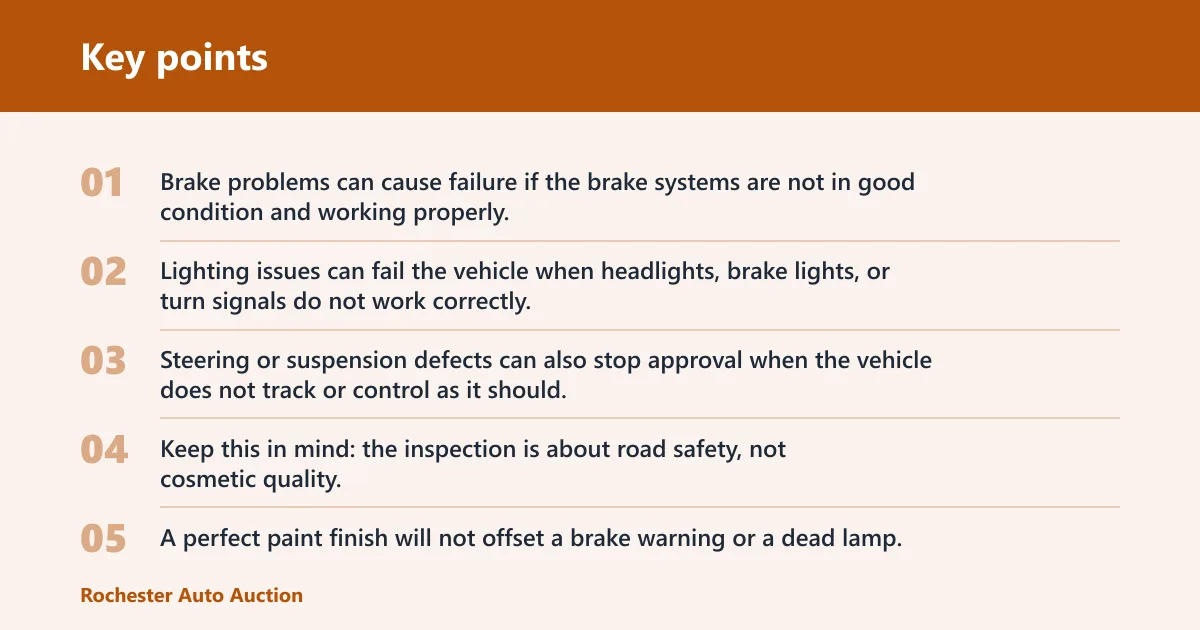
Brake problems can cause failure if the brake systems are not in good condition and working properly. Lighting issues can fail the vehicle when headlights, brake lights, or turn signals do not work correctly. Steering or suspension defects can also stop approval when the vehicle does not track or control as it should.
Keep this in mind: the inspection is about road safety, not cosmetic quality. A perfect paint finish will not offset a brake warning or a dead lamp.
Windshield, airbags, seat belts, tires, and TPMS issues
Passenger-compartment items matter too. Seat belts and airbag systems must be present and working where required. In California, a cracked windshield will cause a vehicle to fail. Worn tires or an on TPMS light can lead to failure, which is why tire condition and warning lamps should be checked before you book.
Safety caveat: follow the vehicle and product manual, never work under a vehicle held only by a jack, never exceed the vehicle’s rated roof, hitch, or tow limit, keep items out of airbag zones and the driver’s view, and check local laws before any road test or transport move.
Missing records or open recalls
Open safety recalls must be resolved before the California inspection, and a recall left open can block approval in programs that check for it. Missing or weak receipts can also cause a failure when the inspector cannot verify the repair story. If the authority asks for proof, bring the proof, not just the claim.
Suppose the headlights work, but the receipt packet only lists “front-end repair” with no part details. That may leave the inspector unable to verify what was installed. The fix is not another guess; it is a better record set.
Salvage inspection checklist
This checklist is organized in the order that usually reduces first-time failure risk: book only after the basics are confirmed, verify repairs before the appointment, then do a final 24-hour check for warning lights, tires, and road-readiness. Use it as a yes/no readiness filter, not as a substitute for local instructions.
Before booking
-
Confirm your local path.
Verify whether your state uses DMV, state police, CHP, BAR, or a station-based inspection. Ask whether a VIN check, smog test, or separate brake and lamp inspection is also required. -
Check recall status.
Look up open safety recalls and confirm whether they must be repaired before the appointment. If your program requires them closed, do not book until they are resolved. -
Gather core paperwork.
Make sure the title paperwork, repair receipts, parts records, and any required forms are complete. If the documents are thin or missing VIN detail, fix that first.
48 hours before inspection
-
Verify OEM-spec repairs.
Review the major repair areas and confirm they were completed to OEM specs or the standard your state accepts. Check body structure, brakes, lights, steering, suspension, and tires against the repair records. -
Inspect warning lights.
Start the vehicle and confirm there are no active warnings that would affect the inspection path. Pay special attention to TPMS, airbag, brake, and check-engine lights where your state checks them. -
Review glass and safety gear.
Examine the windshield for cracks that may violate your program. Confirm seat belts latch and retract properly, and verify that airbags have not been removed, bypassed, or left incomplete.
Day of inspection
-
Do a final walkaround.
Test headlights, brake lights, turn signals, hazard lamps, horn, and brake feel before you leave. If anything fails, fix it before the inspection instead of hoping for a lenient pass. -
Bring every document.
Carry the title packet, receipts, forms, and ID in a single folder. Include any referral paperwork or appointment confirmation your state requires. -
Arrive road-ready.
Make sure the vehicle starts reliably, drives straight, and has proper tire condition for the trip. Follow the vehicle manual for transport or towing rules, and check local laws before driving if your state limits travel to the inspection.
How long does a salvage inspection take? It depends on the state, station, vehicle condition, and whether the paperwork is complete. A common average cited by Wheels Away is 35.2 minutes, but that is not a promise for your appointment. Missing records or failed systems can turn a short visit into a repeat visit.
What happens on inspection day
On inspection day, the inspector may check the body structure, brakes, lights, passenger compartment, steering and suspension, tires and wheels, and any required scan or road test. Bring the vehicle exactly as it will be driven or presented for approval, with all required documents ready before you open the door.
What the inspector may check
In California, the inspection can include the body structure, brakes and lights, passenger compartment, steering and suspension, tires and wheels, an OBD scan, a safety recall check, and a road test. If your state uses a different program, the list may change, but the goal is the same: confirm that the rebuilt vehicle is safe and properly documented.
What to bring and how to present the vehicle
Bring proof of ownership, repair evidence, and any state forms. Keep the vehicle clean enough for the inspector to see key areas, but do not treat detailing as a substitute for functional repairs. A good-looking car with missing paperwork still risks a fail.
After passing, the station gives a vehicle safety report and sends the electronic certificate to DMV in California. Keep the vehicle safety report for your records. If the vehicle fails, the station must inspect all safety systems again, not only the repaired area, so a partial fix does not guarantee a quick retest.
How much does a salvage inspection cost? The price varies by station and by state. California says the cost of an inspection varies by station. Ask about the fee before you book so you can budget for a possible reinspection too.
Frequently asked questions
What is a salvage inspection?
A salvage inspection is the state or local review that checks whether a previously totaled vehicle meets the requirements to return to road use and title completion. The exact program varies. Some states focus on safety systems, while others also require VIN verification, receipts, or anti-theft checks before approval.
How much does a salvage inspection cost?
Costs vary by state, station, and vehicle type. The same source says the inspection fee varies by station. Because fees are not universal, ask the inspection site before booking and plan for another charge if a reinspection is needed after repairs.
Can I drive my salvage car to the inspection legally?
Sometimes, but only if local law allows it and the vehicle is safe enough to travel. Some states require special paperwork, plates, or transport rules. Check with the DMV or relevant authority before driving, and follow the vehicle manual and local laws if the car must be moved under its own power.
Do I need repairs completed before the inspection?
Yes. The vehicle should be repaired to the standard required by your local authority before the appointment, because the inspection is meant to confirm completion, not diagnose a long repair list. If the car fails, complete the repairs and return for reinspection under the program’s rules.
What happens after you pass a salvage inspection?
You keep the vehicle safety report, the station sends any required electronic certificate to the DMV in California, and you finish the title and registration steps that your state requires. After that, the salvage title or rebuilt title process can move forward, but only if all other paperwork is complete.
How do I know if my rebuilt vehicle needs a second inspection?
If the vehicle fails, if the state requires a separate VIN or emissions check, or if paperwork is incomplete, another inspection may be needed. The same source says the station must inspect all safety systems again after a fail, not only the repaired area. Ask the authority what must be repeated before you return.
Is a smog check also required after salvage inspection?
Sometimes. In some states, emissions testing is a separate requirement from the salvage review, and a pass on one does not satisfy the other. Confirm whether your rebuild needs a smog check, a VIN verification, or both so you do not leave registration unfinished after the inspection pass.
How long does a salvage inspection take?
Time varies by station, state, vehicle condition, and whether the paperwork is ready. A cited average is 35.2 minutes, but that is only a reference point, not a promise. Missing parts records, warning lights, or a failure can make the appointment much longer.