What Proof Do You Need to Win Auction Arbitration?
You need proof that the defect existed at sale, was material, and ties to the vehicle’s condition report, usually through photos, diagnostics, timestamps, and repair records. Without that evidence, arbitration can fail, leaving you with the car, the loss, and little chance to recover costs. This guide shows which documents matter, how to connect causation and timing, and what turns a complaint into a usable claim.
What auction arbitration decides
Auction arbitration resolves post-sale disputes under the auction’s written rules. The buyer has to fit the claim into a covered issue, file within the stated window, and submit evidence that matches the auction’s documentation standard.
The claimant carries the burden. That means you need to show the issue existed at sale, that it was material enough to matter under the policy, and that it was not already disclosed or excluded by the auction’s announcement language.
Covered disputes versus excluded issues
Most auctions cover disputes tied to material defects, title status, odometer problems, and certain disclosure failures. They often exclude wear items, obvious pre-sale damage, announced mechanical issues, or problems the buyer had a chance to inspect and accept.
That distinction matters. A bad transmission claim can hinge on whether the symptom was present before sale. A claim can fail if the paperwork already showed a branded title or salvage notation.
Why timing matters in every claim
Timing is not a side note. Arbitrators look for when the symptom first appeared, when it was documented, and when it was reported to the auction. A late inspection or a repair made before photos were taken can weaken causation.
Chronology also helps separate a sale-day defect from post-sale damage. If a vehicle was towed, driven hard, or repaired before the claim was filed, the auction may argue that the condition changed after purchase.
What documents count most
The strongest evidence is the evidence that ties the issue to the sale record. Condition reports, announcement sheets, title documents, odometer disclosures, repair orders, and inspection notes matter because they show what was known, what was hidden, and when the problem surfaced.
Condition reports and announcement sheets
The condition report is often the first document an arbitrator reads. It should be tied to the sale date and the vehicle identification number or stock number, and it may include pre-sale disclosure, damage notes, odometer reading, and as-is language.
The announcement sheet can help or hurt the claim. If it flags a transmission concern, frame issue, flood notation, or title brand, that disclosure may narrow or eliminate the issue you can arbitrate.
Title and odometer paperwork
Title documents and odometer disclosures are central in paperwork disputes. Look for title status, brand or salvage indicators, signature match, and any mismatch between the sale record and the assignment paperwork.
For odometer claims, the document trail should show the mileage stated at sale, the buyer’s disclosure, and any later discrepancy evidence. A clean paper trail matters more than a general complaint that the mileage “seems off.”
Repair orders and inspection reports
Repair orders matter when they identify the fault, the shop, the date issued, the parts and labor involved, and why the repair relates to the sale-day defect. A vague invoice that lists “inspection only” is weaker than a line-item estimate tied to a confirmed failure.
A mechanical inspection report is stronger when it includes diagnosis date, symptom description, source of the inspection, fault confirmation, and repair estimate. A report with no date or no direct link to the symptom often leaves too much room for doubt.
What proof win auction matrix
This table maps the most common dispute types to the proof that usually carries the most weight, the backup evidence that can help, and the gaps that often lead to denial. Use it as a claim-building tool, not a general checklist.
| Issue type | Best evidence | Secondary evidence | Date/time requirements | Common mistakes |
|---|---|---|---|---|
| Engine or transmission failure | Shop diagnosis with fault confirmation, repair estimate, and scan data showing the affected system | Photos of leaks or damaged parts, video of the symptom, condition report notes | Inspection date, symptom first noticed date, and report filed within the auction window | Waiting until after repairs, missing diagnosis date, no link between fault and sale condition |
| Electrical or warning-light claim | Diagnostic scan with DTC codes, freeze-frame data, and timestamped output | Video of warning lights, shop notes, battery or charging test results | Scan date and the time the warning appeared or was first observed | Submitting codes without context, no system identified, no proof the fault existed at sale |
| Body, frame, or structural damage | Photos showing visible damage, frame measurements if available, and repair estimate | Pre-sale condition report, supplement from body shop, video with stock number or VIN visible | Images should show when the damage was found and that it was present before repair | Using undated photos, failing to tie the damage to the auction sale record |
| Title defect | Title copy, brand or salvage notation, assignment records, and discrepancy evidence | Sale document, announcement sheet, dealer communication, rejected title paperwork | Dates on title issuance, assignment, and discovery of the discrepancy | Ignoring title brand language, missing signature trail, filing after the title was already transferred |
| Odometer discrepancy | Odometer disclosure form, title mileage record, and proof of mismatch | Condition report mileage, sale receipt, later mileage records, photo of the cluster if taken at pickup | Sale-date odometer disclosure and the date the discrepancy was discovered | Relying on a verbal complaint, missing sale mileage, no signature match check |
| Disclosure or announcement dispute | Announcement sheet, sale record, and condition report showing what was and was not disclosed | Photos, video, chat logs, and buyer acknowledgment form | Match the disclosure to the sale date and the specific vehicle sold | Claiming a defect that was already announced, missing the buyer acknowledgment, no sale record tie-in |
How to prove the defect existed
Proof is strongest when it connects the symptom to a specific failure, on a specific date, in a specific vehicle. That means scan data, inspection notes, and photos should all point to the same problem instead of standing alone as unrelated papers.
Diagnostic scans and DTC codes
A diagnostic scan is most useful when it shows the affected system, DTC codes, freeze-frame data, and a timestamp close to the discovery date. Codes alone are weaker if they do not match the complaint or if they were pulled long after repairs began.
A scan printout is most useful when it identifies the vehicle, the system affected, and the exact error codes. If possible, keep the full output rather than a cropped photo of a dash light, because the full record gives the arbitrator more context.
Shop inspection notes and fault confirmation
A mechanic’s report does not need to be long, but it does need to be specific. The report should say what symptom was observed, what source examined the vehicle, what fault was confirmed, and what repair is needed or estimated.
If the report comes from a dealer shop, independent shop, or laboratory source, identify that source clearly. A generic note that says “vehicle has issues” is much less persuasive than a diagnosis that names the failed component and the test used to confirm it.
Photos, video, and metadata
Photos and video are strongest when they show visible damage, the VIN or stock number, and date/time metadata. They are strongest in a before-and-after comparison, especially when the damage can be seen without guesswork.
Do not rely on images that cannot be tied to the car or the date. A picture of a broken part without context can be easy to dispute, while a dated video of the same part beside the stock tag is harder to dismiss.
Suppose the check-engine light appears on the drive home and a scan taken the same evening shows a misfire code with freeze-frame data. That is stronger than a scan taken two weeks later after the vehicle has already been repaired, because the first version better links the fault to the sale-day condition.
What you need for title and odometer disputes
Title and odometer claims live or die on paperwork. The key question is whether the sale record matches the title status, mileage disclosure, and signatures on the documents that moved with the car.
Branding, salvage, and title status
If the dispute involves branding or salvage status, the title itself is usually the first exhibit. Look for the brand notation, the assignment chain, and any mismatch between what the auction sold and what the buyer received.
When the title status was disclosed, the claim usually narrows fast. When it was not disclosed, the buyer needs clean records showing the discrepancy and the date it was discovered.
Odometer disclosure and signature match
For odometer issues, the disclosure form should match the sale mileage and the signature on the sale packet. If the numbers differ, the claim packet should show exactly where the mismatch appears and who signed what.
Signature mismatch can matter when the wrong person signed the disclosure or when the form was incomplete. Include both the sale document and any supporting record that shows the discrepancy is real, not just a clerical typo.
Discrepancy records and sale documents
Bring the title, odometer statement, condition report mileage, and sale receipt together in one packet. The goal is to show the arbitrator the gap between the sale record and the later finding without making them search for it.
A common first-timer mistake is to submit only the later DMV letter and leave out the original sale paperwork. That makes it harder to prove the mismatch came from the auction transaction itself.
How to package the claim file
A clean claim packet helps the arbitrator see chronology, causation, and materiality without sorting through unrelated pages. The best packet is short, labeled, and matched to the auction’s filing rules.
- Start with the sale record. Put the condition report, announcement sheet, title paperwork, and sale receipt at the front so the arbitrator can see what was disclosed and when the vehicle changed hands. This creates the baseline for every later exhibit.
- Attach the first proof of the problem. Include the earliest dated photo, scan, inspection note, or repair order that shows the issue. Earlier documentation usually carries more weight than material created after the claim was rejected.
- Add the causation evidence. Include the shop diagnosis, line-item estimate, DTC printout, or fault confirmation that connects the symptom to the defect. This is where the claim stops being a complaint and becomes a supported dispute.
- Mark the timeline. State when the issue was first noticed, when it was documented, and when it was reported to the auction. If the auction has a filing window, show that each date falls inside it.
- Remove weak extras. Leave out duplicate photos, unrelated invoices, and incomplete scans that do not support the defect. A narrow packet is easier to review and less likely to confuse the issue.
Match each exhibit to the rule it supports
Each document should answer a specific question. The condition report addresses disclosure, the inspection report addresses defect confirmation, the scan addresses system fault, and the title paperwork addresses ownership or mileage status.
That matching step matters when the auction denies the claim for ambiguity. If a defect was already disclosed, you need proof it was more severe or different than announced. If the auction says the issue is unsupported, you need a document that confirms it.
Avoid weak or late evidence
Late repairs are a common problem. Once a vehicle has been fixed, the original symptom can be harder to prove, and the auction may argue that the repair itself changed the evidence.
Incomplete scan data can create the same problem. A code list without freeze-frame data, system identification, or timestamp may show a warning light, but not enough about when or why it happened.
Why claims get denied
Claims fail for predictable reasons. The most common are late filing, missing paperwork, prior disclosure in the announcement, and proof that does not show causation or timing.
Late filing and missing paperwork
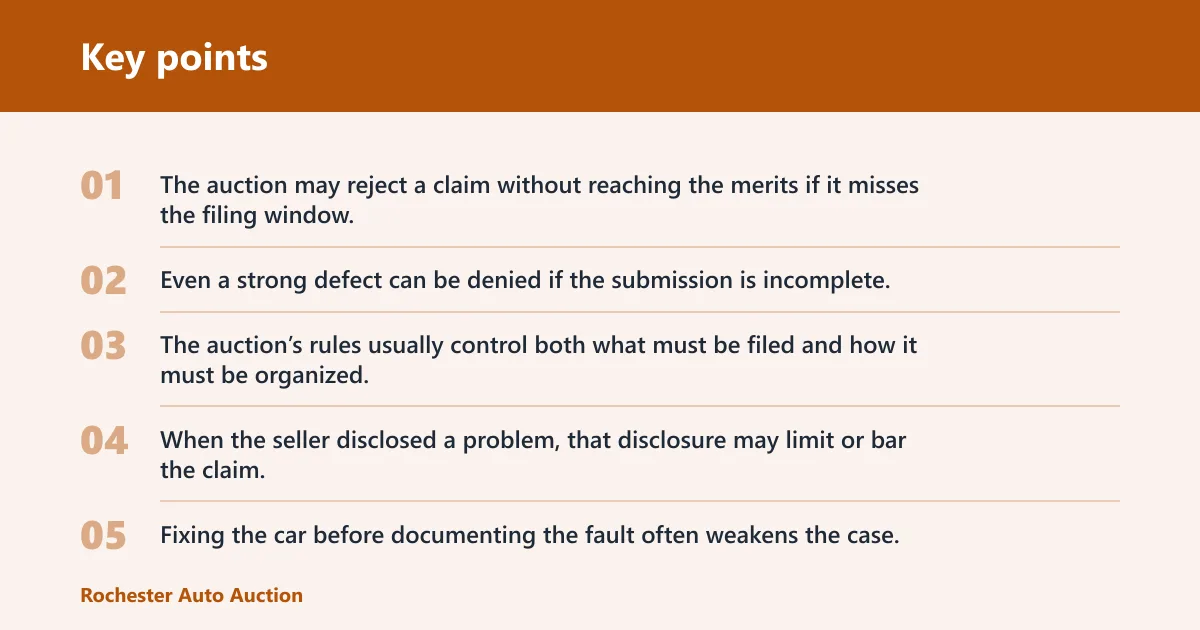
The auction may reject a claim without reaching the merits if it misses the filing window. Missing the condition report, title record, or repair estimate can cause the same result because the arbitrator has no full record to review.
Even a strong defect can be denied if the submission is incomplete. The auction’s rules usually control both what must be filed and how it must be organized.
Prior disclosure or announcement language
When the seller disclosed a problem, that disclosure may limit or bar the claim. An announcement about engine noise, frame damage, or title status can defeat a later argument that the same issue was hidden.
That is why the sale record matters so much. If the paperwork already warned the buyer, the burden shifts to proving a different defect, a larger defect, or a disclosure gap.
Repairs made before documentation
Fixing the car before documenting the fault often weakens the case. Once the part is replaced, the arbitrator may have no clean way to confirm the original failure or whether it existed at sale.
Say a buyer replaces a leaking radiator the day after pickup and only then asks for arbitration. The repair may be real, but the missing before-repair photos and diagnosis notes can make the chronology too thin to support the claim.
Frequently asked questions
What proof do I need to win auction arbitration?
You need evidence that the problem existed at sale, mattered under the auction’s rules, and was not already disclosed or excluded. The strongest packet usually combines the condition report, dated photos or video, a shop diagnosis, and a repair estimate or scan record that ties the fault to the vehicle.
What documents count as evidence in auction arbitration?
The most useful documents are the condition report, announcement sheet, title paperwork, odometer disclosure, repair order, inspection report, and diagnostic scan. The value of each document depends on whether it is dated, tied to the same vehicle, and connected to the specific issue being claimed.
Do I need a mechanic’s report for auction arbitration?
Not always, but a mechanic’s report often helps when the claim involves a mechanical defect. It becomes more important when the auction wants confirmation of the fault, the source of the diagnosis, and the cost to repair. Some title or disclosure disputes may rely more on paperwork than a shop report.
How much proof is enough for an arbitration claim?
Enough proof means enough to show causation, timing, and materiality under the auction’s policy. One document can sometimes do that, but many claims are stronger when the packet includes at least two linked forms of evidence, such as a dated photo plus a diagnosis or a title record plus a mileage mismatch.
Can I use photos, codes, or scan data as evidence?
Yes, but they work best with context. Photos should show visible damage, VIN or stock-number context, and date/time metadata. Scan data should show the affected system, DTC codes, freeze-frame data, and a timestamp. Codes alone are often too thin without a diagnosis or repair note.
What if the defect was not apparent at pickup?
That can still support a claim if you can show the issue appeared soon after sale and was documented promptly. The key is chronology: when the symptom first showed up, when it was first recorded, and whether the auction’s filing window was still open when you reported it.