What Documents Do You Need for a Salvage Inspection?
Bring the title paperwork, a government ID, the salvage or rebuilt application, repair receipts, and photos; add state forms only if your DMV requires them. Missing papers can lead to a failed or delayed inspection, another appointment, and longer title processing time. This guide separates must-have documents from state-specific items and shows the best order to hand them to the inspector.
What a salvage inspection checks
A salvage inspection checks that the vehicle identity, paperwork, and repair history match the car in front of the inspector. It does not always approve title changes by itself. In many states, the inspection is one step before a rebuilt title, so the packet should make the VIN, ownership chain, and repairs easy to verify.
The inspector is usually looking for three things: the vehicle is the same one named on the title, the paperwork shows a legal ownership trail, and the repairs appear consistent with the damage history. If any one of those is unclear, the inspection can pause even when the car is mechanically ready.
Picture a sedan with a salvage title, a 17-character VIN on the dash, and repair receipts that only show a generic “auto parts” purchase. That packet forces extra questions. A cleaner packet ties the title, VIN, and receipts together before the inspector starts checking the vehicle.
What the inspection can and cannot approve
The inspection usually confirms identity and repair compliance, not final road legality in every sense. Passing may move you to the next title step, but you may still need a separate title application, a fee payment, or a DMV review afterward. Keep inspection paperwork separate from retitling paperwork so nothing gets mixed.
Salvage packet checklist
This checklist separates the core packet from state-only items and documents that matter only in certain situations. A common order is ownership first, identity second, repair proof third, then state forms and extras. That order helps the inspector verify the vehicle without flipping back and forth through the stack.
| Document | Required everywhere | Required in some states | Bring if applicable |
|---|---|---|---|
| Salvage title or ownership document | Order 1. Why: proves the vehicle was previously branded salvage and links the title number to the VIN. Missing fallback: bring a transferable title copy, prior title record, or ownership proof; expect delay. | None | None |
| Government photo ID | Order 2. Why: lets the inspector match the signer or presenter to the application. Missing fallback: a named agent may present documents if allowed, but the owner’s ID or authorization may still be needed. | None | None |
| Application for rebuilt or salvage inspection | Order 3. Why: gives the inspector the owner, vehicle, and appointment details in the state’s preferred format. Missing fallback: complete the state form before arrival; unsigned forms often stop the inspection at the counter. | None | None |
| Repair receipts | Order 4. Why: show what parts were replaced or repaired and when the work happened. Missing fallback: assemble invoices, card receipts, salvage yard paperwork, or parts-order confirmations that name the vehicle or VIN if possible. | None | None |
| Before-and-after photos | None | Order 5. Why: some states want damage proof before repair and evidence that the repairs match the photos. Missing fallback: print dated images, shop photos, or digital copies with visible damage points and the repaired vehicle. | None |
| Bill of sale, lien release, or transfer papers | None | Order 1 or 2. Why: certain ownership chains need extra proof when the title is missing, the seller signed over the car, or a lien was recorded. Missing fallback: gather every ownership paper you have; mismatches can stall the file. | None |
| Insurance or registration paperwork | None | None | Order 6 if the state wants it for appointment entry or transport. Why: some offices need proof the vehicle can be moved or scheduled. Missing fallback: ask whether the paper is for transport, not the inspection itself. |
| VIN verification slip, weigh station slip, or other state-only document | None | Order 7 if your state names it. Why: some states use an extra identity check or weight record before title processing. Missing fallback: bring the state’s substitute form if you were told one is acceptable. | None |
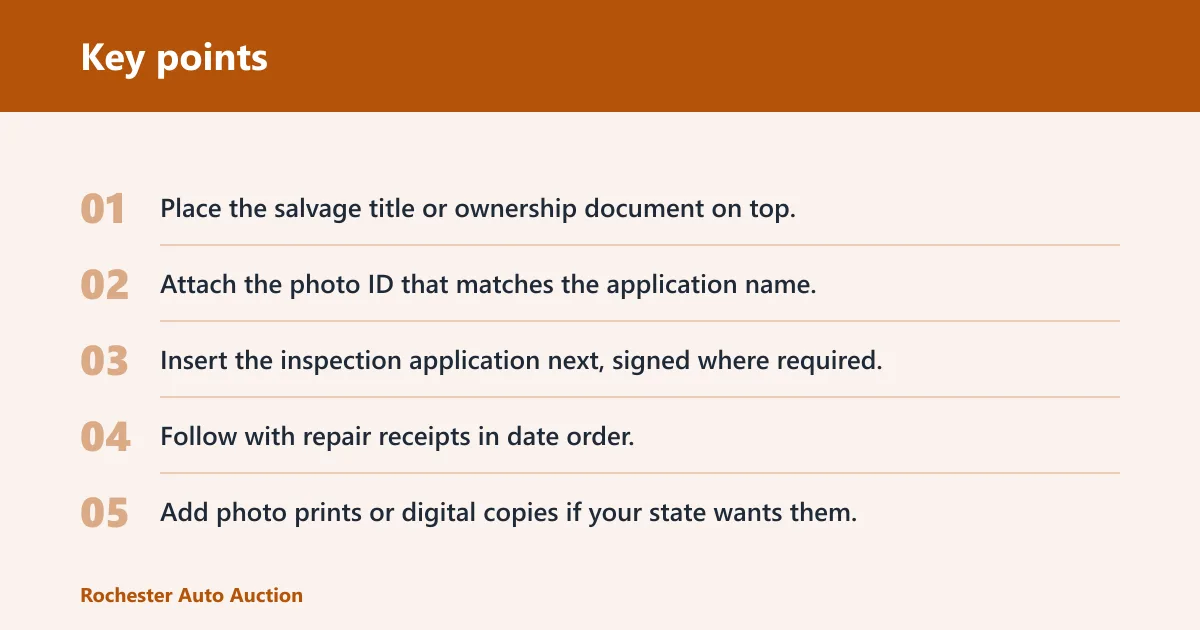
- Place the salvage title or ownership document on top.
- Attach the photo ID that matches the application name.
- Insert the inspection application next, signed where required.
- Follow with repair receipts in date order.
- Add photo prints or digital copies if your state wants them.
- Finish with any state-only slips, insurance papers, or transport papers.
Do you need the title?
Yes, the salvage title or another ownership document is usually the starting point. Inspectors use it to confirm the car was previously declared salvage and to match the title number and VIN to the vehicle presented. If the title is missing, damaged, or not branded correctly, the file may stop before inspection.
Salvage title or proof of ownership
The title should show the correct vehicle identity, including the VIN and owner information that ties back to the vehicle. Some states also look for salvage branding or a similar status mark. If the title record is incomplete, bring every ownership paper you have so the chain is easier to verify.
When a bill of sale or lien release matters
A bill of sale can help when the title is not enough by itself, especially in a private sale or an inherited vehicle situation. A lien release matters when a lender once held an interest in the car. If the ownership chain breaks, the inspector may refuse to continue until the paperwork is cleaned up.
Suppose the title lists one owner, but the seller on the bill of sale is different and no lien release is attached. That mismatch can trigger a hold even if the vehicle passed repair checks. Bring every transfer paper in the order the car changed hands.
What to do if the title name does not match
If the name on the title does not match the current applicant, fix the ownership issue before the inspection if possible. Some states allow an agent, estate representative, or co-owner to present paperwork, but that depends on the exact title situation. Do not assume a name mismatch is harmless.
Repair records and receipts
Repair receipts are commonly required and can be decisive when parts were bought used, online, or from a private seller. The inspector wants to see what was repaired, what was replaced, and whether the work lines up with the damage history. Receipts also help prove the vehicle was rebuilt from salvage in a traceable way.
Parts bought new, used, or online
Receipts are strongest when they list the part name, date, seller, and vehicle identifier. Used parts are common on rebuild projects, but loose notes are weaker than printed invoices. If a private seller handed over a bumper, door, or headlamp without a formal invoice, save the message thread, payment record, and any handwritten bill.
Labor records and dated repair entries
Labor receipts are useful when a shop performed the work, especially for structural, airbag, or electrical repairs. A dated labor entry helps show the repair happened after the damage and before inspection. If you did the work yourself, gather dated parts receipts and any written repair log you have.
How to handle incomplete receipts
Missing line items do not always end the process, but they create questions. If the receipt lacks the VIN, vehicle description, or full part name, attach whatever links the purchase to the car: order confirmation, shipping label, salvage yard record, or payment proof. Keep the explanation short and factual at the counter.
Do you need photos?
Before-and-after photos are common, but not universal. Many states want proof of the original damage and proof that the repairs were completed. If photos are required, they should show the vehicle clearly enough to connect the damage, the repair, and the final condition without guessing.
Before-and-after photos
Before photos should show the damaged areas from angles that make the problem obvious. After photos should show the repaired areas and the overall condition of the vehicle. When a state asks for both, a partial set can slow the file as much as a missing receipt.
Damage proof versus repair proof
Damage photos answer, “Why was this vehicle branded salvage?” Repair photos answer, “What changed before the inspection?” The inspector may want both. If the repair was cosmetic and the damage was heavy, make sure the photo set covers the parts that were actually affected, not just a clean exterior shot.
A common first-timer mistake is bringing only glossy finished photos of the car at a gas station. Those pictures do not prove the damaged quarter panel, headlamp, or deployed airbag was repaired. Bring the damaged state first, then the repaired state, with dates if the state asks for them.
Inspection forms and ID
The application for rebuilt or salvage inspection is the form that ties the owner, vehicle, and inspection appointment together. The exact name changes by state, and signature rules do too. Photo ID is often checked against the application and title before the inspection begins.
Application for rebuilt or salvage inspection
Expect the form to ask for owner information, vehicle details, VIN, and sometimes a place for appointment or submission notes. Some states want signatures from the owner, an authorized agent, or both. If the form includes a section for prior damage or repair certification, complete it before you arrive.
Photo ID and signer requirements
A government-issued photo ID is used to match the person presenting the packet with the person named on the application or title. The name should match closely. If the name differs because of marriage, inheritance, business ownership, or a transfer, bring the supporting ownership paper that explains the difference.
Who can bring the paperwork?
Someone else can sometimes bring the paperwork if the state allows an agent or representative. That person should carry the signed application, the owner’s authorization if required, and any ID the state asks for. If the state wants the owner present for identity verification, sending a friend alone can fail the check.
VIN and state-specific extras
The VIN is the vehicle’s main identity anchor. It must be legible on the car and match the title, receipts, and application. Some states also ask for insurance paperwork, registration papers, a VIN verification slip, or a weigh station slip before they finish the inspection or accept the packet.
VIN verification and legibility
The VIN should be the full 17-character identifier and should be readable on the vehicle. Inspectors may check the dash plate, door jamb label, or another vehicle location depending on the car and state process. If the VIN plate is damaged, altered, or hard to read, stop and resolve that issue first.
Insurance or registration paperwork
Insurance or registration paperwork is often a transport or appointment requirement, not an inspection requirement in every state. That distinction matters. Do not assume the inspector wants it if the DMV only needs it to move the vehicle legally to the site or to complete a later registration step.
Weigh station slips and other state-only items
Some states use extra slips for weight, VIN checks, or identity review. These items are state-specific and should be grouped at the back of the packet unless the local process says otherwise. If the state form asks for them, bring the exact paper requested, not a similar substitute unless the office said it is allowed.
What happens if I’m missing one document?
One missing document can delay the inspection, lead to another appointment, or require a corrected packet. The most common problem is not the lack of paper itself; it is the lack of a paper that proves ownership, identity, or repair history. Fix that category first, then reschedule if needed.
If the missing item is a receipt, substitute supporting records that connect the part to the vehicle. If the missing item is a title or lien release, stop and resolve the ownership issue before the inspection. If the missing item is a state form, complete the exact form the office uses and bring a fresh copy.
Does the salvage inspection paperwork vary by state?
State rules can change the form name, signature rules, photo requirements, and any extra slips that must be presented. The core packet usually stays the same: proof of ownership, identity, the VIN, and repair evidence. Everything beyond that should be treated as state-specific until confirmed.
Frequently asked questions
What documents do you need for a salvage inspection?
Start with the salvage title or ownership document, a government photo ID, the state inspection application, repair receipts, and any required photos. Add lien releases, bills of sale, insurance papers, or state-only slips only when they apply. The exact packet changes by state, but those core items are the usual starting point.
Do I need the title for a salvage inspection?
Usually yes. The title or another ownership document is the main proof that the vehicle was previously branded salvage and that the VIN matches the ownership record. If the title is lost or incomplete, bring any transfer papers, lien release, or ownership record that can fill the gap.
Do I need repair receipts for a salvage inspection?
Most of the time, yes, and they matter even more when parts were bought used, online, or from a private seller. Receipts help show what was repaired, when it was repaired, and whether the parts belong to the vehicle being inspected. Incomplete receipts can still help if you add supporting records.
Do I need photos before and after repairs for a salvage inspection?
Often yes, but not always. Many states want damage photos before the repair and repair evidence after the work is done. If photos are required, bring both sets and make sure they show the damaged area and the repaired area clearly enough to connect the two.
Can someone else bring the paperwork to a salvage inspection?
Sometimes. A representative may be allowed to submit the packet if the state permits an agent, but that person may need signed authorization and matching ID paperwork. If the owner must be present for identity checks or signatures, sending another person alone can cause a delay.
Do I need proof of insurance for a salvage inspection?
Not always. Insurance may be needed to move the vehicle, schedule the appointment, or complete a later registration step, but it is not part of every inspection packet. Treat it as a state-dependent requirement and keep it separate from the core ownership and repair papers.
Do I need a VIN verification or weigh station slip for a salvage inspection?
Only if your state asks for one. Some states require an extra VIN check, weight record, or similar slip before or during the title process. If that item is listed on your appointment letter or form, bring the exact document requested and place it near the front of the packet.