How Long Does ACV Take to Send the Title After Purchase?
ACV title timing depends on the title file, seller paperwork, lien status, and state processing. In straightforward cases, the handoff can move in days once ACV has the packet; when documents are incomplete or a state or lienholder step is still open, it can take days to several weeks depending on seller paperwork, liens, and state processing. This guide breaks down ACV-controlled steps, common delay points, and the fastest escalation path.
How long does ACV take?
For a clean sale with complete seller paperwork, a title can move in days once ACV has the packet in hand. When the file is complete, the full handoff is often in about 2 to 6 weeks, but missing signatures, lien releases, duplicate-title requests, or state review can push the timeline longer. State rules usually drive the longest waits.
What is the realistic day range after purchase?
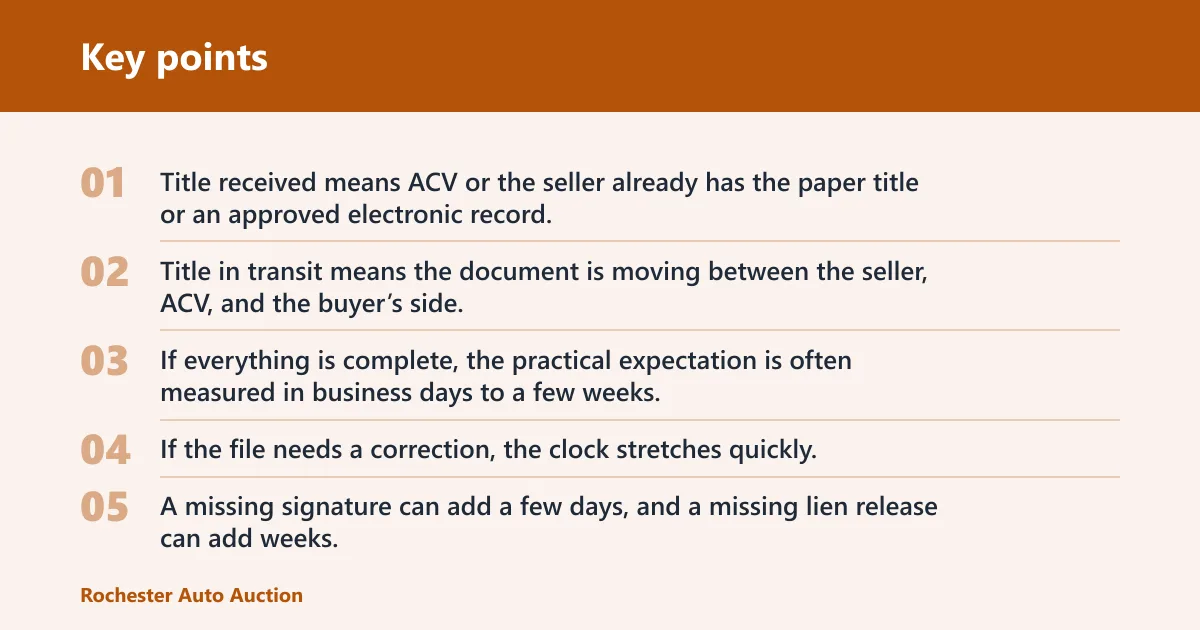
Start with three buckets. Title received means ACV or the seller already has the paper title or an approved electronic record. Title in transit means the document is moving between the seller, ACV, and the buyer’s side. Title ready for transfer means the paperwork is complete enough for assignment or release, but state processing may still be pending.
If everything is complete, the practical expectation is often measured in business days to a few weeks. If the file needs a correction, the clock stretches quickly. A missing signature can add a few days, and a missing lien release can add weeks.
When do delays stretch into weeks?
Weeks are common when ACV is waiting on a seller correction, a lienholder release, a duplicate title, or a state DMV review. The seller controls the document fix. The state controls acceptance and processing. ACV can move the file only after those pieces land in the right order.
Say a dealer buys a unit and the assignment line is blank. That one error can keep the title from being ready for transfer until the seller corrects it and resubmits the document. The delay is not tied to transport, and moving the vehicle sooner will not fix it.
What changes the timeline?
Four things usually decide whether the title moves in days or weeks: document quality, lien status, state processing rules, and whether the buyer account is approved for access. ACV’s title handling is governed by its Title Policy and Terms of Service, which should be checked for the rules that apply to your transaction. Those rules do not remove the seller’s duty to provide correct paperwork or the state’s duty to process it.
How does the ACV title process work?
ACV is a business-to-business online marketplace for eligible wholesale vehicle buyers and sellers. ACV says it does not take title to listed vehicles and is neither the buyer nor the seller in the transaction. That matters because title timing depends on what each party sends, plus any state or lienholder step still open.
What happens at purchase completion and title intake?
When a sale is completed, the title file starts moving after the transaction closes and the needed documents are available. ACV’s title-related handling is tied to its Title Policy, and the account rules in the Terms of Service control how the file is handled after purchase. The process is separate from transport.
ACV Transportation, LLC is referenced under a separate policy. Vehicle pickup can happen before the title is ready, or the title can be ready while pickup is still pending. Those are different tracks.
What does ACV control?
ACV can receive documents, route title-support requests, flag missing items, and help track status. It can also keep account access limited to approved users under its registration and account rules. ACV issues unique login names and passwords after approval, and only authorized representatives may use them.
ACV cannot force a seller to correct an incomplete assignment, and it cannot override a state DMV queue. That is why title timing varies even inside the same marketplace.
What do the seller and state control?
The seller is often the party that must send the title, sign the assignment, provide a lien release, or fix a mismatch. The state or DMV controls acceptance of the document and any new title issuance. If either side pauses, the delay lands outside ACV’s direct control.
What does ACV need before release?
ACV’s registration process can require a dealer’s license, resale certificate, federal tax identification, and Power of Attorney. Buyers and sellers are both covered by the same ACV customer terms, and buyers are bound by those terms after purchase. If account approval is incomplete, title access and support can slow down. For setup and access issues, use the account information in ACV registration and account setup or the support path in ACV post-sale support.
What documents does ACV require for dealer registration?
Registration approval depends on the account being verified with the documents ACV requires for that relationship. The exact package can change by account type, but the briefed examples include dealer credentials, resale certificate, federal tax identification, and Power of Attorney. Missing registration items can keep the account from full access.
What about dealer registration documents and title access?
Title support, login access, and account permissions depend on approved credentials and on the people authorized to use them. If registration is incomplete, the account may not have full title access. ACV’s registration rules and Terms of Service control who can act for the buyer, so missing credentials can slow support even when the title itself is otherwise ready.
Who can use the account as an authorized representative?
Only authorized representatives should access the account. If the person handling the title is not listed or approved, ACV may not act on the file until access is corrected. That protects the account, but it also means an internal handoff can create delay even when the seller’s paperwork is fine.
What do the title, assignment, and POA checks look for?
The fastest files are the ones that match across the title, assignment, buyer entity, and any Power of Attorney. A mismatch between the buyer name and the assignment can stop release. A missing or expired POA can do the same, especially if the title must be signed by an authorized dealer representative.
- Confirm the account is approved. Check that the buyer account is active, the correct dealer entity is attached, and the user viewing the file is an authorized representative. If login access is incomplete, title support may not be able to advance the file.
- Review the title packet. Look for the assigned title, seller signature, odometer statement if applicable, lien release if needed, and any POA used for signature authority. One missing page can hold the file even when the vehicle has already moved.
- Match names exactly. Compare the buyer legal name, dealership name, and assignment line character for character. If the title names do not match the sale record, ask for correction before the file reaches the state.
- Separate transport from title. If pickup is pending, do not assume the title is also pending. If the title is delayed, do not assume transport will fix it. These are separate status checks and often separate teams.
Where do title delays start?
The delay usually starts in one of three places: seller paperwork, buyer account or document issues, or DMV processing. The fastest way to fix the delay is to identify which party owns the missing step. A generic wait-and-see approach usually adds days without changing the file.
What happens with seller document problems?
If the seller has not sent the title, sent an incomplete assignment, or left a lien release pending, the seller owns the delay. The buyer should ask ACV support what exact document is missing and whether the file is waiting on a corrected title or a new release from the lienholder.
What happens with buyer account or document issues?
If the buyer’s dealer credentials are not verified, the account is missing a document, or the POA is not accepted, the buyer owns the delay. That is where registration records matter. The fix is usually to send the requested paperwork in the exact form ACV asked for, not a substitute.
What happens with state or DMV processing delays?
If the title is complete but still awaiting state issuance, the bottleneck is at the DMV or title office. That can add days or weeks depending on state rules and document acceptance. The buyer should ask whether the file is in state processing, returned for correction, or awaiting reissue.
Picture a title marked complete by the seller, but the DMV requires a duplicate-title request because the original was lost. The vehicle may already be on the lot, yet the title cannot transfer until the state finishes its work. The car moves faster than the paper.
How do you use the title delay triage table
Use this table to identify who owns the delay, what proof to check, and the fastest next action. If the issue appears in more than one row, start with the first missing item and fix that before asking for an escalation. For status changes after a sale, keep the title file and transport file separate unless the support team confirms they are linked.
| Issue type | Likely owner of the delay | What proof to check | Fastest next action |
|---|---|---|---|
| Missing POA | Buyer docs | Account file, POA upload status, signature authority record | Send the correct POA and confirm it matches the approved representative |
| Incomplete assignment | Seller | Front and back of title, assignment line, seller signature blocks | Ask ACV to route a seller correction request and hold release until corrected |
| Lien release pending | Seller or lienholder | Lien release letter, payoff confirmation, title brand notes | Request the release status and ask for the lender’s expected turnaround |
| Account not verified | Buyer docs | Dealer’s license, resale certificate, federal tax identification, approved user list | Finish registration and verify access for the authorized representative |
| Wrong buyer name | Buyer docs or sale record | Invoice, account legal name, assignment line, entity name | Send the corrected entity record before the title is sent to the state |
| Seller has not sent title | Seller | Open status note, seller follow-up record, missing-document notice | Ask ACV to confirm whether the seller or the state is holding the file |
| Duplicate-title request | DMV/state | Duplicate request receipt, state filing confirmation, case number | Wait for the state case to clear and request the filing reference number |
| Transport hold | ACV Transportation, LLC or logistics partner | Pickup status, dispatch note, carrier update | Do not treat it as a title issue; contact transport separately and keep title support in the loop if needed |
| State title processing | DMV/state | State receipt, processing status, returned-mail notice, rejected filing note | Ask for the state status and whether the file needs a corrected submission |
What is the numbered checklist after the triage table
Use the checklist in order. It moves from account access to document review to the exact owner of the delay, which makes it easier to route the file to the right queue the first time.
- Check the account status. Look for labels such as title received, title in transit, ready for transfer, pending seller document, pending buyer document, or state processing. Those labels tell you where to aim the next message.
- Gather proof before sending. Attach the invoice, title images, assignment page, lien release, or POA as needed. If the issue is a name mismatch, include the exact legal name from the dealer record.
- Escalate by issue type. Send seller-document problems to title support for seller follow-up, buyer-document problems to the registration side, and state-processing problems to the status owner who can confirm the filing.
- Separate transport from title. If the vehicle has not been picked up, do not wait on transport to solve a title delay. If the vehicle is already delivered, do not treat that as proof the title is complete.
Who do I contact at ACV if my title is delayed? Start with ACV title support and give the sale number, document issue, and the exact status you see in the account. If the delay is tied to transport only, contact the transportation side instead. The fastest path depends on the owner of the delay, not on the age of the sale.
Frequently asked questions
How long does ACV take to send the title after purchase?
Most ACV titles often arrive in about 2 to 6 weeks after payment and seller delivery, but missing signatures, lien releases, duplicate-title requests, or state processing can stretch that to about 30 to 60+ days. If the file is complete, the shorter end is possible; if paperwork is missing, expect the longer end.
When does ACV start title processing after a sale is completed?
ACV starts once the sale is completed and the title file can be intake-ready, which means the needed seller and buyer paperwork is in place. If the seller still owes a title or correction, the process pauses there. The clock does not really start moving until the missing item appears.
What documents does ACV need before it can release a title?
ACV can require approved registration documents such as a dealer’s license, resale certificate, federal tax identification, and Power of Attorney. For the title itself, the file also needs the proper assignment, any seller signature, and a lien release if the title is not free and clear.
What happens if the seller hasn’t sent the title yet?
If the seller has not sent the title, the delay belongs to the seller side of the transaction. Ask ACV to confirm whether the file is waiting on the original title, a corrected assignment, or a lienholder release. Until that item is received, the title cannot move to release.
Who do I contact at ACV if my title is delayed?
Contact ACV title support first and provide the sale number, current status, and the exact missing document if you know it. If the hold is really transport-related, contact the transportation side separately. That keeps the title request focused on the right queue.
What is the difference between title release and vehicle pickup on ACV?
Title release is the paperwork side; vehicle pickup is the logistics side. A vehicle can be picked up while the title is still pending, and a title can be ready even if pickup has not happened. Do not use one status as proof of the other.
Does ACV provide title-support services or is it the seller’s responsibility?
ACV provides related title-support services, but the seller may still be responsible for delivering, correcting, or signing the title documents. ACV’s Title Policy and Terms of Service control how the file is handled. The practical answer is shared responsibility, with each party owning its own part.
What should I do if the title name or assignment is wrong?
Stop the transfer and ask for a correction before the file is sent onward. A wrong buyer name or incomplete assignment can block state acceptance and add weeks. Send the exact legal entity name and a clear image of the problem so the correction request is precise.
How do ACV title policies affect buyers after purchase?
ACV’s Title Policy, along with the Terms of Service, sets how the file is handled after purchase. Buyers are bound by those terms, and the policy may set expectations for document handling, support steps, and exceptions. That is why buyers should check the policy when timing changes.