How Much Does a Salvage Inspection Cost?
A salvage inspection has no single fixed price. In Alberta, your total should include the inspection fee, the Request for Vehicle Inspection form, a possible reinspection, and any repairs needed to reach pass status. If the vehicle misses a required item, towing, storage, and lost time can push the total up fast.
In Alberta, the fee is not provincially fixed. Each licensed inspection facility sets its own price, and the shop may charge separately for the first inspection and for a reinspection after a failure. So the quoted fee is only part of the out-of-pocket cost.
Factors that affect inspection fees
How Alberta salvage inspections are priced
Alberta does not publish one mandatory salvage inspection rate. Licensed inspection facilities set their own fees, and they must post pricing where customers can see it. The province also suggests phoning several licensed facilities before booking, because inspection and reinspection prices can differ from shop to shop.
What the quoted fee usually covers
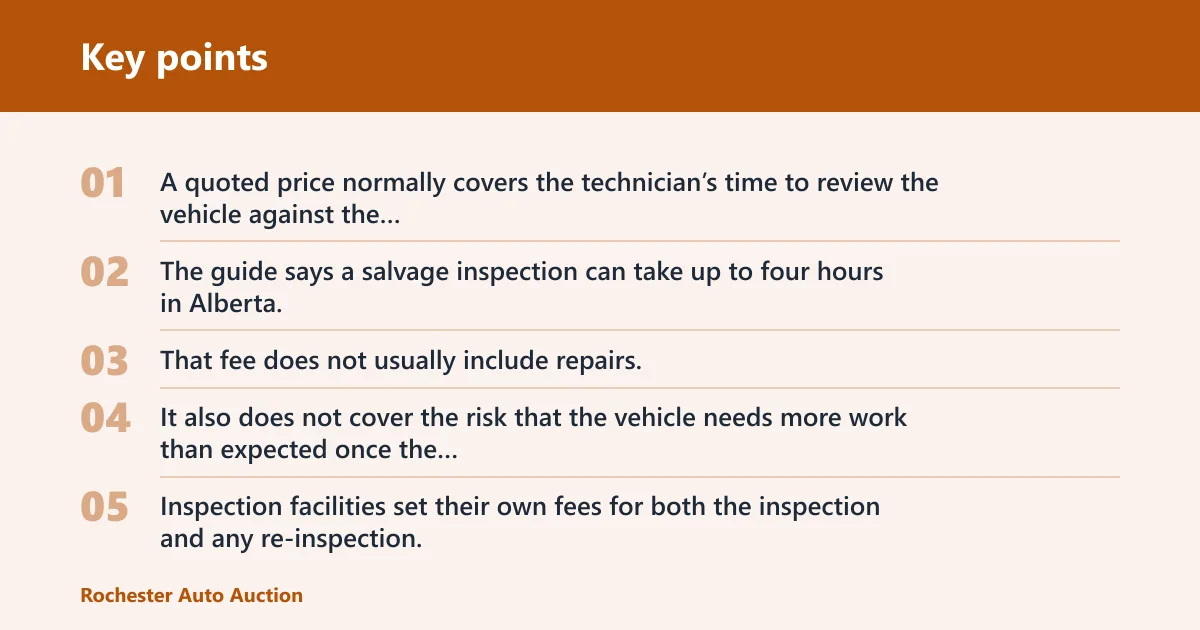
A quoted price normally covers the technician’s time to review the vehicle against the Alberta reject standard, inspect the structural repair work, and check mechanical condition. The guide says a salvage inspection can take up to four hours in Alberta, so labor time is a real cost driver even when the shop posts a simple flat fee.
That fee does not usually include repairs, the form you must buy before the shop can begin, or any return visit after a fail. It also does not cover the risk that the vehicle needs more work than expected once the inspector checks the manual item by item.
Why inspection and reinspection fees can differ
Inspection facilities set their own fees for both the inspection and any re-inspection. A reinspection may cost less than the first visit, but it may also cost the same or more, depending on the shop’s policy. The key point is that the second visit is not automatically free.
Inside Alberta’s 10-day window, the reinspection only covers the rejected items. If the vehicle misses that window, Alberta requires a full new inspection, which can reset the cost model completely.
What to budget for paperwork and repair contingency
The Request for Vehicle Inspection form must be purchased before the shop can start. That is a separate paperwork cost, and it is required in the salvage inspection workflow. For a real budget, add a repair reserve too, because the inspection checks both structural repair and mechanical condition.
A common first-timer mistake is to budget only for the first visit and the obvious body repairs. Say your SUV needs bumper brackets, a rear lamp, and one tire, but the inspector also rejects a warning lamp and a bent wheel. The repair line grows quickly, and the reinspection fee becomes another separate line item.
What the inspection includes
An Alberta salvage inspection is more than a basic safety check. The guide says technicians verify structural repair and mechanical condition, using the Automotive and Light Truck Vehicle Inspection Manual as the pass/fail standard. The result is documented on a Record of Inspection whether the vehicle passes or fails.
Required paperwork before the shop starts
You must buy the Request for Vehicle Inspection form from a registry agent before the shop can begin. Alberta also requires a Rebuilt Vehicle Work Plan for salvage inspection. That work plan documents the repairs performed and helps the inspector verify structural repair work.
- Buy the Request for Vehicle Inspection form from a registry agent.
- Gather the Rebuilt Vehicle Work Plan and repair records.
- Confirm the inspection facility is licensed and has posted pricing.
- Book the inspection and ask whether reinspection pricing is separate.
- Keep the Record of Inspection if the vehicle passes or fails.
Structural repair verification and the manual
The Alberta guide uses the Automotive and Light Truck Vehicle Inspection Manual as the reject-condition standard. That means the technician is not guessing. Each item has pass/fail criteria, and the inspector checks whether the vehicle has been repaired to meet those criteria.
If the repairs involve structural work, the Rebuilt Vehicle Work Plan matters because it shows what was repaired and how. That documentation helps the inspector connect the completed work to the damaged areas the vehicle had after the salvage event.
Record of Inspection and timing after pass or fail
The Record of Inspection is issued whether the vehicle passes or fails. If the vehicle fails, that record starts the timing for repairs and reinspection. If it passes, the certificate must be presented to a registry agent within 14 days.
A passed salvage inspection changes the vehicle status from salvage to rebuilt, and the rebuilt brand stays on the vehicle record for the rest of its life. That long-term brand is part of the cost decision, because it can affect resale value even after the repair bill is paid.
Salvage inspection budget worksheet
This worksheet gives you a simple way to estimate a low, expected, and worst-case total before you book. Use the inspection quote from the facility, then add the form cost, a possible reinspection fee, and a repair reserve. If your total exceeds the vehicle’s value by a wide margin, the repair may not be the better choice.
| Line item | Low | Expected | Worst case |
|---|---|---|---|
| Inspection fee | $_____ | $_____ | $_____ |
| Request for Vehicle Inspection form | $_____ | $_____ | $_____ |
| Reinspection fee | $0 | $_____ | $_____ |
| Repair contingency | $_____ | $_____ | $_____ |
| Total estimated cost | $_____ | $_____ | $_____ |
| Pass/fail decision threshold | Proceed only if your expected or worst-case total stays below your budget cap and below the vehicle’s likely post-repair value. | ||
Use the low column only when the vehicle needs no extra repair work and passes on the first visit. Use the expected column when you think one or two small fixes may be needed. Use the worst-case column when the car has visible structural damage, repeated warning lamps, or signs of hidden mechanical work.
What can make a salvage car fail inspection?
Common fail items include brake problems, lighting faults, tire issues, rust, and warning lamps that stay on. The VIN plate can also end the inspection if it is missing, damaged, or appears to have been tampered with, and the vehicle should match the Request for Vehicle Inspection form.
VIN plate and identity problems
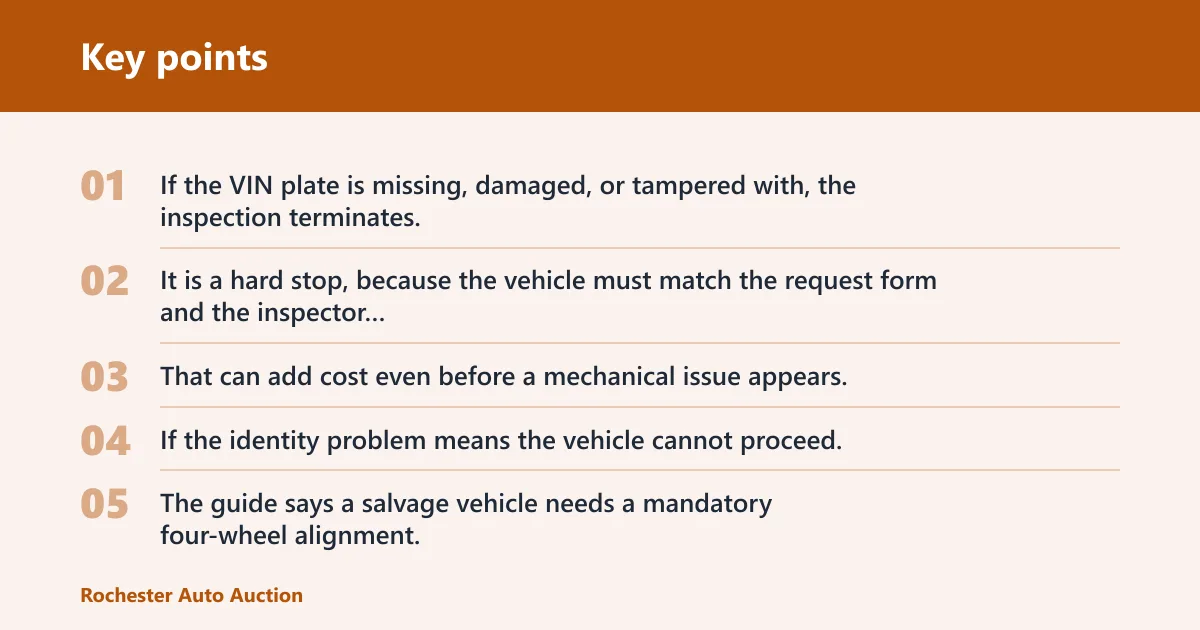
If the VIN plate is missing, damaged, or tampered with, the inspection terminates. That is not a minor note on the report. It is a hard stop, because the vehicle must match the request form and the inspector needs an unbroken identity trail from paperwork to vehicle.
That can add cost even before a mechanical issue appears. If the identity problem means the vehicle cannot proceed, you may still be out the paperwork fee and the inspection fee, and you may need towing to a different facility or back to a repair shop.
Alignment and collision-related findings
The guide says a salvage vehicle needs a mandatory four-wheel alignment. It also says a four-wheel alignment is commonly required on out-of-province vehicles when collision damage or signs of abnormal wear are present. If the wheels are out of spec, the car can fail even when the body panels look finished.
Suppose a compact sedan has had front-end repairs after a collision. The bumper fits, the lamps work, and the airbag light is off, but the alignment printout shows the steering wheel is off-center and one tire shows abnormal wear. That can send the vehicle back for more work and another fee.
What happens after a failed inspection?
If the vehicle fails, you have 10 days to complete repairs and return for reinspection. Inside that window, the reinspection only covers the rejected items. If you miss the window, Alberta requires a full new inspection, which can mean paying the inspection fee again.
Do you pay again for a reinspection?
Usually, yes, you should expect another charge of some kind. Alberta says inspection facilities set their own fees for both the inspection and any re-inspection, so the second visit is a separate budget item. The amount may be lower than the first fee, but it is not guaranteed.
Which rejected items can be retested?
Only the items that were rejected are covered when you return inside the allowed window. That makes the first fail report important, because it tells you exactly what the inspector wants corrected before the next visit. Fixing extra items is smart only if they are close to failing already.
Keep the Record of Inspection with the vehicle file. It is the document that helps track the repair and reinspection timing, and it proves which items were rejected on the first visit. Without that paper trail, the process can slow down and cost more.
When repair costs outweigh the vehicle’s value
The simple test is whether the total repair bill, inspection fees, and likely reinspection costs stay below the vehicle’s market value after it is rebuilt. If the numbers do not work, the rebuilt brand may not be worth the money, even if the vehicle could pass.
That brand stays on the record for life. For some vehicles, that is acceptable. For others, especially high-mileage or low-value cars, the combination of repair work and long-term resale hit makes scrapping the lower-risk choice.
Picture a pickup with frame repair, two damaged wheels, and multiple lamp faults. If the quote for body and mechanical work already pushes near the truck’s post-repair value, a salvage inspection becomes part of a larger financial decision, not just a compliance step.
Frequently asked questions
How much does a salvage inspection cost in Alberta?
Alberta has no fixed provincial price for salvage inspections. Licensed inspection facilities set their own fees, and they can price the inspection and reinspection separately. Ask several licensed shops by phone before booking, then add the form cost and a repair reserve to get the real total.
How much does a salvage inspection cost in PA?
This guide is Alberta-focused, so it does not give a verified Pennsylvania price. Pennsylvania readers should budget by local shop quote, paperwork, and any reinspection fee. The safest starting point is the same: ask a few licensed facilities what their inspection, paperwork, and retest charges are.
How much does a salvage title inspection cost?
The cost depends on the jurisdiction and the shop. In Alberta, the fee is set by each licensed inspection facility and can differ for the first inspection and reinspection. The real budget should also include the required form and any repair work needed before the vehicle can pass.
What does a salvage inspection include?
In Alberta, the inspection checks structural repair and mechanical condition against the Automotive and Light Truck Vehicle Inspection Manual. The process also requires the Request for Vehicle Inspection form, the Rebuilt Vehicle Work Plan, and a Record of Inspection whether the vehicle passes or fails.
Do you pay again if your salvage inspection fails?
Usually, yes. The same source says facilities set their own reinspection fees, and the second visit may cost differently from the first. If you return within the 10-day window, the reinspection covers only the rejected items. Miss that window, and Alberta requires a full new inspection.