Salvage Inspection: How It Works and How to Pass
A salvage inspection passes when the vehicle’s identity matches the paperwork, required safety equipment is present and functional, and the repaired car meets your state’s inspection checklist. Miss one of those and you can lose time, pay repeat fees, or get stuck with a delayed rebuilt-title application. This guide covers the inspection sequence, the documents to gather, and the most common pass-fail problems, in the order you should tackle them.
What salvage inspection
A salvage inspection is a state process used to confirm that a repaired total-loss vehicle is safe enough and correctly identified before it can move into rebuilt or revived status. The exact agency, form set, and test items vary by state, so you need your own DMV rules before you plan the work.
Salvage title vs. rebuilt title
A salvage title generally means the vehicle was declared a total loss. In many states, that branding keeps it out of normal registration until you clear the state’s repair and inspection steps. A rebuilt title is typically the later status issued after the vehicle passes inspection and the registration steps that follow; the salvage history usually remains attached.
State branding can differ after that first salvage label. Some states use terms such as rebuilt or revived salvage, and some separate repairable from non-repairable or junk branding. The label on the record matters because it affects what process you must follow next, and whether the vehicle can return to road use at all.
Why states require an inspection
States use the inspection to check that the repaired vehicle is not hiding identity problems or unsafe repairs. The goal is not to re-grade every body panel. It is to verify that the car in front of the inspector matches the paperwork, has the required safety equipment, and does not show obvious defects that make road use unsafe.
How branding affects registration
Branding affects the next legal step. A salvage title by itself usually does not let you register and drive the vehicle in normal status. After a pass, the vehicle can move toward rebuilt or revived registration, but the process is state-specific and the salvage record remains in the title history.
Check your state rules first
Start with your own DMV or equivalent agency. Salvage inspection rules vary by state, and the inspection may be handled by a DMV office, state patrol, motor vehicle safety unit, emissions program, or another agency. If you follow the wrong process, you may complete repairs that do not satisfy the actual form set.
Which agency handles the inspection?
Do not assume the title office is the inspection office. Some states split identity checks, safety checks, and final title issuance across different departments. Others require a private inspection station for part of the process and a DMV handoff for the final step. The agency name on the form controls the workflow.
How to confirm the correct forms and appointment steps
Use your state’s salvage or rebuilt title page, then confirm three items: the form number, the appointment method, and whether the vehicle must be present for the first inspection. If the state uses a staged process, get every part of the sequence before you book towing or a return visit.
If the state wants photos and receipts before it schedules the inspection, file those first. That changes the repair order, and it can change which parts you fix before the first appointment. Submit the documents, then set the visit, then finish anything the state wants verified in person.
What inspectors check
Most salvage inspections break down into identity, safety equipment, and paperwork. Identity checks verify that the vehicle is the one described on the documents. Safety checks look for functional equipment and obvious defects. Paperwork checks confirm that your repair story is supported by records, photos, and the correct state forms.
Identity and VIN
The inspector confirms that the VIN and other identifiers match the vehicle and the paperwork. On major parts, some states or inspection programs may also want proof that serial numbers or VINs align with the vehicle record. Missing or mismatched identification can stop the process before safety items are even reviewed.
Safety systems and roadworthy parts
Inspectors commonly look at airbags, seat belts, brakes, lights, tires, steering, suspension, and body structure. The exact list changes by state, but these are the recurring areas. A visible defect, warning light, poor operation, or missing component can move the vehicle from pass to fail quickly.
Paperwork and repair proof
Bring receipts, invoices, parts records, and before-and-after photos. If your state asks for proof tied to major components, keep that too. The file should show what was replaced, what was repaired, and where the parts came from. A clean folder helps the inspector and helps you if the first visit ends in a fail.
California and Nevada examples
California and Nevada show why salvage inspection is not one national template. California uses a vehicle safety systems inspection for revived salvage vehicles before DMV registration. Nevada uses a VIN inspection in the salvage-to-rebuilt path, with separate form steps. Do not copy either process into another state without checking your own rules first.
California safety systems inspection items
California’s revived salvage process requires a vehicle safety systems inspection before DMV registration. The inspection covers body structure, brakes and lights, passenger compartment, steering and suspension, and tires and wheels. California also includes an on-board diagnostics scan, an open recall check, and a road test. (CA)
California says open safety recalls must be resolved before the inspection, and improper repairs must follow OEM repair specifications. It also says a cracked windshield will cause failure. Seat belts and airbag systems must be present and working, and a TPMS light that is on can lead to failure.
Nevada VIN inspection and Form VP-64 path
Nevada’s salvage-to-rebuilt process typically includes a VIN inspection before final title issuance. In the Form VP-64 flow, Part I is completed at the safety inspection and Part III is completed by the DMV for the VIN inspection. That split matters because the inspection station and the DMV do different jobs.
What to verify before you copy either process
Check whether your state wants the car inspected before the title handoff, after a safety station visit, or in a separate DMV appointment. Also confirm whether the vehicle can be driven, must be towed, or can be trailered. Do not assume California or Nevada timing matches your state.
Follow the vehicle and repair manual, never work under a vehicle held only by a jack, never exceed the vehicle’s rated roof, hitch, or tow limit, keep items out of airbag zones and the driver’s view, and check local laws.
Salvage inspection readiness matrix
This matrix gives a pass-first view of the most common inspection areas. Use it to sort failures into identity, safety, or paperwork problems before you schedule the visit. One missing document can be just as fatal as one warning light.
| Inspection area | What inspectors verify | Most common failure symptom or missing proof |
|---|---|---|
| Identity / VIN | VIN matches the vehicle, title, and state records; major parts may need matching proof where required | Mismatched VIN, missing plate, altered stamping, or paperwork that does not match the car |
| Airbags | Airbag system is present and working | Airbag warning light on, missing module, deployed bag not correctly repaired |
| Seat belts | Belts retract properly and lock when pulled sharply | Stuck retractor, torn webbing, belt that will not lock or buckle cleanly |
| Brakes | Brake system works properly and shows no obvious safety defect | Spongey pedal, warning lamp, poor stopping performance, visible leaks |
| Lights | Required exterior lights operate correctly | Dead headlamp, broken brake light, turn signal fault, lens damage that affects function |
| Tires | Tires and wheels are safe, matched to the vehicle’s needs, and free of obvious defects | Worn tread, damaged sidewall, bent wheel, TPMS light on in California guidance |
| Steering / suspension | Vehicle tracks, steers, and supports weight without dangerous play or damage | Pulling, loose steering feel, damaged control parts, clunks, uneven stance |
| Body structure | Unibody or frame repairs follow the state’s structural standard and OEM repair specifications where required | Visible crash distortion, poor welds, misaligned panels, non-OEM repair method |
| Recalls | Open safety recalls are cleared where the state requires it | Unresolved recall record or no proof the recall repair was completed |
| OBD scan | Diagnostic scan shows no blocking fault for the inspection program that uses it | Check-engine light, communication fault, unresolved module codes |
| Paperwork | Receipts, invoices, forms, and repair photos support the rebuild claim | Missing repair records, no before-and-after photos, unsigned state form, incomplete parts proof |
How to prepare the car and file
Finish repairs before you book the inspection. That sounds basic, but it is the fastest way to avoid repeat fees and a second appointment. The car should be as close to finished as possible when you start the paper trail, especially if your state wants photos or proof of major repairs.
Build a pre-inspection document stack
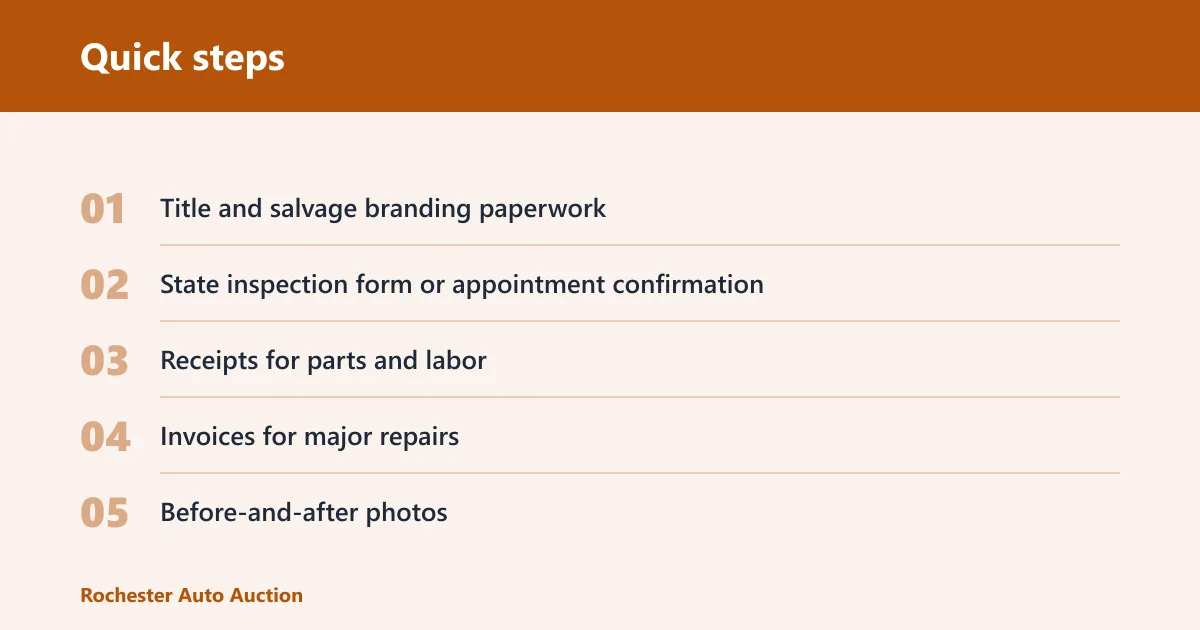
Put the file in this order so you can hand over the important pieces quickly:
- Title and salvage branding paperwork
- State inspection form or appointment confirmation
- Receipts for parts and labor
- Invoices for major repairs
- Before-and-after photos
- Parts records or serial-number proof when the state asks for it
- Any recall completion proof
MyAirbags advises collecting receipts, before-and-after images, and state forms. That is the right core stack for most rebuilders. If your state wants extra proof for airbags or other safety parts, keep that with the main packet rather than scattered across multiple folders.
Check recalls, warning lights, and basic operation
Clear open safety recalls before the California inspection. If the airbag light is on, treat it as a fail risk until the system is diagnosed and repaired. If the TPMS light is on, deal with the tire or sensor issue before the visit. If the windshield is cracked, replace it before you expect a pass in California.
A common first-timer mistake is to bring a car that looks finished but still has one active warning lamp. If the brake repairs are complete, the lights work, and the car runs clean, but the airbag light stays on, that single lamp can turn a good-looking rebuild into a failed inspection.
Use OEM repair specifications for the critical repairs
The same source says improper repairs must follow OEM repair specifications. That matters most for structure, airbag systems, restraints, and brakes. If a repair method is not supported by the original equipment manufacturer standard, the inspector may treat the work as incomplete or unsafe.
That warning also applies to mixed parts and patchwork fixes. A structural repair that looks neat but was done with the wrong procedure can still fail. Keep the repair record clear enough that someone else can trace what was done and what parts were used.
Why cars fail inspection
Most failures fall into three groups: a safety defect, a paperwork gap, or an identity mismatch. If you sort the problem early, you can focus on the right repair instead of guessing. A fail does not always mean major damage is left; sometimes it means one light, one form, or one missing receipt.
Common safety failures
Common safety failures include a brake problem, a dead light, a seat belt that does not retract or lock, an airbag warning light, an open recall, or a cracked windshield where California guidance says the vehicle fails. Tire and wheel issues also matter, especially if the TPMS light is on under California rules.
Missing or weak proof of repair
If the vehicle is repaired but the file is thin, the inspection can still fail. Missing invoices, no before-and-after photos, or no proof for major parts are common problems. If your state wants VIN or serial-number proof for parts, include it before the appointment rather than after a rejection.
Identity or paperwork problems
VIN mismatch is a hard stop. So is a title or form that does not match the vehicle. MyAirbags notes that VINs must match on all parts, and that airbag warning lights can result in failure. Even if the bodywork is sound, the wrong record details can block the rebuild path.
A sedan can have a new bumper cover, a repaired front crash bar, and working headlights, then still fail because the replacement module paperwork does not match the VIN on the car. The fix is not another body repair. It is a corrected file and the right proof for the part change.
How do I get a salvage inspection after repairs?
Finish the repairs, then identify the correct state agency and inspection form. Next, assemble the repair file, schedule the appointment, and make sure the car is in the exact condition your state allows for presentation. If your state uses a staged process, follow that sequence rather than guessing.
Practical ordering for the appointment
1. Confirm the title brand and the exact inspection path.
2. Check whether the inspection is by DMV, police, state patrol, or a private station.
3. Gather receipts, photos, and the state form.
4. Fix any warning lights, recall items, cracked glass, or obvious safety defects.
5. Schedule the appointment only after the car and file are ready.
Can I drive a salvage car to the inspection legally?
Maybe, but that depends on your state and on the vehicle’s current legal status. Some states allow limited movement to an inspection appointment, some require a tow or trailer, and some have restrictions tied to insurance, registration, or temporary permits. Confirm your local rule before you drive the car anywhere.
If the vehicle is not legally registered for road use, do not assume a trip to the inspection station is allowed. Check whether the state permits direct travel to the inspection site, whether a permit is required, and whether the inspector expects the car to arrive by trailer. Follow local laws.
How long does a salvage inspection take?
The time varies by state, agency, and whether the paperwork is already complete. A clean identity check with a short safety review may move quickly, while a vehicle with missing forms, warning lights, or a VIN issue can take much longer. The schedule also depends on appointment load.
Plan for more than the inspection slot itself. You may need time for intake, photo review, an OBD scan where required, a road test where required, and a return trip if anything fails. If the state handles title handoff separately, add that trip too.
How much does a salvage inspection cost?
The fee depends on the state and the agency that performs the inspection. Some states charge one inspection fee, some split the process into multiple paid steps, and some add separate charges for VIN verification, title work, or retesting. Check the current fee schedule before you book.
If the inspection fails, ask whether the state charges again for the reinspection. That detail matters because a cheap first visit can turn into a more expensive process if you arrive with avoidable problems. The price is part of the plan, not an afterthought.
What happens after a salvage vehicle passes inspection?
After a pass, the inspector or agency issues the required report or approval step, and you move to the DMV or title office for the next stage. In many states that means rebuilt or revived-title processing, registration work, or both. The salvage history stays on the record.
Keep the pass paperwork with the title file. If the state wants a separate submission, send it promptly so the title and registration steps do not stall. If the vehicle later changes hands, the branded history remains part of the record even after the rebuild is complete.
Frequently asked questions
What does a salvage inspection check on a rebuilt car?
It usually checks identity, safety, and proof of repair. Inspectors look for a matching VIN, functional brakes and lights, working airbags and seat belts where required, safe tires and steering, and the paperwork that supports the rebuild. Some states also add recalls, OBD checks, and a road test.
What documents do I need for a salvage inspection?
Bring the salvage title or brand paperwork, the state inspection form, repair receipts, invoices, before-and-after photos, and any parts proof the state asks for. If the state wants recall completion evidence or VIN proof for major components, add that to the stack before the appointment.
Why do salvage vehicles fail inspection?
They fail for safety defects, missing paperwork, or identity problems. A lit airbag lamp, bad brakes, cracked windshield, open recall, TPMS issue, missing receipt, or VIN mismatch can stop the process. In many cases, the fix is specific and straightforward once you identify which bucket failed.