How Long Do You Have to File Auction Arbitration After Purchase?
Many auto auctions require arbitration within about 24 hours or by the next business day after purchase, though the exact deadline depends on the posted house rules. Miss it, and you can lose the right to claim a misrepresentation, condition issue, or title problem. This guide explains how to count the deadline, where auction rules differ, and what to do when the window is almost closed.
Auction arbitration deadline basics

Arbitration has a deadline. That deadline is the auction house’s time limit for submitting a claim after purchase, and it may be measured in hours or business days. The number is not universal, so start by checking the house rules, the sale type, and the exact trigger date before you do anything else.
What the arbitration window means
The arbitration window is the filing period for a buyer to raise a defect, title issue, or other covered dispute. It usually takes more than a phone call. The buyer must submit the auction’s arbitration claim form before the deadline expires, and supporting documents often need to match the sale record.
That window may be short. Some auctions use about a 24-hour clock. Others use a next-business-day rule. A few sale types set different time limits for in-lane, online, simulcast, or dealer block purchases.
Why the deadline changes by house and sale type
Auction house rules control the filing period, not the buyer’s preference. Sale format can also change the rule. In-lane sales may follow one timeline, while online or simulcast sales may use another. Dealer block transactions can carry their own filing steps and exclusions.
Announcements matter too. A vehicle condition report, sale announcement, or AS-IS statement can narrow what qualifies for arbitration. If the issue was announced before sale, the claim may not be valid even if the buyer files on time.
What a buyer should confirm first
Before you count any deadline, confirm three points: the sale date, the auction’s filing rule, and whether the issue is covered. Look for the arbitration time limit, the accepted filing method, and any note about announcements, prior damage, or title status.
If the paperwork is unclear, contact the auction office right away. That is the safest move when the window is short.
When does the clock start?
The clock usually starts on the sale date, rather than the pickup date or delivery date. For many auctions, the trigger is the time of sale on the invoice or run list. Online and simulcast sales may use the close of bidding, payment time, or another posted trigger, so the exact rule matters.
Sale date versus pickup date
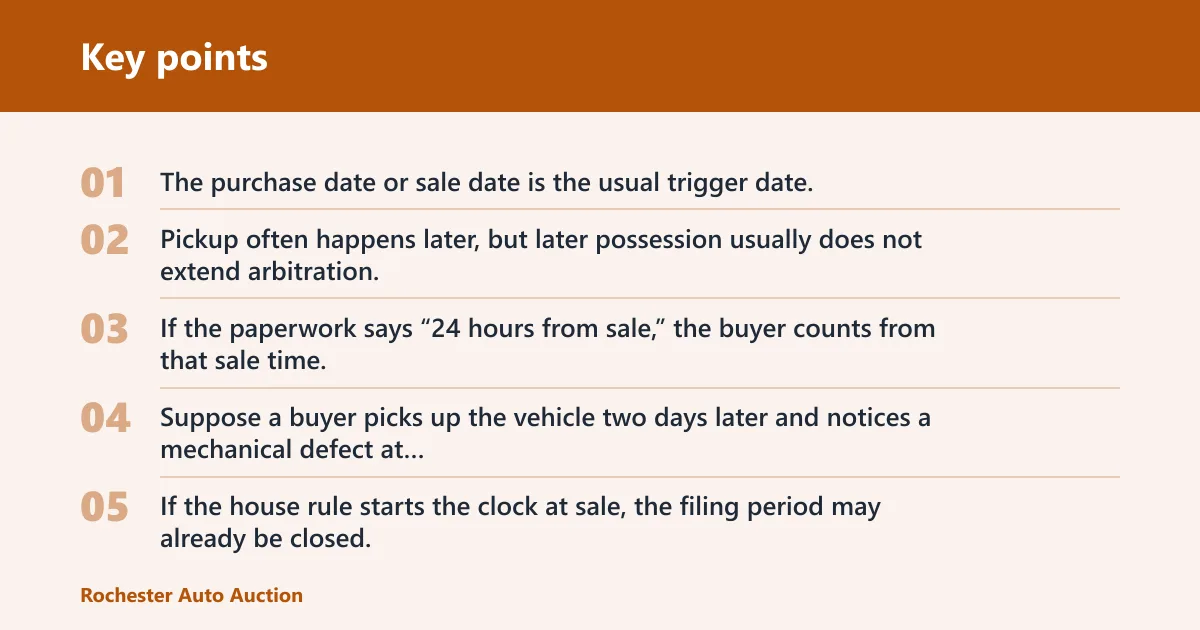
The purchase date or sale date is the usual trigger date. Pickup often happens later, but later possession usually does not extend arbitration. If the paperwork says “24 hours from sale,” the buyer counts from that sale time, even if the car sits on the lot overnight.
Suppose a buyer picks up the vehicle two days later and notices a mechanical defect at that point. If the house rule starts the clock at sale, the filing period may already be closed. The pickup date does not reset the deadline unless the auction rule says it does.
How online and simulcast sales may start the clock
Online sales often use the final bid time, buyer confirmation time, or invoice time as the trigger. Simulcast purchases may follow the same rule as the live lane or a separate online rule, depending on how the auction writes its house policy. Do not assume all digital purchases use one timeline.
If the auction has a separate online arbitration policy, it may also define when the clock begins for condition-based claims and title-related claims. Those two issues can be handled differently.
What to do if the paperwork and pickup dates differ
When sale paperwork and pickup happen on different days, use the earliest clearly posted trigger unless the auction states otherwise. The invoice, buyer receipt, or sale announcement usually controls. If those documents conflict, call the auction office and ask which timestamp governs the arbitration filing window.
Do weekends and holidays count?
Weekends and holidays may count, but only if the auction uses a calendar-hour deadline. If the auction uses business days, weekends and posted holidays may be excluded. The rule is not automatic, so you need to know whether the house counts elapsed hours or only open business days.
Calendar-hour windows
A 24-hour deadline usually runs continuously. Saturday, Sunday, and holidays still count unless the house rules say otherwise. If the vehicle sold at 3:15 p.m. on Friday, a strict 24-hour window ends at 3:15 p.m. on Saturday.
This is why waiting for the next open office day can be risky. The office may close before the deadline expires, but the clock may keep running.
Business-day windows
Business-day deadlines count only the days the auction designates as business days. If the house uses “next business day,” a Friday sale may allow filing on Monday, but a holiday can shift that timing. The posted holiday schedule matters because a closed office day may not count.
How to count the last filing moment
Use the auction’s own clock, then count forward exactly as written. If the rule says hours, count by hour and minute. If it says business days, count only qualifying office days. Do not assume midnight is the cutoff unless the auction states that clearly.
A common first-timer mistake is reading “24 hours” as “by the end of tomorrow.” That can be wrong by many hours. The deadline is usually tied to the sale timestamp, not the end of a calendar day.
Sale type changes the rule
Sale type can change both the filing deadline and the claim process. In-lane, online, simulcast, and dealer block purchases may have different time limits, different forms, or different eligibility rules. Read the sale-specific language, not only the general auction policy.
In-lane purchases
In-lane sales often use the live sale timestamp as the starting point. The buyer should confirm whether the auction uses a 24-hour filing window, a next-business-day rule, or a shorter claim period for certain defects or titles. The run sheet and lane announcement are key records.
Online purchases
Online sales may be timed from the close of bidding or from invoice generation. Some auctions also require digital submission through a buyer portal before the window closes. If the online listing includes condition grades, prior damage, or a no-arbitration notice, that language can limit eligibility.
Simulcast and dealer block purchases
Simulcast purchases can follow live-lane rules or digital-sale rules, depending on how the auction classifies the transaction. Dealer block purchases may have the most variation because they are often governed by separate trade-only rules. Always confirm whether that sale type has its own arbitration deadline and document list.
How long have file table
This table gives a plain-text way to map common purchase scenarios to the filing clock. Use it as a buyer-side calculator, then compare it with the house rules on the invoice, condition report, or sale announcement.
| Purchase scenario | When the clock starts | How to count the last filing moment |
|---|---|---|
| Same-day discovery after an in-lane sale | Sale time on the day of purchase | If the rule is 24 hours, file before the same clock time the next day; if it is a business-day rule, count only the next valid office day |
| Next-business-day discovery after purchase | Usually the sale date, not the discovery date | Count from the sale timestamp first; discovery on the next day does not extend the deadline unless the house rule says it does |
| Online sale | Often the close of bidding or invoice time | Use the posted online trigger and file before the stated hour limit or by the next business day if the auction uses that rule |
| Weekend purchase | Weekend sale time, if the auction uses calendar hours | Weekend hours count in a 24-hour window; if the rule uses business days, count only the next open auction day |
| If you are unsure | The earliest sale timestamp shown on the paperwork | File immediately, then call the auction office to confirm the trigger and accepted submission method before the window closes |
What documents do you need?
To file before the deadline, you usually need the auction’s arbitration claim form, the vehicle condition report, and any sale announcement notes that support the claim. Title records may also matter if the issue involves title status rather than a mechanical defect. Missing paperwork can slow or void the claim.
Arbitration claim form
The claim form is the required submission method at many auctions. It may ask for the stock number, VIN, sale date, odometer reading, defect description, and the exact issue you are claiming. The form must be complete before the deadline expires, even if supporting documents follow shortly after.
Vehicle condition report
The vehicle condition report is the core support document for most condition claims. It can show miles, announcements, prior damage notes, and any listed mechanical concerns. Match your claim to the report language. If the report already disclosed the defect, the claim may be denied under the auction’s policy.
Announcement notes and title records
Announcements can change eligibility. If the seller announced frame damage, flood history, warning lights, or “AS-IS,” that note may limit or defeat the claim. Title records matter for title status issues, and they may need to show whether the delay or defect is separate from the vehicle’s condition.
What to attach before the deadline
Attach the claim form, the condition report, any lane or online announcement, the invoice, and any photos or repair estimates that fit the house rules. If the defect is a mechanical issue, describe the symptom plainly and tie it to the condition report. Keep the submission short and factual.
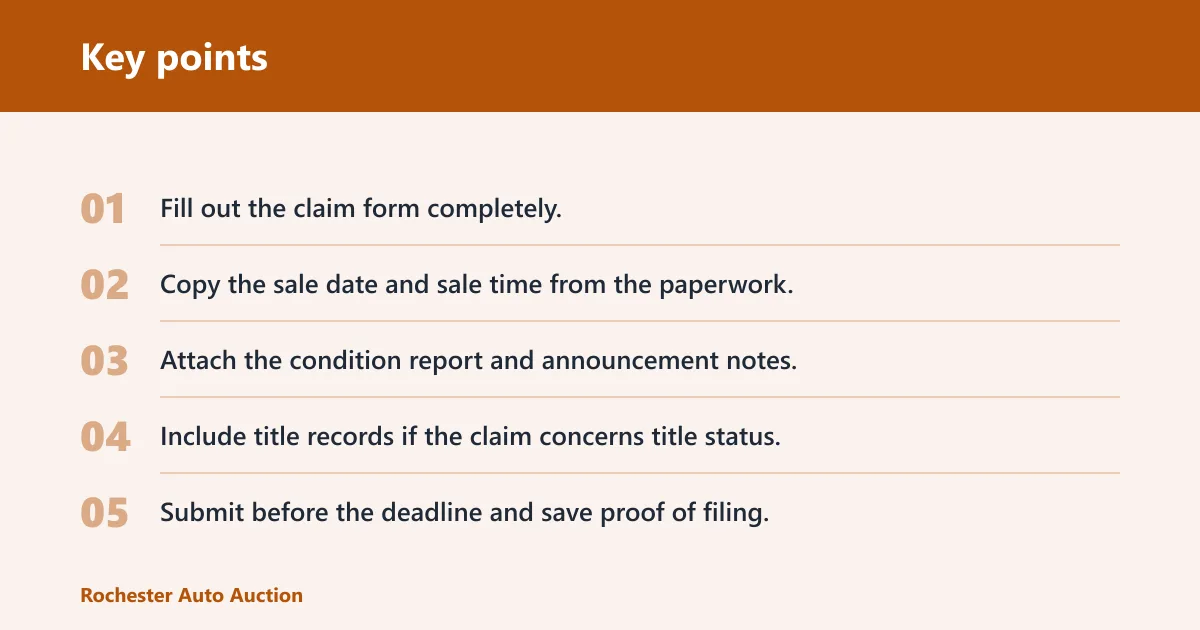
- Fill out the claim form completely.
- Copy the sale date and sale time from the paperwork.
- Attach the condition report and announcement notes.
- Include title records if the claim concerns title status.
- Submit before the deadline and save proof of filing.
What if the deadline is close?
If the window is nearly closed, file first and sort out the details second. The safest move is to submit the completed claim form with the best supporting documents available, then contact the auction office right away. A late call without a filed form is much riskier than a fast, incomplete submission.
How to file fast
Use the auction’s stated filing channel, whether that is an office counter, email, portal, or fax. Keep the defect description short, specific, and tied to the sale paperwork. State whether the issue is a mechanical defect, a title status problem, or an announcement dispute.
When to contact the auction office
Contact the auction office right away if the deadline is unclear, the paperwork is inconsistent, or the office is about to close. Ask three questions: what is the trigger date, what submission method counts, and what time is the last acceptable filing moment. Get the answer before the clock runs out.
What happens when the window closes
If the deadline passes, the claim may be void. That can leave the buyer with no arbitration remedy for the issue, even if the defect is real. Some auctions may still discuss the problem informally, but that is not the same as a valid claim under house rules.
Can the title still be unresolved after the window closes? Yes. Title delay and condition arbitration are not always the same issue, and a title problem does not automatically reopen the condition claim window. If the title has not arrived yet, file any title-based concern right away and ask whether it is handled separately from condition arbitration.
Frequently asked questions
How long do I have to file auction arbitration after buying a car?
Most auctions require filing within 24 hours or by the next business day, but the exact period depends on the house rules and sale type. The deadline usually starts on the sale date, not delivery. If you are close to the cutoff, submit the claim form right away.
Does the filing deadline start on the sale date or the pickup date?
Usually, it starts on the sale date or sale time shown on the invoice or sale record. Pickup is often later and does not extend the window. If the auction’s paperwork uses a different trigger, that written rule controls, so confirm it before counting any hours or business days.
Is the arbitration window different for in-lane, online, or simulcast purchases?
Yes, it can be different. In-lane sales often use the live sale timestamp, while online and simulcast sales may use the close of bidding, invoice time, or another posted trigger. Dealer block purchases can also follow separate rules. The sale type matters, so read the specific policy for that transaction.
Do weekends or holidays count toward the arbitration deadline?
If the auction uses a 24-hour deadline, weekends and holidays usually count. If it uses a business-day rule, closed days may not count. The posted house policy controls the count, so do not assume a holiday pauses the clock unless the auction says that it does.
What happens if I miss the auction arbitration filing deadline?
Missing the deadline can void the claim. That means the auction may reject the dispute even if you later find a mechanical defect, title issue, or misrepresentation. Some buyers can still ask the auction office for guidance, but an informal discussion is not the same as a timely arbitration filing.
What documents do I need to file before the deadline?
You usually need the arbitration claim form, the vehicle condition report, and the sale announcement or invoice. If the issue is title-related, add title records or notice of delay. File with the documents you have now, then follow up quickly if the auction allows extra paperwork after submission.