How to Read an ACV Auctions Condition Report Before You Bid
Read an ACV Auctions condition report by separating cosmetic, mechanical, title, and transport risk, then lowering your bid for each exposure; if the report shows a hard-stop issue you cannot price, pass. A condition report is a pricing tool, not a promise. Bad reads turn clean-looking units into lost margin and reconditioning surprises. This guide shows how to turn each report field into a bid adjustment or a no-bid decision.
What ACV condition reports tell you
An ACV condition report is a pricing tool, not a promise. Read the vehicle condition summary, damage disclosures, mechanical status, photo set, vehicle specifications, title or paperwork notes, odometer reading, and report date/time together, then decide whether each item adds cost, delay, or both. The report is most useful when you treat it as a snapshot that must be checked against the title file and the vehicle’s history before you bid.
Start with the written facts. Separate what the report states from what you are inferring from the photos or the headline. A clean summary can still hide transport risk, title delay, or reconditioning work if the report leaves out a panel, a warning light, or a release timeline.
Read the report in seven passes
- Confirm the event, lot number, and vehicle identification details.
- Read the summary line, damage disclosures, and mechanical status.
- Check the odometer reading against the vehicle history report.
- Review the title or paperwork notes for brand, release, or delay risk.
- Inspect the photo set for mismatch, overspray, trim damage, and wear clues.
- Cross-check accident records, ownership count, odometer issues, and service gaps on the history report.
- Turn each risk into a deduction or a pass decision before you bid.
A common first-timer mistake is pricing from the headline only. Suppose the summary says “clean” and the photos show shiny paint, but the paperwork note says title pending release. That delay can matter more than a bumper scuff if your buyer needs the car on the lot this week.
How do you judge the photos?
Judge the photo set as evidence, not decoration. The strongest photo set supports the written damage list, shows the reported damage area from multiple angles, and includes enough detail to confirm condition rather than imply it. If the photos are thin, incomplete, or mismatched to the notes, price that uncertainty or walk away.
Look for panel mismatch, overspray, and gap changes that point to prior repair. Then use close-ups to spot wear, stains, broken trim, missing switches, or nonworking electronics. If the written damage says “front bumper scuff” but the photos show a different hood shade or a misaligned fender, price for more than cosmetic repair.
What to look for in exterior photos
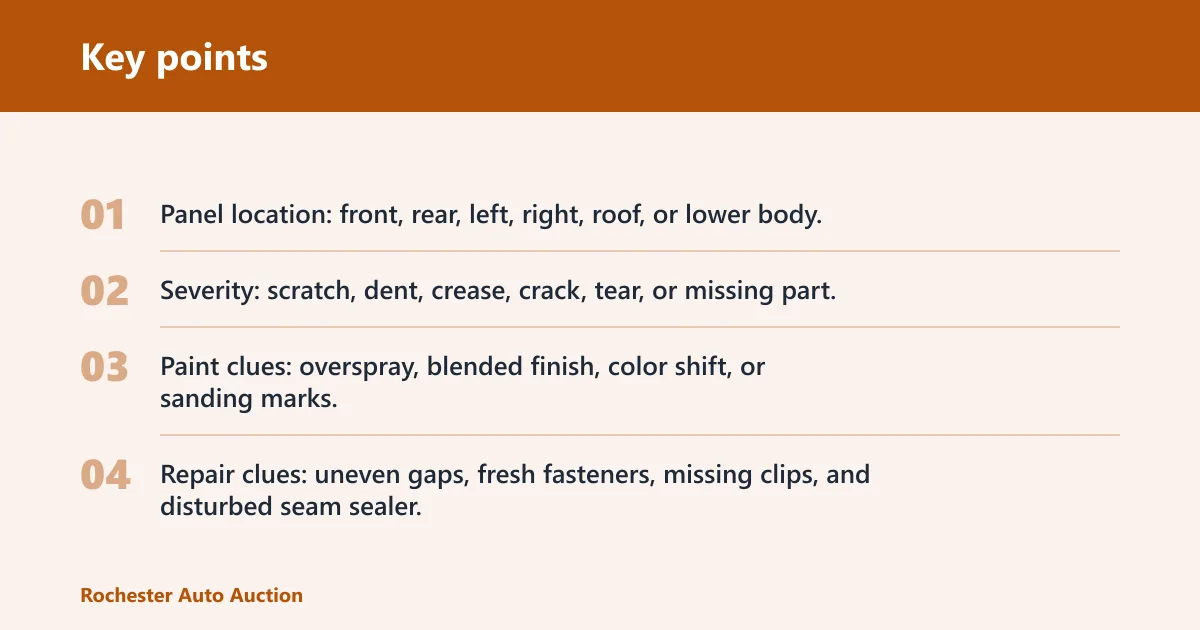
- Panel location: front, rear, left, right, roof, or lower body.
- Severity: scratch, dent, crease, crack, tear, or missing part.
- Paint clues: overspray, blended finish, color shift, or sanding marks.
- Repair clues: uneven gaps, fresh fasteners, missing clips, and disturbed seam sealer.
Exterior damage matters most when it points to hidden work. A rear quarter panel with fresh orange peel and a different gap at the tail lamp can mean prior repair that was not fully documented. That does not automatically kill the deal, but it should move the car into a higher deduction bucket.
What to look for inside the cabin
Interior condition affects both retail appeal and recon cost. Watch for smoke odor, stains, torn seats, broken switches, missing trim, and electronics that do not function. A stained driver seat on a high-mileage sedan may be normal wear; a wet floor or mold smell points toward water intrusion and a much larger problem.
Say your report shows a late-model crossover with clean paint but a dark headliner, cigarette odor, and a failed infotainment screen. The paint may cost little to correct, while odor removal, interior detailing, and an electronics diagnosis can erode margin fast. Treat each interior symptom as a separate charge, not one vague “detail” line.
What does untested mean?
Untested, unknown, or limited-start claims mean risk, not reassurance. If ACV lists the vehicle as untested, or notes that it starts but does not drive, you should budget for diagnostics, towing, and possible mechanical repair. Check warning lights, drivability notes, and known faults together before you assign a number.
Mechanical status matters in layers. A unit that starts, runs, and drives carries less risk than one that only cranks, but either can still hide transmission slip, cooling faults, brake issues, or a check-engine light. If the report does not confirm tested drivability, add a reserve for diagnosis and transport, especially on units with high mileage or weak service history.
Mechanical flags that should move your bid
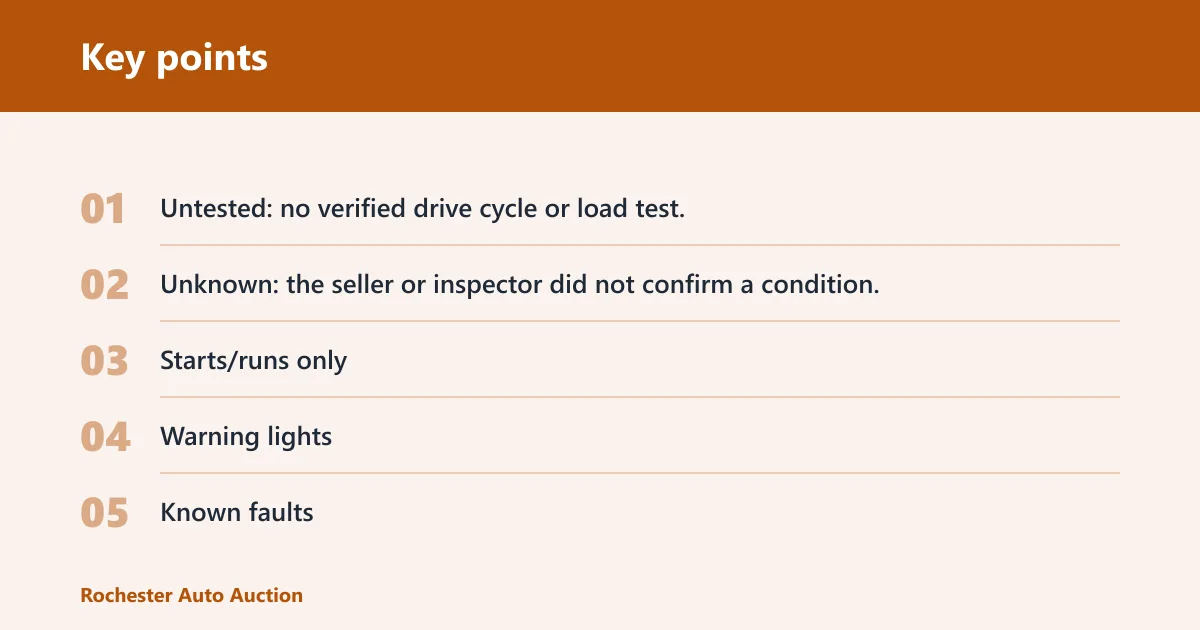
- Untested: no verified drive cycle or load test.
- Unknown: the seller or inspector did not confirm a condition.
- Starts/runs only: possible drivability or transmission risk.
- Warning lights: code scans, emissions faults, or ABS issues may be present.
- Known faults: use the note literally and deduct for the stated repair.
Underbody and frame details deserve the same caution. Rust, bends, subframe damage, and impact marks can change both safety and resale value. A clean exterior does not cancel a bent cradle or rusted mount. If the report hints at structural concern but provides weak photos, the correct move is often to pass.
Title and paperwork risk
Read title status, brands, and release timing as money factors. A clean title is easier to fund and retail than a branded title, but even clean paperwork can carry delay risk if release is pending. Title brands and odometer problems are not cosmetic issues; they can change financing, disclosure, and marketability. Cross-check the paperwork with the vehicle history report for title brands, accident records, odometer issues, and service gaps before you bid.
Title risk often hides in timing. A vehicle with good cosmetics and a strong mechanical note can still sit if the paperwork is incomplete, the title is not ready, or the release chain is unclear. If your floorplan, funding, or buyer timeline is tight, lower the bid for paperwork delay even when the car itself looks easy.
Questions the history report should answer
- Does the title show clean or branded status?
- Are there accident records that match the visible damage?
- Is the odometer reading consistent with the history report?
- How many prior owners are listed?
- Are there service gaps that weaken confidence in the mechanical note?
How can you tell if a report is hiding title, frame, or drivetrain risk? Look for mismatches. A low-mileage claim with a long gap in service records, a car with front-end damage but no underhood photos, or a clean title paired with a paperwork delay all deserve extra caution. If the report will not let you price the delay, the frame risk, or the drivetrain risk, treat that omission as a pass signal.
Questions to ask before placing a bid on ACV
Use this checklist before you commit a number. The goal is to surface hard-to-price issues early: title release timing, keys and remotes, warning lights, undercarriage visibility, frame evidence, drivability confirmation, transport distance, and any missing photo angles. If more than one of those items is unresolved, the bid should usually come down fast or stop.
Pre-bid checklist
- When will the title be released, and is that timing written in the report?
- Are all keys and remotes present?
- Are there warning lights or an untested dashboard?
- Do the photos show the undercarriage clearly enough to judge rust or impact?
- Is there evidence of frame or structural repair, or are the critical angles missing?
- Does the report confirm drivability, or only start/run status?
- How far will the vehicle need to travel to reach your store or recon center?
- Are any key photo angles missing, including the damaged side, tires, underhood, or rear corners?
Ask these questions as a group, not one at a time. A report with a delayed title and missing undercarriage photos creates two separate risks: paperwork delay and hidden damage. Together they can erase the margin that a clean exterior seemed to promise.
ACV condition worksheet
Use the report as a bidding model. Convert cosmetic, mechanical, title or paperwork, and transport risk into separate deductions, then subtract those deductions from your market ceiling. A practical ceiling also has to absorb fees, recon, and pickup costs. The cleanest way to do that is with a simple all-in formula.
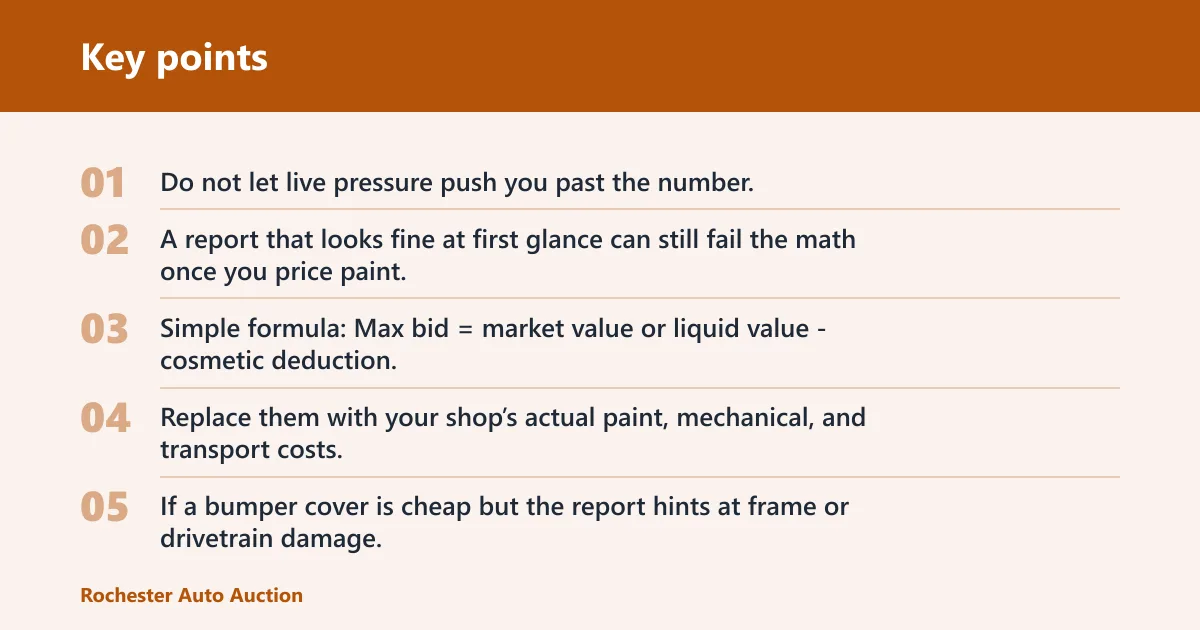
Set the max bid before the auction starts. Do not let live pressure push you past the number. A report that looks fine at first glance can still fail the math once you price paint, tires, battery, transport, title delay, and dealer fee stack.
Simple formula: Max bid = market value or liquid value – cosmetic deduction – mechanical deduction – title/paperwork deduction – transport deduction – fees – recon reserve – hold-time reserve
All-in cost line: Hammer price + buyer fees + transport + recon + hold time = total landed cost
Pass/fail threshold: If unknown mechanical condition, title delay, or missing undercarriage evidence cannot be priced with confidence, the bid fails unless the discount is large enough to cover worst-case repair and delay.
| Vehicle scenario | Cosmetic deduction | Mechanical deduction | Title/paperwork deduction | Transport deduction | Formula for max bid |
|---|---|---|---|---|---|
| Clean late-model | $350 | $500 | $250 | $150 | Market value – $1,250 – fees – recon reserve |
| High-mileage retail | $800 | $1,500 | $500 | $250 | Liquid value – $3,050 – fees – recon reserve |
| Lane-risk wholesale | $1,200 | $2,500 | $1,000 | $500 | Liquid value – $5,200 – fees – recon reserve |
Those numbers are a worksheet, not a policy. Replace them with your shop’s actual paint, mechanical, and transport costs. If a bumper cover is cheap but the report hints at frame or drivetrain damage, move the car out of the cosmetic-only column and into pass territory unless the discount is large enough to cover worst-case repair.
Suppose a wholesale SUV has a clean exterior, untested mechanical status, a branded-title delay, and roughly 180 miles of transport. Even if the sheet looks modest, the paperwork and shipping penalties can wipe out margin before recon starts. That is the point where a “good buy” becomes a no-bid.
When should you pass?
Pass when the report leaves out key facts, the photos do not support the written claims, or the missing detail would change your number. Missing photos, vague notes, and conflicting details are enough to walk away if you cannot price the risk. Frame, flood, or drivetrain concerns with weak evidence should not be treated as minor unknowns.
Also pass when the report cannot support your reconditioning budget. If the vehicle history report and ACV notes disagree on mileage, ownership count, or damage type, your bid should fall sharply or stop. A clean-looking report is not a guarantee. It is only one piece of the pricing file.
Pass triggers that matter most
- No undercarriage or frame evidence when impact damage is present.
- Title or paperwork notes that do not show a clear release timeline.
- Untested mechanical status on a unit that needs retail-ready speed.
- Photo set that skips the damaged side or key interior areas.
- History report conflicts on mileage, ownership count, or accident records.
Frequently asked questions
How do I read an ACV Auctions condition report before bidding?
Read the summary, photos, damage disclosures, mechanical status, title notes, odometer reading, and report timestamp together. Then cross-check the vehicle history report for title brands, accident records, odometer issues, ownership count, and service gaps. Any missing piece that changes your price should lower the bid or end the bid.
What do ACV condition report grades mean?
Do not treat a grade as a buy signal by itself. Use it as a quick summary, then verify what sits behind it: exterior damage, interior wear, tested or untested mechanical status, and paperwork timing. A strong grade can still hide transport delay, recon cost, or a title issue.
What should I look for in the photos on an ACV report?
Look for panel mismatch, overspray, uneven gaps, broken trim, stains, smoke residue, and missing electronics. Compare the images with the written damage list, and give extra weight to underhood and undercarriage shots if they are provided. If the photo set skips the damaged area, treat that as a warning.
Which damage types matter most before I bid on a car?
Damage matters most when it changes safety, funding, or retailability. Prioritize frame, subframe, flood, drivetrain, and title-related issues first, then interior odor or heavy wear, then paint and panel repair. Small cosmetic work may be easy to price; structural or paperwork problems usually deserve a bigger deduction.
What does untested or unknown mean in an auction report?
Untested or unknown means the seller or inspector did not confirm the condition you need for pricing. That can hide drivability faults, warning lights, transmission issues, or a no-start problem. Add reserve for diagnosis and towing, or pass if the missing test result would change your ceiling.
How do I turn a condition report into a max bid?
Start with market value or liquid value, then subtract separate deductions for cosmetic, mechanical, title or paperwork, and transport risk. Add fees and a recon reserve next. If the final number leaves no margin after buyer’s premium, transport, likely repairs, and hold time, the correct max bid is zero.