Vehicle History Report: How Auction Buyers Should Use It
Use the vehicle history report to assign risk deductions, then cap your bid at market value minus recon, fees, transport, and a history reserve of 0.5 to 3.0 times expected hidden-cost risk. Treating it as a simple buy/pass check can leave title delays, structural stigma, warranty ineligibility, and potentially significant resale or arbitration exposure. This guide gives you a bidding workflow: screen red flags, cross-check auction data, score the report, and turn those findings into a hard maximum bid.
Start with the VIN match
The report only helps if it belongs to the exact vehicle in the lane. A valid modern VIN is a 17-character identifier, and every character matters.
Match the VIN across five places before you read anything else: the dashboard VIN plate, the driver-door label, the title paperwork or title status notice, the auction listing, and the auction inspection or condition report. If one character differs, stop and verify before bidding.
Cloned, altered, or re-tagged vehicles are less common than ordinary title problems, but the risk is real enough to justify a strict check. A report tied to the wrong VIN can hide theft-recovery history, a salvage brand, or a mileage issue that belongs to the car in front of you.
Do not rely only on a seller-provided PDF or an old listing attachment. Pull or confirm a current report by VIN close to sale time, because title brands, total-loss events, theft recoveries, and mileage updates can post after the copy in the folder was generated.
VIN check workflow
- Read the full 17-character VIN from the dash plate.
- Match it to the driver-door label.
- Match it to the auction listing and stock number.
- Match it to the auction inspection report or condition sheet.
- Match it to title paperwork, title status notice, or title announcement.
- Run or refresh the history report using that exact VIN.
- Check the report date and the most recent event date before bidding.
What can a vehicle history report actually tell you?
A vehicle history report can show title brands and title transfers, odometer readings from inspections or other recorded events, registrations, service visits, auctions, or title work, reported damage and total-loss records, theft or recovery entries, registration activity, and some service records tied to the VIN. It is useful for screening auction risk, but coverage varies by source, state reporting, insurer participation, and delay between the event and the database update.
Read it as a compiled record, not a condition certificate. The strongest parts are usually title status, reported mileage sequence, and major insurance or registration events. The weakest parts are repair completeness, private-party damage, and any issue that never reached an insurer, dealer, state agency, police file, or participating shop.
What usually appears
- Title history: clean title, salvage title, rebuilt title, flood, junk, lemon, theft recovery, and similar title brands when reported.
- Odometer history: mileage readings at inspections, registrations, sales, service visits, emissions checks, or title transfers.
- Damage and loss records: collision, total loss, flood, hail, fire, structural notes, and airbag deployment notes if reported to a data source.
- Theft events: theft reported and theft recovered entries when available.
- Service records: oil changes, inspections, dealer visits, and maintenance entries from participating shops.
What it cannot prove
A clean report does not prove a clean car. It means the report did not find damage, title, or mileage problems in the databases it checked at that time, and those databases can miss private repairs, uninsured losses, delayed title brands, flood exposure, poor structural work, or airbag repairs that never reached a reporting source.
It also does not settle recall status. Open recalls should be checked separately by VIN through the manufacturer’s recall lookup or the NHTSA recall tool, because recall status can change after a report is issued and many history reports may not include complete or current recall data.
How should you read title status before you bid?
Title status should set the starting risk tier for the car, because it affects transportability, insurability, financing, resale audience, and value before you even get to mechanical condition. Clean-title and branded-title units can both be buyable, but they need different discounts, different exit plans, and different arbitration expectations.
At auction, title status is pricing, not decoration. A clean title may support a wider retail audience and easier financing. A branded title narrows the buyer pool, can limit finance approval, and often cuts resale value even after competent repairs.
How common title brands change the bid
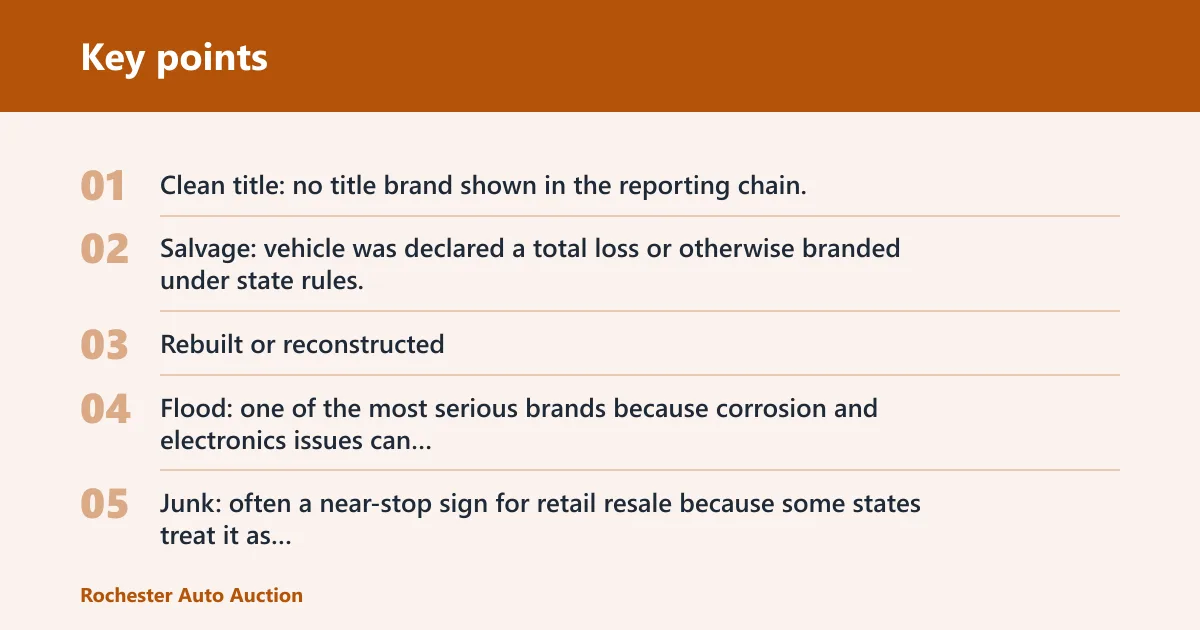
- Clean title: no title brand shown in the reporting chain, but still not proof of no major damage.
- Salvage: vehicle was declared a total loss or otherwise branded under state rules. Expect resale discount, inspection requirements in some states, and buyer hesitation.
- Rebuilt or reconstructed: previously branded, later repaired and retitled. Better than unknown salvage paperwork, but stigma remains.
- Flood: one of the most serious brands because corrosion and electronics issues can surface long after sale.
- Junk: often a near-stop sign for retail resale because some states treat it as nonrepairable.
- Lemon: title brand tied to manufacturer buyback rules in some states. Market reaction varies by make, age, and documentation.
- Theft recovery: can be benign or ugly. The key question is what happened during the theft period and whether damage or parts stripping followed.
Title status in auction context
Title brands affect more than the hammer price. They can change title release timing, transporter acceptance, insurance options, warranty eligibility, and who will buy the car from you later.
Suppose a midsize SUV books at $18,500 clean-title retail-ready, but the report shows rebuilt title and prior airbag deployment. The issue is not whether the unit is drivable today. The issue is that the next buyer, lender, and appraiser will price that history too, so the discount has to be built into your maximum bid before the lane starts.
How do odometer and damage entries change risk?
Odometer and damage entries matter because they change both value and fraud risk. A tidy mileage line with sensible checkpoints lowers uncertainty, while gaps, reversals, unit errors, or damage entries that do not fit the current condition raise the odds of hidden recon, title trouble, or a resale discount larger than the visible defect suggests.
Start with mileage sequence, then move to damage severity. Event count matters less than what each entry means for structure, safety systems, corrosion, and resale stigma.
How to read odometer history
Look for reported mileage checkpoints in date order. The normal pattern is gradual increase with occasional flat spots when a car is stored or offered for sale. Red flags include a lower later reading, a large gap with no explanation, or unit conflicts such as kilometers in one record and miles in the next.
A single odd entry is not always fraud. Data-entry mistakes happen. But the burden shifts to proof when the sequence breaks, because an odometer inconsistency can follow the car into arbitration or retail disclosure requirements.
High mileage itself is not a defect. It is a pricing signal. A well-documented 168,000-mile work truck may be lower risk than a 92,000-mile crossover with two unexplained mileage reversals and a late salvage brand.
How to read damage entries
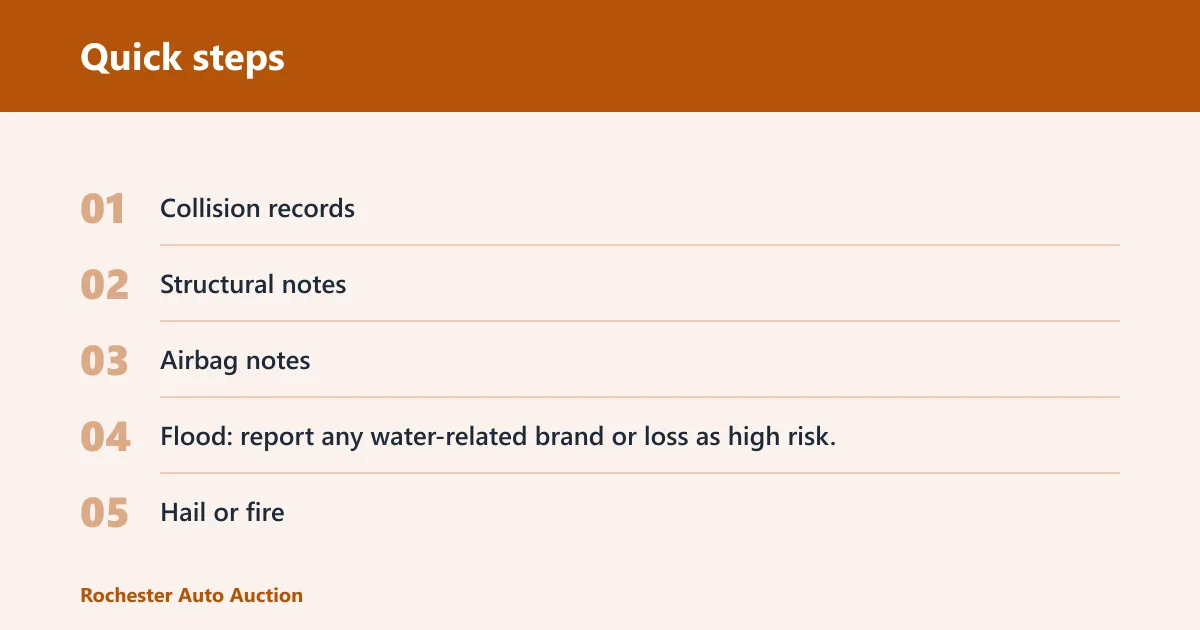
- Collision records: look for whether the report notes minor, moderate, or severe damage if that detail is provided.
- Structural notes: frame or unibody damage changes exit strategy fast, especially on retail units.
- Airbag notes: deployment entries raise repair-cost and safety-system questions.
- Flood: report any water-related brand or loss as high risk, even if the photos look presentable.
- Hail or fire: these can be cosmetic or total-loss level depending on severity and component damage.
- Theft and recovery: watch for stripped interiors, ignition damage, wheel theft, or missing modules that the report may not detail.
Picture a compact sedan with two accident entries over six years, both described only as damage reported. If the auction inspection sheet now mentions left-front structural repair and the photos show uneven apron seam sealer, the real risk is the structural note, not the number two.
How do you compare the report with the auction inspection report?
The history report and the auction inspection report answer different questions, so read them side by side. The history report tracks reported past events tied to the VIN, while the auction inspection report usually adds current cosmetic and mechanical observations that history databases often never capture.
Start with three direct comparisons: title status, odometer reading, and damage description. Then read auction photos, announcements, and arbitration terms as tie-breakers.
Use the condition report to test the history report
The auction inspection report may note paintwork, body damage, warning lights, engine noise, transmission issues, tire condition, interior wear, glass damage, and odor. Those observations can expose recent damage or wear that has not reached a history database yet.
If the report shows clean title and no accident entries, but the condition report notes replaced rear body panel, quarter repair, and SRS light on, treat the history report as incomplete rather than clean. Bid from the physical evidence.
Use the history report to test the condition report
The reverse matters too. If the condition report is light on damage notes but the history shows prior flood brand, theft recovery, or an odometer inconsistency, assume the auction sheet is describing current visible condition, not the full ownership or title risk.
What to do when they conflict
- Verify the VIN again on all documents and labels.
- Check report date and event recency for stale data.
- Read auction announcements and title availability notes.
- Review photos for signs that support one document over the other.
- Increase the history reserve or pass if the conflict affects title, mileage, structure, flood exposure, or arbitration rights.
A common first-timer mistake is treating a clean database entry as stronger than a fresh lane announcement. If the auction announces possible title delay or unverified mileage, price that live risk now. A history report cannot cancel an announcement made at sale time.
What can a clean report miss?
A clean report can miss accidents, flood exposure, theft-related damage, private repairs, and recent total-loss events that have not yet reached the data feed. It can also miss service work done outside participating shops, so absence of maintenance entries is common and should not be treated as proof of neglect by itself.
Reporting lag is one of the main auction failure points. An insurer may total a car, a state may process a brand later, or a police theft file may close after the sale date. The closer you are to the event, the more stale-data risk matters.
Stale or incomplete data at auction
Check both the report date and the date of the most recent event. A report pulled weeks ago on a recently damaged vehicle is weak evidence. For fast-moving inventory, fresh data matters more than a long ownership-history summary.
Say your report was generated 19 days before sale, and the auction photos now show a fresh right-rear hit that is absent from the file. That is not a mystery to solve with optimism. It is a signal to add a larger hidden-cost reserve or skip the unit.
Missing service data
Service records help when they exist, especially dealer maintenance, oil changes, emissions inspections, and repeat visits that support mileage progression. Still, many independent shops, fleets, and do-it-yourself owners leave no digital trail that reaches consumer history databases.
Use service entries as supporting evidence, not as a maintenance score. Missing records do not prove abuse. Present records do not prove perfect care.
Vehicle history report checklist
Vehicle history report checklist
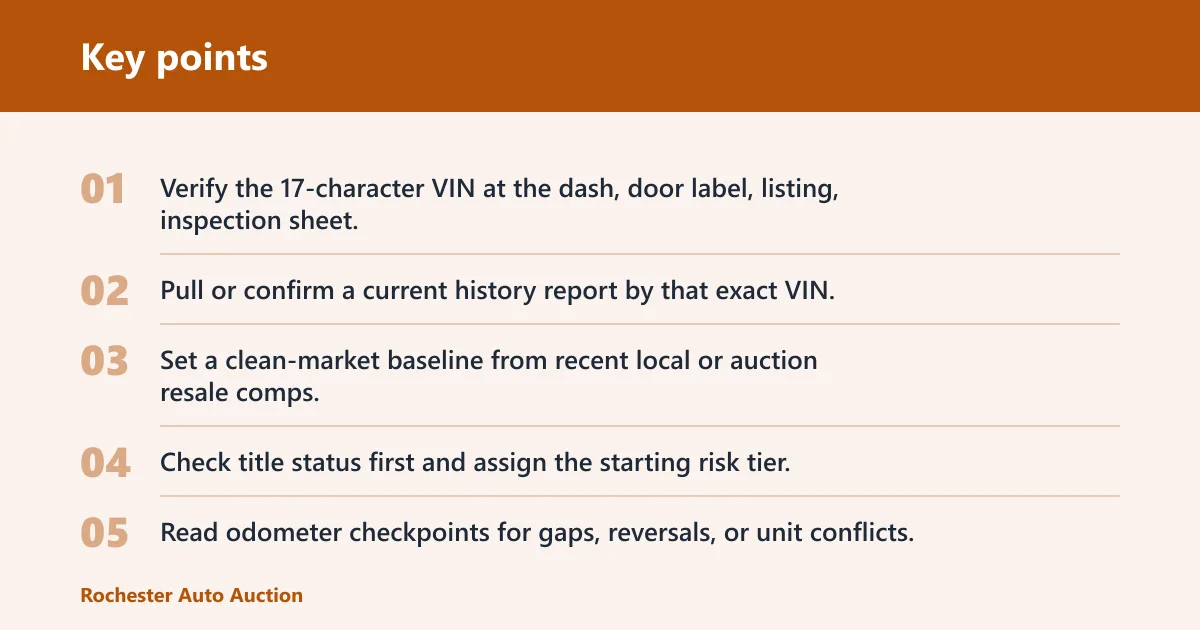
- Verify the 17-character VIN at the dash, door label, listing, inspection sheet, and title paperwork.
- Pull or confirm a current history report by that exact VIN.
- Set a clean-market baseline from recent local or auction resale comps.
- Check title status first and assign the starting risk tier.
- Read odometer checkpoints for gaps, reversals, or unit conflicts.
- Read damage, theft, flood, fire, hail, structural, and airbag entries in date order.
- Compare the report with the auction inspection report, photos, and announcements.
- Check recall status separately.
- Estimate recon, transport, buyer fees, title delay cost, and likely resale discount.
- Add a history reserve of about 0.5 to 3.0 times the expected hidden-cost risk, based on data confidence.
- Convert the findings into a score and maximum bid.
Vehicle history report decision table
| Finding | Risk points | Maximum-bid adjustment | Notes |
|---|---|---|---|
| Clean title, consistent mileage, no report conflicts | 0 to 2 | Subtract 0% to 3% from clean-market baseline | Use lower end only if inspection report and photos also fit. |
| Clean title with prior collision or moderate damage record | 3 to 5 | Subtract 5% to 10% | Use higher end for structural note, airbag entry, or visible poor repair. |
| Rebuilt title or theft recovery with good documentation | 6 to 8 | Subtract 15% to 25% | Plan for smaller resale audience and financing friction. |
| Salvage title, flood brand, or serious structural history | 9 to 12 | Subtract 25% to 40% | Transport, insurance, and resale limits often widen the discount. |
| High mileage with consistent history | 3 to 5 | Subtract 7% to 15% | Price for wear items and narrower retail demand. |
| Odometer inconsistency or rollback suspicion | 10 to 12 | Subtract 25% to 50%, or no-bid | Disclosure, arbitration, and resale risk can outweigh value. |
| Incomplete data, stale report, or report/inspection conflict | 4 to 9 | Add history reserve of 1.0 to 3.0 times expected hidden-cost risk | Use the larger multiplier when the conflict involves title, mileage, flood, or structure. |
How to turn points into a hard maximum bid
Use a simple formula:
Maximum bid = clean-market baseline – recon – transport – fees – resale discount – history reserve
The table above handles resale discount and history reserve. A common rule of thumb is to use the low end of the reserve range when documents agree and the high end when data is stale, incomplete, or contradicted by the auction inspection report.
Example calculation: clean-market baseline $14,000, recon $1,400, transport $350, fees $500, damage-history discount 8% of baseline ($1,120), history reserve $900. Maximum bid = $14,000 – $1,400 – $350 – $500 – $1,120 – $900 = $9,730.
How should different auction buyers use the same report?
Different buyers should read the same report through different exit plans. A clean-title retail unit needs protection against front-end gross loss and arbitration headaches, while a budget car, branded-title flip, or high-mileage work unit can tolerate more history if the bid reflects the narrower buyer pool and added recon risk.
Clean-title retail units
These units need the strictest mismatch standard because the resale audience is widest, and that audience is most sensitive to title surprises, structural history, and odometer problems. Small history defects can erase margin fast.
Price clean-title retail cars against the standard a lender, appraiser, and retail shopper will use later. If the history report and condition report disagree on damage or mileage, protect the deal with a larger reserve or walk.
Budget transportation units
For older, lower-price vehicles, some cosmetic and minor history flaws may be acceptable at the right number. The threshold question is whether the history issue changes safety, title transfer, or near-term reliability enough to swamp the small gross available in the car.
Keep the math blunt. A cheap car with uncertain title timing or flood suspicion can become expensive very quickly.
Branded-title and high-mileage units
These require the clearest exit strategy. The report should tell you whether the discount is already big enough for the limited resale audience, likely financing friction, and higher recon variance.
Branded-title units can work when documentation is complete, repairs are visible and consistent, and the market discount is already deep. High-mileage units can work when mileage is consistent, service history supports use, and the inspection report does not add hidden drivetrain risk.
What should you check outside the history report?
Check recall status, market value, auction terms, announcements, and title availability outside the history report because none of those items is reliably covered in every file. Auction decisions fail when buyers price only the report and ignore live sale terms, release timing, and the true resale market for that exact risk profile.
Open recalls
Most manufacturers list open recalls by VIN, and NHTSA tools also track recall campaigns. A recall may be free to repair, but parts delays, stop-sale effects, or unresolved safety concerns can still disrupt your turnaround time.
Market value after risk discounts
Start with realistic resale comps for the exact trim, driveline, title status, and mileage band. Then discount for title brands, damage history, high mileage, or missing data. Market value without those discounts is only the headline number, not the bid number.
Auction terms and title availability
Read arbitration limits, title delay terms, sale-light language, and lane announcements. A strong history report does not erase a title-hold issue, and a weak history report may be manageable if the auction disclosures are clear and the price leaves room.
Frequently asked questions
How should I use a vehicle history report before bidding at auction?
Use it as one input in a risk model, not as a yes-or-no screen. Verify the VIN, read title and mileage first, compare damage and theft entries with the auction inspection report, then convert the findings into discounts, a hidden-cost reserve, and a hard maximum bid.
What problems can a vehicle history report help me avoid at an auction?
It can help spot title fraud, salvage or flood branding, theft recovery history, odometer inconsistency, prior total-loss events, and resale issues that may not be obvious in photos. It also helps identify units that need bigger discounts because the future buyer will see the same history.
What does it mean if an auction car has a clean history report?
It means the report did not find negative events in the sources it checked at that time. It does not prove the car never had damage, flood exposure, rollback, or poor repairs. Clean report should be read together with current inspection notes, photos, announcements, and title status.
Can a vehicle history report miss accidents or flood damage?
Yes. Private repairs, uninsured damage, delayed insurer reporting, state processing lag, and nonparticipating data sources can all leave gaps. Flood exposure is especially tricky because corrosion and interior replacement can hide evidence, and branded-title or loss entries may appear after the auction date.
How recent should a vehicle history report be before I buy?
Fresher is better, especially for auction units with recent transport, damage, or title movement. Check the report date and the date of the most recent event. If the report is older and the car shows fresh issues in photos or the condition report, treat the file as stale.
How do I compare a history report with the auction inspection report?
Match VIN, title status, odometer reading, and damage notes first. Then use photos and announcements to see whether one source is missing recent facts. If they conflict on title, mileage, structural damage, or flood risk, raise the reserve sharply or pass on the unit.