What Does “in Negotiation” Mean on ACV Auctions?
“In negotiation” on ACV Auctions means the vehicle is under active price or terms discussion, so the listing is not final until ACV or the seller accepts, counters, or closes it. Miss this status and you can waste bids, delay floorplanning, or assume a unit is still available when it is not. This guide explains what the status means for buyers, sellers, and dealership staff, plus the next move to take.
How in negotiation status works in the ACV app
On ACV Auctions, “in negotiation” means the listing is in a live decision stage. A buyer offer has usually been sent, reviewed, or answered, and the unit has not reached a final outcome yet. The vehicle is still in play, but it is not settled.
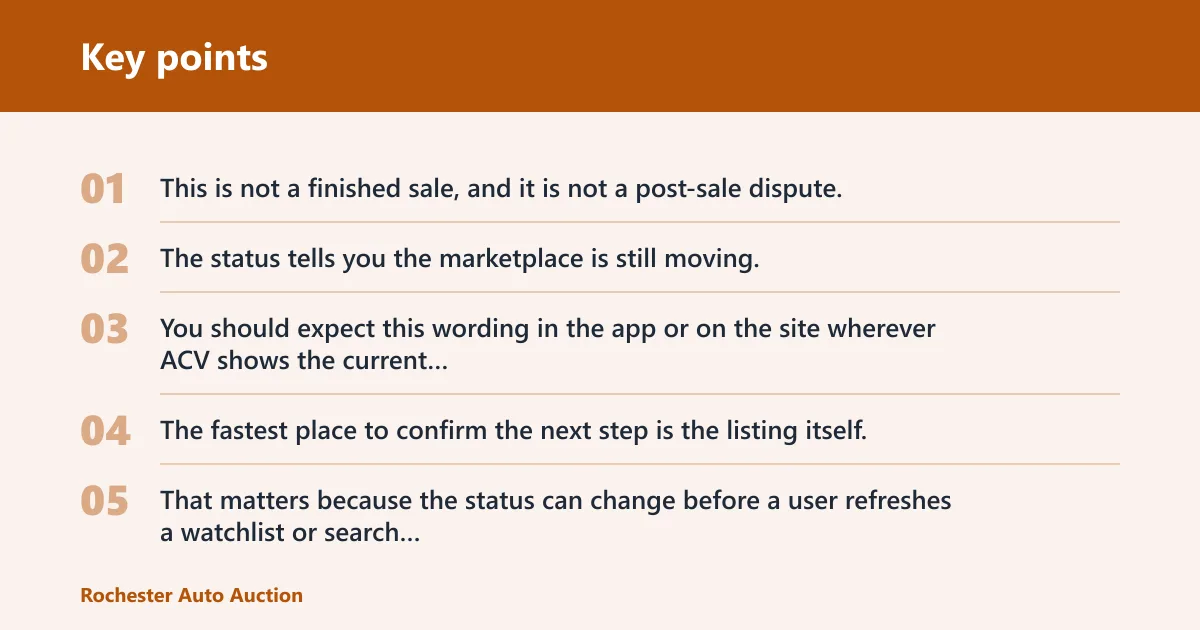
This is not a finished sale, and it is not a post-sale dispute. The status tells you the marketplace is still moving, which is why the listing can change quickly after a message, a counter, or an internal approval.
Where the status shows up
You should expect this wording in the app or on the site wherever ACV shows the current listing state and message flow tied to that vehicle. The fastest place to confirm the next step is the listing itself, then the inbox or notifications tied to your account.
That matters because the status can change before a user refreshes a watchlist or search results page. If a buyer offer has been sent, check ACV inbox messages for a seller response first.
What the status does and does not mean
“In negotiation” does mean the listing is still active in a decision sense. It does not guarantee a counteroffer is waiting, and it does not mean the vehicle is automatically pending sale in the final, closed sense. It is a holding pattern, not an end state.
For buyers, the practical meaning is simple: the vehicle may still be purchasable, but the exact next action depends on who moved last. For sellers, the listing is open to accept, reject, or counter if the platform flow allows that step.
| Status signal | What it usually means | Best next check |
|---|---|---|
| In negotiation | Offer review or counter discussion is underway | Open the vehicle message thread and notifications |
| Pending | A final step is waiting before the result is locked | Confirm whether a response or approval is due |
| Sold | The transaction has been accepted and moved forward | Check fee, transport, and title follow-up |
| Arbitration | A post-sale issue is being reviewed | Review the condition issue and claim path |
Is the listing still active when ACV shows in negotiation?
Usually, yes in practical terms: the vehicle is still in an active decision stage and can still move to a sale outcome. But “active” here does not mean open for every action at every moment. It means the listing has not closed into a final result yet.
That difference matters. A unit in negotiation may still change hands, but the buyer may not be able to place a fresh bid if the seller is already reviewing a prior offer. The listing has not disappeared, yet the workflow may be paused for the next response.
What this means for availability
If the vehicle remains in negotiation, treat it as a live opportunity with a short fuse. The status can clear into acceptance, rejection, or a counter. It can also stall if nobody responds quickly.
A common first-timer mistake is assuming the unit is safe to ignore until the end of the day. In a fast-moving auction app, a message can change the outcome before that. Check the listing before you assume it is still available.
How this differs from a closed listing
A closed listing has already reached its result. A negotiation status has not. That is the core difference, and it is why the next action matters more than the label itself.
Suppose a dealer sees “in negotiation” after sending an offer on a late-model SUV with disclosed front-end damage. The unit may still be available, but the seller’s next response decides whether the buyer should wait, revise the offer, or move on.
What buyers should do next
Buyers should first check the offer they sent, then watch the ACV inbox and push alerts for a response. If the status is still live, the next move is usually to wait for the seller’s answer, revise the offer if the platform flow allows it, or stop pursuing the unit.
Because the listing is under review, speed matters. A delay can cost the unit, especially when another buyer is waiting or the seller is comparing the current offer to a minimum acceptable number.
- Open the vehicle listing and confirm the offer amount you sent.
- Check ACV inbox messages for a seller response or counter.
- Review push alerts on the app if they are enabled for your account.
- Decide whether to wait, revise the offer, or walk away.
- Escalate inside your dealership if the unit affects inventory or front-line planning.
When to escalate inside your dealership
Escalate when the unit matters to a buyer request, a sold-unit replacement need, or a floorplan decision. If the status has not changed after your internal deadline, a manager or buyer should decide whether to hold the line or redirect attention elsewhere.
For a high-demand unit, that internal deadline should be short. For a lower-priority unit, the buyer can wait longer. The point is to set a rule before the status drags on.
What sellers and dealership staff should do
Sellers and staff should review the buyer offer, compare it to the minimum acceptable price, and then accept, reject, or counter. The negotiation step is an internal decision point as much as a marketplace message thread.
The clearest workflow is simple: inspect the offer, confirm any floor or reserve logic used inside the dealership, and answer quickly enough that the listing does not go stale. Delay creates uncertainty for both sides.
How minimum acceptable price shapes the outcome
The minimum acceptable price is the internal number that tells staff where to stop discounting. That number may sit above a buyer’s first offer, which is why a counteroffer is often the middle path.
Do not confuse that internal floor with public bidding language. The seller may be working from a number that is never shown to the buyer. The buyer only sees the response, not the internal threshold.
Set a response deadline for staff follow-up
Staff should set a same-day deadline whenever possible, because negotiation status is time-sensitive. If the offer sits too long, the unit can lose momentum or the buyer may move on to another listing.
If the dealership uses a manager approval step, the approval window should be tracked inside the store, not left to memory. The status on ACV only tells you that something is still open.
Buyer offer, counteroffer, and timing

A buyer offer is the amount the buyer is willing to pay at that moment. It may invite acceptance, rejection, or a counteroffer. It is part of the negotiation flow, not the final result unless the seller accepts it.
In many auction tools, an e-auction is an online negotiation tool where bidders place bids until a target amount is reached. E-auctions can be described as reverse auctions, but the terms are not identical. An e-auction can be forward or reverse if it takes place electronically. That broader language helps explain the workflow, but ACV’s listing status still needs to be read inside the app’s own context.
Is the offer binding?
Do not assume the offer is the final purchase unless the platform flow and acceptance step say so. In practice, the offer is a step in the process. Once accepted, the buyer should expect follow-up on fees, transport, and title timing.
That is why speed matters on both sides. A response delay can shift the outcome, even if the amount itself is acceptable.
How counters usually work in the flow
A counteroffer means the seller has responded with a different price or term. It is not the same as a sale, and it is not the same as a rejection. It is a new position in the same negotiation thread.
If the counter is close to the buyer’s ceiling, the buyer can accept or step away. If it is too far apart, the buyer should move on instead of waiting for a result that is unlikely to change.
Negotiation versus arbitration on ACV
Negotiation and arbitration are different stages. Negotiation happens before the sale is finalized. Arbitration happens after the sale when a condition or disclosure issue needs review. Do not treat them as the same process.
The condition report matters in both places, but for different reasons. During negotiation, disclosed damage can shape the offer. After the sale, a condition-related problem may move into arbitration if it falls within the platform’s dispute path.
Where condition reports fit
ACV’s vehicle condition report is the buyer’s main guide to disclosed damage and condition notes. That report helps explain why a buyer may offer less than asking or why a seller may counter.
It does not erase risk. It only gives both sides the same disclosed information before the price is settled. If a problem is discovered after the sale, the question changes from negotiation to arbitration.
When a post-sale issue belongs in arbitration instead
If the deal is already accepted and the issue is about condition, damage, or a disclosure mismatch, arbitration is the more likely path. If the price is still being discussed, the issue belongs in negotiation.
That distinction matters because the fix for one is not the fix for the other. A buyer who treats a post-sale claim like a new offer can lose time.
What to do when ACV shows In Negotiation
Use the status as a short, internal decision point. If the buyer started the offer, wait for the response and prepare a revision only if the seller counters. If the seller countered, decide quickly whether to accept, reject, or push back. If the status is stale, escalate and stop waiting blindly.
| Branch | Exact next action | Who acts | When to escalate internally |
|---|---|---|---|
| Buyer initiated offer | Check the offer amount, then watch ACV inbox and push alerts for the seller’s reply | Buyer or buyer-side staff | If no reply by your dealership deadline, ask a manager whether to wait or move on |
| Seller counteroffer | Review the counter against your ceiling and decide to accept, reject, or counter back | Buyer, sales manager, or desk staff | Escalate before the response window closes if the unit affects inventory or customer demand |
| Stale status older than 2 hours | Recheck messages, refresh the listing, and contact internal staff to confirm whether a response was missed | Buyer-side coordinator or inventory manager | Escalate immediately if the unit is needed for a same-day decision or trade commitment |
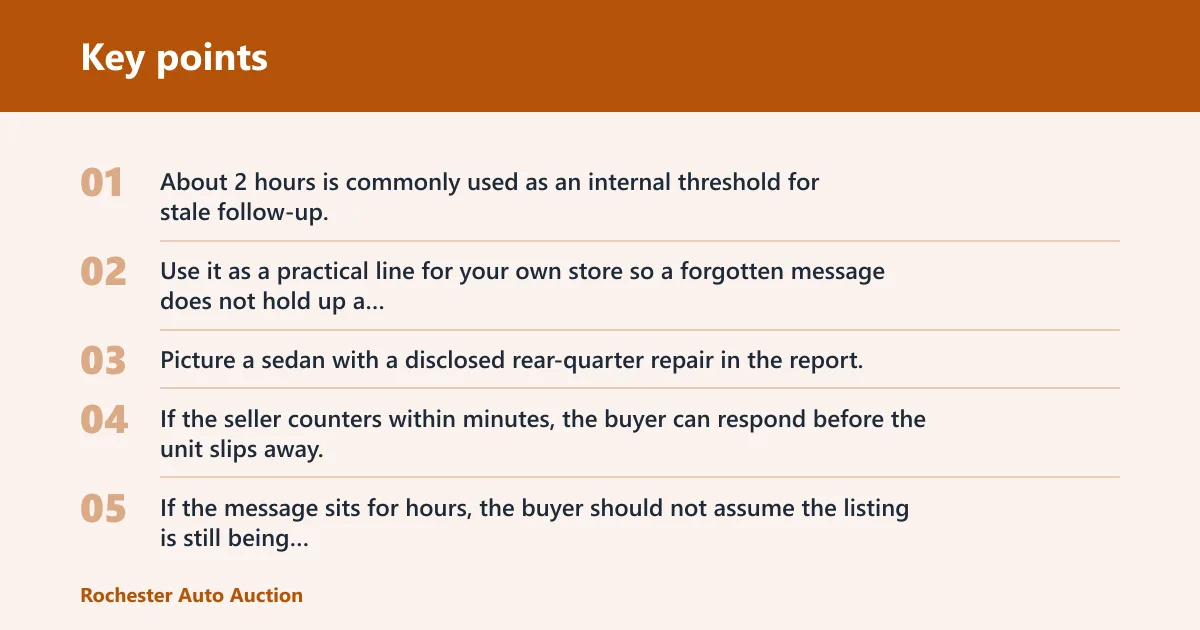
About 2 hours is commonly used as an internal threshold for stale follow-up, not a platform promise. Use it as a practical line for your own store so a forgotten message does not hold up a decision.
Picture a sedan with a disclosed rear-quarter repair in the report. If the seller counters within minutes, the buyer can respond before the unit slips away. If the message sits for hours, the buyer should not assume the listing is still being actively worked.
What does ACV mean in car auction?
In this context, ACV is the platform name tied to the online auction workflow. For shoppers asking what is ACV in auction or what does ACV mean in auto auction, the useful answer is that it identifies the marketplace and its message-driven buying process, not a separate vehicle condition label.
The term itself matters less than the action it triggers. If the status says “in negotiation,” the practical job is to check messages, track the offer, and decide your next move.
Frequently asked questions
What does “in negotiation” mean on ACV Auctions?
It means the listing is in an active back-and-forth stage, with a buyer offer, seller review, or counteroffer still open. The vehicle is not final yet. Check the listing, then check your inbox or notifications so you know whether to wait, revise, or move on.
Is “in negotiation” the same as a counteroffer?
No. A counteroffer is one possible event inside the negotiation. The status can also reflect an offer waiting for review, a reply delay, or another open step. Do not assume every negotiation status means the seller already sent a counter.
Can I still bid when a vehicle is in negotiation?
Not always. The status does not guarantee that fresh bidding is open at that moment. It means the listing is still in a live decision stage, so the safest move is to check the message thread and follow the platform’s current action buttons.
How long does negotiation usually take on ACV Auctions?
The timing can be short or delayed depending on how fast the buyer, seller, and staff respond. There is no safe universal timer to trust. Treat the status as time-sensitive and use inbox messages or push alerts to avoid missing the next step.
Who is negotiating on ACV Auctions, the buyer or seller?
Both sides can be involved, but the current move usually comes from the last party to act. A buyer may send an offer, then the seller reviews it, accepts it, rejects it, or counters. The app status reflects that live exchange.
What is the difference between negotiation and arbitration on ACV Auctions?
Negotiation is the pre-sale price or terms discussion. Arbitration is a post-sale dispute path for condition-related issues or disclosure concerns. If the deal is still open, it belongs in negotiation. If the sale is already complete and the issue is about condition, arbitration is the more likely path.