VIN Check for Auto Auctions: What to Verify
Run a VIN check before you bid: confirm the 17-character VIN matches the listing and photos, then verify title brand, odometer history, salvage or total-loss records, open recalls, and seller disclosures; any identity mismatch is a walk-away. Skip this step and you can end up with a junk title, odometer rollback, an unresolved theft record, or parts incompatibility that cuts resale value. This guide gives you a pre-bid sequence, shows what counts as caution, and explains when to bid, ask for proof, or walk away.
Start with identity, not damage. A VIN ties together title and history records, while photos and seller descriptions can be incomplete, old, or plain wrong. A VIN can confirm make, model, year, engine, and trim, but it cannot by itself prove current condition, repair quality, airbag status, or that every visible part still belongs on that vehicle.
That split matters at auction. Your order is simple: confirm identity first, then review title and mileage risk, then prior auction and registration risk, and only then decide if the car deserves deeper inspection or a bid ceiling.
What should you verify first in a VIN check?
Verify the VIN itself before reading any damage notes or seller claims. The first pass is mechanical: confirm the VIN is 17 characters, confirm the ninth character passes a check-digit validation, and decode year, make, model, engine, body style, and trim. If those basics do not match the listing, stop there.
Why identity comes before damage
A modern VIN is seventeen characters. The ninth character checks the VIN’s internal consistency. If the format is wrong or the check digit fails, the rest of the report is suspect because the record anchor may be wrong.
That first screen catches more than typos. It can expose a copied listing, a bad manual entry, or a masked vehicle identity that no amount of damage-photo review will solve.
Decode the fields that matter to a bidder
A VIN can confirm make, model, year, engine, and trim. For auction buyers, body style belongs in that same first review, even when the decoder labels it indirectly through series or configuration data.
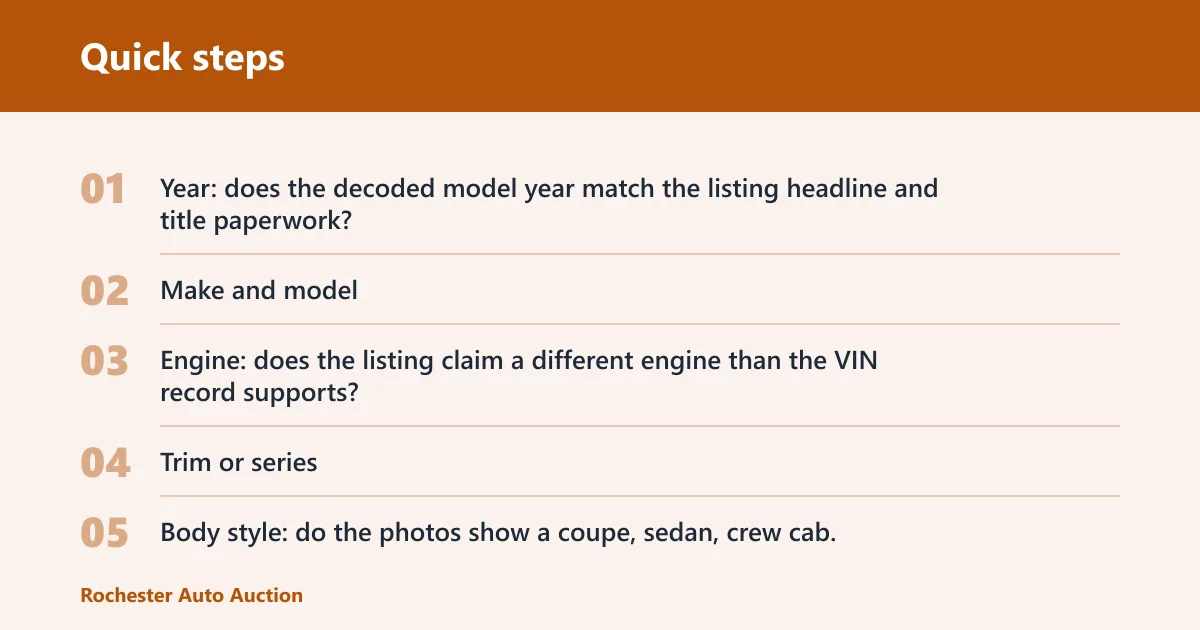
- Year: does the decoded model year match the listing headline and title paperwork?
- Make and model: does the record point to the exact vehicle family advertised?
- Engine: does the listing claim a different engine than the VIN record supports?
- Trim or series: is the car being priced like a higher trim than the VIN identifies?
- Body style: do the photos show a coupe, sedan, crew cab, or hatchback consistent with the VIN-based record set?
Trim and engine mismatches matter because they change value, parts fit, insurance assumptions, and resale. Many competing pages stop at year, make, and model. For an auction bid, that is too shallow.
What a VIN check can prove, and what it cannot
A VIN check can prove whether the identity data is internally consistent and whether title, odometer, and prior auction records attach to that identifier. It can also pull accident history, ownership timeline, title transfers, and reported odometer readings from a vehicle history report.
It cannot prove the photos are current, the airbags are present, the frame is straight, the listed options are still installed, or the repairs were done correctly. You still need photos, title documents, seller answers, or a physical inspection for those points.
Suppose a listing advertises a higher trim with leather, a turbo engine, and upgraded wheels, but the decoded VIN points to a lower trim and different engine. That is not cosmetic. It changes value, parts ordering, and likely resale, so the right move is to ask for proof or walk away.
Set the first decision
After the identity pass, place the vehicle in one of three buckets:
- Proceed: VIN length, check digit, and decoded details all match the listing.
- Ask: one detail is unclear, such as missing trim data or weak photos of badges.
- Walk away: VIN fails validation, or decoded year/make/model/body style conflicts with the listing.
How do you know the VIN matches the auction listing?
The VIN matches the auction listing when the identifier, decoded vehicle details, and visible VIN locations all point to the same car. Check the VIN in listing details, compare decoded year, model, engine, trim, and body style to the seller description and photos, and treat any conflict as either a proof request or a walk-away.
Where the VIN appears on auction platforms
Auction listings may show the VIN in listing details. Some platforms may partially mask the VIN until login. That matters because a stock number or lot number is not a substitute for the vehicle identifier used in title and history records.
Copart is identified as the largest US salvage auction. IAAI is named as Insurance Auto Auctions. Manheim often sits closer to dealer wholesale workflows, with disclosure depth that can differ from salvage-focused platforms. On all three, the VIN usually appears in listing details when available, but the amount of visible history can vary.
Where to compare the VIN beyond the text field
Use every VIN source you can get before bidding:
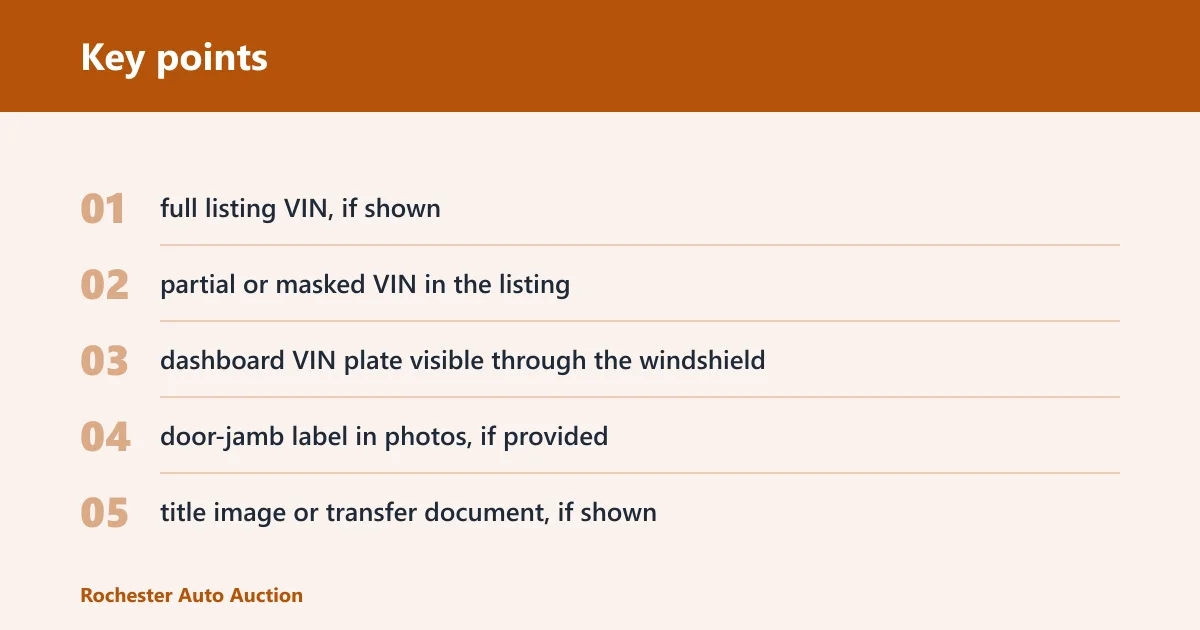
- full listing VIN, if shown
- partial or masked VIN in the listing
- dashboard VIN plate visible through the windshield
- door-jamb label in photos, if provided
- title image or transfer document, if shown
The dashboard and door jamb are the most useful physical checkpoints because they tie the paper record to the car on the lot. If neither appears in photos, you are leaning more heavily on the platform record and should price that uncertainty in.
Common mismatch failure modes
The usual failures are predictable:
- Year mismatch: headline says one model year, decoder shows another.
- Make or model mismatch: the listing text or lot title names the wrong vehicle family.
- Engine or trim mismatch: premium variant pricing attached to a lower-spec VIN.
- Body-style mismatch: VIN points to one configuration, photos show another.
- Physical VIN mismatch: dashboard or door-jamb VIN on the car does not match the listing VIN.
Seller-written descriptions create risk because they can be copied, shortened, or manually edited. Photos create a different risk because they may be incomplete or misleading. Trust the matched record chain, not the most optimistic text block.
Picture a lot photo set with twelve exterior shots but no dashboard close-up. The listing text says “rebuilt title,” while the VIN history points to salvage and a lower trim level. That is enough to pause bidding until the title image and physical VIN are confirmed.
What to do when records conflict
If the listing VIN and decoded data conflict, ask for additional proof, such as a clear dashboard VIN photo, door-jamb label photo, or title image. If the physical VIN conflicts with the listing or paperwork, walk away. That is not a pricing issue. It is an identity failure.
What can title and NMVTIS records tell you?
Title and NMVTIS records tell you whether the vehicle’s legal history creates repair, registration, financing, insurance, or resale risk before money is committed. They can reveal salvage, rebuilt, flood, junk, and certificate-of-destruction problems, and they help catch state-to-state title washing that a basic listing description may miss.
Read title brands as bidding instructions
Title brands to verify include salvage, rebuilt, flood, and junk. Certificate of destruction belongs in the same review because it can create registration blocks or end-use limits depending on the issuing state.
- Salvage: caution. The vehicle may be repairable, but registration, inspection, financing, and resale can be harder.
- Rebuilt: caution with paperwork review. The car may be road-eligible, but repair quality still needs separate proof.
- Flood: high caution. Registration may be possible, but corrosion, electronics, and mold risks sit outside what the VIN alone can prove.
- Junk: usually a walk-away for a road-use buyer because registration and resale options can collapse.
- Certificate of destruction: often an automatic walk-away for a buyer expecting a registerable vehicle.
State-specific issuing rules matter. One state’s branded title path is not always the same as another’s, which is why you should review both the current title status and your home-state registration rules before funds move.
How NMVTIS changes the review
NMVTIS is a national title data source that helps track title brands across states. For salvage buyers, that matters because it can expose title washing, where a severe brand is obscured or softened as the vehicle moves through different jurisdictions.
NMVTIS does not replace a vehicle history report. It strengthens the title-side review. The history report adds accident entries, ownership timeline, title transfers, and reported odometer readings that may not show the same way in every title-only source.
When a title finding is caution, and when it ends the bid
Use title records to separate priceable risk from non-priceable risk.
- Caution: salvage or rebuilt with consistent identity, a clear title path, and state registration eligibility you have already checked.
- Ask: title brand wording in the listing conflicts with title records, or the issuing state is unclear.
- Walk away: junk, certificate of destruction, or any title path that your state will not register for the intended use.
This is also where resale math shifts. Even if repair costs make sense, a hard title brand can depress resale, shrink the buyer pool, and limit financing or insurance later.
How do you read odometer history without overreacting?
Read odometer history as a pattern, not a single line item. Look for prior mileage readings, not-actual mileage flags, exceeds-limits flags, and sequence breaks, then grade the problem by severity. Some conflicts point to clerical error. Others suggest rollback risk and should end the bid.
What the report can show
Odometer flags can include not-actual and exceeds-limits. A vehicle history report may also show reported mileage at title transfers, inspections, service entries, or prior auction events.
Those records do not prove every mile on the vehicle is accurate, but they do show whether the mileage story is stable. Stable does not mean perfect. It means the sequence makes sense.
Mileage patterns by severity
- Minor caution: a single small mismatch surrounded by otherwise logical readings. This can be a clerical entry problem that still deserves a question.
- Serious caution: a later record showing lower mileage than an earlier record, with no documented cluster replacement or correction.
- Automatic walk-away: not-actual mileage branding tied to multiple inconsistent readings, or a rollback pattern that affects value and legal disclosures.
Exceeds-limits needs context. Older record systems could cap display ranges, and some entries reflect recording limits rather than fraud. Even so, an exceeds-limits flag typically lowers confidence and should reduce the bid ceiling unless the paperwork explains it clearly.
When mileage changes the maximum bid
If the mileage sequence is mostly consistent but one entry looks wrong, the right action is not always to walk away. Lower the maximum bid to account for resale uncertainty and ask for title documentation. If the seller cannot produce supporting paperwork, move the vehicle into the no-bid pile.
A common first-timer mistake is treating every discrepancy the same way. A single transposed entry is not equal to repeated drops in mileage across title events and auction runs. The first calls for proof. The second points to fraud risk.
How VIN-based mileage review fits with inspection
The VIN report can surface patterns. It cannot tell you whether the current odometer display works, whether the cluster was swapped correctly, or whether interior wear aligns with the stated miles. Those still need photos or an in-person check.
Why do prior auction records matter?
Prior auction records matter because they show whether the car has cycled through multiple sales, how it was described earlier, and whether damage notes or photos changed over time. Repeat auction appearances can point to unresolved title, condition, pricing, or repair issues that the current listing does not fully explain.
What prior auction history can reveal
A VIN can reveal prior auction appearances. That matters more than many guides admit, especially for salvage and insurance-related units where the current listing may be only one chapter of the vehicle’s sale history.
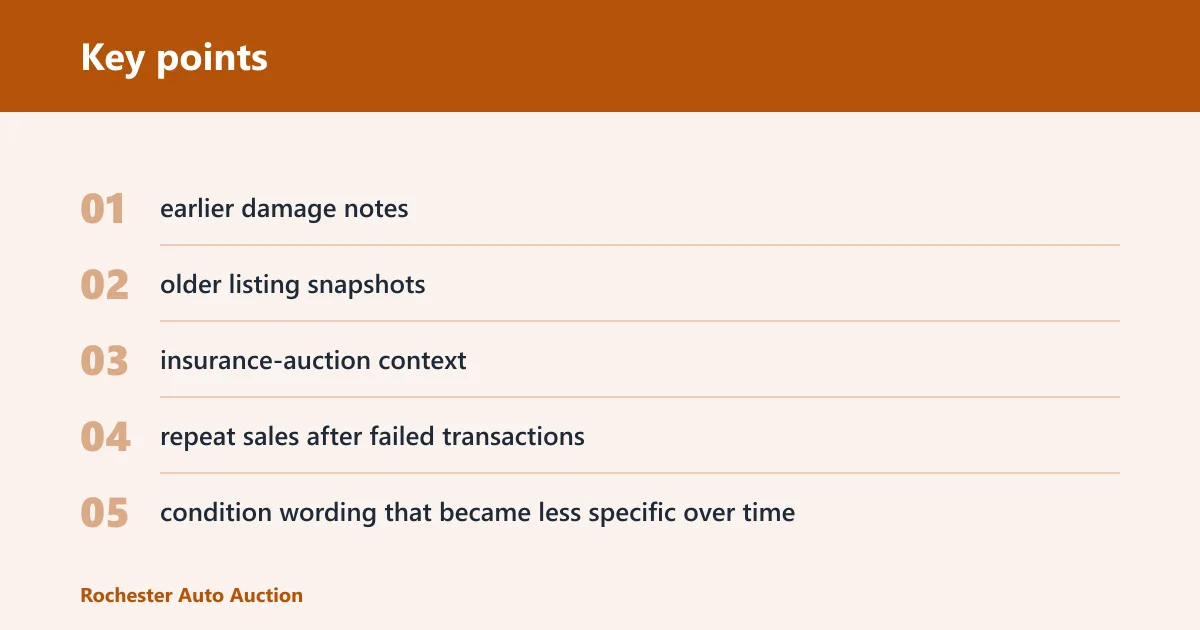
- earlier damage notes
- older listing snapshots
- insurance-auction context
- repeat sales after failed transactions
- condition wording that became less specific over time
How repeat cycles change the risk read
One prior appearance is not automatically bad. Several close-together appearances with unchanged damage and no sale completion can signal unresolved issues, title friction, transport problems, or a reserve that keeps missing the market.
If the older listing showed stronger disclosure than the current one, treat that as a caution. Less information later is rarely better for the buyer.
Insurance-auction context
Insurance-auction history changes the read because the total-loss decision reflects insurer economics, not just visible damage. A road-test or repair invoice still might not exist. That makes title review and physical VIN confirmation even more important before payment.
Pre-bid verification matrix
| Check | Pass/fail threshold | Auction action | Decision |
|---|---|---|---|
| VIN length and check digit | Pass if VIN is 17 characters and the ninth character validates internal consistency; fail on wrong length, invalid character set, or failed check digit | Do not review damage or pricing until this clears | Bid if pass; walk away if fail |
| Year, make, model, engine, and trim match | Pass if decoded fields match listing title, seller description, and visible body style; fail on year, variant, engine, or body-style conflict | Ask for dashboard VIN photo or title image if one field is unclear; stop on hard mismatch | Bid if match; ask if unclear; walk away on hard mismatch |
| Title brand | Pass only if title path fits intended use and home-state registration plan; fail on junk or certificate-of-destruction for a road-use buyer | Review issuing state rules and title image before bidding above parts value | Bid on acceptable brand; ask on unclear brand; walk away on unusable brand |
| Odometer consistency | Pass if readings follow a logical sequence with no not-actual or rollback pattern; fail on repeated lower later readings or unresolved not-actual branding | Lower bid cap for isolated clerical-looking issues; stop for rollback risk | Bid if consistent; ask on isolated conflict; walk away on fraud pattern |
| Prior auction history | Pass if history is limited or explained; fail if repeated auction cycles show worsening disclosure gaps or unresolved sale issues | Compare older listing snapshots and damage notes before bidding | Bid if stable; ask if unexplained repeat sale; walk away if risk compounds |
| VIN on car match | Pass if dashboard and door-jamb VINs match the listing and paperwork; fail on any physical mismatch | Require clear photos before payment; do not fund on assumption | Bid if match is likely and later confirm; ask for proof if missing; walk away on mismatch |
| Registration risk | Pass if home state can register the title status for intended use; fail if state rules block registration or inspection path is missing | Check state rules before payment and transport booking | Bid if registerable; ask if unclear; walk away if blocked |
What should you verify before payment and transport?
Before payment and transport, reconfirm the physical VIN on the dashboard and door jamb, match that VIN to the title or transfer document, and confirm the title status will not block registration in your state. The goal is to catch last-minute identity or paperwork problems before funds become harder to recover.
Pre-payment checks
Do the second-stage review only after the vehicle clears the pre-bid matrix.
- Match the listing VIN to the dashboard VIN photo.
- Match the dashboard VIN to the door-jamb label, if available.
- Match both to the title or transfer document.
- Confirm the title brand and issuing state on the actual paperwork.
- Check that any promised keys, disclosures, or documents appear in the sale record.
If the platform only showed a partial VIN before login, this is where the full record must line up cleanly. A masked listing is not a problem by itself. A masked listing that becomes a mismatched car is.
Pre-transport checks
Transport should follow paperwork confirmation, not replace it. Before booking a truck, make sure title release timing, storage fee rules, and your home-state registration path all make sense for the exact title status attached to that VIN.
Open recall review also belongs here as a separate check. Recall status is VIN-based, but it is not the same as a history report or title report.
Build your pre-bid verification sequence
Pre-bid
- Get the full VIN if possible; if masked, log in or request the complete identifier.
- Confirm 17 characters and validate the ninth-character check digit.
- Decode year, make, model, engine, trim, and body style.
- Compare decoded data to listing title, seller description, and photos.
- Review title brand and NMVTIS-backed title history.
- Review vehicle history for accident entries, title transfers, and odometer readings.
- Review prior auction appearances and older listing snapshots.
- Set the action: bid, ask for proof, or walk away.
Pre-payment
- Confirm the physical VIN on the dashboard.
- Confirm the VIN on the door-jamb label.
- Match the VIN to the title or transfer document.
- Recheck title brand wording and issuing state.
- Resolve any mileage or identity conflict before funds move.
Pre-transport
- Confirm title release timing and document delivery method.
- Confirm your state can register the branded title for intended use.
- Verify transport paperwork uses the same VIN as the sale record.
- Keep copies of listing details, VIN reports, and title images for later disputes.
For auction day triage, one competitor says to prioritize up to five vehicles before auction day. That is a sensible cap for manual review because VIN checking is comparison work, not report buying alone. Another competitor markets a full auction VIN report at $5, and one claims CARFAX and AutoCheck bundle pricing of $9.99; pricing varies, but the key point is to spend the small report cost before risking a large bidding mistake.
Frequently asked questions
What should I verify in a VIN check before I bid at an auto auction?
Verify the VIN format first, then decode and match year, make, model, engine, trim, and body style to the listing. After identity, review title brand, NMVTIS-backed title history, odometer pattern, prior auction appearances, and registration risk. Any hard identity mismatch is a walk-away.
How do I know if the VIN matches the auction listing?
The VIN matches when the listing details, decoded data, dashboard VIN, door-jamb label, and title paperwork all identify the same vehicle. Compare the seller description and photos against the decoded variant, not just the headline. Conflicts in year, trim, engine, or body style need proof before bidding.
What does a VIN check show on an auction car?
A VIN check can show decoded identity data, title brands, title transfers, reported odometer readings, accident entries, ownership timeline, and prior auction appearances. It can anchor the history to one vehicle. It cannot by itself prove current condition, repair quality, missing parts, or whether photos fully reflect damage.
Can a VIN check reveal salvage, flood, or rebuilt title history?
Yes, title history tied to the VIN can reveal brands such as salvage, rebuilt, flood, and junk, and NMVTIS helps track branded title records across states. State rules still matter, though. The same branded status can create different registration and resale consequences depending on where you plan to title it.
How do I spot odometer fraud from a VIN report?
Look for mileage sequences that move backward, not-actual mileage flags, exceeds-limits flags, and repeated inconsistencies across title or auction records. One odd entry can be clerical. Several lower later readings without supporting paperwork point to rollback risk and should usually end the bid.
Can I check an auction car’s VIN before I have the vehicle in hand?
Yes, in many cases. Auction listings may show the VIN in listing details, though some platforms may partially mask the VIN until login. You can still decode identity, review title and history records, and compare photos before seeing the car. Physical VIN confirmation still belongs before payment.