Rebuilt Title: What It Means and When to Buy
A rebuilt title means the car was previously declared a total loss, then repaired and state-inspected; buy only if repair records are solid, insurability is confirmed, and the price is roughly 20% to 40% below a comparable clean-title car. Ignore those checks and you can overpay for a car with hidden damage, limited financing, lower resale, or insurance trouble. This guide covers title status, repair proof, inspections, insurance, financing, resale, and the discount needed to make the risk worthwhile.
A rebuilt-title car makes sense only if the discount appears to cover the added risk. It is not an automatic bargain or an automatic pass. The right buy depends on repair records you can verify, an independent inspection, workable insurance and financing, and a discounted price that still beats a similar clean-title car over the years you expect to keep it.
How a vehicle gets a rebuilt title
A rebuilt title is a state-issued brand placed on a vehicle title after the car was previously branded salvage, repaired, and then passed the required post-repair inspection in that state. It does not mean accident-free, factory-certified, or repaired to original manufacturer standards, and it still affects resale, insurance, and financing.
What “rebuilt title issued” usually signals
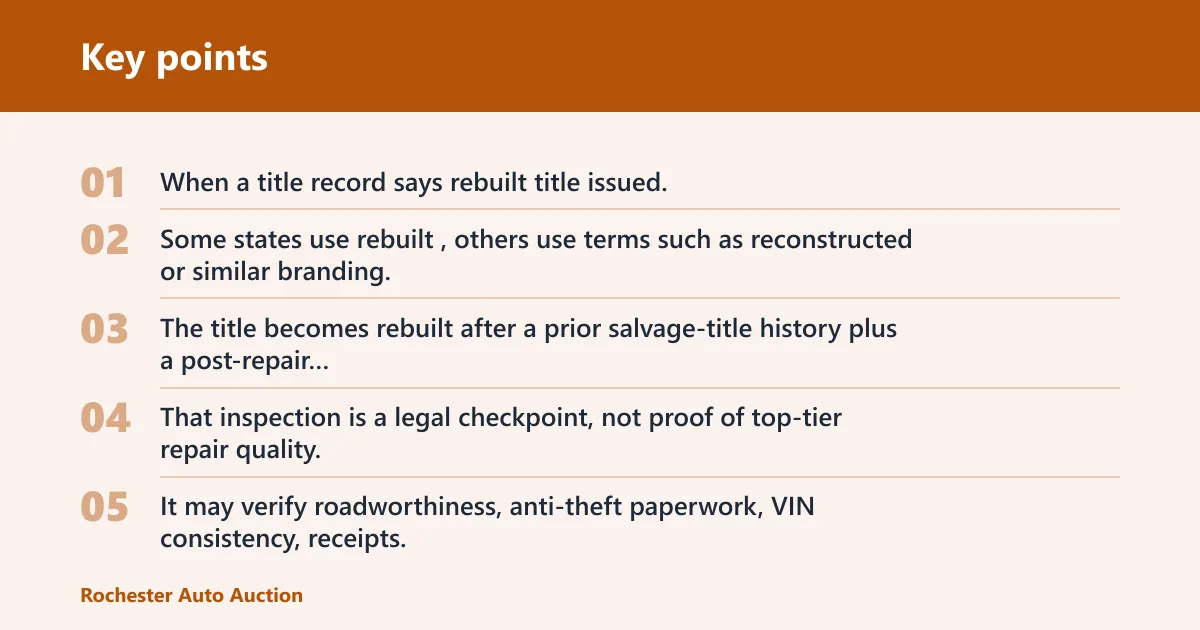
When a title record says rebuilt title issued, it usually means the vehicle had a prior total-loss event, was repaired, and then cleared through a state process so it could be legally registered and driven again. The exact wording varies by state. Some states use rebuilt, others use terms such as reconstructed or similar branding.
What makes a title rebuilt
The title becomes rebuilt after a prior salvage-title history plus a post-repair inspection under that state’s rules. That inspection is a legal checkpoint, not proof of top-tier repair quality. It may verify roadworthiness, anti-theft paperwork, VIN consistency, receipts, or major component replacement, depending on the state agency involved.
What the brand does and does not tell you
The brand tells you the vehicle crossed a total-loss threshold in the past and later met a state’s retitling requirements. It does not tell you how severe the original damage was, whether OEM or aftermarket parts were used, whether advanced driver-assistance systems were recalibrated, or whether the repair quality is good enough for long-term ownership.
How does a car get a rebuilt title?
A car usually gets a rebuilt title after an insurer or owner treats it as a total loss, the title is branded salvage, repairs are completed, and the state approves it through a post-repair inspection. The sequence sounds simple on paper, but total-loss thresholds, required receipts, and inspection scope change from one state to the next.
From total loss to salvage brand
A salvage title usually comes first before a rebuilt title. That brand commonly appears when damage, theft recovery, flood loss, hail loss, or another insured event pushes repair cost and value calculations past the state or insurer’s total-loss threshold. In many states, a salvage vehicle cannot be legally driven on public roads until it is repaired and retitled.
Repairs, receipts, and reinspection
After the salvage event, the vehicle is repaired and submitted for state review. The state may require parts receipts, labor invoices, VIN verification, photos, and proof that major safety systems were restored. That review is the basis for many rebuilt-title vehicles, but it is not the same as a detailed pre-purchase inspection done for you.
Why outcomes vary by state
Title brands are jurisdiction-specific labels. States can use salvage, rebuilt, flood, hail, theft, lemon, or junk brands, and those labels follow the vehicle record. One state’s inspection may be handled by a DMV, another by state police, and another by an authorized inspection station. Because the rules change by state, the title alone is never enough; the receipts, inspection forms, and title-history sequence need to line up with the current brand.
Rebuilt title vs salvage title: what is the difference?
A salvage title marks a vehicle as a prior total loss that usually cannot be driven legally until repaired and retitled, while a rebuilt title means that same vehicle later passed a state post-repair process and returned to road use. The salvage history still matters because the rebuilt brand does not erase the original loss.
Legal status and road use
Salvage is the “before repair” stage. Rebuilt is the “after state approval” stage. That is the clearest practical difference for a buyer. A salvage-title car is generally a repair project or parts vehicle. A rebuilt-title car is at least legally back on the road, subject to registration and insurance rules in your state.
Why the salvage event still matters
The original salvage event still shapes value and risk. A car rebuilt after hail may carry a different risk profile than one rebuilt after front-end structural damage or flood exposure. Buyers often focus too much on the word rebuilt and too little on the reason the title was branded in the first place.
Other title brands in the record
A vehicle history report may show more than one title brand over time. Flood, hail, theft recovery, lemon, or junk entries can appear alongside salvage or rebuilt history. Cross-check the current title, history report, and seller paperwork so the branding story matches from one document to the next.
Which rebuilt-title cars are higher risk?
Higher-risk rebuilt-title cars usually involve structural crash damage, flood history, missing airbag documentation, unresolved electrical issues, or title-history mismatches. Lower-risk cases can include some hail and theft-recovery vehicles, but even those still carry resale penalties because the buyer pool is smaller and many lenders and insurers stay cautious.
Major collision and structural damage
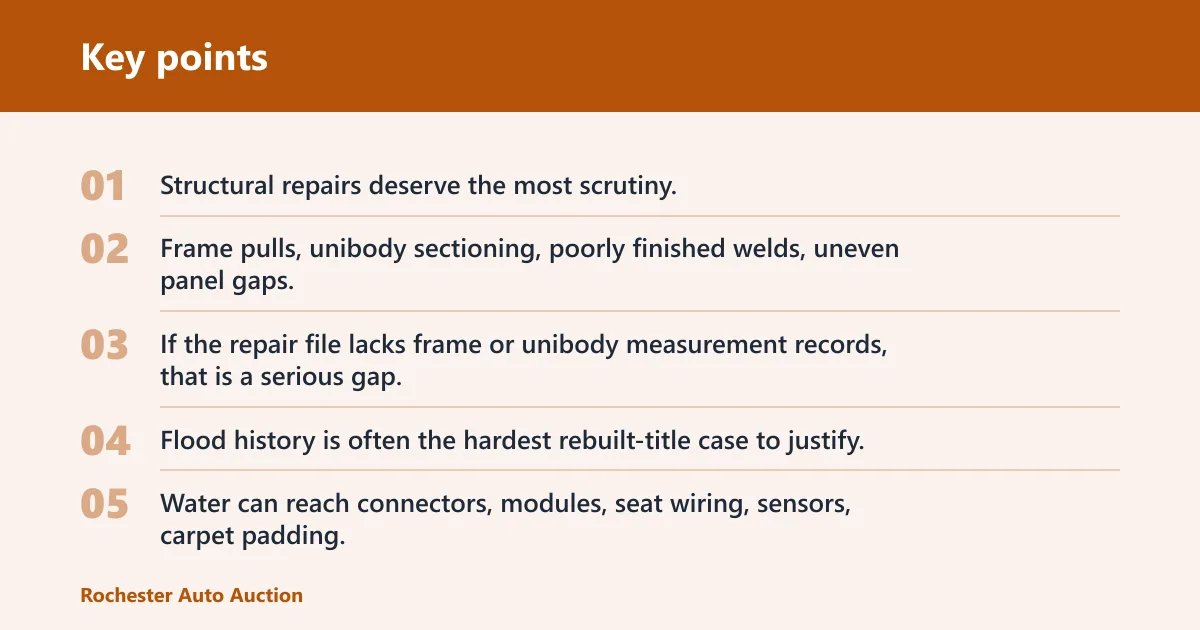
Structural repairs deserve the most scrutiny. Frame pulls, unibody sectioning, poorly finished welds, uneven panel gaps, and alignment problems can point to a vehicle that was restored to pass inspection but not restored especially well. If the repair file lacks frame or unibody measurement records, that is a serious gap.
Flood and water-related branding
Flood history is often the hardest rebuilt-title case to justify. Water can reach connectors, modules, seat wiring, sensors, carpet padding, and hidden cavities. A vehicle may drive normally during a short test drive and still develop corrosion, mold odor, intermittent warning lights, or communication faults months later.
Picture a compact SUV with a tidy engine bay and fresh carpet, but there is light oxidation on seat tracks, silt in a spare-tire well seam, and a musty smell when the air conditioning first turns on. That combination points toward water exposure, and a rebuilt discount alone does not make that risk attractive.
Hail, theft recovery, and other lower-impact cases
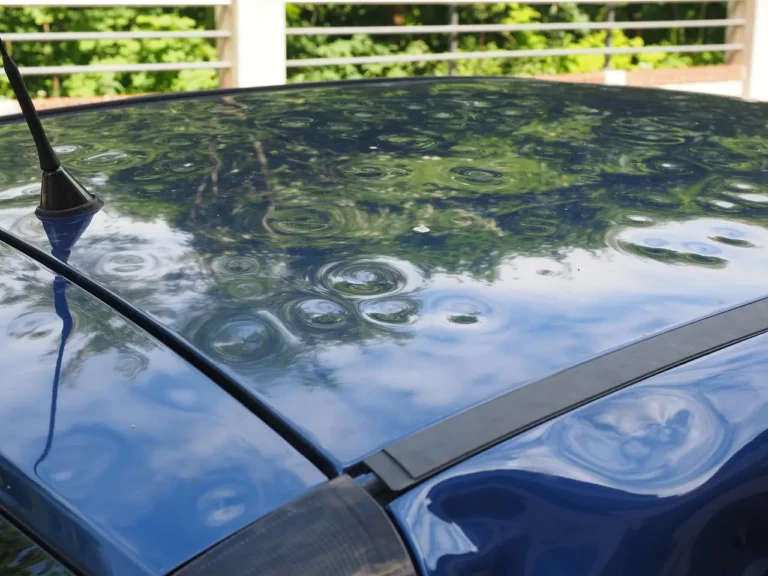
Some rebuilt-title vehicles were not totaled by a major crash. Hail can push repair costs high through panel replacement or paintless dent work. Theft recovery can lead to branding if the insurer paid out before the vehicle was found, even when the physical damage is limited to locks, trim, wheels, glass, or a stripped interior.
Why non-accident branding still hurts value
Even when the underlying damage seems less severe, the rebuilt brand still follows the record. That reduces resale value, narrows your future buyer pool, and often weakens trade-in offers. For a long-term owner those penalties may be manageable. For a resale-focused buyer, they often erase the appeal.
How do you verify repair quality before buying?
Before buying a rebuilt-title car, verify it with the current title, a vehicle history report, and repair documentation. Then use a rebuilt-specific inspection checklist and pay for an independent pre-purchase inspection. If the story does not line up across documents, condition, and inspection findings, treat that as a stop sign.
Match the title, VIN, and vehicle history report
Start with the current title and compare the VIN on the dashboard, door label, and paperwork. Then check a vehicle history report for salvage, rebuilt, flood, theft, or other branding events. Dates should make sense. If the title says rebuilt but the history report shows unresolved branding gaps or inconsistent state transfers, slow down.
Repair paperwork that actually matters
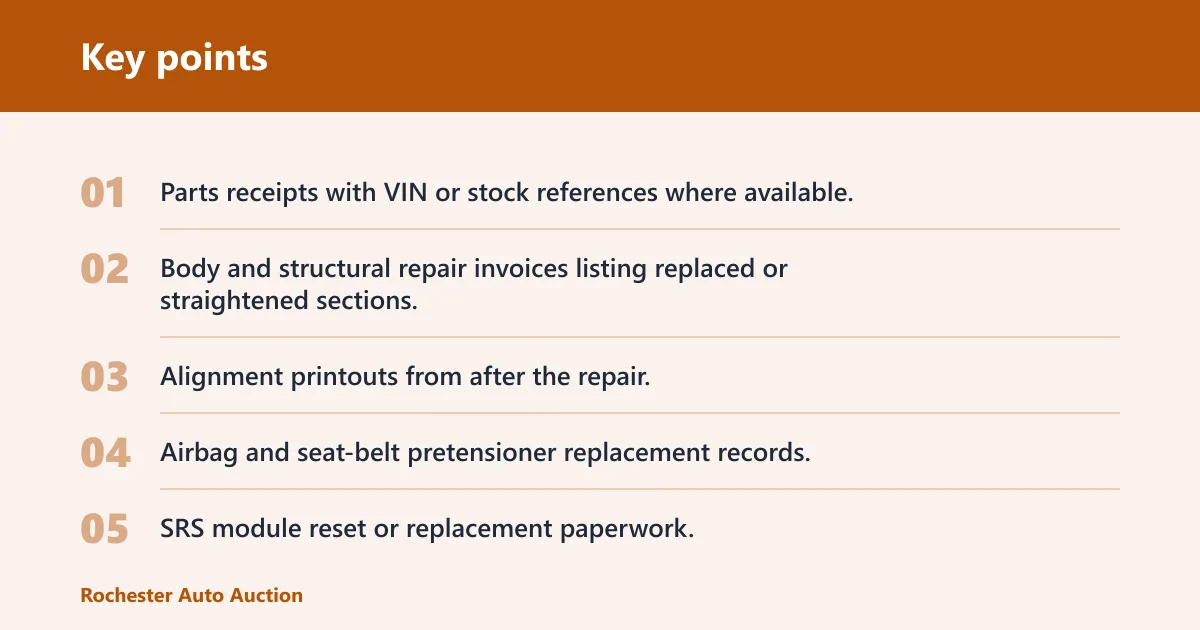
The most useful records are specific, not broad statements like “fully repaired.” Ask for:
- Parts receipts with VIN or stock references where available.
- Body and structural repair invoices listing replaced or straightened sections.
- Alignment printouts from after the repair.
- Airbag and seat-belt pretensioner replacement records.
- SRS module reset or replacement paperwork.
- ADAS calibration records for cameras, radar, blind-spot sensors, or parking systems.
- Photos from before, during, and after repairs.
Rebuilt-title inspection checklist
Use a checklist that targets the usual failure points after major repairs or water exposure. A state post-repair inspection is not enough for this step.
- Frame or unibody measurement records.
- Weld quality, seam sealer consistency, and underbody finish.
- Paint match across adjacent panels and inside jambs.
- Panel gaps at hood, fenders, doors, and liftgate.
- Airbag and SRS warning lights at startup and after the bulb check.
- Electrical functions: windows, locks, mirrors, HVAC, infotainment, cameras, sensors.
- Water intrusion signs in trunk wells, carpet backing, seat mounts, and connectors.
- Steering pull, wheel centering, vibration, and uneven tire wear.
- ADAS operation and calibration status if equipped.
Why an independent inspection still matters
An independent shop can put the car on a lift, scan modules, inspect repairs from underneath, and spot what a seller walkaround cannot. Ask for written notes on structural work, warning lights, rust or water evidence, and whether the shop sees any reason the car should be priced much closer to clean-title market.
Say your seller has a midsize sedan priced 28% below a clean-title equivalent and hands over paint receipts, but nothing for airbags, alignment, or ADAS calibration. The discount looks strong until the inspection finds a replaced front bumper, a stored SRS code, and steering that is slightly off-center. That becomes a negotiate-hard or walk-away case, not an easy buy.
What does it cost to own a rebuilt-title car?
Owning a rebuilt-title car can cost less up front but more in insurance friction, tighter financing, lower trade-in value, and a longer sale process later. The right comparison is total ownership cost against a similar clean-title car, not the purchase price alone, because the discount does not automatically carry through every other cost.
Insurance availability, coverage limits, and payout issues
Liability coverage is often easier to place than collision and comprehensive on a rebuilt-title vehicle. Some carriers want extra underwriting, photos, inspections, or valuation review before writing physical-damage coverage. Premiums may not fall in proportion to the lower purchase price, and claim settlements can become contentious because actual cash value on branded-title vehicles is lower.
Financing limits and loan-to-value friction
Many banks and credit unions treat salvage and rebuilt collateral more cautiously. Some will not lend at all. Others shorten the loan term, require more money down, or lend against a lower internal vehicle value than the asking price. If a lender finances only part of the deal, the rebuilt discount can disappear into extra cash out of pocket.
Resale, trade-in, and time-to-sell penalties
Rebuilt-title vehicles usually sell for less than comparable clean-title cars, and that discount often widens at trade-in. Dealers know the next buyer pool is smaller and appraisals are harder. Private-party resale can work, but expect more questions, slower responses, and a lower ceiling even when the car has been trouble-free during your ownership.
Compare total ownership, not sticker price
A common rule of thumb is to start considering rebuilt-title vehicles only when the discount is at least 20% to 40% below a comparable clean-title example. The lower end fits well-documented, cleanly inspected cars with workable coverage. The higher end fits cases with weaker resale prospects, limited lender interest, or any uncertainty around structural or electronic repairs.
When is it smart to buy a rebuilt-title car?
It is smart to buy a rebuilt-title car only when the discount is large enough to offset risk, the repair story is documented, an independent inspection is clean, and insurance and financing are already confirmed. That usually fits long-term ownership better than quick resale, and some buyer types should be stricter than others.
Daily driver
A daily driver needs the toughest standard because reliability, safety-system function, and insurance continuity matter every day. For this buyer, rebuilt only makes sense when documentation is complete, inspection findings are minor, and the discount is closer to the strong end of the 20% to 40% range.
Short-term commuter
A short-term commuter buyer may accept cosmetic imperfections or a hail-history rebuild if the mechanical condition checks out and insurance is easy to place. This buyer still needs to account for weak resale in a year or two. A modest discount is usually not enough because the ownership window is short.
Project car
A project car can tolerate more risk because the buyer expects extra work and usually values purchase price more than trade-in strength. Even here, flood history and missing airbag records remain poor bets. A rebuilt title is no substitute for careful chassis, rust, and parts-availability checks.
Resale-focused buyer
This is the least suitable buyer segment for rebuilt-title vehicles. Lower private-party value, weaker trade offers, and narrower financing options for the next buyer all work against a quick flip or easy exit. In many cases, a clean-title car bought at a fair market price is the stronger financial move.
Cases where a clean-title alternative wins
If a clean-title equivalent costs only slightly more, the cleaner car often wins once you factor in financing flexibility, easier insurance, stronger resale, and less time spent proving the vehicle’s history to future buyers. That is especially true for late-model cars loaded with cameras, radar, and expensive safety electronics.
Branded-title decision matrix
Use this matrix after you have a clean-title price baseline, the paperwork file, the independent inspection result, and answers from insurers and lenders. It is built to turn a vague “maybe” into a concrete buy, negotiate, or walk-away decision.
Buyer decision table
| Discount vs clean-title comparable | Repair documentation present | Inspection result | Insurance availability | Lender approval | Recommended action |
|---|---|---|---|---|---|
| Under 20% | Complete file | Clean, no structural or SRS concerns | Liability and collision confirmed | Approved | Negotiate or choose clean-title instead |
| 20% to 25% | Complete file | Minor cosmetic notes only | Liability and collision confirmed | Approved | Negotiate |
| 25% to 30% | Complete file with airbag, alignment, ADAS records | Clean independent inspection | Liability and collision confirmed | Approved | Buy |
| 30% to 40% | Mostly complete, one minor gap explained | Clean or minor service items only | Liability confirmed, collision subject to underwriting | Approved or cash purchase | Buy if ownership will be long-term |
| 30% to 40% | Partial file, missing key safety records | Small warning signs, no proof of calibration | Liability only or uncertain collision | Conditional approval | Negotiate hard or walk away |
| Any discount | Missing or conflicting records | Structural concerns, flood evidence, SRS issues, unresolved warning lights | No suitable coverage | Denied | Walk away |
Short scoring guide
Give one point each for: at least 25% discount, complete repair records, clean independent inspection, collision coverage confirmed, and lender approval or a no-financing cash plan. A total of 5 points is a buy case. 3 to 4 points is a negotiate case. 0 to 2 points is a walk-away case.
When should you walk away?
You should walk away when the car’s repair story cannot be proven, the inspection finds structural, flood, airbag, or electrical red flags, or suitable insurance and financing are unavailable. A rebuilt title works only when uncertainty is low and the discount is large; unresolved safety or paperwork questions break that math fast.
Missing records and title-history conflicts
Walk away if the seller cannot produce basic repair evidence, if the VIN story does not match across title and history report, or if key events appear out of order. Missing airbag invoices, missing alignment proof after front or side impact work, and unexplained state-to-state title jumps all raise the risk sharply.
Structural, flood, airbag, and electrical red flags
Poor welds, crushed pinch welds, visible unibody wrinkles, corrosion in interior hardware, damp carpet backing, mildew odor, warning lights that do not cycle normally, and inoperative safety electronics are all strong no-buy signals. A state inspection does not erase those concerns, and neither does a large sticker discount.
Insurance or lender dead ends
If no carrier will write the coverage you need, or if every lender declines the collateral, the car is telling you something about future ownership friction. The lower purchase price does not fix that problem. In most markets, that is the point to step back and shop a clean-title alternative.
Frequently asked questions
What does rebuilt title issued mean?
It usually means the state issued a title showing the vehicle had a prior salvage history, was repaired, and then passed that state’s post-repair process. It does not mean the car is accident-free or restored to OEM standards. It means the car is legally back in service with a permanent brand on its record.
What constitutes a rebuilt title
A rebuilt title generally requires a prior salvage brand, completed repairs, supporting receipts or invoices, and a state-administered inspection or verification step. The exact threshold depends on state rules. The current title brand, the vehicle history report, and the repair file together tell you whether that rebuilt status makes sense.
Can you get insurance on a rebuilt title car?
Usually yes, but coverage varies. Liability is often easier to obtain than collision and comprehensive, and some carriers ask for extra photos, inspections, or underwriting review. The key question is not only whether coverage exists, it is whether the coverage type, premium, and claim-value treatment still make the purchase worthwhile.
What problems should you look for on a rebuilt title car?
Look for structural repair signs, flood evidence, missing airbag records, unresolved warning lights, poor paint match, uneven panel gaps, bad welds, water intrusion, electrical faults, steering pull, uneven tire wear, and missing ADAS calibration proof. Those issues matter more on a rebuilt-title car because the prior loss event already raises the baseline risk.
Rebuilt title vs salvage title: what’s the difference?
A salvage title marks a prior total-loss vehicle before legal return to the road. A rebuilt title means that same vehicle was repaired and later passed a state retitling process. Rebuilt is road-legal status; salvage is pre-repair status. The original salvage event still affects value, insurance, financing, and resale either way.