How to Check VIN and Title Match Before You Buy at Auction
By an auction-title editor — Before you bid, match the title VIN to the windshield plate, door-jamb label, and any secondary stamp. If one digit differs, stop. A mismatch can mean a bad title, a swapped body, cloned VINs, or a costly unwind after sale. Use the checklist below to verify the vehicle’s identity in under 10 minutes.
Before you bid
Start with the full VIN, the title, and the lot listing before you step onto preview day. On road vehicles built since 1981, the VIN is 17 characters long, and the characters should match exactly across the paperwork and physical locations. A missing digit, an altered label, or a brand that does not fit the story is enough to pause. Use the free recall lookup, VINCheck, and an NMVTIS consumer-access report as core public screens, but they do not replace a hands-on VIN match.
- Get the full VIN from the listing, seller packet, or title before you travel.
- Save or print the title details, including any brand language.
- Use this inspection order: windshield VIN, door-jamb label, secondary stamp, then paperwork.
- Reserve time for free recall and theft checks before you bid.
- Stop if the title, listing, and vehicle identity do not line up.
What you’ll need
- Flashlight
- Phone camera
- Saved or printed VIN and title details
- Access to NHTSA recall lookup
- Access to NICB VINCheck
- Access to an NMVTIS-based title report source
How do you compare the VIN to the title?
Read the title VIN character-for-character against the vehicle before you bid. Check the seller name or selling authority too, because the right VIN with the wrong seller can still be a problem. If the title is incomplete, altered, or does not clearly connect to the lot, pause and ask for clarification before you spend. For title-brand context, consumer-access materials can help show that brands can affect value, insurance, and transferability.
- Read the title VIN one character at a time.
- Match it to the dashboard VIN plate through the windshield.
- Confirm the seller name matches the authority to sell.
- Look for title brands such as salvage, rebuilt, flood, junk, or lemon law buyback, if present.
- Stop if any character, name, or brand detail conflicts with the vehicle.
What the title should tell you
The title should match the vehicle VIN and should clearly show who has the right to sell it. Title branding matters because salvage branding can affect safety, resale, and insurability. A clean-looking title with a brand hidden elsewhere in the paperwork is a red flag, not a detail to ignore. NMVTIS consumer-access guidance is useful here because it is built to surface title history and title brands, while state title records remain the controlling documents.
Where should you inspect the vehicle VIN?
Use more than one physical location. The dashboard VIN visible through the windshield is a common first checkpoint. Then compare the driver’s door-jamb label, and, if the make uses one, an engine bay or firewall stamp. A one-location check misses swapped panels, replacement tags, and forged plates. The exact secondary locations vary by make, so always confirm the model’s factory VIN placement before preview day.
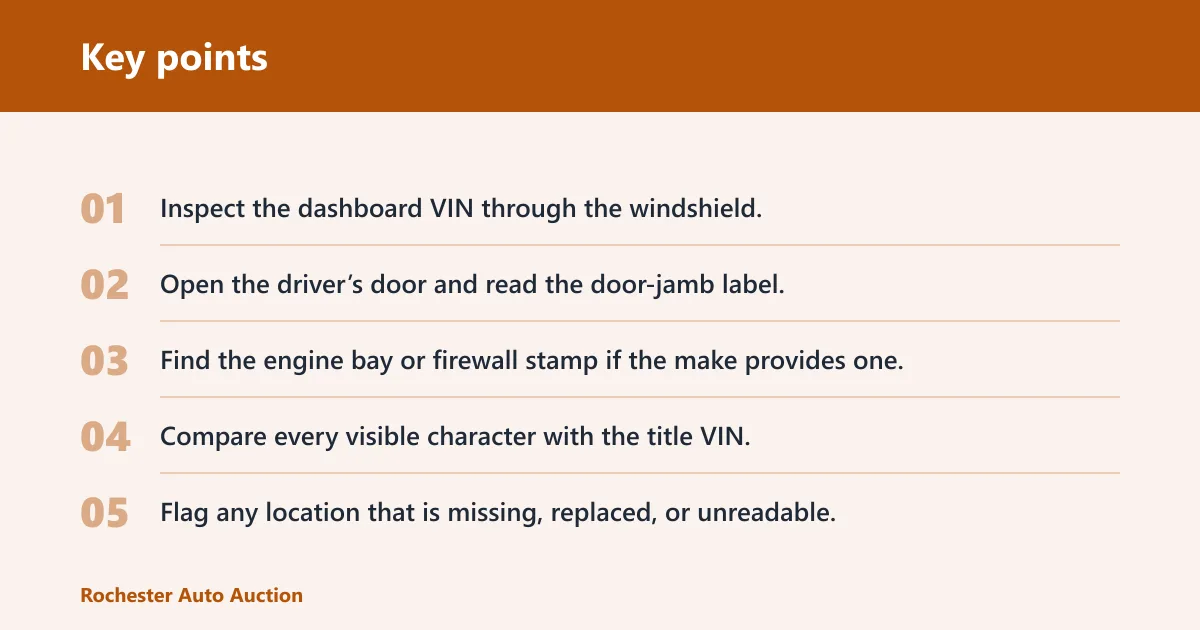
- Inspect the dashboard VIN through the windshield.
- Open the driver’s door and read the door-jamb label.
- Find the engine bay or firewall stamp if the make provides one.
- Compare every visible character with the title VIN.
- Flag any location that is missing, replaced, or unreadable.
Dashboard plate signs to watch
The dashboard VIN plate should look factory-installed. Scratched fasteners, disturbed trim, uneven adhesive, or tool marks around the plate are tampering clues. A plate that looks newer than the surrounding interior is another warning sign. If the plate itself seems out of place, verify the other VIN locations before going further.
Can a door-jamb VIN sticker be legitimate?
Yes, a mismatched or replaced door-jamb sticker can be legitimate after body repair, but it needs context. A new-looking label on an old vehicle, or a label on a panel that does not fit the rest of the car, deserves scrutiny. Treat the repair story as unproven until the other VIN locations agree.
Say your lot car has a door that looks recently painted, but the dashboard VIN and title match. That can still be a repair-related replacement. If the door-jamb label is new and the fasteners, paint edge, and secondary stamp all disagree, the repair explanation is weaker. A legitimate repair will usually show a coherent pattern; cloned VINs and tampering often leave one or more mismatched clues, such as inconsistent fasteners, uneven label aging, or a missing secondary stamp.
VIN title match checklist
Use this table on your phone during preview day. If one item fails, note the cause before you bid. A mismatch is treated as an immediate stop. For history verification, use the NMVTIS history report together with the free screens, then check the report date before you rely on it.
| Check | Where to inspect | Pass / fail signs | Red-flag cause | What to do next |
|---|---|---|---|---|
| Dashboard VIN | Through the windshield | Matches title exactly; plate looks factory-installed | Scratched fasteners, disturbed trim, loose plate | Compare to door-jamb label and secondary stamp |
| Door-jamb label | Driver’s door jamb | Matches dashboard VIN character-for-character | Swapped door, replacement label, fresh adhesive on old trim | Check for repair records or inspect other VIN locations |
| Secondary VIN stamp | Engine bay or firewall | Matches dashboard VIN exactly | Missing stamp, partial stamp, ground metal | Pause and verify the lot identity |
| Title VIN | Paper title or seller packet | Matches every vehicle VIN location | One-digit difference, swapped digit, altered paperwork | Ask for corrected documents before bidding |
| Seller authority | Title holder and auction paperwork | Seller name connects to the right authority to sell | Missing assignment, incomplete chain of title | Do not bid until the paperwork is complete |
| Title brand | Front and back of title, if present | Brand matches the vehicle history | Salvage, rebuilt, flood, junk, lemon law buyback | Compare with NMVTIS and the listing story |
| NHTSA recall | Free recall lookup by VIN | No open recall, or a clear recall record | Open safety recall not mentioned by seller | Note the recall status before you bid |
| NICB VINCheck | Free public theft/salvage screen | No theft or salvage hit on the tool’s data | History gap, insurer not participating | Do not treat a clean result as full proof |
| NMVTIS report | Consumer report from an approved provider | Title brands and history align with the title | Coverage gap, older report date, missing event | Check report date and compare with paperwork |
| Auction listing | Lot sheet and seller notes | Listing, title, and VIN all agree | Reconsigned lot, export note, missing paperwork | Stop and resolve the mismatch before bidding |
What title brands should you look for before you buy at auction?
Look for salvage, rebuilt, flood, junk, total loss, or lemon law buyback language anywhere on the title or report, if it appears. These brands can carry over through title history and they matter for value and insurability. A matching VIN does not erase a brand, and a clean-looking title does not cancel older branding in the record. Title-brand history also matters because title washing can hide a vehicle’s past when a branded vehicle is retitled in another jurisdiction or after document manipulation.
Use the brand to frame the bid
Brand language should affect how you value the car and whether you can insure it the way you expect. A salvage brand on the current title is not a side note. Compare it with the seller’s explanation and with the report, because brand history often follows the VIN through later transactions. If the title story seems too clean for the vehicle’s condition, the safer assumption is that more digging is needed before bidding.
What free VIN checks should you run before you pay?
Run the free checks first, then pay for a history report if the vehicle still looks like a serious candidate. The free VIN recall lookup and VINCheck are public screens for recall and theft/salvage concerns. Neither one proves the vehicle has never been damaged or stolen, so a clean result is only a screen rather than final proof. For a title-history layer, use NMVTIS consumer access information from an approved provider, because it is designed to surface title brands and prior title events across state records.
- Enter the VIN into NHTSA recall lookup and note open recalls.
- Run NICB VINCheck and save the result.
- If the vehicle still qualifies, order an NMVTIS-based report from an approved consumer access provider.
- Compare the report date, brands, and events against the title and lot sheet.
How do you tell if a VIN report is missing auction or salvage history?
Look at the report date, the coverage notes, and whether the brands on the title appear in the report. NMVTIS is a useful US title-history starting point, but reports can miss events if the record set is incomplete or outdated. A clean result from one database does not override a branded title or a suspicious physical inspection.
What should you do if the VIN, title, and listing do not agree?
Treat the disagreement as a stop signal. Common causes include swapped doors, cloned VINs, title washing, reconsigned stock, or missing paperwork, but a repair story only matters if the evidence supports it. If the mismatch cannot be explained with documents and matching physical VINs, do not bid. The best rule is simple: no clean identity match, no safe purchase.
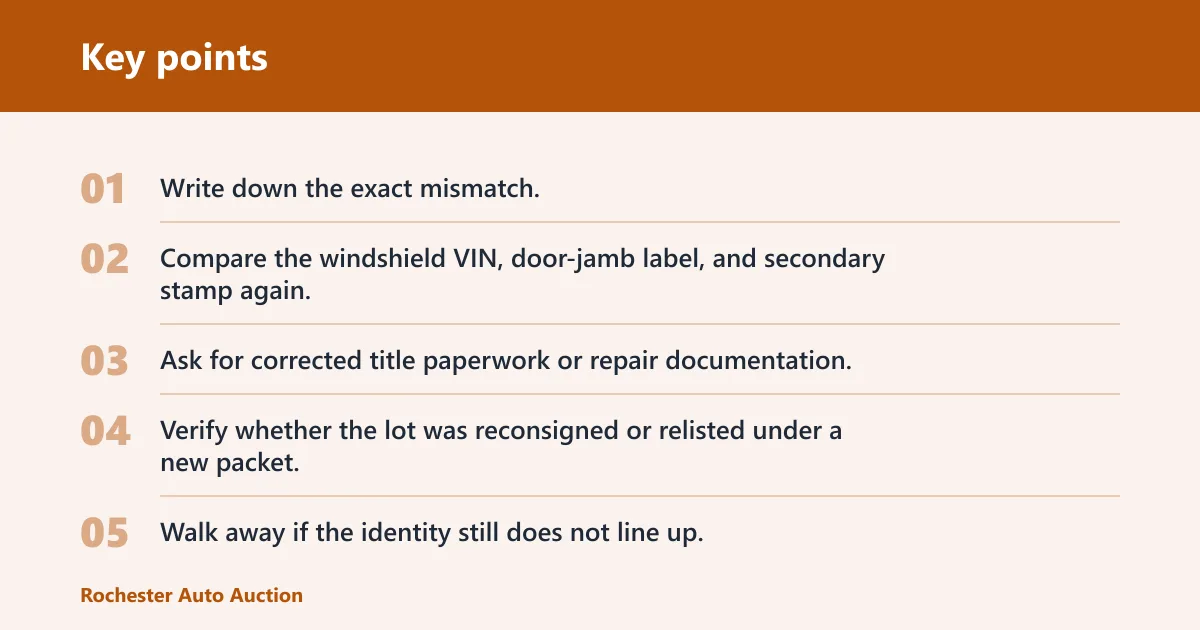
- Write down the exact mismatch.
- Compare the windshield VIN, door-jamb label, and secondary stamp again.
- Ask for corrected title paperwork or repair documentation.
- Verify whether the lot was reconsigned or relisted under a new packet.
- Walk away if the identity still does not line up.
Common first-timer mistake
Picture a buyer who sees a clean dashboard VIN and a clean NICB result, then bids without checking the door-jamb label. If that label was replaced during a door swap, the mismatch shows up only after the sale. One clean screen is not enough when the paperwork, body panels, and title history all matter.
Bid / verify / walk away decision tree
If the title VIN matches every visible VIN location and the brand story is consistent, bid with your normal limits. If the vehicle has a plausible repair explanation but one detail is still unclear, verify with documents, NMVTIS history, and a closer look at the suspect area. If the VINs disagree, the brand is hidden, or the paperwork chain breaks, walk away.
Common mistakes
Most problems start with speed. Buyers trust one VIN location, ignore branding, or accept a seller story before the title and body agree. The fix is simple: inspect multiple VIN locations, read the brand language, and use the free screens before you commit.
- Trusting only the windshield VIN
- Ignoring branded-title language
- Assuming a clean recall or theft screen proves the whole history
- Bidding before checking the physical vehicle
- Overlooking missing paperwork or an incomplete seller chain
When can an auction house unwind a sale for title or VIN issues?
Read the house rules before bidding, because the remedy window and documentation standard can vary.
Frequently asked questions
How do I check if the VIN on the car matches the title before bidding?
Read the title VIN against the dashboard plate, then confirm the door-jamb label and any secondary stamp. If every character matches and the seller name fits the authority to sell, proceed to the history checks. Any one-digit difference should stop the bidding process immediately.
Where should I look for the VIN on an auction vehicle?
Start with the dashboard VIN visible through the windshield. Then inspect the driver’s door-jamb label and, where available, the engine bay or firewall stamp. These locations help confirm the same vehicle across multiple points, which matters when a plate or panel may have been changed.
What VIN mismatch signs suggest the car has been tampered with?
Watch for scratched fasteners, disturbed trim, uneven adhesive, ground metal around a stamp, or a door-jamb label that looks newer than the rest of the car. A mismatch between the windshield plate and a secondary location is especially serious when there is no clear repair record to explain it.
Can a mismatched door-jamb sticker ever be legitimate after body repair?
Yes, a replacement sticker can be legitimate after a panel or body repair, but it needs supporting evidence. The dashboard VIN, secondary stamp, and paperwork should still agree. A new-looking label on old trim without documentation is enough to keep you from bidding.