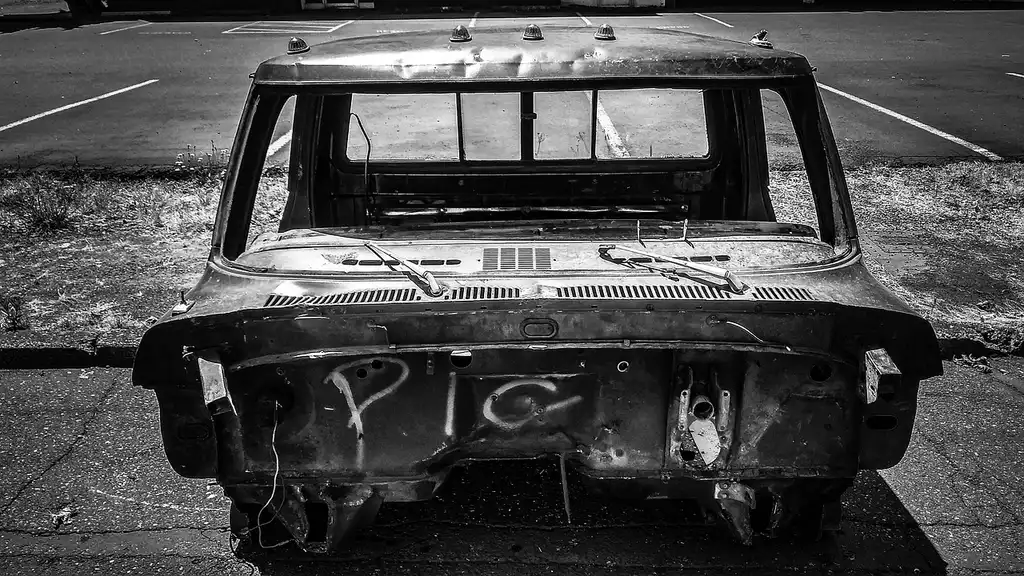
Salvage Title vs Rebuilt Title: What Is the Difference?
Salvage title means an insurer or state has declared a vehicle a total loss; rebuilt title means that same vehicle has been repaired and passed the required inspection, so the title can be returned to road use. Skip the distinction and you can buy a car that still cannot be registered, insured, or financed normally. This guide explains salvage title vs rebuilt title, the legal status of each, and the documents and inspections usually needed before a repaired vehicle can be titled or registered.
| Decision factor | Salvage title | Rebuilt title | Winner |
|---|---|---|---|
| Legal status | Declared a total loss; not ready for normal road use until repaired and inspected in many states. | Former salvage vehicle that has been repaired and cleared by any required inspection. | rebuilt title |
| Registration readiness | Often cannot be registered right away because repair and inspection steps are still pending. | Can be closer to registration, but only after state-specific paperwork and inspection are complete. | rebuilt title |
| Buyer risk | Higher. Damage history is unresolved, and the vehicle may still need major work. | Lower than salvage, but the branded history remains and repair quality still matters. | rebuilt title |
| Insurance and resale friction | Typically harder to insure, finance, and resell. | Still can face insurance, lending, and resale friction, but often less than salvage. | rebuilt title |
| Best use case | Parts car, project car, or buy only if you can verify every repair step and state rule. | Road-use candidate if the inspection is documented and the repair record makes sense. | rebuilt title |
Salvage title vs rebuilt title

What each title means in plain terms
A salvage title marks a vehicle as a total loss, often after major damage or an insurance payout tied to repair cost versus market value. A rebuilt title means the vehicle was once salvaged, then repaired and inspected enough to return to road use. That is the sequence: total loss first, repaired and cleared second.
The difference matters because title status changes the next step. Salvage usually means more work, more paperwork, and more uncertainty. Rebuilt still carries branded history, so it is not the same as clean title, but it can move from project status to roadworthy status if the state accepts the repairs.
Why the difference matters to buyers
Buyers should treat salvage as the higher-risk stage because it may still hide unresolved structural, safety, or theft-related issues. Rebuilt is better only if the repairs were real, the inspection was passed, and the paperwork matches the vehicle. Price alone does not settle the question.
Suppose a sedan took front-end damage in a collision and the insurer declared it a total loss because the repair estimate ran close to market value. If the owner later replaces the damaged parts, documents the work, and clears the state inspection, the title can move from salvage to rebuilt. If the repairs are only cosmetic, that move should not be trusted.
| Salvage vs. Rebuilt: buyer checklist | Title status | What it means | Required inspection | Likely documents | Insurance friction | Resale impact | Red-flag scenarios |
|---|---|---|---|---|---|---|---|
| Salvage title | Total-loss brand | Vehicle was written off and is not yet cleared for ordinary road use. | State salvage inspection before retitling in states that require it | Salvage certificate, proof of ownership, repair receipts, state paperwork | High | Usually lower than clean-title vehicles | Missing receipts, no inspection plan, frame damage with no repair proof |
| rebuilt title | Post-repair branded history | Former salvage vehicle repaired and cleared for road use under state rules. | Required in some states before title or registration | Inspection certificate, salvage certificate, proof of ownership, repair receipts | Moderate | Usually lower than clean-title vehicles | Inspection done in a different state with different rules, vague repair record, damaged VIN plate |
📊 The Maryland salvage inspection fee is $75. Source: Maryland.
How does a salvage title become rebuilt?
From total loss to repaired vehicle
A salvage title car can become a rebuilt title if repairs are completed and the state permits retitling after inspection. The vehicle has to move from declared total loss to verified roadworthy condition. That means the damage must be fixed, and the title paper trail must match the repair work.
Total loss is an insurance-company decision tied to repair cost versus market value. Once a vehicle crosses that threshold, many states brand it salvage. After repairs, the owner usually needs the right salvage certificate, ownership proof, and inspection result before the title can change.
When inspection is required before retitling
Some states require a salvage inspection before a repaired vehicle can be titled or registered. Maryland is a clear example: it requires salvage inspection before you can get a title or registration for a salvage-declared vehicle. That is the gate between repair work and legal road use.
A common first-timer mistake is assuming the title flips back the moment the body shop finishes the work. It does not. The state may still want proof of ownership, repair receipts, and a vehicle that is fully repaired and roadworthy before it will move the title forward.
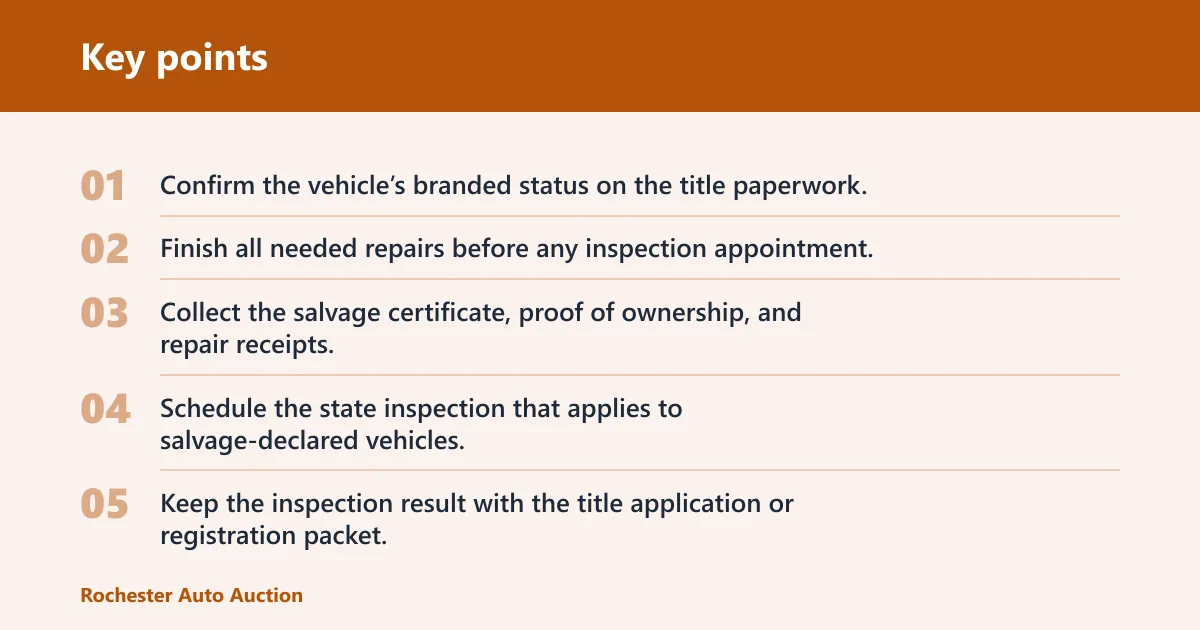
- Confirm the vehicle’s branded status on the title paperwork.
- Finish all needed repairs before any inspection appointment.
- Collect the salvage certificate, proof of ownership, and repair receipts.
- Schedule the state inspection that applies to salvage-declared vehicles.
- Keep the inspection result with the title application or registration packet.
Is a rebuilt title the same as salvage?
Why rebuilt still carries branded history
No. A rebuilt title is not the same as a salvage title. Rebuilt means the vehicle was previously salvage, then repaired and inspected. The history stays with the car, though, so insurers, lenders, and later buyers can still treat it differently from a clean-title vehicle.
That branded history matters because it can still affect underwriting and resale. A rebuilt title can be a usable road vehicle, but it is still a branded vehicle. Do not assume the inspection erased the past; it only changed the current status.
What changed after repairs and inspection
The main change is roadworthiness, not a clean history. A rebuilt title says the vehicle cleared the state’s repair and inspection rules. It does not say the vehicle is new, damage-free, or equal to a clean-title car in future resale value.
AskAnyDifference states that rebuilt-title vehicles must pass inspections to ensure roadworthiness, while salvage-title vehicles are for vehicles deemed a total loss by an insurance company. That is the practical split buyers need to keep in mind.
What inspection is required?
Maryland-style salvage inspection steps
Maryland requires a salvage inspection before title or registration for salvage-declared vehicles. The vehicle must be fully repaired and roadworthy before inspection, and the inspection fee is $75. Maryland may require a salvage certificate in the owner’s name, plus proof of ownership and repair receipts.
During inspection, Maryland checks VINs and whether stolen parts were used. If the VIN plate is missing or damaged, Maryland routes the vehicle to the Auto Theft Unit. That makes the inspection more than a formality; it is also a theft-screening step.
Required documents and fee
For a Maryland-style inspection, the paperwork matters as much as the wrench work. The owner should bring the salvage certificate, proof of ownership, repair receipts, and any state-specific inspection paperwork. Without those items, the title path can stall even if the vehicle is physically repaired.
| Maryland-style inspection item | What the state wants to see |
|---|---|
| Vehicle condition | Fully repaired and roadworthy before inspection |
| Title paperwork | Salvage certificate in the owner’s name |
| Ownership proof | Proof of ownership and repair receipts |
| VIN check | VINs verified and stolen parts screened |
| Fee | $75 |
| Special trigger | Missing or damaged VIN plate can send the vehicle to the Auto Theft Unit |
Salvage vs rebuilt buyer checklist
When a rebuilt title may be acceptable
Choose rebuilt title if you want a lower-cost vehicle and can verify the repair history, inspection result, and state paperwork. It is usually the better pick when the damage was documented, the repairs were substantial rather than cosmetic, and the vehicle is clearly roadworthy.
Choose rebuilt title if you can tolerate some insurance and resale friction. Even then, get the inspection records and repair receipts before you buy. A rebuilt title is a condition to verify, not a shortcut to ignore.
When a salvage title is too risky
Choose salvage title only if you are prepared for a vehicle that may still be uninsurable, unregistrable, or incomplete. It is too risky for a shopper who needs immediate road use, lender approval, or a simple resale later. If the documents are thin, walk away.
Picture a pickup with obvious quarter-panel damage, no repair receipts, and a missing VIN plate. That is a poor buy even if the price is low. The missing plate alone can trigger a deeper inspection path, and the paperwork gap makes the risk worse.
Questions to ask before you buy
Ask whether the car is still salvage or already rebuilt, whether the inspection was completed in the current state, and whether the salvage certificate is in the owner’s name. Ask for proof of ownership, repair receipts, and any inspection paperwork. If the seller cannot produce those documents, treat that as a serious warning sign.
What does branded title mean?
How salvage and rebuilt fit under the branded-title umbrella
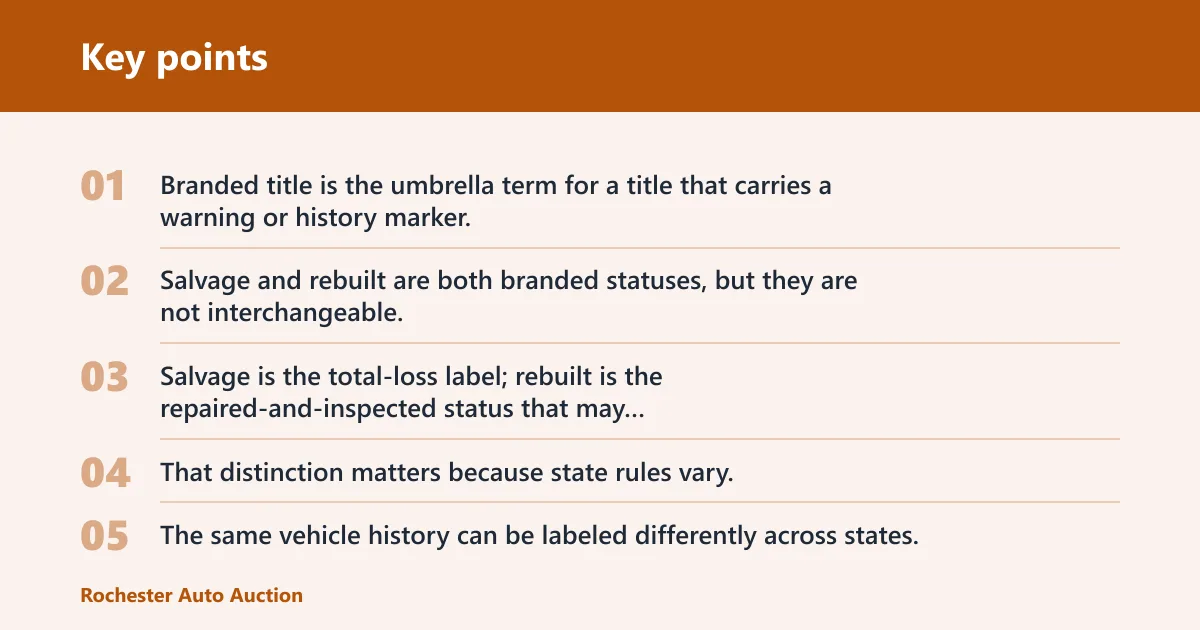
Branded title is the umbrella term for a title that carries a warning or history marker. Salvage and rebuilt are both branded statuses, but they are not interchangeable. Salvage is the total-loss label; rebuilt is the repaired-and-inspected status that may follow it.
That distinction matters because state rules vary. The same vehicle history can be labeled differently across states, and one state’s salvage paperwork may become another state’s rebuilt paperwork after the required inspection and retitling steps.
Why state rules can label the same vehicle differently
State-by-state variation is common. One state may require a salvage inspection before retitling, while another may use a different process or wording. That is why buyers should verify the rules where the vehicle will be titled, not just where it was repaired.
Do not treat salvage, rebuilt, and branded title as one bucket. The label tells you where the vehicle stands in the legal process, and that process changes what you need before the car is safe to buy and legal to drive.
Choose Salvage title if… / Choose rebuilt title if…
Choose Salvage title if you want a project vehicle, can inspect the repair history closely, and do not need immediate registration or financing. It can make sense when you plan to source parts, verify every repair step, and accept that the vehicle may still need inspection before it can be road legal.
Choose rebuilt title if you want a vehicle that has already cleared the repair-and-inspection hurdle, and you can live with branded history and possible insurance friction. It is the better pick when the title, receipts, and inspection result line up, and the vehicle is clearly roadworthy.
The safest rule is simple: salvage needs proof, rebuilt needs verification, and neither should be treated like clean title. If you want a car for immediate daily driving, rebuilt is usually the more practical option, provided the inspection and paperwork are complete.
Frequently asked questions
What is the difference between a salvage title and a rebuilt title?
A salvage title marks a vehicle as a total loss, usually after major damage or an insurance payout tied to value. A rebuilt title means that same vehicle was repaired and passed the required inspection, so it can return to road use under state rules. The branding still matters.
Can a salvage title car become a rebuilt title?
Yes, if the vehicle is fully repaired and the state allows retitling after inspection. The owner usually needs the salvage certificate, proof of ownership, repair receipts, and the required inspection result. If the vehicle is not roadworthy yet, the title should not move forward.
Is a rebuilt title the same as a salvage title?
No. Salvage means total loss status. Rebuilt means the vehicle started as salvage, then passed repair and inspection steps that changed its current title status. The branded history remains, so rebuilt is still not the same as a clean title.
Which title is safer to buy, salvage or rebuilt?
Rebuilt is usually safer because it has already passed the repair-and-inspection stage, while salvage may still need major work before it can be driven or registered. Even so, rebuilt is only as safe as the repairs and inspection records show, so paperwork still matters.
What inspection is required before a rebuilt title can be issued?
States that require salvage inspections want the vehicle fully repaired and roadworthy first, then checked for VIN accuracy and stolen parts. Maryland also requires a salvage certificate in the owner’s name, proof of ownership, repair receipts, and a $75 fee. Rules vary outside Maryland.
Can you register a rebuilt title car right away?
In many states, registration may depend on completing the required salvage or rebuilt inspection and providing the needed documents. Maryland is explicit that salvage inspection comes before title or registration for salvage-declared vehicles, so the vehicle must clear that step first.