What Does Run and Drive Mean on an Auction Inspection?
“Run and drive” means the vehicle started, moved forward and reverse under its own power during the inspection, but it is not proof that the car is road-ready or mechanically sound today. Miss that distinction, and you can overbid on a car that still has engine, transmission, brake, or cooling problems. This guide explains the label and how to turn damage type, title status, keys, and inspection age into a bid-risk decision.
Run and drive basics
Run & Drive means the vehicle moved under its own power at inspection. That is the core signal. It does not mean the car is currently safe, sorted, or ready for the road, and you should never read it alone without photos, damage notes, title type, and listing timing.
What the label confirms
At minimum, the label tells you the auction staff observed motion under power at the time of inspection. In Copart history reports, run-and-drive status can appear with primary damage code, secondary damage, sale date, lot number, yard location, and sometimes odometer reading at sale. Those details help you anchor the label to a real listing record.
What it does not confirm
Run & Drive is not a warranty of current drivability. It does not promise that the engine, transmission, brakes, cooling system, steering, or electrical system are healthy today. It also does not prove that the vehicle will pass inspection, start after transport, or make a trip home without trouble.
Why the label is only a starting point
Use the label as a filter, not proof. A front-end car can still have cooling damage. A flood listing can still roll and move in a yard. A vehicle with cosmetic damage can still hide electrical faults. The bid decision comes after you pair the movement label with damage code, title type, photos, keys, odometer status, and how old the inspection is.
Run and drive vs starts
“Starts” is weaker than Run & Drive. Starts means the engine started, but drivability and transmission status can still be unknown. That matters because an engine that idles in place can still have a slipping transmission, no reverse, low fluid pressure, or a cooling issue that appears only after load.
How starts differs from run and drive
Run & Drive adds movement to the signal. Starts only proves the engine fired. A car can start, idle, and still fail to move cleanly through the yard. That is why starts is a higher-risk label than run and drive, especially on listings with mechanical, flood, or rear-end damage.
Why drivability and transmission status still matter
Drivability is more than an engine turning over. You need evidence that the vehicle can move, shift, and stop in a usable way. If the listing says starts but the photos show missing front-end parts, a broken axle, or an airbag deployment, the movement label should not calm the bid. It should sharpen your review.
Why starts is a weaker signal
Starts gives you a partial check. It can help separate a dead vehicle from one that at least powers up. But it does not answer the bigger question buyers care about: how much money will it take to get the car to usable condition? That question still depends on the damage code, title, and repair evidence.
Does not run meaning
Stationary or Does Not Run means the vehicle did not move under its own power. That signals higher mechanical risk. The label should push you toward a larger budget buffer, stricter photo review, and a lower willingness to bid on listings with mechanical, flood, or title complications.
What stationary or does not run tells you
It tells you the auction could not confirm movement at inspection time. AuctionCalc treats does not run as unknown engine or transmission condition. That uncertainty raises risk because you do not know whether the failure is minor, major, or both.
Why the mechanical risk is higher
No movement means you have less verified function. The vehicle may have engine trouble, transmission trouble, or another issue that prevents motion entirely. Even if the body damage looks light, a non-running label can hide a repair bill that is larger than expected once fluids, wiring, or drivetrain parts are inspected.
When to add a larger budget buffer
Add a larger buffer when Does Not Run appears with flood, mechanical, or front-end damage, or when the title is salvage, rebuilt, junk, or certificate of destruction. A common rule of thumb is to reserve more contingency when the label and the damage code point in the same risky direction instead of offsetting each other.
Run and drive bid risk table
This table turns the movement label into a simple bid-risk adjustment. It is not a price guide. It is a discipline tool that helps you decide whether to bid normally, trim your ceiling, or walk away. Use it with damage type, title type, keys, and photo coverage.
| Auction label | Common damage or title pairing | Risk read | Bid adjustment or threshold |
|---|---|---|---|
| Run & Drive | Front end damage, clean title, keys present | Moderate risk; movement is confirmed, but hidden cooling or alignment damage may still exist | Trim your ceiling by 5% to 10% until photos and notes confirm no frame, radiator, or suspension issues |
| Run & Drive | Rear end damage, salvage title, keys missing | Higher risk; the movement label does not offset title exposure or replacement costs | Reduce ceiling by 10% to 15% and subtract key cost before bidding |
| Run & Drive | Flood damage, rebuilt title, odometer exempt | High risk; water history and title status matter more than the movement label | Bid only if photos and notes show a clear, limited water path; otherwise walk away |
| Starts | Mechanical damage, salvage title, keys present | High risk; engine started, but transmission and roadworthiness remain unknown | Cut your ceiling by 15% to 25% and require strong photo evidence before bidding |
| Starts | Side damage, clean title, keys missing | Moderate to high risk; the engine ran, but missing keys add cost and uncertainty | Subtract key replacement cost and keep a smaller reserve for unseen electrical issues |
| Does Not Run | Mechanical damage, junk title, no keys | Very high risk; both movement and resale path are weak | Walk away unless the reserve is deep enough to cover towing, diagnostics, keys, and major repair |
A common checklist is to review exterior, engine bay, interior, and undercarriage photos in that order. That order works well here because the first images tell you whether the movement label fits the visible damage, and the undercarriage often reveals hidden impact or fluid issues that the headline label will not show.
Picture a sedan listed as Run & Drive with front-end damage, a salvage title, and no keys. The label alone sounds encouraging. Once you factor the keys and title, the better move is to bid as if the car is more expensive to return to service than the label suggests.
Suppose a crossover is listed as Starts with rear damage and a clean title. The engine fires, but the rear impact may have damaged wiring, fuel components, or suspension points. In that case, the starts label should lower your ceiling rather than raise confidence.
What else to verify before bidding?
Check primary damage code, title type, photos, odometer status, and keys before you treat any movement label as meaningful. Those items tell you whether the car is repairable, road-legal, or already expensive to revive. They also reveal whether the inspection record is consistent with the visual evidence.
Primary damage code
Primary damage code is the first triage step. Front end, rear end, side, flood, vandalism, and mechanical are the common categories that matter most for bidding. A Run & Drive vehicle with mechanical damage deserves more caution than one with light cosmetic damage because the label says nothing about the quality of the internal systems.
Title type
Title type must be checked separately from the movement label. Copart title types listed include clean, salvage, rebuilt, junk, and certificate of destruction. Each one changes resale value and road-use value in a different way, so a car that moves in the yard may still be a poor retail candidate.
Auction photos and notes
Photos are the quickest way to test whether the label fits the listing. Exterior shots may reveal missing bumpers or alignment issues. Engine bay images can show leaks, missing parts, or exposed damage. Interior photos can expose airbag deployment or water intrusion. Undercarriage images can reveal frame damage or corrosion.
Do not assume every listing has full coverage. Photo coverage varies by listing, and missing angles increase uncertainty. If the listing has only a few exterior shots and no engine bay or undercarriage images, your bid should reflect the blind spot.
Odometer status
Odometer reading matters because actual, not actual, or exempt status all affect value and risk. Copart listings may include odometer reading at sale, and that number should be priced into the bid. A low number can support value only if the rest of the listing supports it.
Keys present or missing
Keys affect total cost because missing keys add replacement expense and delay. AuctionCalc lists missing keys as a cost of $300–$600 for a standard key fob replacement. The impact is higher on push-button vehicles, where programming and replacement are often more expensive than on basic keyed systems.
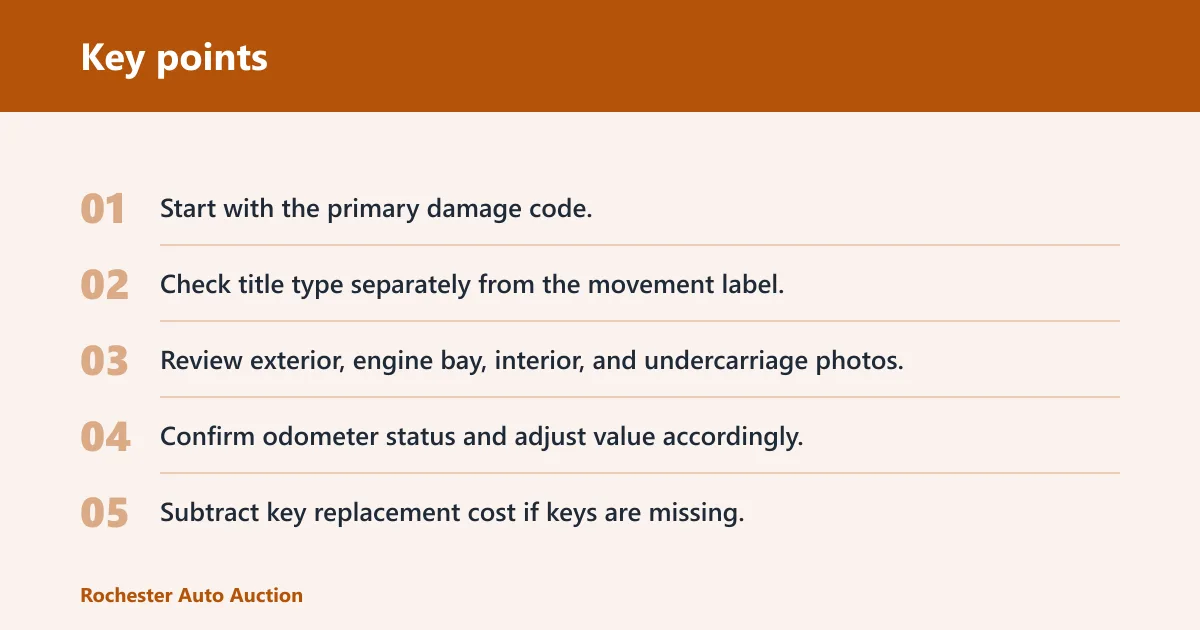
- Start with the primary damage code.
- Check title type separately from the movement label.
- Review exterior, engine bay, interior, and undercarriage photos.
- Confirm odometer status and adjust value accordingly.
- Subtract key replacement cost if keys are missing.
- Compare the inspection date to the sale timing before you bid.
How old is the inspection?
The older the inspection, the less reliable the label becomes. A Run & Drive status can turn stale if the listing is old, the car has moved through multiple storage events, or the vehicle has been damaged again since the report was made. Time matters because condition changes between inspection and sale.
Why stale inspection data can mislead
A movement label captures one moment. It does not promise the same condition months later. A battery can fail. A tire can lose air. A yard move can cause new damage. The longer the time gap, the more you should treat the label as a historical clue instead of current proof.
What to check in the listing timeline
Check the sale date, lot number, yard location, and any updated notes. Copart history reports can include those details, and they help you judge whether the listing is still fresh. If the inspection and sale are separated by a long gap, do not let an old run-and-drive label carry more weight than the current photos.
When to treat the label as less reliable
Treat it as less reliable when the car has sat long enough for weather, storage movement, or missing parts to become plausible. The same caution applies when the listing has changed yards or the photo set looks newer than the movement record. In those cases, the bid should lean conservative.
Can a run and drive car still have major problems?
Yes. A Run & Drive vehicle can still have major engine, transmission, flood, frame, brake, cooling, or electrical problems. The label only confirms movement at inspection. It does not guarantee that the vehicle is healthy, complete, or worth repairing at the price you are considering.
Hidden engine or transmission issues
The engine may start and move the vehicle even if it has low compression, poor cooling, internal wear, or fluid contamination. The transmission can also shift enough to move the car in the yard while still failing under load or at speed. That is why the label is a snapshot, not a diagnosis.
Flood, frame, or electrical risk that can remain
Flood damage can leave corrosion, sensor faults, and wiring problems after the vehicle moves. Frame damage can coexist with movement if the alignment is still barely passable at low speed. Electrical issues can also be hidden if the vehicle was briefly coaxed into motion for inspection.
Why photos and notes can contradict the label
Photos and notes often tell the story the label cannot. A vehicle may be listed as Run & Drive, yet the engine bay shows missing parts or fluid streaks. The notes may mention warning lights, airbag deployment, or damage that lowers confidence. When the images and the label conflict, the images win.
A common first-timer mistake is to treat Run & Drive as proof of a healthy drivetrain. A pickup can roll forward and reverse in a yard, yet still have a slipping transmission, a leaking radiator, or a damaged wiring loom. In that case, the bid should reflect repair uncertainty, not just the movement label.
Frequently asked questions
What does run and drive mean on an auction inspection?
Run & Drive means the vehicle moved under its own power at inspection time. It also means the vehicle started, moved forward and reverse, and stopped during that inspection. It does not mean the car is currently reliable, roadworthy, or free of hidden mechanical damage.
Does run and drive mean the car is safe to drive home?
No. Run & Drive is not a safety guarantee and not a road-trip promise. It only confirms movement at inspection. You still need to check damage code, title, photos, odometer status, and keys before you decide whether the car has enough margin to drive or requires transport.
What is the difference between run and drive and starts?
Starts means the engine started, but drivability and transmission status can still be unknown. Run & Drive goes one step further by confirming movement under its own power. That makes starts the weaker signal and a higher-risk label when you are trying to estimate repair cost and resale value.
Can a car be run and drive and still have major mechanical problems?
Yes. A vehicle can move in a yard and still have engine wear, transmission trouble, cooling issues, brake problems, or electrical faults. The label does not inspect internal condition. It only shows that the vehicle moved at one point, so you should still price in repair uncertainty.
How old is an auction inspection status before it becomes unreliable?
There is no universal cutoff, but the longer the gap between inspection and sale, the less dependable the label becomes. If the listing is old, has changed yards, or shows newer damage in photos, treat the status as stale and reduce confidence before you bid.
What should I verify besides the run and drive label before bidding?
Verify the primary damage code, title type, auction photos, odometer status, and whether keys are present. Those items change the risk more than the movement label does. A vehicle that runs and drives can still be a poor bid if the title is weak or the photos show hidden damage.