How to VIN Check for Recalls Before You Bid
Run the VIN through the manufacturer and NHTSA recall lookup before you bid. If an open safety recall has no repair proof, walk or bid only with that condition. Missing a recall can leave you with an unsafe unit, a delayed sale, or a repair bill after the hammer falls. This guide shows how to verify the VIN, read recall results by urgency, and decide whether to bid, walk, or require proof of repair.
What you’ll need
- The exact 17-character VIN.
- The vehicle’s registration card, if the VIN tag is hard to read.
- The insurance card, which may also list the VIN.
- A phone or laptop with access to the NHTSA recall search.
- The seller’s paperwork folder for a repair order, campaign number, or manufacturer lookup screenshot.
- If needed, the vehicle’s license plate number for a secondary search.
📊 NHTSA says a VIN search will show: ‘0 unrepaired recalls associated with this VIN’ when none are open. Source: Nhtsa.
Why recall status matters before you bid
An open safety recall is an unrepaired defect or federal safety standard violation that the manufacturer must fix. Some recalls carry “do not drive” guidance, which changes the bid from routine risk to an immediate problem. At auction, the gap between a clean result and a missing repair record can mean a normal purchase or a unit you cannot safely move.
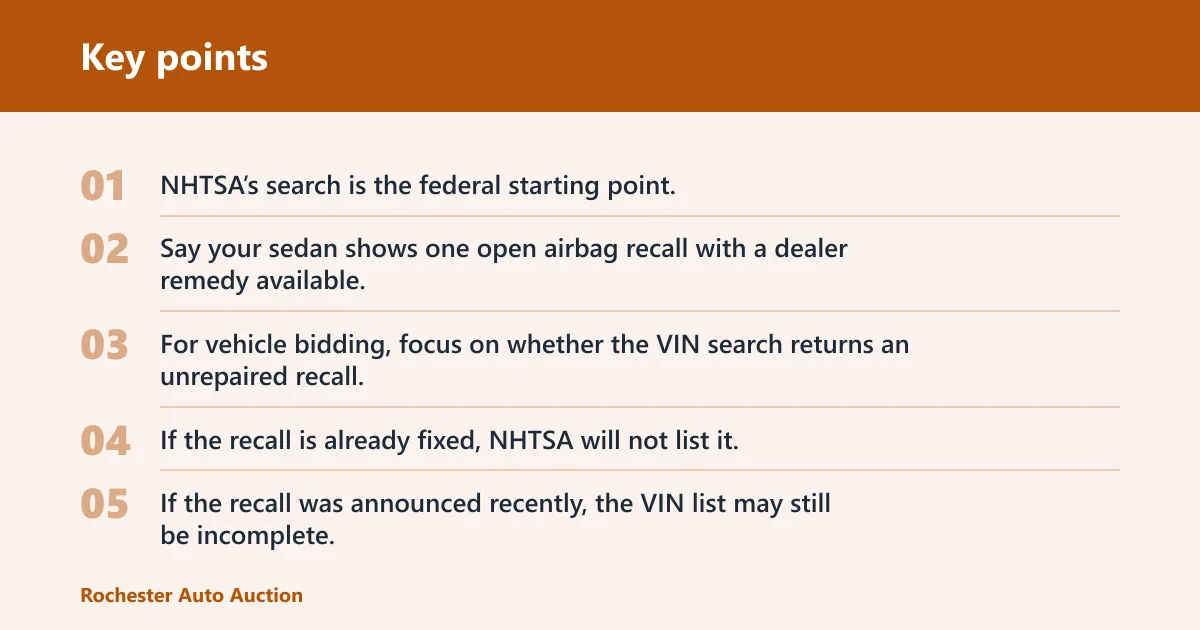
NHTSA’s search is the federal starting point. It shows whether a specific vehicle needs recall repair, but it does not show a recall that has already been repaired. That matters because a clean lookup does not prove the vehicle never had a recall.
Say your sedan shows one open airbag recall with a dealer remedy available. That is a conditional bid only if the seller can prove the repair was completed, or if your bid already accounts for the repair delay and any transport limits.
What NHTSA shows and what it misses
NHTSA lets users search vehicles, car seats, tires, and other equipment for safety recalls, investigations, complaints, and manufacturer communication. For vehicle bidding, focus on whether the VIN search returns an unrepaired recall. If the recall is already fixed, NHTSA will not list it. If the recall was announced recently, the VIN list may still be incomplete.
NHTSA also does not show recalls more than 15 years old, except where a manufacturer offers more coverage. That means you still need seller paperwork and, for some brands, the maker’s own recall page. (Nhtsa)
How to VIN check for recalls
Use the VIN first, then read the result by urgency. NHTSA’s free search shows unrepaired recalls for certain manufacturers and tells you whether that specific vehicle needs recall repair. For some brands, the manufacturer database may show recall information before NHTSA posts it.
-
Confirm the VIN. Match the 17 characters on the dashboard label to the VIN on the door jamb, registration card, or insurance card. One swapped character can return the wrong record.
-
Run the NHTSA search. Use the VIN first. If needed, use the license plate search as a backup, but treat it as secondary because DMV data can lag.
-
Check the recall status line. Look for open, unrepaired recalls. NHTSA says a clean result may read “0 unrepaired recalls associated with this VIN.”
-
Read each campaign number. The campaign number is the NHTSA identifier used to reference or schedule the repair. Keep it with the lot sheet.
-
Verify seller proof. Ask for a repair order, campaign number, or manufacturer lookup screenshot if the result is open or recently closed.
Check the brand portal too
For some brands, run the manufacturer recall database after the federal lookup. Premium Autos notes this is especially important for Tesla, where the brand page may surface details that differ from the federal search. Manufacturer pages can also show recall notices before NHTSA posts them.
Suppose a late-model EV shows no open items in the federal search, but the brand portal lists a fresh campaign with parts not yet available. That is not a green light to ignore the issue. Treat it as a timing risk and ask the seller whether the unit is drivable, schedulable, or already repaired.
Can you check recalls with a license plate?
Yes, but only as a fallback. NHTSA says a VIN or license plate search can show an unrepaired recall for certain manufacturers, and license plate information is generated from state DMV data. If the records are stale, the lookup may attach to a different vehicle or miss the one you are bidding on.
Use the plate only when the VIN is unavailable, damaged, or unreadable. If the plate result conflicts with the VIN tag, trust the VIN and ask the seller to correct the paperwork before bidding.
When plate searches go wrong
- The plate was transferred from another car and the DMV record has not caught up.
- The vehicle came from another state and the plate data is incomplete.
- The plate matches a fleet record instead of the exact unit in front of you.
What does the recall result mean?
Open recalls are commonly treated as bid blockers unless there is repair proof or a priced-in plan. If the recall is safety-related and the manufacturer has issued “do not drive” guidance, the safest move is to walk unless transport and repair are already arranged.
| Result type | Meaning | Bid action |
|---|---|---|
| No unrepaired recalls | NHTSA shows no open recall for that VIN. | Bid normally, but still ask for repair proof on recent or brand-specific items. |
| Open safety recall | Unrepaired manufacturer remedy is still due. | Bid only with proof of repair or a written condition tied to completion. |
| Do not drive guidance | Recall may create a fire, crash, or other immediate hazard. | Walk unless the seller can prove the fix is complete and the unit is safe to move. |
| Recently announced recall | NHTSA may not have all VINs listed yet. | Hold or condition the bid on manufacturer confirmation and parts status. |
What repair proof should look like
Ask for a repair order from an authorized dealer, the campaign number tied to the work, or a manufacturer screenshot showing completion. Authorized dealers typically perform recall repairs at no charge through the manufacturer-paid service network. If the seller cannot produce one of those items, treat the recall as open.
A clean lookup does not replace paperwork. NHTSA hides already repaired recalls, so the only way to confirm a closed item before bidding is seller documentation or a brand portal that shows completion.
VIN recall decision checklist
Use this as a pre-bid screen before the unit leaves the lane. It turns the lookup into a bid, no-bid, or conditional-bid call.
| Field | Check | Decision |
|---|---|---|
| VIN verified | 17 characters matched on the vehicle and paperwork | Proceed only if the VIN is exact |
| NHTSA result | Open recall, no unrepaired recall, or recent recall | Use the result to set bid, walk, or condition |
| Recall urgency | Do not drive, soon, or low priority | Higher urgency means tighter bid or no-bid |
| Required seller proof | Repair order, campaign number, or manufacturer lookup screenshot | Do not bid without proof when the recall is open |
Decision ladder
-
Bid normally. Use this when the VIN is verified, NHTSA shows no unrepaired recall, and the paperwork is consistent.
-
Bid conditionally. Use this when the recall is open but the seller provides a repair order, campaign number, or brand screenshot before the hammer falls.
-
Walk. Use this when the VIN is uncertain, the recall is do-not-drive, parts are unavailable, or the seller cannot prove completion.
Common mistakes that distort recall checks
The most common mistake is treating a license plate lookup like a VIN lookup. Plate data can be stale, and it may map to the wrong vehicle. Another mistake is assuming a clean NHTSA page means the unit never had a recall. NHTSA does not show repaired recalls.
Buyers also miss timing risk. A newly announced recall may not yet list every VIN, and some manufacturers post more detail on their own site before NHTSA does. If the vehicle is from a brand with a separate recall portal, check both sources before you bid.
Common first-timer mistake: a seller hands over a campaign number but no repair order. That number is useful, but it only proves the recall exists. It does not prove the repair was completed.
If the recall is newly announced
Use the manufacturer portal and ask the seller whether parts are available. If the brand has not assigned all VINs yet, place the unit on hold rather than guessing. For some vehicles, a fire-risk notice can also call for parking outside and away from structures until the repair is done.
-
Check the brand portal. Look for the same VIN in the manufacturer recall database before you bid.
-
Request the campaign number. Match it to the seller’s repair order or screenshot.
-
Delay the bid. If the recall is not fully assigned or parts are unavailable, wait for proof of repair or pass.
Frequently asked questions
Does a vin recall check show only open recalls?
Yes, that is the practical use case. NHTSA’s VIN search shows unrepaired recalls and will not show a safety recall that has already been repaired. It also leaves out recalls older than 15 years, so a clean result is useful, but it is not a full life-history record.
Is a recall repair free on a used car?
Yes, when it is an open safety recall handled through the manufacturer’s network. An authorized dealer performs the work at no charge. If the seller has already completed the repair, ask for the repair order or campaign reference so you are not paying twice.
What should I do if the vin shows an open recall?
Ask for proof of completion before you bid: repair order, campaign number, or a manufacturer screenshot. If the recall includes do-not-drive language, walk unless the vehicle is already repaired and documented. If parts are unavailable, treat the unit as a timing risk, not a routine buy.
Can I check recalls with a license plate instead of vin?
Yes, but only as a backup. NHTSA says plate data comes from state DMV records, and those records can be outdated. If you have the VIN, use it first and use the plate only to locate the vehicle or confirm a secondary record.
How recent do recalls appear in a vin lookup
Very recent recalls may lag. NHTSA says newly announced recalls may not have all VINs identified yet, and manufacturer databases can sometimes update sooner. For that reason, check the maker’s recall page when a fresh campaign is likely and hold the bid if the status is unclear.
What does nhtsa show in a recall search?
NHTSA lets users search vehicles, car seats, tires, and other equipment for safety recalls, investigations, complaints, and manufacturer communication. For a vehicle VIN, the recall search shows whether that specific unit has an unrepaired recall, but it will not show already repaired recalls or recalls older than 15 years.