What Extra Fees Can Be Added After You Win a Car at Auction?
After you win, extra fees can include buyer’s premium, title and registration, taxes, transport, storage, inspection, reconditioning, arbitration, and payment or admin charges. Some are mandatory, some are optional, and some can be disputed. Miss one, and the final invoice can rise after the hammer falls, leave the car unpaid, or trigger storage and cancellation penalties. This guide maps each post-sale charge, who adds it, when it appears, and whether you can avoid or challenge it.
Buyer fees, taxes, and late pickup charges
The hammer price is only the winning bid. It is not the total you owe. After a win, the most common add-on is the buyer’s premium, then taxes, title work, and any auction-billed admin or release charge. If pickup is late, storage can start. If payment or paperwork fails, more charges can follow.
Buyer fees and sale charges
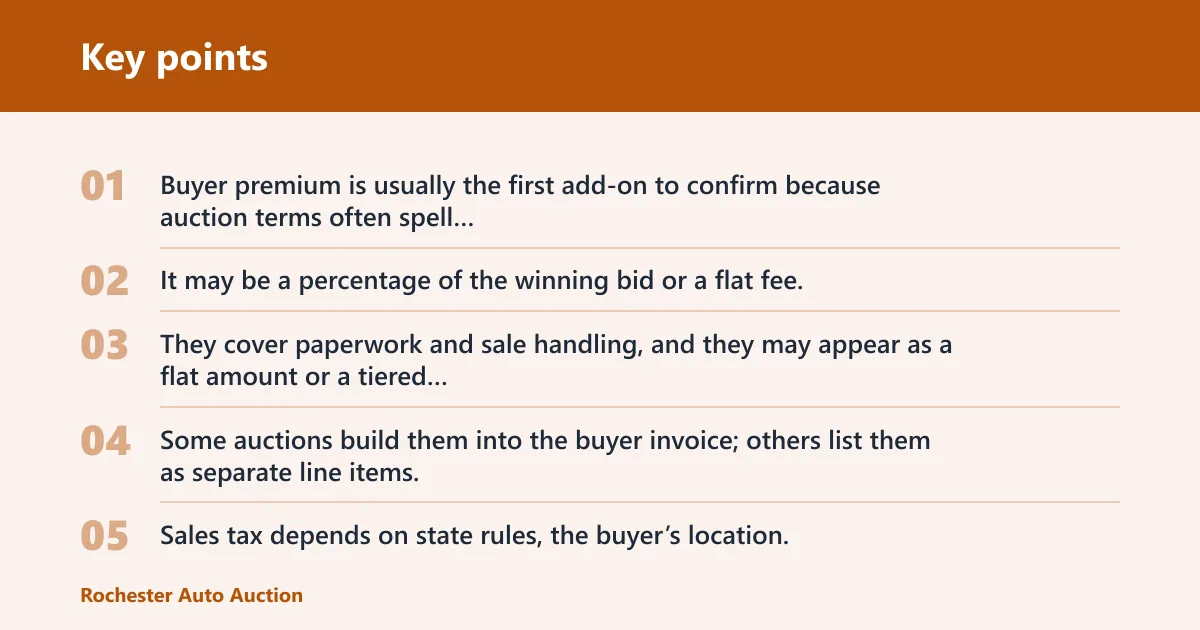
Buyer premium is usually the first add-on to confirm because auction terms often spell it out before bidding begins. It may be a percentage of the winning bid or a flat fee, and the rate can change by auction type or vehicle price band.
Administrative fees are different. They cover paperwork and sale handling, and they may appear as a flat amount or a tiered charge on the invoice after sale. Some auctions build them into the buyer invoice; others list them as separate line items.
Taxes, title, and registration
Sales tax depends on state rules, the buyer’s location, and sometimes the fee base used by the auction or title service. Some states tax the vehicle price only; others include certain fees in the taxable amount. Title fees and registration fees are separate. Title processing is not the same as DMV registration, and either one may be handled by a different office.
Late pickup and transport charges
Storage fees commonly start after a grace period ends. They are often billed daily, so a short delay can become expensive fast. A gate fee or lot release fee may also apply when the vehicle is released for pickup. Tow or transport charges can appear if the car has to leave on a carrier rather than under its own power.
Payment and dispute charges
Payment processing fees can apply to a card deposit, an electronic transfer, or the full balance, depending on auction policy and state law. If there is a condition dispute, an arbitration charge may appear first and then be reversed only if the claim is accepted and documented on time.
Say your winning bid is about $8,000 and the auction terms list roughly a 10% buyer’s premium, plus an administrative fee of about $95. Before tax, the invoice can climb to about $8,895. If pickup slips past the grace period, a daily storage line can begin later and change the total again.
A common first-timer mistake is treating the win notice as the final bill. The better check is the invoice, then the terms sheet, then the title and pickup rules. Those documents show which charges are already fixed and which ones can still appear after sale.
Which fees are billed by the auction?
The auction usually bills the buyer’s premium, administrative fee, lot release or gate fee, and any payment processing charge allowed by policy. Those charges can show up on the sale invoice or at checkout, even before the vehicle leaves the lot. They are separate from DMV, storage, and transport bills.
Buyer premium on the invoice
Buyer premium is the most common auction-billed add-on. It is usually a percentage of the hammer price, though some sales use a flat fee. Check whether the rate changes for dealer-only lanes, internet bids, salvage units, or low-priced vehicles, because those terms can differ.
Administrative and gate release charges
Administrative fees often cover paperwork, clerical handling, or sale processing. They may appear after the sale is posted rather than at the moment of winning. A gate fee or lot release fee may be charged before a buyer can take possession, especially when the lot controls physical release of the vehicle.
Payment method fees
Payment processing fees may apply to credit cards, debit cards, ACH, wire transfers, or split payments, but policy and state law matter. Some auctions cap card use, some ban convenience fees on certain payment types, and some only assess a fee on deposits rather than the full balance.
Which fees come from taxes and title work?
Taxes and title charges often appear after the auction’s own fees, and they may be billed by the auction, a title agent, or a state office. Sales tax depends on the buyer’s location and title status. Title processing is separate from registration, and registration often depends on how and where the vehicle will be used.
Sales tax rules by state and buyer status
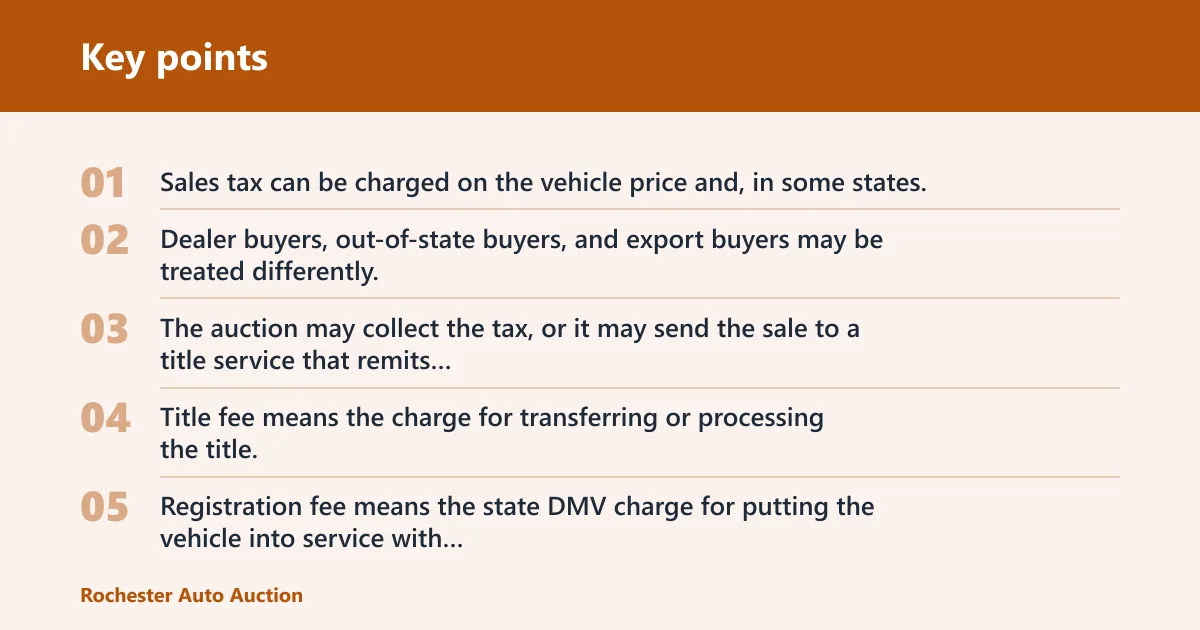
Sales tax can be charged on the vehicle price and, in some states, on certain fees tied to the sale. Dealer buyers, out-of-state buyers, and export buyers may be treated differently. The auction may collect the tax, or it may send the sale to a title service that remits it later.
Title processing versus registration
Title fee means the charge for transferring or processing the title. Registration fee means the state DMV charge for putting the vehicle into service with plates or tags. One can appear without the other. A buyer who is titling in another state may still owe title processing while registration is handled elsewhere.
What document to check first
Start with the invoice, then confirm the title paperwork and the auction’s buyer terms. If the sale involves a title service, check that service’s fee schedule too. A clean title, salvage title, rebuilt title, or missing title can change both the process and the amount due.
| Fee name | Who charges it | When it appears | Avoidable? | What document to check |
|---|---|---|---|---|
| Buyer premium | Auction house | At sale or on the invoice after you win | Usually no, if the bid is accepted | Terms, invoice |
| Administrative fee | Auction house | After sale processing | Usually no | Invoice, terms |
| Sales tax | Auction, title agent, or DMV | At checkout or during title filing | Sometimes, based on buyer status or exemptions | Invoice, title paperwork |
| Title fee | Auction, title agent, or state office | When title is processed | Usually no | Title paperwork |
| Registration fee | DMV | When the vehicle is registered | Depends on use and jurisdiction | Title paperwork, DMV requirements |
| Storage fee | Auction lot or storage vendor | After pickup deadline passes | Yes, if pickup is on time | Pickup policy, invoice |
| Gate fee / lot release fee | Auction house | Before pickup or release | Sometimes, based on sale terms | Pickup policy, invoice |
| Tow / transport fee | Transporter or auction-arranged carrier | When the car is moved off-site | Yes, if you arrange and pay separately | Transport order, invoice |
| Payment processing fee | Auction house or payment processor | At deposit or final payment | Sometimes, depending on policy or law | Invoice, payment terms |
| Arbitration / condition dispute fee | Auction house or claim administrator | After a claim is filed | Sometimes, if the claim is accepted | Claim rules, inspection records |
What happens if pickup is late?
If pickup misses the grace period, storage fees can begin and grow by the day. The auction may also add a gate release charge before the vehicle leaves. If the car cannot move under its own power, tow or transport may be required, and that cost is usually separate from the auction invoice.
Storage fees after the grace period
Storage is one of the fastest-growing post-sale charges because it can compound daily. The pickup policy should say when the clock starts, how many free days are allowed, and whether weekends or holidays count. If the lot charges by calendar day, the total can rise even when the office is closed.
Lot release and gate charges
Some auctions bill a release charge every time a vehicle is pulled from the lot. Others charge only once per vehicle, while some include release in a broader admin fee. Read the pickup rules closely, because a buyer who splits pickup into multiple trips can be billed more than once.
Tow or transport if the car must move
Tow and transport are often billed by a third party, not by the auction itself. That matters because the auction invoice may show only the release or sale balance, while the carrier sends a separate bill later. If the vehicle is dead, damaged, or not road-legal, transport planning should happen before the pickup deadline.
| Common failure case | Typical result | Who bills it | What to check right away |
|---|---|---|---|
| Late pickup | Daily storage begins, plus possible release charge | Auction lot or storage vendor | Pickup policy, invoice |
| Missing title | Title processing stalls, delay in registration | Auction, title agent, or seller process | Title paperwork, sale terms |
| Payment failure | Late fee, cancellation, or relisting risk | Auction house or payment processor | Invoice, payment terms |
| Transport delay | Storage may continue until the vehicle leaves | Storage vendor or auction lot | Pickup policy, transport order |
How do disputes affect extra charges?
Disputes can stop or reverse some charges, but only if the buyer follows the auction’s claim window and submits the right documents. A condition claim can affect reconditioning, arbitration, or other sale-related charges. It will not automatically erase taxes, title fees, or valid storage billed for missed pickup.
Claim windows and required records
Most auctions require fast notice, often with photos, inspection notes, or repair estimates. If the claim deadline passes, the charge may stand even when the buyer believes the vehicle was misdescribed. Keep the invoice, condition report, pickup records, and any text or email tied to the sale.
Missing title or paperwork problems
If the title is missing or the paperwork is incomplete, confirm whether the delay is inside the auction’s control or caused by a state process. Some title-related charges may be reversed if the auction failed to provide what its terms promised. Others will not move, especially if the fee came from a state office or third-party title service.
When a fee may be reversed
A fee is most likely to be reversed when it was charged in error, applied outside the posted terms, or tied to a claim that the auction accepts. A storage charge may be reduced if the buyer proves the vehicle could not be released on time because the auction withheld required release paperwork.
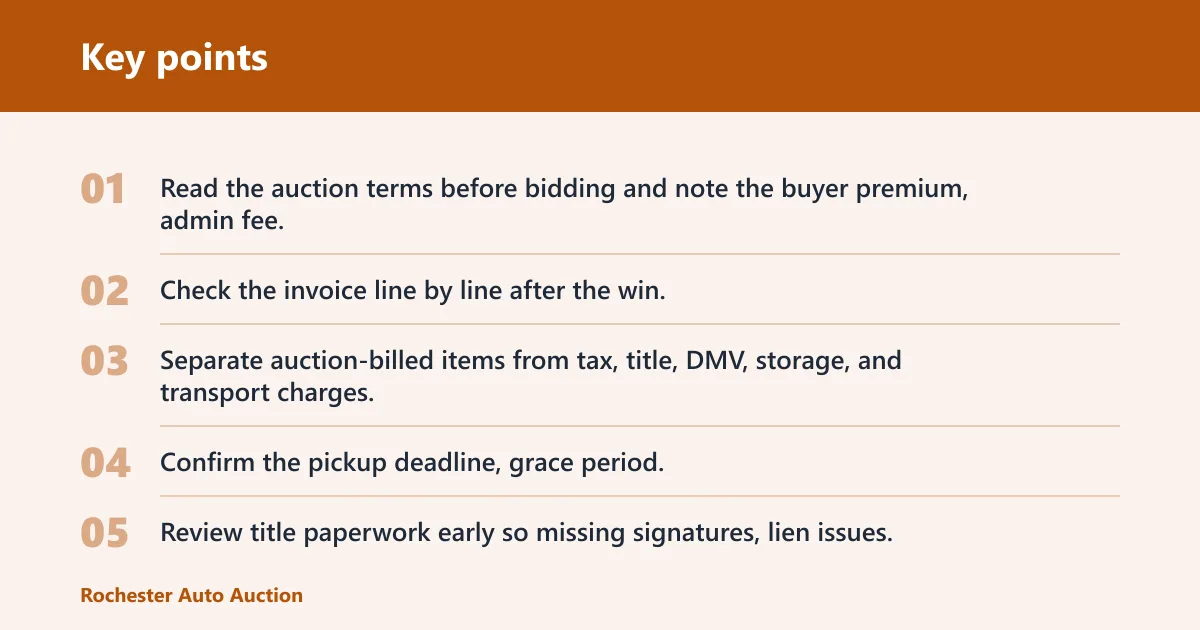
- Read the auction terms before bidding and note the buyer premium, admin fee, release rules, and payment limits.
- Check the invoice line by line after the win. Compare each charge with the posted fee schedule.
- Separate auction-billed items from tax, title, DMV, storage, and transport charges.
- Confirm the pickup deadline, grace period, and whether the lot charges daily storage after cutoff.
- Review title paperwork early so missing signatures, lien issues, or state forms do not delay release.
- Keep proof of payment, pickup attempts, transporter booking, and any condition claim filings.
- Dispute only the charge that does not match the terms or the sale record, and file it before the claim window closes.
Frequently asked questions
What extra fees can be added after I win a car at auction?
After you win, common extras include buyer’s premium, admin fees, taxes, title processing, registration, storage, gate release, transport, payment processing, and dispute-related charges. Not every sale has every fee. The auction terms, title rules, and pickup policy determine which charges can appear and when.
Can an auction charge me after I already paid the winning bid?
Yes. Paying the hammer price does not close the file. The auction can still bill buyer premium, admin fees, taxes, release charges, and storage if the car stays on the lot. That is why the invoice and terms matter more than the bid alone.
What is a post-sale fee at a car auction?
A post-sale fee is any charge added after the auction closes or after the invoice is issued. It may come from the auction, a title service, a storage vendor, a transporter, or a state office. The key question is not the name, but who issued it and why.
Are storage fees charged if I do not pick up the car quickly?
Often, yes. Many auctions allow a short grace period, then bill storage by the day. The exact start date and rate are set by the pickup policy, and the charge can grow quickly. If the lot is full or the vehicle is blocked in, extra handling can follow too.
Can I be charged for a missing title or paperwork after the sale?
Yes, but the charge depends on what the auction terms say and who caused the delay. Title processing fees may still apply, while a true error by the auction or title service may be disputable. Keep the invoice, title paperwork, and any written promise about release timing.
Do auctions add taxes, gate fees, or admin fees after the hammer price?
They can. Taxes may be collected by the auction or title agent, admin fees are commonly auction-billed, and gate or release fees may be due before pickup. These are separate from the winning bid and should be checked against the posted fee schedule before you bid.