How to Use an Auction Inspection Sheet Before You Bid
Use the auction inspection sheet to set a hard bid ceiling: subtract cosmetic repairs, add a mechanical-risk reserve, and stop bidding on any frame, airbag, flood, title, or run-and-drive contradiction. Bad reads can wipe out margin fast. This guide shows how to separate cosmetic flaws, mechanical risk, and stop-bidding defects before you bid.
What an auction inspection sheet tells you
An auction inspection sheet is generally a pre-bid condition report, not a warranty or guarantee. Read it for disclosures, noted damage, mechanical checks, and omissions, then price the car within those limits. The quickest mistake is treating vague wording as clean proof.
Read the right sections first
Start with body, interior, mechanical, and notes. Those sections usually tell you whether the car needs cosmetic work, may need drivetrain repair, or carries a stop-bidding disclosure such as frame or flood damage. If the sheet is light on detail, that silence should pull your ceiling down, not push it up.
Spot missing detail before you price it
Missing notes matter. A report that lists “minor scratches” but says nothing about underbody condition, warning lights, or electrical function leaves a real gap between what is disclosed and what may still be wrong. Price that gap as risk, not as savings.
How to decode symbols and abbreviations
Use the symbol legend before you price anything. Auction sheets often mix icons, abbreviations, and short notes to mark observed damage, disclosed damage, and areas that were not fully checked. Treat shorthand as risk clues, not repair quotes.
Separate observed damage from reported damage
Observed damage is what the inspector notes on the sheet. Reported damage can include prior title branding, seller disclosure, or auction comments. Those are not the same thing. A clean walkaround can still sit beside a branded-title history, and that changes the bid ceiling.
Read shorthand as uncertainty
Words like “possible,” “suspect,” “needs further inspection,” and “vehicle not fully tested” should raise caution. They do not give you a repair bill, but they do tell you the sheet is incomplete. That gap belongs in your max-bid adjustment.
Bid ceiling worksheet
Use this worksheet to turn report findings into a max-bid adjustment. Cosmetic defects should move the bid a little. Mechanical uncertainty should move it more. Frame and flood disclosures should usually trigger a stop or a very low ceiling.
| Report finding | Estimated repair risk tier | Recommended max-bid adjustment |
|---|---|---|
| Light scratches, one dented panel, missing trim piece | Low | Subtract a small cosmetic allowance; treat as visible reconditioning only |
| Mismatched paint, several panels with prior repair signs | Medium | Subtract a larger body allowance; price for possible hidden prior damage |
| Run and drive with no further mechanical detail | Medium | Add a mechanical-risk reserve; do not price it like a verified healthy car |
| Transmission slip, overheating note, brake warning, no test details | High | Cut bid sharply or skip unless the repair path is clear and cheap |
| Frame disclosure or structural note | Stop / very high | Apply a major bid reduction; many buyers should pass |
| Flood clues, waterline marks, mildew odor, corrosion | Stop / very high | Usually skip; if bidding at all, treat as severe hidden-risk exposure |
Use the final go/no-go box
Go if the total of cosmetic deductions plus mechanical reserve still leaves room for profit or personal use. No-go if the sheet includes frame disclosure, flood clues, airbag deployment, title branding you cannot finance or insure, or a report that conflicts with what you can see on the lot.
What does run and drive mean?
Run and drive usually means the engine starts and the vehicle moves under its own power. It does not mean the car is roadworthy, safe, or free of mechanical or electrical faults. Treat it as a narrow starting point, not proof that the vehicle is a good buy.
What it confirms
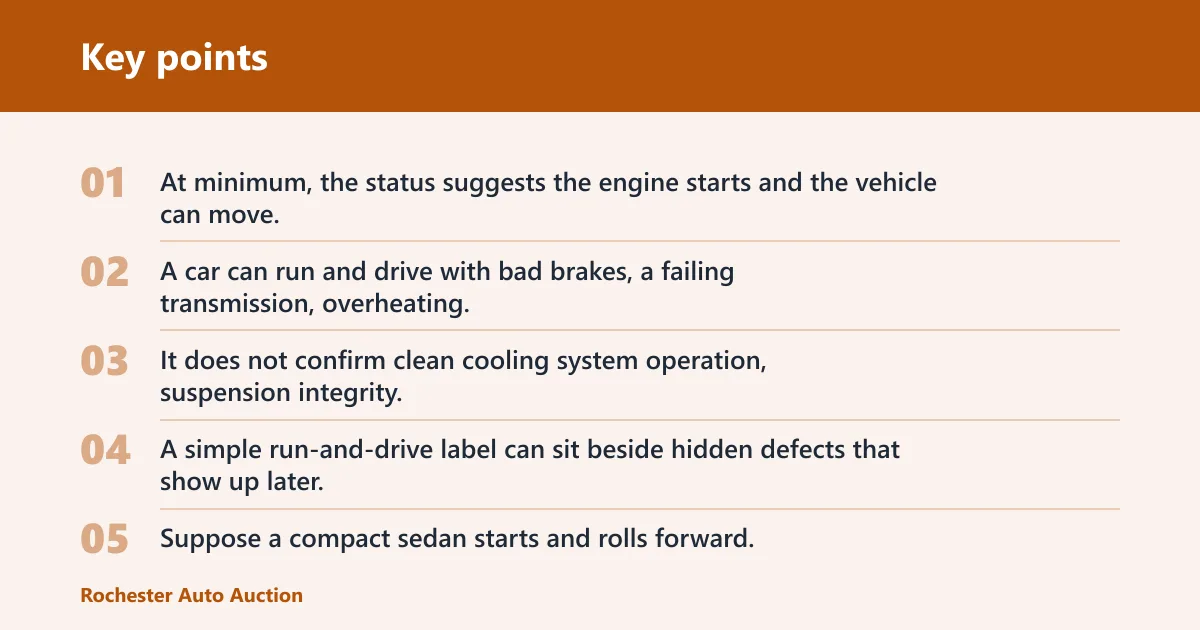
At minimum, the status suggests the engine starts and the vehicle can move. That is useful, but limited. A car can run and drive with bad brakes, a failing transmission, overheating, or intermittent electrical problems that were not obvious during the auction check.
What it does not confirm
It does not confirm clean cooling system operation, suspension integrity, airbag readiness, or stable charging. A simple run-and-drive label can sit beside hidden defects that show up later, especially if the report also contains vague notes or no test details.
Why the label still leaves risk
Suppose a compact sedan starts and rolls forward, but the report also mentions “check engine light on.” That vehicle may move fine in the lane and still need diagnostics, sensors, or emissions work after purchase. The label supports a bid, but only with a reserve for unknowns.
How do you spot stop-bidding defects?
Frame damage, flood clues, and serious title branding are commonly treated as stop-bidding defects by many buyers. They can change repairability, resale, insurance, and financing, which means they belong in a much higher risk tier than scratches, dents, or worn upholstery.
Frame damage indicators
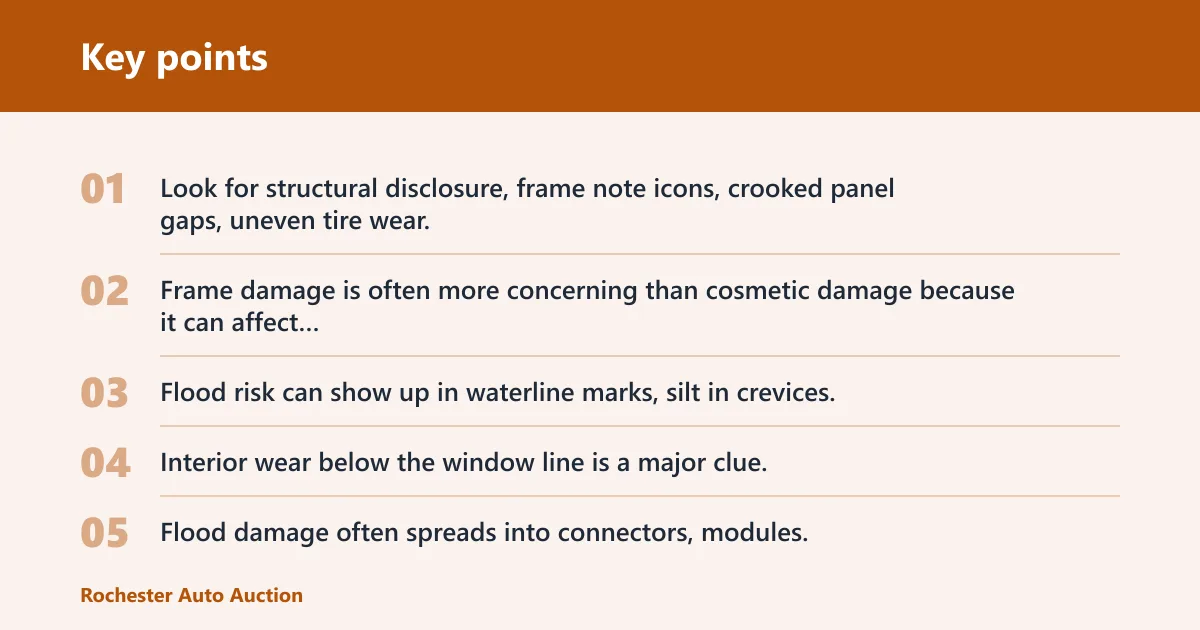
Look for structural disclosure, frame note icons, crooked panel gaps, uneven tire wear, and mismatched repairs near the rails or pillars. Frame damage is often more concerning than cosmetic damage because it can affect alignment, safety, and future resale value.
Flood damage clues
Flood risk can show up in waterline marks, silt in crevices, corrosion under seats or dash trim, mildew odor, fogged lamps, and electrical oddities. Interior wear below the window line is a major clue. Flood damage often spreads into connectors, modules, and wiring long after the carpet looks dry.
Title branding and salvage history
Salvage or repair history affects bid ceiling because prior damage severity changes repair uncertainty and market acceptance. It can also limit insurance or financing options. If the report shows branded title language, price it as a different car, not a discounted clean-title equivalent.
Picture a midsize SUV with clean paint, a run-and-drive label, and a faint damp odor inside. If the report also lists flood clues and the rear seat brackets show corrosion, that is not a cosmetic bargain. That is a high-risk car with uncertain electronics and resale problems.
How do you turn report notes into a starting bid?

Start with the cleanest likely market value for that exact trim and mileage, then subtract each risk layer: cosmetic repair, mechanical uncertainty, and stop-bidding defects. Compare the odometer reading with wear, repairs, and listed condition, then set the number before the auction begins.
Compare odometer reading with wear and condition
The mileage number on the report should make sense next to seat wear, pedal wear, steering wheel wear, and service notes. A low-mileage reading with heavy interior wear can signal use inconsistency or tampering risk. A high-mileage car with light wear may still be honest, but the sheet should support the story.
Price cosmetic damage separately from mechanical uncertainty
Do not combine dents and drivetrain risk into one vague deduction. Cosmetic damage is visible and usually more predictable. Mechanical uncertainty is different because the report may not catch electrical faults, underbody damage, or intermittent problems. Those hidden-risk gaps need their own reserve.
Set a maximum bid before the auction starts
A common first-timer mistake is deciding the bid after the opening call. That is too late. Set the max bid from the worksheet, then stay below it unless fresh, reliable information cuts the risk. If the report is vague, lower the ceiling again.
- Read the legend, then scan for frame, flood, airbag, and title notes.
- Separate cosmetic flaws from mechanical warnings.
- Check the odometer against wear and condition.
- Add a reserve for mechanical uncertainty.
- Apply a severe deduction or skip on frame or flood clues.
- Lock in a max bid before bidding starts.
What common problems are missed in auction inspections?
Common misses include intermittent electrical faults, underbody damage, and issues that only show up under load, heat, or wet conditions. A quick inspection may also miss cooling problems, hidden corrosion, airbag warnings that clear and return, and repairs hidden behind fresh trim or paint.
Where missed issues usually hide
Check the underbody, wheel wells, door bottoms, trunk channels, carpet edges, and the area around battery terminals and fuse boxes. Those spots often reveal water intrusion, impact damage, or corrosion before the rest of the car does. Missing detail in these areas should lower the bid ceiling.
Why the sheet is not a full diagnosis
The sheet is a disclosure document. It is not a teardown, scan report, or long road test. That is why a “clean” report can still leave repair risk on the table. Use the sheet to avoid overbidding, not to prove the car is problem-free.
How do you use the inspection sheet before you bid?
Read every section before you bid, then convert each finding into a price change. Use the sheet as a filter: cosmetic defects reduce value, mechanical warnings require reserve, and frame or flood disclosures usually set the car apart as a skip unless you have a very specific reason to buy it.
Buyer type changes the ceiling
Retail flippers need enough margin to cover reconditioning, transport, and days on lot. First-time bidders should be conservative because small mistakes compound fast. Budget commuters can tolerate light cosmetics, but not safety or title risk. The same report should not produce the same ceiling for every buyer.
How to bid at auction with the sheet in hand
Bring the report to the lane, not just the listing price. If the visible car matches the report, hold the ceiling. If the walkaround shows a bigger dent, mismatched panel, warning light, or damp interior than the sheet suggests, reduce the bid or walk away.
Say your bidder card is set for a sedan with two scratches and one dented fender. If the car also shows a dash warning light and a strong mildew smell, the sheet is no longer a cosmetic-only purchase. The bid ceiling should move down or disappear.
Frequently asked questions
How do I use an auction inspection sheet before I bid?
Read the legend, then review body, interior, mechanical, and title notes before looking at price. Turn cosmetic flaws into small deductions, mechanical uncertainty into a reserve, and frame, flood, or title problems into stop signs. The sheet should set your maximum bid, not confirm the car is safe.
What does an auction inspection sheet tell me?
It tells you what the auction disclosed, what the inspector observed, and where the report is incomplete. Look for damage notes, symbols, odometer reading, mechanical checks, and any title branding. It does not give a full mechanical diagnosis, so missing detail should be treated as risk.
Which red flags on an auction report should stop me from bidding?
Frame disclosure, flood clues, severe title branding, airbag deployment, and major run-and-drive contradictions are the biggest stop-bidding defects. They can change repairability, resale, insurance, and financing. If the report is vague on those points, caution should rise, not fall.
What does run and drive mean on an auction inspection sheet?
It usually means the engine starts and the vehicle moves under its own power. It does not mean the car is safe, roadworthy, or free of hidden mechanical or electrical faults. Price it as a limited status, not as proof of condition.
How do I determine a starting bid from an auction inspection sheet?
Start with market value, subtract cosmetic repair cost, subtract a reserve for mechanical uncertainty, and cut the number hard for frame or flood disclosures. Compare the odometer with wear and condition, then set the ceiling before the sale begins. If the report is vague, be more conservative.
Is a pre-auction inspection worth paying for?
Yes, when the vehicle has thin disclosure, a suspicious odor, mismatched panels, or a title history that needs confirmation. A paid inspection can reveal underbody damage, warning lights, or flood clues that a sheet may miss. It is usually worth more than one bad bid.