How to VIN Check for Accidents on an Auction Car
To VIN check for accidents on an auction car, compare the VIN against title history, auction condition reports, damage codes, odometer records, and photos. Treat a single clean source as incomplete if the others conflict. Missing prior damage can mean overpaying, inheriting structural repairs, or bidding on a car that cannot be retitled as expected. This guide shows how to verify accident, salvage, and structural history before you place a bid.
VIN basics for auction buyers
That code is the starting point for decoding a vehicle’s identity, but it does not by itself confirm accident history, title status, or ownership changes.
Where to find the VIN
Check the dash at the base of the windshield, the driver-side door jamb, the title, the registration, and the auction listing. The number should match in all places. If one source shows a different VIN, pause the bid process and verify the vehicle before trusting any report.
Use the car itself first. Then compare the paperwork. Auction buyers should also confirm that the listing VIN and the physical VIN agree character for character, because a single typo can pull the wrong history.
Why the 9th character matters
The 9th VIN character is a check digit used to validate standard U.S. VINs. It helps confirm that the VIN format is valid, but it does not prove the car is clean, safe, or free of accident history.
A valid VIN can still point to a car with prior front-end damage, a total loss title, or a repeated auction sale. Format and condition are separate questions.
What a VIN check can show
A VIN check can surface accident records, title events, odometer readings, and other history clues, but the depth depends on the tool. A decoder and a history report are different tools, and auction buyers need both to verify what the car has been through.
VIN decoder versus vehicle history report
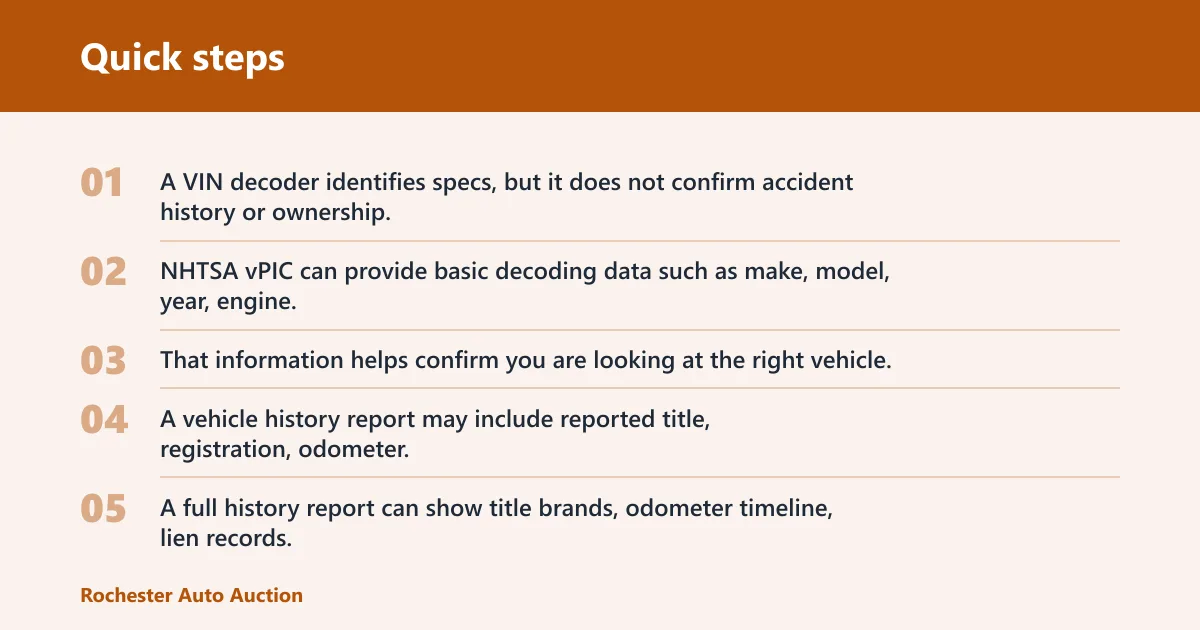
A VIN decoder identifies specs, but it does not confirm accident history or ownership. NHTSA vPIC can provide basic decoding data such as make, model, year, engine, and build details. That information helps confirm you are looking at the right vehicle, not its full life story.
A vehicle history report may include reported title, registration, odometer, and accident information. A full history report can show title brands, odometer timeline, lien records, theft records, and auction photos. That is the report type buyers use when they need more than trim and engine data.
Why clean-looking records can still miss damage
A clean VIN lookup can still miss a prior hit if the loss was never reported, if records were filed under a different event, or if the car changed hands through multiple auctions. That is why auction photos, condition notes, and mileage progression matter as much as the headline result.
Picture a sedan that shows no accident event on a basic lookup, yet the auction listing says “front end” and the photos show a crushed bumper support. In that case, the auction record is the stronger clue for bid risk, even if the report looks clean.
NHTSA vPIC VIN decode
Use NHTSA vPIC when you need to confirm the VIN’s basic build data before you compare history sources. It helps you verify that the seller listing, the dashboard VIN, and the decoded vehicle description all point to the same car.
Match decoded specs to the seller listing
Check make, model, year, engine, and build details against the listing. If the listing says one body style and the decoder points to another, you may be looking at a typo, a swapped listing, or a misread VIN. Any of those can distort the rest of the history check.
Spot VIN typos before you trust the report
A single wrong character can return the wrong accident, title, or mileage record. Before you pay for a report, verify the full 17-character VIN on the car and paper trail. A bad match wastes time and can lead to a bad bid.
Auction accident verification matrix
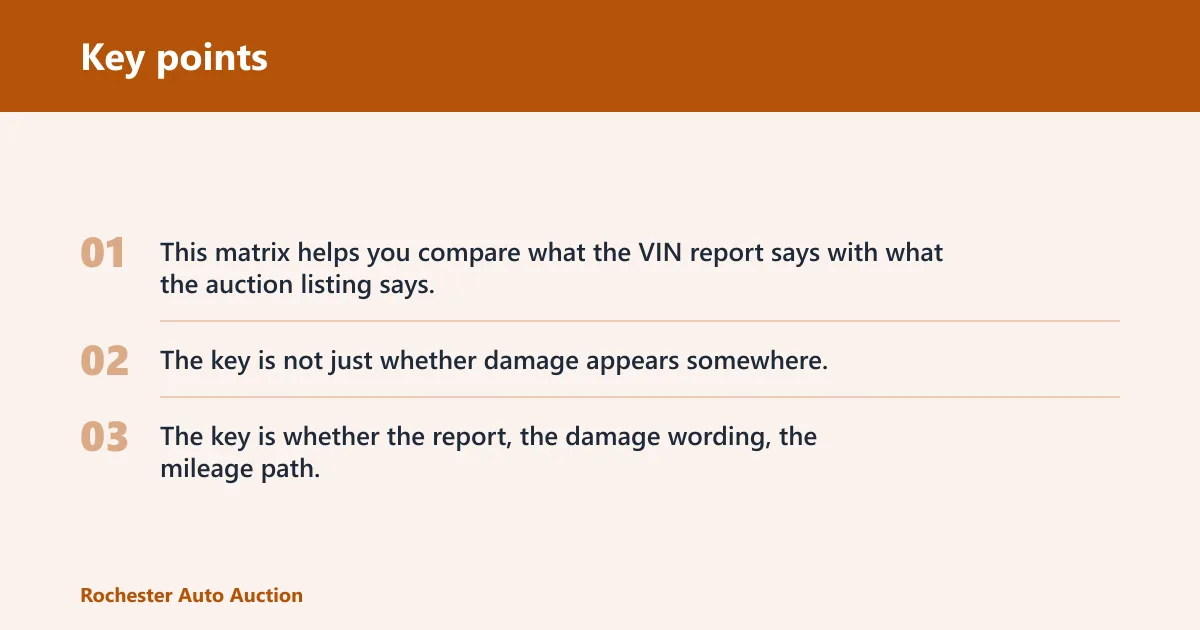
This matrix helps you compare what the VIN report says with what the auction listing says. The key is not just whether damage appears somewhere. The key is whether the report, the damage wording, the mileage path, and the photos all point in the same direction.
| VIN report signal | Auction listing clue | What it means | Bid decision |
|---|---|---|---|
| Front-end accident record | “Front end,” “front damage,” broken bumper, hood, radiator support visible | Likely collision damage to the nose of the car; repairs may involve cooling, airbags, sensors, or structure | Bid only after photo review and repair estimate review |
| Water or flood history | “Water/flood,” interior staining, mud lines, corrosion, musty cabin photos | Possible electrical and hidden corrosion risk beyond visible body damage | High caution; avoid unless records are complete and pricing reflects the risk |
| Structural or frame event | “Structural,” “frame,” “rails,” uneven panel gaps, damaged subframe notes | Repair may affect alignment, crash protection, and resale value | Bid only with full documentation and a clear repair path |
| Odometer inconsistency | Lower mileage than a prior auction record | Rollback, instrument replacement, or incomplete records | Do not bid until the mileage story is explained |
| Salvage title | “Salvage,” “rebuilt,” “reconstructed,” or similar branding | Major loss history; the car may have been a total loss and later repaired | Only bid if title status matches your intended use and registration rules |
| Repeated auction appearance | Same VIN listed again within a short span | Prior bid failure, repair issue, title issue, or buyer rejection | Review prior photos and sale notes before bidding again |
| Missing history | No photos, sparse notes, little mileage context | Record gap; damage may exist but be undocumented | Treat as incomplete data and bid conservatively |
How to read auction damage clues
Auction damage wording is often brief, but the terms are meaningful. The description usually points to where the impact was, how broad it was, and whether the damage likely stayed cosmetic or reached structure.
Front end, rear end, and side damage
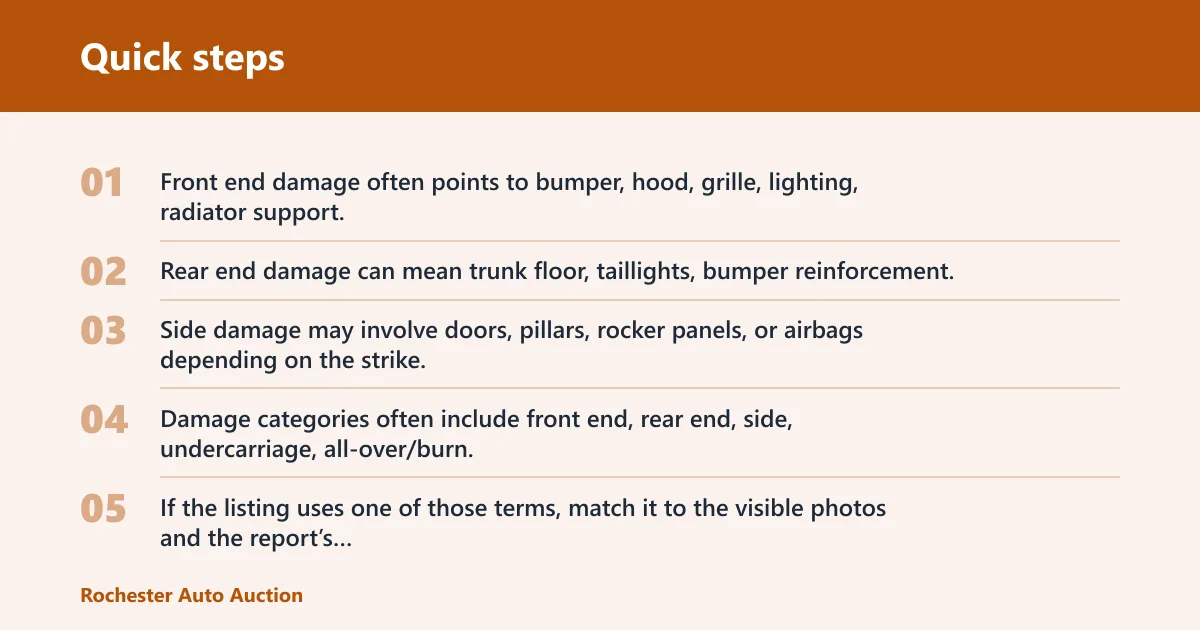
Front end damage often points to bumper, hood, grille, lighting, radiator support, or airbag concerns. Rear end damage can mean trunk floor, taillights, bumper reinforcement, and quarter-panel work. Side damage may involve doors, pillars, rocker panels, or airbags depending on the strike.
Damage categories often include front end, rear end, side, undercarriage, all-over/burn, water/flood, and mechanical. If the listing uses one of those terms, match it to the visible photos and the report’s accident wording.
Structural or frame wording
Structural or frame language matters more than a simple panel replacement note. It may indicate the vehicle had a hard hit, rail repair, or alignment risk. A car can look tidy in photos and still carry a frame brand in the history record.
Suppose a crossover has “rear” damage in the listing, but the photo set also shows a bent quarter panel, wrinkled floor, and a frame note. That is not a light cosmetic repair. It is a bid-risk increase, even if the paint appears fresh.
Water, flood, and undercarriage signs
Water and flood clues are often more serious than surface damage because electrical, safety, and corrosion issues can hide under trim and carpet. Undercarriage damage can also mean suspension, exhaust, or floorpan issues that are easy to miss in a quick glance.
When the listing says water/flood, check for staining, corrosion on fasteners, muddy residue, and inconsistent interior photos. If those signs appear and the report is thin, the safer choice is usually to pass.
Check mileage across records
Odometer readings should progress logically over time. Compare the auction listing, the history report, and any prior sale records. A mismatch where current mileage is lower than a prior auction reading is a serious red flag.
Compare auction listings, title events, and reports
Start with the most recent mileage shown in the auction listing, then compare it with the odometer timeline in the report. If a title event or prior auction record shows higher mileage, the story needs explanation before bidding.
- Record the current listing mileage.
- Check the prior auction mileage if archived records exist.
- Review the vehicle history report for mileage entries.
- Look for gaps, resets, or jumps that do not fit normal use.
- Decide whether the mismatch is documented or unresolved.
When an odometer gap needs more review
A gap does not always mean fraud, but it does mean risk. A replacement cluster, missing service record, or incomplete auction archive can leave the mileage picture incomplete. If the numbers do not line up, do not treat the car as verified.
Consider a compact SUV that shows 86,214 miles in one auction record and 79,900 miles in a later listing. That drop is not normal wear. It calls for a deeper review of title history, cluster replacement notes, and photo dates before any bid.
When titles reveal more than the report
Title branding can tell you more than a short report summary. Salvage, rebuilt, and reconstructed titles are major resale and insurability signals, and they can change after repairs or inspections.
Salvage title meaning
Salvage means the vehicle was declared a total loss and not yet rebuilt or inspected. That branding is a major warning sign because it usually follows a serious damage event, theft recovery, or another high-cost loss.
Rebuilt or reconstructed title signals
A rebuilt or reconstructed title usually means the car has already gone through repair and a required inspection process. That can make the vehicle road-legal again, but it does not erase the loss history or the reason it was branded in the first place.
Check whether the auction listing uses current title branding that matches the report. A clean current title with older salvage history still matters, because prior branding affects resale, financing, and future buyer confidence.
Repeated auction listings and missing photos
The same VIN can appear at auction more than once. That repetition can signal unresolved damage, title issues, failed sale attempts, or a vehicle that changed hands without a full record trail.
Why the same VIN may appear again
Repeated auction appearances in a short period can signal trouble. A car that failed to sell once, then returns with a lower grade or fewer notes, deserves extra scrutiny. The second listing may reveal more than the first.
How to use photo history to confirm damage
Some auction history records include photos archived from the original listing. Those images can confirm whether the damage description was accurate, whether repairs were partial, and whether the car’s condition improved or simply changed angle between sales.
If the report shows prior front-end damage and the archived photos show airbag deployment, radiator support deformation, and missing headlights, the history is clearer than a short text label. That is the kind of evidence that should influence your bid.
What to do when photos or records are missing
Missing photos do not prove the car is clean. They mean the file is incomplete. In that case, rely on title branding, mileage continuity, and the seller’s current disclosure, and price the uncertainty into the bid or walk away.
What records should you cross-check besides the VIN report?
Cross-check the auction listing, title record, registration details, odometer trail, and archived photos. A vehicle history report is useful, but it is strongest when the other records agree with it. If one source disagrees, treat that as a verification task, not a minor detail.
The best sequence is simple: decode the VIN, confirm the vehicle specs, review the history report, then compare the auction damage wording and photos. If any source conflicts with the others, do not assume the cleanest document is the correct one.
How do I check if an auction car was in an accident by VIN?
Match the VIN to a vehicle history report, then compare that report with auction damage wording, photos, and title records. If the report shows accident history and the listing shows matching damage, the case is stronger. If the report is clean but the auction evidence is not, trust the conflict and investigate further.
Use the VIN as the index, not the verdict. The car itself, the auction archive, and the title trail must line up before you treat the vehicle as verified.
Frequently asked questions
What does a VIN check show for accident history?
A vehicle history report may show accident records, title brands, odometer entries, and lien or theft records, depending on the data source. It can also include auction photos in some cases. A VIN decoder alone will not show those ownership and damage events.
Can a free VIN check reveal accident history on an auction car?
A free VIN lookup can confirm basic vehicle specs and sometimes surface limited history, but it often misses auction photos, title brands, and mileage context. For an auction purchase, that is usually not enough. Use a paid history report when the car is close to a bid decision.
How do I tell if an auction car was totaled before?
Look for salvage branding, rebuilt or reconstructed title language, major damage descriptions, and photo evidence of severe loss. If the report shows salvage and the auction listing shows structural or flood damage, treat the vehicle as a prior total-loss car until proven otherwise.
How can I verify auction damage photos by VIN?
Use the VIN to pull archived auction records, then compare the photos with the damage wording and title history. Look for the same panel damage, airbag deployment, flood marks, or frame distortion across sources. If the photos are missing, treat the record as incomplete.
Does a valid VIN guarantee the car has no accident history?
No. A valid VIN only confirms that the code format checks out. The 9th character is a check digit, but it does not prove the car is free of accidents, title brands, or mileage issues. You still need history records and auction evidence.
What should I do if the VIN report and the car don’t match?
Stop and verify the VIN on the dash, door jamb, title, and listing. If the decoded specs, mileage, damage story, or title status do not align, do not bid yet. A mismatch can point to a typo, swapped listing, or a history file for the wrong vehicle.