Do Online Auctions Really Work for Used Car Buyers?
Online auctions can work for used car buyers, but only if you price the full landed cost first: hammer price, buyer fees, transport, taxes, and any reconditioning or title delays. Miss those costs, and a “cheap” bid can turn into an overpriced, hard-to-title car that needs immediate repair. This guide explains when online auctions beat retail lots, what fees change the math, and which risks deserve a no-bid decision.
How online car auctions work
Most online auto auction platforms let you register, review listings, place pre-bids, and join a live sale from a browser or app. Some listings also offer Buy It Now. The difference is plain: you can bid from home, but you still buy under auction terms, not retail terms.
Registration, membership tiers, and deposits
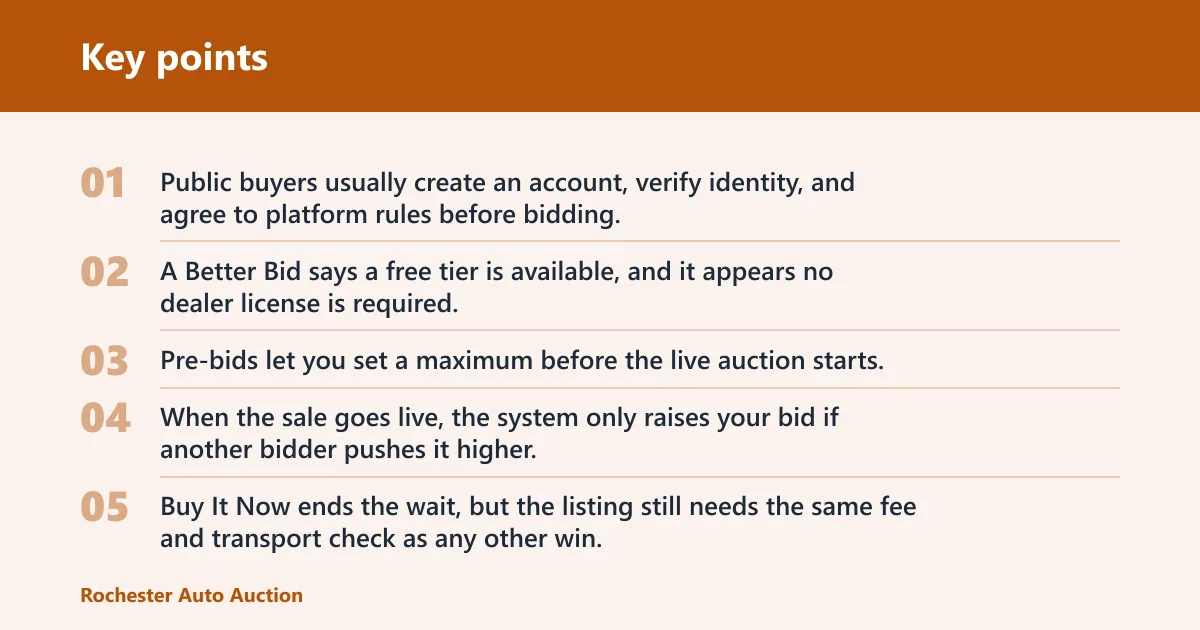
Public buyers usually create an account, verify identity, and agree to platform rules before bidding. Some platforms keep access open with a free tier, while others use membership tiers, buying power limits, or security deposits to control who can bid and how much.
A Better Bid says a free tier is available, and it appears no dealer license is required. It also says its public online car auctions are 100% online, with more than 150 weekly live auctions open to the public and 300,000+ repairable, wrecked, and salvage title cars for sale.
Pre-bid, live bid, and Buy It Now
Pre-bids let you set a maximum before the live auction starts. When the sale goes live, the system only raises your bid if another bidder pushes it higher. Buy It Now ends the wait, but the listing still needs the same fee and transport check as any other win.
What public buyers can and cannot access
Public access is real, but it is not universal. Some platforms open many listings to non-dealers, while others still reserve key lanes for licensed buyers or higher deposits. That matters because a buyer who can browse a car may still be blocked from bidding, or may face buying-power limits that cut off higher-value inventory.
Can public buyers use them?
Yes, some public buyers can use online auto auctions without a dealer license, but the rules vary by platform and inventory type. You still need to confirm registration requirements, deposit rules, and whether the specific listing is open to public bidding before assuming access.
Dealer-license rules versus public access
A Better Bid says no dealer license is required, which makes it useful for public buyers who want online access to auction inventory. Other platforms may still require dealer credentials for some lanes or sale types, so the account page and listing terms matter more than the headline promise.
Buying power, security deposits, and account limits
Buying power can be capped until the buyer completes a deposit or higher-tier approval. That limit affects more than bidding range. It also affects how many cars can be won at once, how fast payment must clear, and whether the buyer can take delivery before paperwork is finalized.
When local auctions still require a dealer
Many physical wholesale auctions still expect a dealer license or a dealer-affiliated buyer. That can make a local sale less accessible than an open public site, but it can also give the buyer a faster in-person look at the vehicle and fewer surprises on transport timing.
Online auction condition reports
Condition reports help, but they are not full proof of condition. Photos, listing notes, and disclosed damage show what the seller or platform chose to report. They do not guarantee there is no frame damage, flood exposure, electrical fault, or title problem hiding outside the camera angle.
Photos, listing notes, and damage disclosure limits
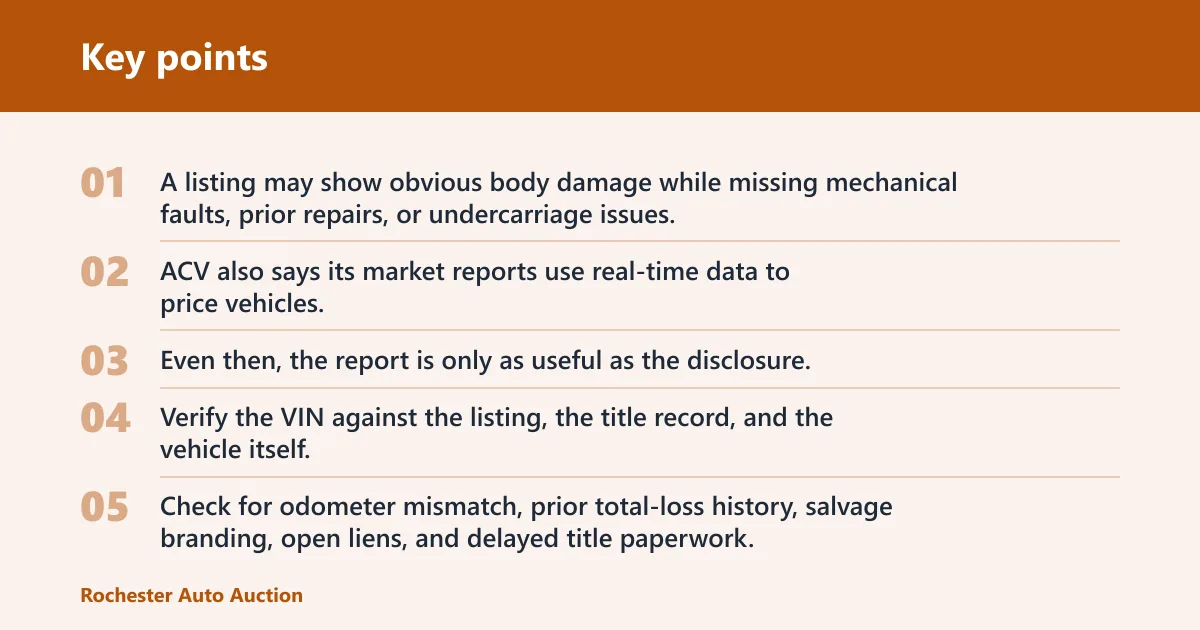
A listing may show obvious body damage while missing mechanical faults, prior repairs, or undercarriage issues. ACV says its Virtual Lift technology shows the undercarriage in high-definition, which helps buyers inspect areas that photos often miss. ACV also says its market reports use real-time data to price vehicles.
Even then, the report is only as useful as the disclosure. Buyers should treat missing panels, blurred photos, inconsistent trim, and vague comments as warning signs, not as reasons to assume the car is fine.
VIN checks, odometer checks, and title checks
Verify the VIN against the listing, the title record, and the vehicle itself. Check for odometer mismatch, prior total-loss history, salvage branding, open liens, and delayed title paperwork. If any of those items do not line up, the bid should pause until the seller clears the record.
When to use third-party inspection
A third-party inspection matters most when the listing has high value, unclear damage, or a title type that could affect resale. A separate inspector can confirm panel fit, fluid leaks, warning lights, glass markings, and obvious underbody damage before the buyer commits money that may be hard to recover.
Say your target car is a 2019 sedan with clean paint in the photos and a low bid. If the listing only shows front angles and a short note about “minor cosmetic damage,” a paid inspection may be cheaper than discovering bent suspension parts after pickup.
True cost of an auction win

The winning bid is only the starting point. Buyer fees, transport, storage risk, title work, taxes, and pickup timing can move a bargain into retail territory fast. In a tighter market, that gap matters more: wholesale used-vehicle prices jumped 6.2% year-over-year in March 2026, and days-supply fell below 40 days, tightening inventory for buyers.
| Scenario | Hammer price | Buyer fee | Deposit | Shipping | Storage risk | Title delay cost | Estimated all-in price |
|---|---|---|---|---|---|---|---|
| Clean-title public car | $9,000 | $850 | $250 | $700 | $0 | $150 | $10,700 |
| Repairable car | $5,500 | $775 | $300 | $900 | $200 | $250 | $8,025 |
| Salvage car | $3,200 | $650 | $400 | $1,100 | $350 | $400 | $6,100 |
These examples use only the auction-side costs most buyers forget to add before bidding. Taxes, reconditioning, state title fees, and repairs can add more. A “low” hammer price is useful only if the final number stays below the value of a comparable retail car.
Transport, storage, and late pickup charges
Shipping can be a domestic delivery option, but many platforms require a licensed transporter for the move. Pickup timing after payment matters because storage and late fees can start if the car sits too long. A buyer who wins on Friday and arranges transport next week may owe more than expected.
- Confirm pickup timing. Ask how many days are allowed after payment before storage charges begin. That window often determines whether a low bid stays low.
- Book licensed transport. If the platform requires a transporter, line it up before the sale closes. That reduces the chance of paying storage while waiting for a carrier.
- Verify delivery limits. Check whether the carrier can handle running, non-running, or damaged vehicles. A salvage car may need winching or special loading gear.
Taxes, title work, and paperwork timing
Title transfer is part of the total cost. Clean-title cars usually move faster, but paperwork timing still varies by seller, platform, and state. Salvage and rebuilt titles often take longer, and that delay can block registration, insurance, or resale until the paperwork clears.
A common first-timer mistake is bidding on a car with a low hammer price and then discovering the title will not arrive for weeks. If the buyer needs the car on the road quickly, that delay can matter more than the sticker price.
What risks come with buying a used car online at auction?
The main risks are condition mismatch, title problems, and limited remedies after the sale. Many auction vehicles are sold as is, where is, so the buyer assumes condition risk. That means no warranty from the seller or platform, and returns or arbitration may be narrow, time-limited, or unavailable.
As-is, where-is sale terms
A Better Bid says vehicles are sold as is, where is, and that inspections are the buyer’s responsibility. That is the core risk shift: the platform discloses the listing, but the buyer owns the condition once the bid wins.
The same source says it offers 10-day arbitration protection at no charge. That is helpful, but it is still limited protection, not a blanket return policy. Buyers should read the arbitration rules before bidding, not after a problem appears.
Return and arbitration limits
Arbitration usually covers specific disclosure failures, not ordinary wear, cosmetic issues, or a buyer’s change of mind. If the platform’s policy window is short, the inspection and pickup plan must be fast enough to detect problems before the claim deadline closes.
Which title types are worth buying?
Title type should match your repair budget and resale plan. Clean-title cars fit normal retail use best. Repairable cars can make sense when the damage is visible and the buyer can price repairs accurately. Salvage and rebuilt title vehicles carry more paperwork and resale friction, so the discount has to be real.
Clean title and normal retail use
Clean title is the easiest path for most used-car shoppers. It usually means faster registration, simpler insurance setup, and better resale later. That does not make the car perfect, but it lowers the title risk that often turns auction bargains into paperwork problems.
Repairable or damage-disclosed cars
Repairable cars fit buyers who can estimate body, suspension, or cosmetic repair costs before bidding. They work best when the damage is visible, parts are available, and the buyer has a hard ceiling on both repair spend and transport cost.
Suppose a crossover has a damaged bumper, a drivable engine, and a clear repair estimate from a body shop. That may be a workable purchase if the total remains well below a similar retail listing after fees and transport.
Salvage and rebuilt title risk
Salvage cars can be worth buying online when the buyer wants parts, a rebuild project, or a very specific model at a steep discount. The risk is that the final cost can rise quickly once shipping, inspection gaps, title timing, and repairs are added. Rebuilt title cars may be easier to register than salvage titles, but they still deserve a close history check.
When online auctions make sense
Online auctions make the most sense for buyers who can judge total cost, tolerate as-is risk, and verify title status before bidding. They are less attractive when the buyer needs a guaranteed-ready car, a fixed payment plan, or a fast in-person inspection with a return option.
Best-fit buyer profiles
Online auctions often fit buyers who can handle transport logistics, read condition reports critically, and budget for repairs. They also fit buyers who want inventory beyond a local lot and are comfortable walking away if the title or report raises questions.
When a local used-car lot is the safer choice
A local used-car lot is usually safer when the buyer wants to test-drive, inspect in person, and keep repair risk low. The sticker price may be higher, but the buyer may avoid surprise shipping charges, storage issues, and title delays.
When a local auction is the better route
A local auction can be better when the buyer wants to inspect in person before bidding and arrange immediate pickup. It may also be better for buyers who already have dealer access, a transporter ready, and enough experience to judge condition without relying on photos alone.
How to avoid overpaying at an online auto auction
The best way to avoid overpaying is to bid on the landed cost, not the hammer price. Add buyer fees, shipping, taxes, title work, storage risk, and a repair buffer before setting your maximum. If the total no longer beats a retail or local-auction alternative, skip the lot.
- Set a hard ceiling. Calculate the maximum all-in price before the sale starts. Leave room for transport, title timing, and one repair item you may not see in the photos.
- Check the paperwork first. Match the VIN, title type, odometer, and damage disclosure before placing a bid. A mismatch can wipe out the deal faster than a high bid.
- Bid only on known risk. Favor listings with clear photos, strong disclosure, and a real inspection path. If the listing is vague, the missing information is part of the price.
Online auctions are not automatically cheaper than retail. They work when the buyer gets disciplined about total cost, title status, and inspection limits. They fail when convenience hides the expenses that show up after the bid wins.
Frequently asked questions
Do online car auctions actually save money for used car buyers?
Sometimes, but only when the hammer price stays low enough to absorb fees, shipping, taxes, and title work. In a tighter market, that margin shrinks fast. If the same car can be bought locally for close to the all-in auction total, the auction is not the cheaper option.
Can public buyers use online auto auctions without a dealer license?
Yes, on some platforms. A Better Bid says a free tier is available and no dealer license is required. Still, access can vary by sale type, deposit level, and listing rules, so public buyers should confirm eligibility before they bid.
How do online auction fees, shipping, and title transfer affect total cost?
They can change the purchase from a bargain into an average or expensive buy. Buyer fees, transport, and title work are added after the hammer price, and storage or late pickup charges can appear if the car is not collected on time. That total should set the bid limit.
What condition information should I trust before bidding?
Trust the listing details only as a starting point. Use the VIN, odometer record, title status, photo consistency, and any third-party inspection to confirm what the report misses. If the damage disclosure is vague or the undercarriage is hidden, treat the listing as incomplete.
Are salvage or repairable cars worth buying online?
They can be, but only for buyers who can estimate repair cost and title effort before bidding. Salvage and repairable cars usually fit project buyers, parts buyers, or shoppers who accept more risk in exchange for a lower upfront price. For many shoppers, clean-title inventory is the safer match.
When is an online auction better than a local used-car lot?
An online auction is better when the buyer has transport lined up, can verify the title, and wants access to more inventory than a local lot offers. A local lot is better when a test drive, faster paperwork, and lower condition risk matter more than a slightly lower bid.
How do I avoid overpaying at an online auto auction?
Start with the full landed cost, not the bid. Add buyer fees, shipping, taxes, title fees, and a repair reserve before you decide the top number. Then skip any car with unclear condition, weak title data, or pickup timing that could trigger storage costs.