What Does Reserve Not Met Mean at a Car Auction?
“Reserve not met” means the highest bid has not reached the seller’s minimum price, so the vehicle has not sold yet. Ignore it, and you may waste time bidding on a car that can still be withdrawn or relisted. This guide explains what the status means, what buyers can do next, and what sellers usually decide after the auction.
Reserve price basics
A reserve price is the lowest amount a seller will accept. Most platforms keep it hidden, so bidders often see only “Reserve not met,” which means the current high bid is still below that private floor. Major auction platforms generally describe this as a seller-controlled minimum, not a public bid level.
Sellers use a reserve price to avoid selling too cheaply. A starting bid is different: it is the first number shown on the listing, and it stays visible. The reserve can sit above that first bid, so an auction can draw attention while the final sale price remains out of reach. Platform help pages from major marketplaces commonly treat the starting bid and reserve as separate mechanics.
Why sellers use reserve pricing
Reserve pricing gives the seller a floor without putting that floor in public view. That matters in vehicle auctions, where a low opening number can pull in bidders while the seller still protects a higher acceptable price. On large auction sites, that hidden floor is often used to balance visibility with downside protection.
It also helps sellers avoid a weak result on a clean, desirable vehicle. For buyers, that means the auction can stay active even when the leading bid is not high enough to close the deal. In practice, the auction remains competitive until the reserve is met, lowered, waived, or the sale ends unsold.
What reserve not met means in a car auction?
“Reserve not met” means the current high bid has not reached the seller’s minimum, so no automatic sale has happened yet. The auction is still live when the reserve has not been met, and the car may still sell if bidding gets high enough or if the seller chooses to accept the bid before the close. That outcome depends on the platform’s rules and the seller’s settings.
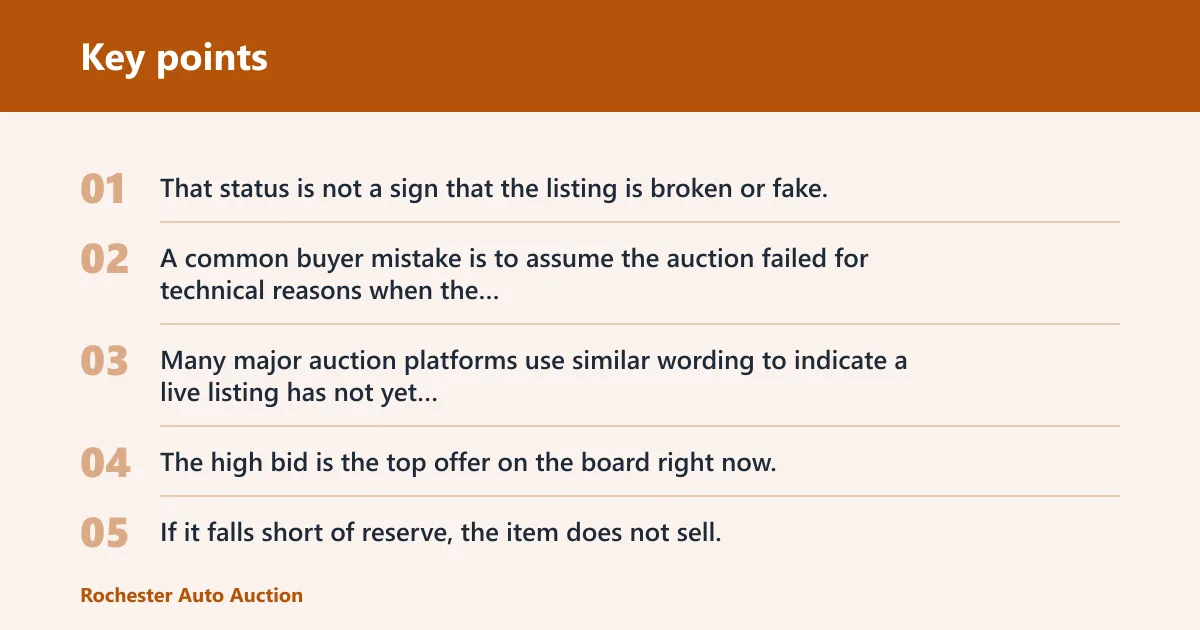
That status is not a sign that the listing is broken or fake. A common buyer mistake is to assume the auction failed for technical reasons when the platform is simply showing a normal live-auction status. Many major auction platforms use similar wording to indicate a live listing has not yet reached the seller’s minimum.
What the current high bid tells you
The high bid is the top offer on the board right now. If it falls short of reserve, the item does not sell. That is the practical meaning of the status: the auction has a leader, but not yet a winning price. The message is informational, not a guarantee that the item will or will not sell.
Some platforms may also use a message such as “reserve almost met.” That wording is meant to keep bidders active, but it still does not mean the reserve has been reached. Sellers can still choose to accept, lower, or hold firm depending on the platform’s controls and the auction’s timing.
Reserve not met vs starting bid
The starting bid begins the auction, while the reserve protects the seller’s bottom line. The starting bid is visible to everyone. The reserve is usually hidden, and it can be higher than the first public bid. Those two numbers are related, but they do not mean the same thing. If the reserve is hidden, bidders can only infer it from the auction status or bid movement.
| Term | What bidders see | What it does | Buyer takeaway |
|---|---|---|---|
| Starting bid | Always visible | First number shown on the listing | Begins the auction |
| Reserve price | Usually hidden | Seller-set minimum accepted price | Must be reached for a standard sale |
| High bid | Visible as the top bid | Current leading offer | Shows where the auction stands now |
| Reserve not met | Often shown as a status label | Signals the bid is still below the floor | No automatic sale yet |
Say your auction starts at a visible $1,000 bid, with the seller’s hidden floor set higher. The listing can still attract bids, but the car will not sell unless the high bid reaches that private minimum or the seller changes the outcome. That relationship is normal across many reserve-based auction formats.
What happens if reserve is missed?
If bidding ends below reserve, the auction closes without a sale. The seller can often relist the vehicle or negotiate afterward, depending on the platform and the seller’s decision. The missed reserve does not create a sale by itself, and it does not force the seller to accept the top bid. Many platforms treat the close as a non-sale unless the seller takes a separate action after the auction ends.
That split after close matters. Buyers often focus on the live status and miss the two practical outcomes that follow: the vehicle ends unsold, or the seller reopens discussion after the auction. Auction marketplaces commonly frame this as an ended listing with possible follow-up, not as an automatic win for the top bidder.
Common post-close outcomes
- The auction ends with no sale.
- The seller relists the vehicle for a later auction.
- The seller contacts or is contacted for a possible direct deal after close.
Picture a pickup that closes at a strong bid but still misses reserve by a small gap. The live auction ends without a sale, then the seller may decide whether to relist at a new floor or negotiate with the top bidder after close. That sequence is common when the platform permits post-close communication or offers.
If a car shows reserve not met, what happens next?

Here is the short version: the buyer can keep bidding, wait for the seller to lower or waive the reserve, or step away if the price no longer fits the budget. The likely outcome depends on whether the auction is still live, whether the platform allows reserve changes, and whether the seller accepts a below-reserve offer.
Branch 1: Keep bidding while the auction is live. Buyer action: continue only if the vehicle still fits your budget and condition threshold. Likely outcome: the bid may rise to the reserve and the car may sell normally.
Branch 2: Watch for a seller reserve change. Buyer action: monitor bid activity and platform messages. Likely outcome: if the platform allows reserve lowering during the auction, the listing may become sellable at a lower price.
Branch 3: Seller accepts below reserve. Buyer action: confirm the platform permits that outcome before assuming success. Likely outcome: some platforms allow the seller to override the reserve and close the deal.
Branch 4: Auction ends without reserve being met. Buyer action: watch for relisting or follow-up contact rather than assuming a sale. Likely outcome: the vehicle closes unsold unless the seller negotiates afterward.
Branch 5: Post-close negotiation starts. Buyer action: respond quickly if the seller invites discussion and the price still makes sense. Likely outcome: the car may sell after the auction through a separate agreement, if the platform and seller allow it.
- Check whether the auction is still live.
- Compare the high bid with your own ceiling.
- Look for seller action or platform messages.
- Decide whether to keep bidding or step away.
- After close, watch for relisting or follow-up contact.
Can a car still sell below reserve?
Yes, but only if the seller accepts the top bid or the platform allows a reserve override. That is not automatic, and it is not the same on every site. Some platforms lock the reserve once the auction starts, while others let a seller lower the reserve during a live auction. Major auction houses and online marketplaces vary here, so platform rules matter.
Reserve override and platform rules
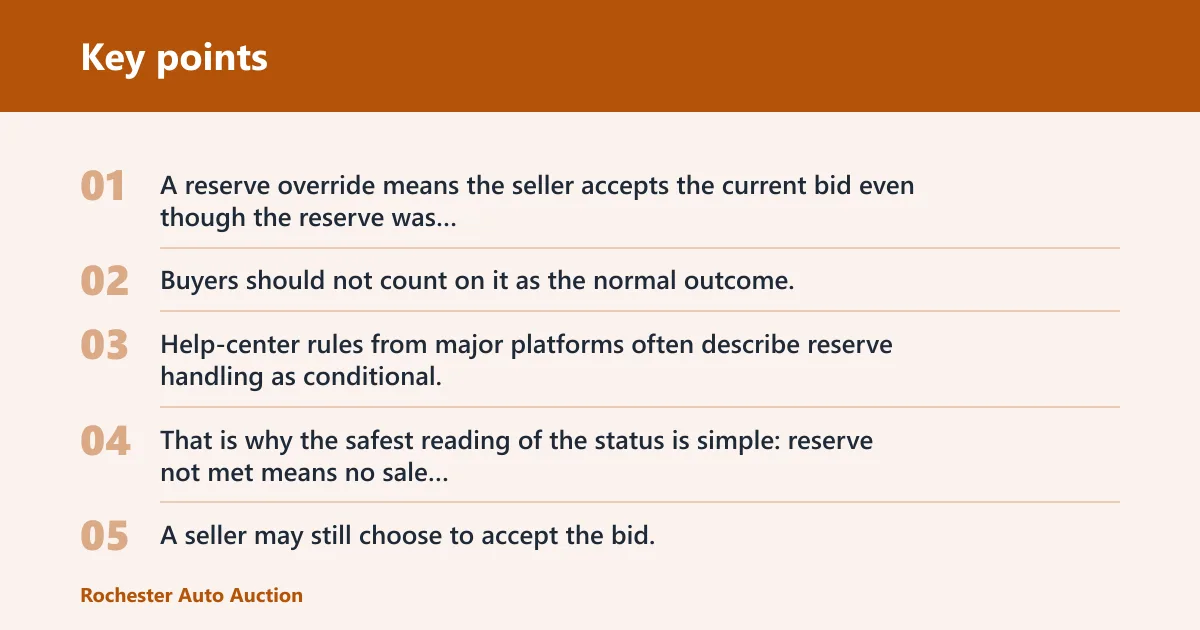
A reserve override means the seller accepts the current bid even though the reserve was not reached. Some platforms allow this, and some do not. Buyers should not count on it as the normal outcome. Help-center rules from major platforms often describe reserve handling as conditional, seller-controlled, or limited to certain listing types.
That is why the safest reading of the status is simple: reserve not met means no sale has been triggered yet. A seller may still choose to accept the bid, but the platform and the seller’s settings control that result. If the site’s rules do not permit a change, the auction usually remains below the sell threshold.
A common first-timer mistake is treating reserve not met as proof that bidding is useless. It is not proof of that. It is a signal to decide whether the car is still worth your next bid, not a reason to assume the listing is invalid.
| Rule variation | Common platform behavior | Buyer impact |
|---|---|---|
| Hidden reserve | Sellers set a private minimum; bidders only see the status | Price ceiling is uncertain until the reserve is met or waived |
| Reserve lowering | Some platforms let the seller reduce the reserve during the live auction | The item may become sellable before the auction closes |
| Override allowed | Some platforms let the seller accept the top bid below reserve | The car can sell even though the reserve was not reached |
| Post-close negotiation | Some platforms allow follow-up contact after the auction ends | The vehicle may still sell through a separate agreement |
What does no reserve mean at a car auction?
A no-reserve auction means the seller accepts whatever the final bid is. Because there is no hidden floor to clear, these auctions often attract more bidders. The tradeoff is clear: the seller takes more risk, because the vehicle can sell for less than a protected reserve listing might have brought. Platforms that allow no-reserve listings usually state that the high bid at close wins outright.
For buyers, no reserve can change bidding behavior. More people may enter early because they know the car can sell at the final price shown on the board. For sellers, that same openness can increase competition, but it also removes the safety net of a minimum sale price. The result is simpler than a reserve listing: highest bid at close usually wins.
Reserve almost met messages
Some platforms use “reserve almost met” or similar wording to keep bidders active. The message is meant to suggest that the gap is small enough to stay engaged. The wording varies by site, though, and it should not be read as a promise that the car will sell. It is a prompt, not a guarantee.
That matters because messaging can affect behavior. A bidder may be more likely to stay in the auction when the platform suggests the reserve is close, even though the seller still has the final say on whether the bid is acceptable. Platform copy is designed to encourage participation, but the underlying rule still depends on the marketplace.
Frequently asked questions
What does reserve mean at a car auction?
Reserve means the seller’s minimum acceptable price. It is usually hidden from bidders, and the car will not sell below that floor unless the seller or platform allows a special exception. In practice, it protects the seller from accepting a result that is too low.
What happens if a car does not reach reserve?
If a car does not reach reserve, the auction ends without a sale. The seller may relist the vehicle, adjust the terms, or sometimes negotiate after close. The missed reserve does not complete the transaction on its own, and the bidder does not automatically win the car.
Can buyers find out the reserve price before the auction ends?
Usually no. Most platforms do not show the reserve amount, and bidders may only see a label such as “Reserve not met.” A seller may choose to disclose the reserve, but that is not standard. Buyers should assume the figure is private unless the listing says otherwise.
Can a seller lower the reserve price during a live auction?
Sometimes, but not always. Some platforms allow a seller to lower the reserve while the auction is live, while others lock it once bidding starts. Buyers should not assume the reserve can change mid-auction unless the site’s rules or a seller message confirms it.
How is reserve not met different from starting bid?
The starting bid is the first visible number on the listing, and it begins the auction. Reserve not met means the current high bid has not reached the seller’s hidden minimum. One starts the bidding, while the other tells you the auction is still below the sale floor.