What Are the Dealer License Requirements by State?
Dealer license requirements vary by state, but most states require a business location, surety bond, sales tax registration, and background checks before you can buy and sell vehicles for profit. Missing one state rule can delay approval, trigger fines, or force you to restart the application. This guide compares the strictest requirement categories so you can spot the differences before you apply.
Dealer license requirements by state
State rules differ on bond amount, education, renewal timing, inspection steps, and location approval. Start with the issuing motor vehicle dealer licensing agency in your state, then compare the rules that usually cause delays: zoning, bond filing, education certificates, and site approval. Used, wholesale, franchise, and specialty licenses can follow different rule sets.
What changes first from state to state
The first screen is usually not the application form. It is the state agency checklist. One state may want an inspection before issuance, another may accept the application first and inspect later, and another may require classroom or online education before you file. Processing time can stretch when a review or inspection is pending.
Dealers should also separate recurring compliance from startup work. A bond, office setup, and first filing are usually one-time or initial steps. Renewal fees, education refreshers, and renewed filings are ongoing costs in some states. That difference matters when you compare where licensing is simpler versus where the recurring burden is heavier.
A common first-timer mistake is to open a dealership near a residence before confirming the local land-use rules allow it. Suppose the lease lists a commercial address, but the city has not approved vehicle sales at that site. The state can hold the file even if every other document is complete.
📊 Texas replaced dealer temporary tags with dealer temporary plates beginning July 1, 2025. Source: Txdmv.
Which agency issues dealer licenses?
Your state motor vehicle dealer licensing agency is the office that issues the license, publishes the forms, and sets the checklist. It may also handle inspections, education rules, fingerprints, and renewals. Use that agency’s current forms and instructions, because county or city paperwork alone is not enough.
How to find the correct state office
Look for the state office that regulates motor vehicle dealers, not the general business registration office. The right agency usually publishes application packets, bond instructions, site approval steps, and renewal notices. If the state splits duties between agencies, follow the dealer licensing office first and confirm any tax or zoning forms they require.
That agency is also the source for special rules by license class. Retail, wholesale, franchise, and specialty dealers may not follow the same location or inspection steps. Brokers can be regulated separately, and some low-volume sellers or business-use vehicle disposals may be exempt from dealer licensing in some states.
Dealer bond and fee differences
Dealer bond requirements vary by state and license type. Many states require a surety bond, but some allow a cash deposit or certificate of deposit instead. The amount, filing method, and who must be listed on the bond can differ by retail, wholesale, used-car, or specialty category, so match the bond to the exact license class.
Bond amount and acceptable bond types
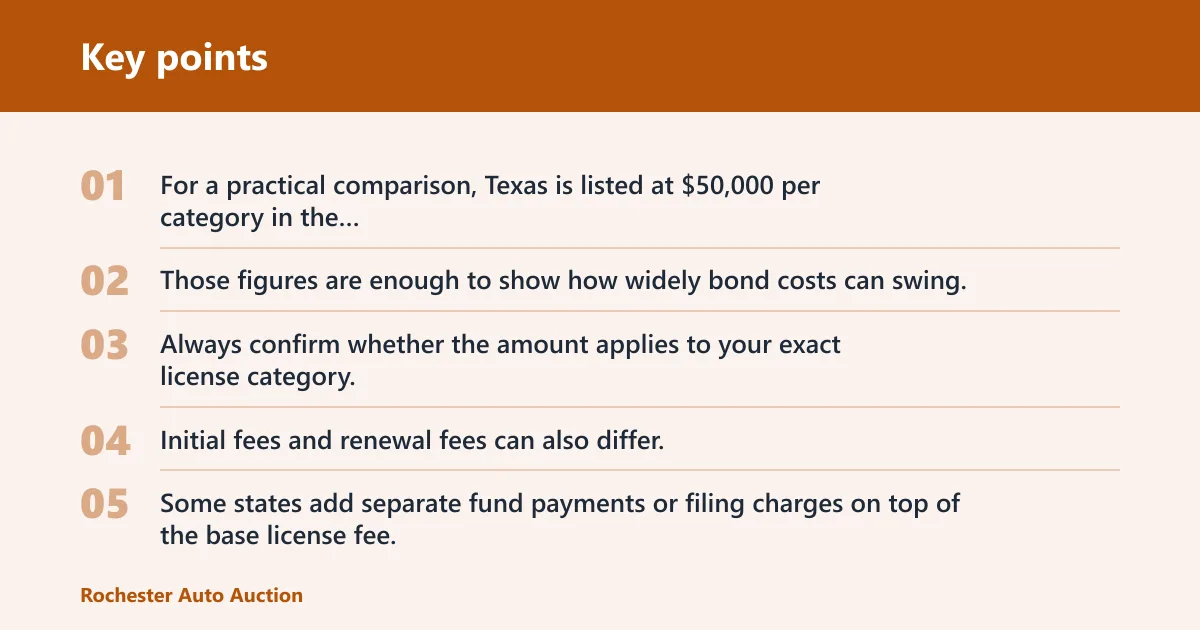
For a practical comparison, Texas is listed at $50,000 per category in the California-focused dealer guide, Florida at $25,000, Nevada at $100,000, and Oregon at $50,000. Those figures are enough to show how widely bond costs can swing. Always confirm whether the amount applies to your exact license category.
Initial fees and renewal fees can also differ. Some states add separate fund payments or filing charges on top of the base license fee. South Dakota, for example, lists a Vehicle Dealer/Used Car Dealer new license fee of $300. That kind of fee is only one part of the startup total.
Initial fees versus renewal fees
Do not assume the first payment and the renewal payment will match. States often set a different renewal charge, and some add education or system-use charges later. The cleaner way to compare states is to separate one-time filing costs from recurring annual or multi-year costs before you commit to a site.
For Texas dealers, the state now requires licensed dealers to use the webDEALER system for sales transactions. Texas also replaced dealer temporary tags with dealer temporary plates beginning July 1, 2025. Those are operational changes, not just paperwork details, and they affect how the dealer handles transactions after licensing.
Do states require dealer education?
Some states require pre-licensing education, and the hour count can vary sharply. Education may be one-time for new applicants, or it may return at renewal in a shorter format. In states that require training before filing, a missing certificate can stop the application even if the bond and site paperwork are already complete.
One-time versus renewal training
Texas requires a one-time 6-hour online pre-licensing course for new applicants and 3 hours of online instruction for renewal applicants in the covered group. Texas education applies only to independent motor vehicle GDN holders and applicants, and the course cost is capped at $150 per person. That is a strong example of a state tying education to license class. (Txdmv)
The same guide says Oregon has an 8-hour pre-licensing requirement, while Arizona has no pre-licensing education requirement. Those two states sit at opposite ends of the spectrum. If you are comparing states for speed, education rules are one of the quickest ways to spot extra friction.
Say your file is otherwise ready, but the training certificate is missing. In a state that requires education before filing, the agency may not move the application forward until the certificate is attached. That can add days or weeks if the course schedule is tight.
Location, zoning, and inspection rules
Business location rules often decide whether a dealer application moves quickly or stalls. Many states require zoning approval, office standards, sign requirements, and sometimes display area rules. Some also require an on-site inspection or site approval before the license is issued, and a temporary license may be possible in some states.
Office, sign, and display area requirements
The location must usually match the license type. A retail lot may need an office and display area, while a wholesale location may face different physical standards. The agency may ask for a lease, deed, utility bill, photos, or a local zoning letter to prove the site is legal for dealer activity.
Inspection and approval can also happen before issuance. South Dakota requires a motor vehicle dealer license before any sales transactions occur, issues the paper dealer license for 5 years, and bills renewal about 3 months before expiration. That makes the timing and renewal calendar very clear compared with states that use a shorter cycle. (SD)
Another common failure point is mismatch between the paperwork and the site. If the application lists a sign size, office address, or storage area that does not match the local approval, the agency can send the file back. That is one reason location review belongs near the top of any comparison checklist.
State dealer license matrix
Use this matrix as a readiness check. It compares the listed bond amount, education hours, renewal term, inspection requirement, and notable filing extras so you can judge whether a state looks easier or harder to license in before you submit papers. Confirm every detail with the issuing agency before you rely on it.
| State | Bond amount | Pre-licensing hours | Renewal term | Inspection requirement | Notable filing extras | Fastest path / highest friction |
|---|---|---|---|---|---|---|
| Texas | $50,000 per category | 6 hours for new applicants; 3 hours at renewal for the covered group | Renewal applies to the covered group; timing set by the agency | Agency review and site steps can apply | webDEALER required; dealer temporary plates beginning July 1, 2025; education capped at $150 per person | Fastest path: clear if you already have the correct GDN class and course complete. Highest friction: education, system use, and category-specific bond handling. |
| South Dakota | Not stated in the sourced facts | Not stated in the sourced facts | 5 years | Site approval can apply before issuance | New license fee of $300; renewal billed about 3 months before expiration | Fastest path: long 5-year term simplifies renewal planning. Highest friction: getting the site approved before any sales transactions. |
| Florida | $25,000 | Not stated in the sourced facts | Not stated in the sourced facts | Not stated in the sourced facts | Bond figure is lower than several other states in the comparison set | Fastest path: lower stated bond burden. Highest friction: confirm whether your license class has added location or filing steps. |
| Arizona | Not stated in the sourced facts | No pre-licensing education requirement | Not stated in the sourced facts | Not stated in the sourced facts | Education hurdle is absent in the cited guide | Fastest path: no pre-licensing education requirement. Highest friction: still verify the agency’s bond, location, and application checklist. |
| Nevada | $100,000 standard bond | Not stated in the sourced facts | Not stated in the sourced facts | Not stated in the sourced facts | Highest stated bond in this comparison set | Fastest path: no specific education fact is listed here. Highest friction: the $100,000 bond is a major front-end barrier. |
| Oregon | $50,000 | 8 hours | Not stated in the sourced facts | Not stated in the sourced facts | Higher education burden than Arizona | Fastest path: straightforward if the course is complete. Highest friction: the combined bond and 8-hour education requirement. |
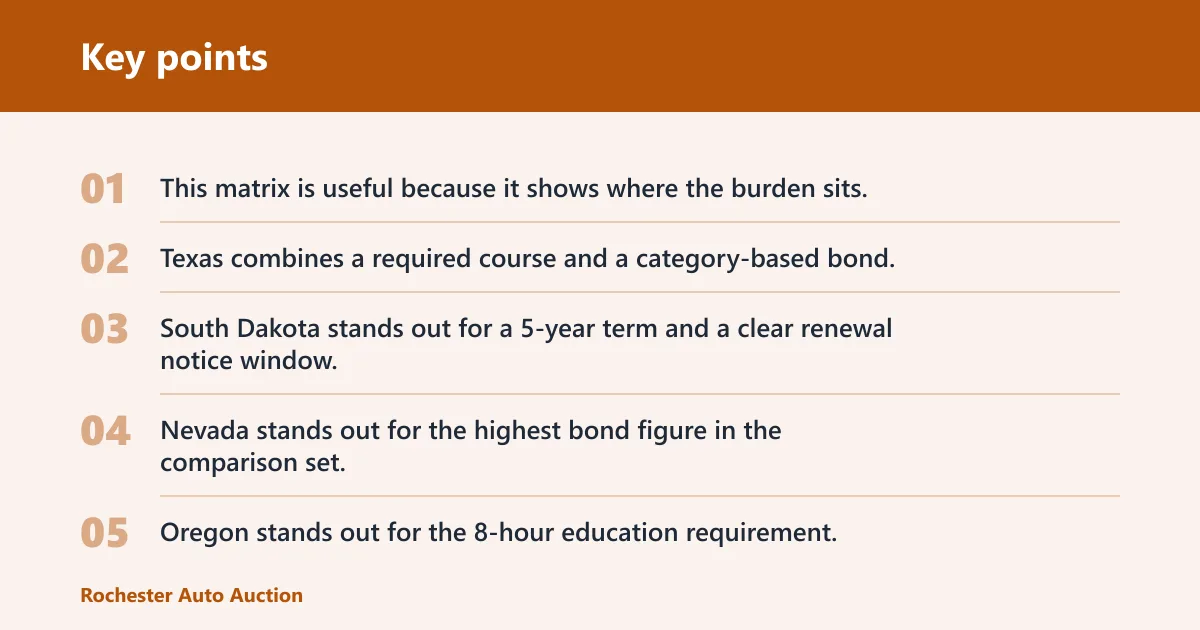
This matrix is useful because it shows where the burden sits. Texas combines a required course and a category-based bond. South Dakota stands out for a 5-year term and a clear renewal notice window. Nevada stands out for the highest bond figure in the comparison set. Oregon stands out for the 8-hour education requirement.
How to compare states before you apply
Compare states in the same order every time: agency, location, bond, education, inspection, fee, renewal. That order helps you catch the failures that most often delay approval. It also keeps you from mixing one-time startup work with ongoing compliance costs, which is where many comparisons go wrong.
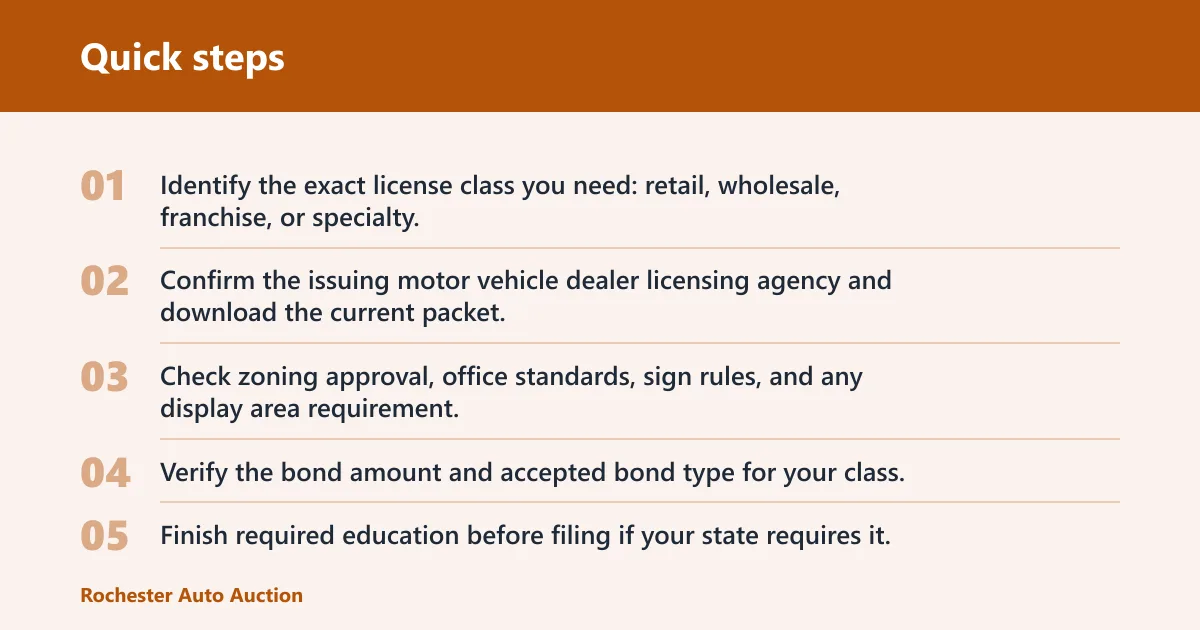
Use the matrix as a readiness check
- Identify the exact license class you need: retail, wholesale, franchise, or specialty.
- Confirm the issuing motor vehicle dealer licensing agency and download the current packet.
- Check zoning approval, office standards, sign rules, and any display area requirement.
- Verify the bond amount and accepted bond type for your class.
- Finish required education before filing if your state requires it.
- Confirm whether inspection or site approval must happen before issuance.
- Separate one-time fees from renewal fees and note any added fund payments.
- Track the renewal term so you do not miss a 3-month notice window or a multi-year deadline.
How to become a licensed dealer is usually the same broad sequence, but the details differ by state. In most cases, you form the business, secure the site, file the bond, submit the application, and complete inspection or approval steps. The order can change if your state requires education or a pre-approval visit first.
How to get a dealer license also depends on why you want it. If you need it for retail sales, the location rules are usually stricter. If you only need access to dealer-only auction lanes, check whether your state offers a wholesale or broker path that fits your business model. The wrong class can add unnecessary cost.
Frequently asked questions
What are the dealer license requirements by state?
Dealer license requirements vary by state, but the usual building blocks are a business location, a dealer bond, tax and business filings, background checks, and a state application. Some states also require pre-licensing education, zoning approval, and an inspection before the license is issued.
How do dealer license bond amounts vary by state?
Bond amounts can vary from state to state and by license class. The bond may be a surety bond, cash, or certificate of deposit.
Which states require pre-licensing education for dealers?
Some states require it and some do not. In the sourced facts, Texas requires a one-time 6-hour online pre-licensing course for new applicants, Oregon requires 8 hours, and Arizona has no pre-licensing education requirement. Other states should be confirmed directly with the issuing agency.
How do I know who issues dealership licenses in my state?
Look for the state motor vehicle dealer licensing agency. That office publishes the forms, checklists, inspection steps, education rules, and renewal instructions. If you only find general business registration information, keep looking, because the dealer licensing office is usually a separate regulatory unit.
Do dealer license renewal cycles differ by state?
Yes. Renewal timing can be annual or multi-year, and some states bill before expiration. South Dakota issues the paper dealer license for 5 years and bills renewal about 3 months before expiration. Texas also has renewal training for the covered group, which makes timing and compliance more than a simple date reminder.
What documents do states usually require for a dealer license?
States often ask for the application form, bond proof, business formation documents, sales tax registration, zoning or location approval, and education certificates if required. Some also want inspection records, fingerprints, photos, or lease documents. The exact set depends on the state and license type.
Which states have the toughest dealer license requirements?
The toughest states are usually the ones with the highest bond, mandatory education, strict location rules, and inspection before issuance. In the sourced comparison, Nevada stands out for a $100,000 standard bond, Texas for required education and system use, and Oregon for an 8-hour education rule. Toughness depends on your starting point.