What Does a VIN Check Tell You on an Auction Car?
At auction, a VIN check can confirm the vehicle’s identity, year, make, model, trim, engine, plant, title brand, theft status, and open recalls, but it cannot prove condition, prior repairs, flood damage, or odometer tampering. A weak VIN review can turn a cheap bid into an expensive error. This guide shows what to trust from the VIN, what to verify in photos and documents, and which red flags need an in-person inspection before you bid.
Factory specs, history events, and provider depth
A VIN check starts with the vehicle’s unique identifier. A VIN decoder can reveal factory build data such as make, model, production country, and production date. Some reports also list engine power, body type, fuel type, and transmission type when the provider has that data.
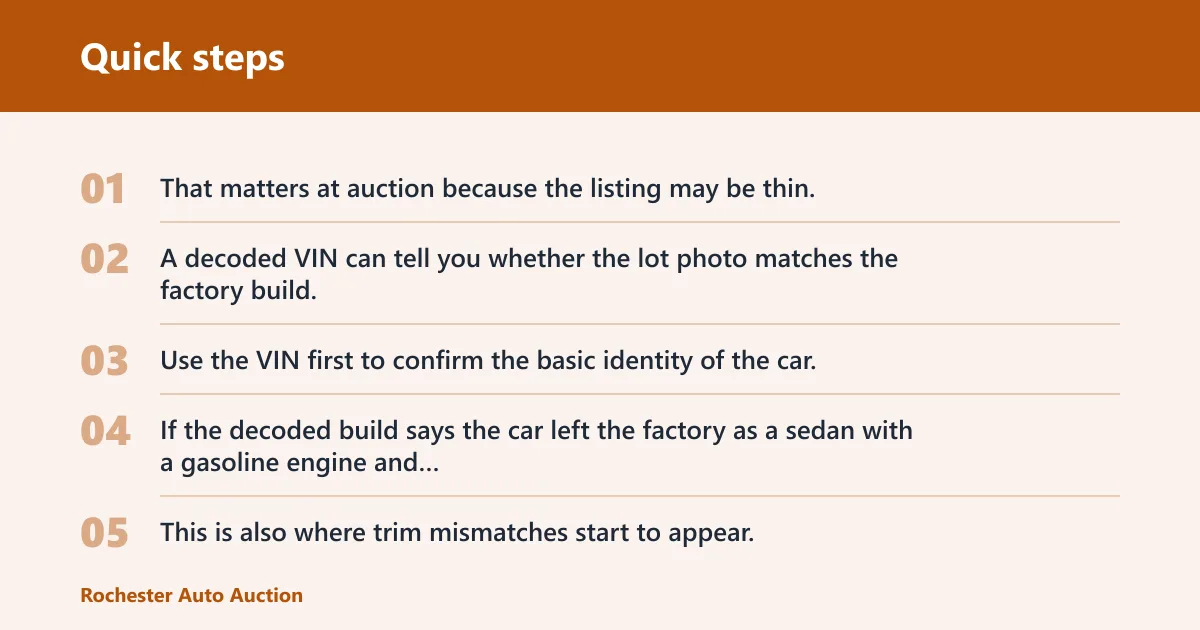
That matters at auction because the listing may be thin. A decoded VIN can tell you whether the lot photo matches the factory build, or whether the seller’s trim claim looks wrong on its face.
Factory build data a decoder can confirm
Use the VIN first to confirm the basic identity of the car. If the decoded build says the car left the factory as a sedan with a gasoline engine and automatic transmission, that gives you a concrete baseline before you compare it to the title image and photos.
This is also where trim mismatches start to appear. A badge can be swapped. A grille can be changed. The VIN is harder to fool than the outside of the car.
History signals a report may include
A vehicle history report can add event data tied to the VIN, including genuine mileage, accidents, theft, inspections, owners, and registration countries. Depending on the provider, it may also include title branding, salvage or total-loss history, and photos from various periods.
Some services also offer market price evaluation as an added feature. That can help frame bidding, but it does not replace a document check or a physical inspection.
Why report depth varies by provider
Not every VIN tool pulls the same records. Some services provide only basic decoding, while others cross-check many more databases, title sources, auction records, and cross-border events. One listed provider says it uses over 100,000 distinct sources in one report provider listing. Another offers 60+ title checks across 28 million documents.
Coverage also depends on country and data access. One listed provider covers the United States and Canada. Another includes free recall checks, and one offers 21-day unlimited reporting. That variation is why a clean basic lookup is not the same as a full history report.
Auction VIN verification checklist
Use the VIN as a filter, not a verdict. At auction, the useful question is not only “Does the VIN decode?” but “What does the report confirm, and what still needs proof from photos, documents, or the lot itself?”
| Confirmed by VIN report | Still requires inspection/doc check |
|---|---|
| Year, make, model | VIN plate and title image match |
| Trim or factory build data when available | Actual trim on seller photos and badges |
| Title brand history in covered databases | Original title image and auction disclosure wording |
| Mileage trail from historical records | Odometer cluster photo and dashboard condition |
| Theft flag, if reported in accessible databases | Title, VIN plate, and seller identity verification |
| Open recall status, if the tool includes recall checks | Whether the recall is still open and repair status proof |
| Flood indicators only if the provider has them | Underbody, interior, wiring, and moisture inspection |
| Seller photos from the report, when included | Current lot photos and condition on the day of sale |
| Lot disclosure text tied to the VIN | Hidden damage, missing equipment, or rebranded title details |
Say your report shows the right year and engine, but the auction photos show a different wheel design and missing fog lamps. That is not a VIN failure. It is a sign to check whether the car was modified, repaired, or mislisted before you bid.
Can a VIN check show if an auction car was stolen?
A VIN check may show theft flags when a stolen vehicle record appears in accessible databases. That can be useful, but it is not the final word. A theft flag should always be paired with title review, VIN plate inspection, and seller identity verification before any bid.
How theft flags appear in history tools
Theft records usually show up as part of the vehicle history report, not the decoder alone. If the provider has access to the event, the report may note a stolen vehicle record, a recovery event, or related registration data tied to the VIN.
That record helps you stop early. It does not tell you whether the seller is the current lawful holder, whether the paperwork is valid, or whether the car has a mismatched identity plate.
Why you still need title and identity checks
A stolen-vehicle flag is only one layer. Compare the VIN on the dash, the door jamb label, the title image, and the auction listing. If any of those disagree, stop and verify before bidding.
That is especially important on auction vehicles, where listing data can be limited and hidden damage or title issues may sit behind a clean-looking photo set.
Can a VIN check show salvage title or total loss history?
A VIN report may show salvage title or total-loss history when those events are present in accessible databases. A vehicle history report can include title branding, salvage history, and total-loss records when those events are present in the databases the provider can reach. But the report has to be compared with the title image and the auction disclosure, because branding can be described differently across markets and providers.
What salvage and brand records can confirm
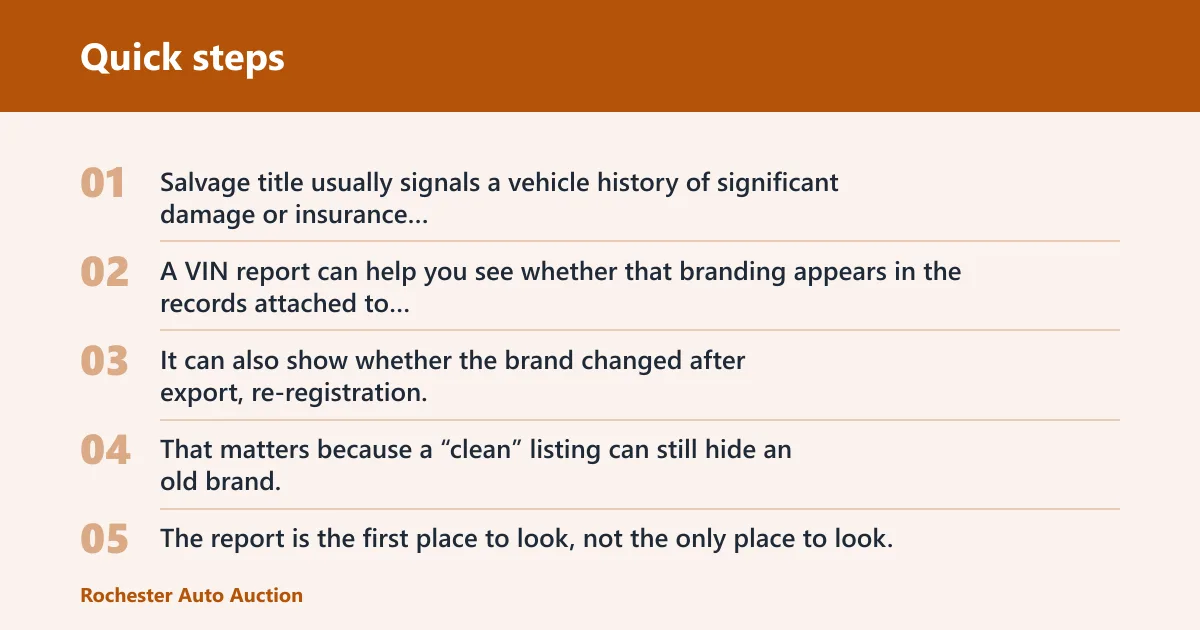
Salvage title usually signals a vehicle history of significant damage or insurance write-off in many markets. A VIN report can help you see whether that branding appears in the records attached to the car. It can also show whether the brand changed after export, re-registration, or a reissue in another jurisdiction.
That matters because a “clean” listing can still hide an old brand. The report is the first place to look, not the only place to look.
Where auction disclosures may differ from the report
An auction disclosure may mention salvage, rebuilt, prior damage, or no warranty language that does not appear in a basic VIN lookup. The reverse can happen too: the report may show a title brand that the listing text leaves out. Compare both.
A common first-timer mistake is trusting the title status line without reading the full disclosure box. That box may be where the seller has already warned you about branded history or special paperwork.
Can a VIN check show accidents and mileage rollback?
Yes, many history reports can show accident records and mileage readings tied to the VIN. They can also surface odometer fraud clues, including mileage rollback or clocking. But those clues often come from records, not from a quick walk-around or short test drive.
How accident records and mileage readings show up
Accident history may appear as documented events in the report. Mileage may appear as a trail of readings from inspections, registrations, or other record sources, and some reports may flag a possible rollback if later readings move backward. When those readings jump backward, the report may flag a possible rollback.
One listed provider gives a vehicle score on a 1-to-100 scale. That can help summarize risk, but the underlying mileage and title events matter more than the score alone.
Why odometer fraud can still slip past a quick look
Odometer fraud can be hidden even when the dash looks normal. A clean cluster, a believable wear pattern, and a short drive do not prove the mileage is honest. You need the mileage trail from the history report and the odometer reading in the photos or lot images.
Picture a sedan listed at 82,000 miles with a tidy interior and fresh tires. If the report shows prior readings around 142,000 miles, the visual condition no longer matters as much as the record gap.
What a VIN check does not tell you
A VIN check does not prove condition. It will not confirm bodywork quality, paint quality, flood repair quality, or whether hidden corrosion sits under clean trim. It also will not settle every listing error, especially when the auction data is thin.
Damage quality, flood repair quality, and cosmetic repair
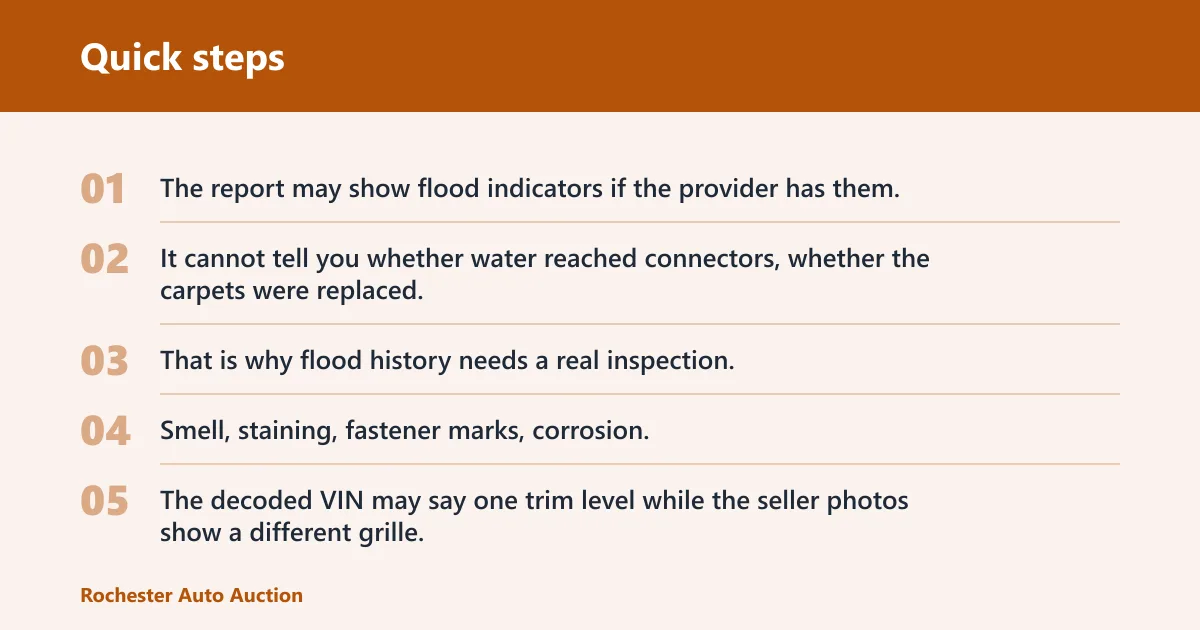
The report may show flood indicators if the provider has them, but it cannot grade repair quality. It cannot tell you whether water reached connectors, whether the carpets were replaced, or whether the body filler was applied well.
That is why flood history needs a real inspection. Smell, staining, fastener marks, corrosion, and wiring condition matter more than a clean summary line.
Trim mismatch, missing equipment, and listing errors
The decoded VIN may say one trim level while the seller photos show a different grille, wheel package, or interior layout. A VIN report can expose the mismatch, but it cannot tell you why it happened.
That is where lot photos, title images, and the disclosure field matter. If the listing says one thing and the decoded build says another, assume the car needs manual verification before you bid.
Why seller photos and lot disclosure matter
Some VIN decoders can also provide photos from various periods. Those can help you compare condition over time, but they do not replace the current auction photos. Use both, then compare them against the disclosure text line by line.
If the seller notes mention prior damage, branded title, or a warning about missing keys, treat that as part of the buying decision. The VIN report is evidence, not a warranty.
How to verify the VIN before you bid
Start with the VIN, then move outward. Decode the build, compare it to the title image and seller photos, review the mileage trail and brand history, and inspect anything the report cannot settle. That order catches more auction red flags than reading the listing first.
- Decode the VIN and confirm year, make, model, and available build data.
- Compare the decoded trim, engine, and body type to the seller photos.
- Check the title image for branding, ownership, and VIN consistency.
- Review mileage readings for gaps, reversals, or missing periods.
- Look for theft flags, recall status, and prior registration countries.
- Read the lot disclosure for salvage, flood, run-and-drive, or odometer notes.
- Inspect anything the report cannot prove before you place a bid.
Suppose the report shows a clean title history and open recalls only, but the auction photos reveal a replaced steering wheel, mismatched front bumper, and a missing airbag light bulb. The VIN did its job. It told you what the car was built as and what records exist. It did not tell you how well the repairs were done.
Is a free VIN lookup enough before I bid?
Usually not for auction cars. Free lookups often stop at basic decode data, while paid reports may include deeper history, title branding, mileage trail, theft records, recalls, photos, and sometimes market value evaluation. A free tool can be a first pass, not a final bid decision.
What free tools usually cover
Free tools often confirm the VIN format and basic factory build data. That can tell you the make, model, year, and sometimes body or engine information. It may be enough to catch a bad listing quickly.
It is rarely enough to clear an auction car. If the listing is thin, the title language is unclear, or the photos raise questions, a basic lookup leaves too much unknown.
When a paid report is worth it for auction cars
A paid report is worth a closer look when the car has a branded title, uneven photos, a mileage gap, a possible theft flag, or a trim mismatch. One listed provider even has separate auto auction report packages, which fits the way auction buyers actually shop.
That extra depth matters most when the car is cheap enough to tempt you and risky enough to hurt you. If the report cannot answer the key questions, you still need the document check and a physical inspection before bidding.
Frequently asked questions
What does a VIN check tell you on an auction car?
It can tell you the car’s identity, factory build details, and any recorded history the provider can access, such as title branding, mileage readings, theft flags, accidents, inspections, and recalls. It cannot prove condition, repair quality, or whether the listing photos leave anything out.
What vehicle details can I confirm from a VIN before bidding?
Before bidding, you can often confirm make, model, production country, production date, and sometimes engine power, body type, fuel type, and transmission type. Some reports also include history items tied to the VIN, such as mileage records, owners, and prior registration countries.
What does a VIN check not tell you on an auction listing?
It does not prove flood repair quality, paint quality, bodywork quality, or hidden mechanical issues. It also may not capture every missing option or listing error. Use the VIN to narrow risk, then verify the lot photos, title image, and disclosure before bidding.
How do I tell if the VIN matches the title and trim?
Compare the dash VIN, door-jamb label, title image, and decoded build data. Then check whether the trim in the report matches the badges, wheels, interior, and equipment shown in the seller photos. Any mismatch needs document review before you place a bid.