Are Title and Registration Costs Included in Buyer Fees?
Buyer fees usually do not include title and registration costs; those are often separate line items, along with tax in many states. Miss this, and your “winning bid” can be hundreds more than planned. This guide breaks down buyer fee, title fee, registration fee, and tax, and shows how to verify each before you bid. For Rochester Auto Auction, verify the buyer-fee page and the sales-tax page before bidding.
Are title and registration included in buyer fees?
Usually no. Buyer fees are auction-added charges tied to the sale itself, while title and registration are separate DMV-related costs in many states. That split matters because the auction invoice may look complete at first glance, yet the final out-the-door total can still rise once state paperwork and tax are added.
Why buyers get surprised at pickup
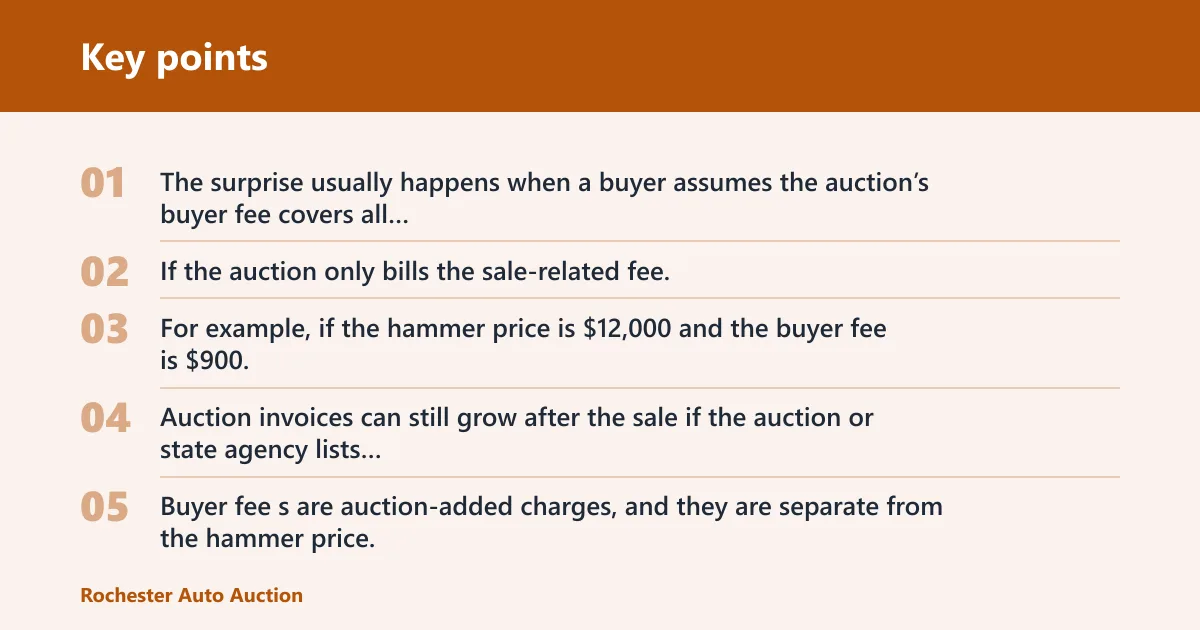
The surprise usually happens when a buyer assumes the auction’s buyer fee covers all paperwork. It often does not. If the auction only bills the sale-related fee, the buyer may still owe title transfer charges, registration charges, document handling, and sales tax before the vehicle can be titled or put on the road.
For example, if the hammer price is $12,000 and the buyer fee is $900, that is not the final total when title, registration, doc fees, and tax are separate. Auction invoices can still grow after the sale if the auction or state agency lists additional charges on top of the auction fee.
What buyer fees usually cover
Buyer fees are auction-added charges, and they are separate from the hammer price. They may vary by auction house and by vehicle segment. They may also exclude taxes, title, and registration. That is why a buyer fee should be read as an auction charge, not as a DMV package.
What the buyer fee covers depends on the auction’s own rules. Some auctions use it to cover auction operations, gate processing, and sale administration. Others add separate document or service charges. The key point is simple: do not assume the buyer fee includes title work or state registration paperwork.
📊 In California, doc fees are capped at $85 for dealers in 2025. Source: Caranddriver.
What fees are included in buyer fees versus paid separately after the sale?
Buyer fees usually cover the auction’s sale-side charge, but title fee, registration fee, document fee, and sales tax are often separate. The safest approach is to treat every line as its own bucket until the invoice says otherwise. If the auction does not spell it out, ask before you bid.
| Fee type | What it pays for | Common status in auction buying | Usually collected by auction vs later at DMV |
|---|---|---|---|
| Hammer price | The winning bid amount | Always separate | Auction at sale; verify the invoice matches the bid before paying |
| Buyer fee | Auction-added charge for the sale | Usually separate from DMV costs | Auction; verify whether it includes any filing or service charge |
| Document fee | Paperwork or processing | Often separate | Either auction or later service provider; verify whether it is a flat admin fee or a pass-through |
| Title fee | Transfer of legal ownership | Usually separate from buyer fee | Usually later at DMV or via auction paperwork service; verify state title requirements before bidding |
| Registration fee | Permission to operate the vehicle | Usually separate from buyer fee | Usually later at DMV; verify state formula, plate type, and whether weight or MSRP changes the amount |
| Sales tax | State and local tax | Often separate, jurisdiction-dependent | Usually later with the titling/registration step; verify whether the sale, fees, or both are taxable in your state |
Title fee, registration fee, and tax
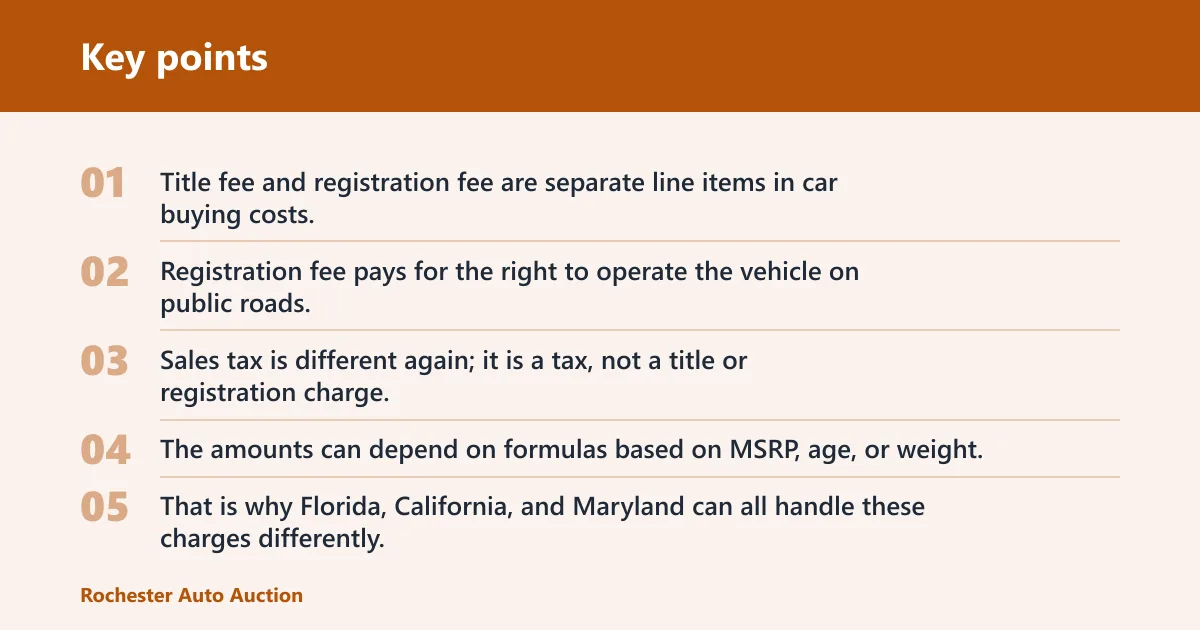
Title fee and registration fee are separate line items in car buying costs. Title fee pays for legal ownership transfer. Registration fee pays for the right to operate the vehicle on public roads. Sales tax is different again; it is a tax, not a title or registration charge.
Title and registration costs vary by state. The amounts can depend on formulas based on MSRP, age, or weight, so check the relevant state agency before you bid. That is why Florida, California, and Maryland can all handle these charges differently.
Sales tax may apply to the purchase price and, in some states, certain fees as well. It may be collected at sale or later, depending on the transaction and state rules. That is why two buyers can win similar cars at the same hammer price and still face very different totals.
A common first-timer mistake is treating title transfer and road use as the same thing. They are not. Ownership can change hands before the car is legal to drive, and a car can be titled without being ready for road use. The state’s forms and timing rules decide how those steps happen.
Who handles the paperwork?
The auction may handle some paperwork, but the state DMV or motor vehicle agency still controls the title and registration rules. Dealers may handle registration and title paperwork for buyers, and some dealerships charge an additional fee for completing title and registration on your behalf. The exact process depends on the auction’s service model and your state.
Auction paperwork services
Some auctions act as the middle step. They collect the sale documents, prepare transfer forms, and send paperwork to the right agency or service provider. That can reduce errors, but it does not erase the state fee. If the auction is processing the paperwork, ask whether the charge is a document fee, a service fee, or a state fee passed through on your invoice.
DMV and state agency steps
The DMV or motor vehicle agency sets the title and registration requirements, and those rules can include proof of purchase, identification, and insurance. Out-of-state buyers should check this carefully because the auction’s process may not match the buyer’s home state. The same car can require different forms depending on where it will be titled.
How to verify fees before bidding
Check the invoice terms before you bid. That is the only reliable way to know whether the buyer fee is just the auction charge or part of a wider paperwork package. If the listing is unclear, ask for the exact fee breakdown and the state-specific title and registration process before you commit.
Read the invoice terms
Look for separate lines for buyer fee, document fee, title fee, registration fee, and sales tax. If the invoice groups items together, ask what is included in the group and what is still due later. Do not assume a “fees included” phrase covers DMV paperwork unless the document says so in plain language.
Ask what is included
Ask three direct questions: Does the buyer fee include title work? Does it include registration? Does it include tax or any state filing charge? If the answer is no or unclear, budget each item separately. That step prevents a false low total from shaping your bid.
Check state-specific requirements
Title and registration rules vary by state and locality. Some states cap or limit certain fees, such as California’s dealer doc fee limit, while others use different formulas. Check the state agency rule before you bid, rather than relying on a generic fee table.
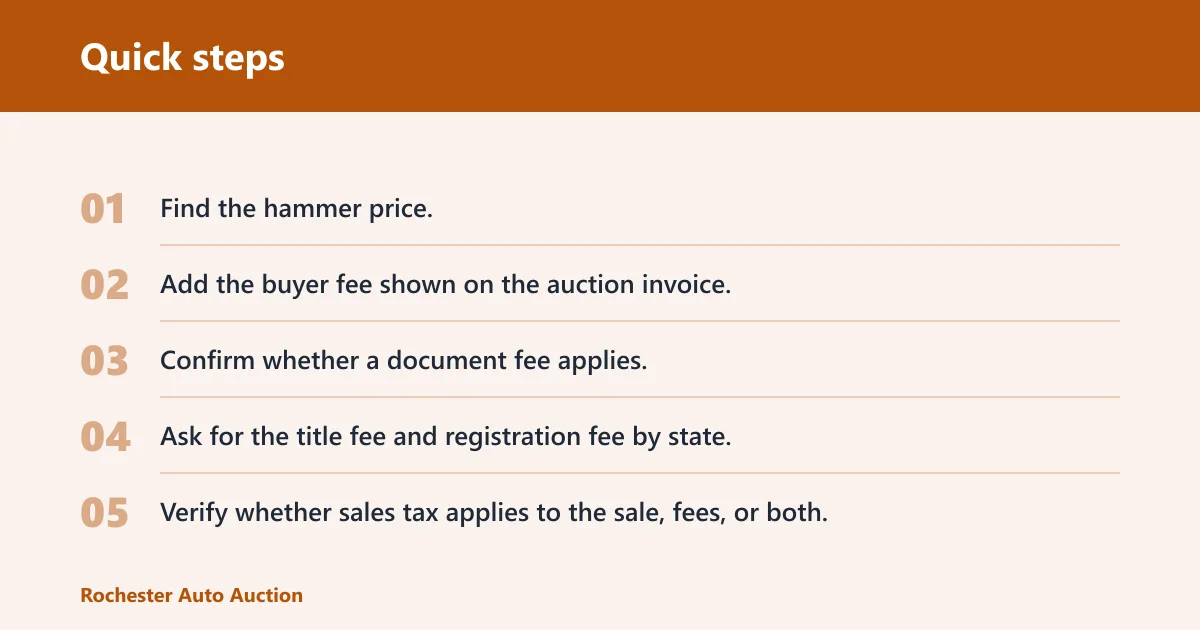
- Find the hammer price.
- Add the buyer fee shown on the auction invoice.
- Confirm whether a document fee applies.
- Ask for the title fee and registration fee by state.
- Verify whether sales tax applies to the sale, fees, or both.
- Add transport if the vehicle will move by carrier.
- Total every line before you bid.
Auction out-the-door cost checklist
Use this checklist before bidding so you do not mistake the buyer fee for the full DMV bill. Out-the-door cost means the hammer price plus the buyer fee plus applicable taxes and state fees, plus any transport you need. It is the final budget number, not the winning bid alone.
| Line item | Fill-in amount | Notes |
|---|---|---|
| Hammer price | $________ | Winning bid |
| Buyer fee | $________ | Auction-added charge |
| Document fee | $________ | Paperwork or processing |
| Title fee | $________ | Ownership transfer |
| Registration fee | $________ | Road-use permission |
| Sales tax | $________ | State and local tax |
| Transport | $________ | Tow or carrier cost |
| Total | $________ | All-in out-the-door cost |
Auction-controlled versus DMV-controlled charges
| Typically auction-controlled | Typically DMV-controlled |
|---|---|
| Buyer fee | Title fee |
| Document fee | Registration fee |
| Sale paperwork handling | State filing requirements |
| Transport coordination | Sales tax rules by jurisdiction |
That split helps you spot hidden assumptions before you bid. If a listing shows a modest buyer fee but gives no detail on title or registration, the missing numbers may arrive later. A buyer who asks early can compare apples to apples across auctions and states.
Can title and registration be rolled in?
Sometimes paperwork can be handled for you, but that does not mean the cost disappears. Buyers should not assume title and registration are rolled into the buyer fee. Some dealer or auction services may process the forms and collect the state charges, but the underlying title and registration obligations still exist.
What can be bundled?
Processing can sometimes be bundled for convenience. The auction may charge a document or service fee and then send the title and registration work to the right channel. That bundle can simplify payment, but it should still show each fee clearly. The label matters because a bundled service charge is not the same as a state fee.
What still has to be paid separately
State fees usually remain state fees, even if the auction handles the paperwork. Sales tax may also remain separate, depending on jurisdiction. If you are buying across state lines, confirm where the vehicle will be titled and registered, since that determines which agency’s rules apply and which amounts you owe.
Suppose a buyer wins a truck for $18,500 at auction and sees a buyer fee of $1,100. If the state still requires title, registration, doc fee, sales tax, and transport, the final bill can still be higher than the auction price plus the buyer fee. The paperwork service can save time, but it does not erase the state’s charge list.
Frequently asked questions
Are title and registration costs included in buyer fees at auto auctions?
Usually no. Buyer fees are auction-added charges, while title and registration are commonly separate state-related costs. The exact invoice depends on the auction and the jurisdiction. Before you bid, ask for the full breakdown so you do not assume the buyer fee covers DMV paperwork.
Do I still have to pay title and registration if I win a car at auction?
In many cases, yes. Winning the vehicle does not remove the need to transfer ownership and register it under state rules. Title fee and registration fee vary by state, and the DMV or motor vehicle agency decides what is required before the vehicle can be legally operated.
How much are title and registration fees compared with buyer fees?
Buyer fees vary by auction house and vehicle segment, so compare all lines together.
Who handles the title transfer and registration paperwork after an auction win?
It depends on the auction and the buyer’s state. Dealers may handle title and registration paperwork for buyers, and some auction or dealer services do the filing on the buyer’s behalf. Even then, the DMV or motor vehicle agency still sets the rules and fee amounts.
Are title and registration fees different by state?
Yes. Title and registration costs vary by state and locality. Check the state’s rules before you bid. That is why an auction invoice from one state may look different from a similar vehicle sale in another state, even before tax is added.