ACV Auctions: How It Works, Fees, and Dealer Access
ACV Auctions is a dealer-only wholesale platform: approved dealers bid online on vehicles with condition reports, then pay the hammer price plus a buyer fee, transport, and any financing or arbitration costs. Miss one cost bucket or ignore a title-timing issue, and a cheap buy can turn into a margin miss or an aging unit. This guide lays out access requirements, buying steps, fee categories, transport, financing, and post-win execution in one decision framework.
That framing matters because ACV works less like a public car-shopping site and more like a remote inventory acquisition system. The bid is only one step. Access approval, condition-report review, fee verification, shipping selection, funding, title flow, and post-sale paperwork all affect the real cost of inventory.
What ACV Auctions is really built
ACV describes itself as “The Leading Online Marketplace for dealer car auctions“. More plainly, it is a dealer-only wholesale marketplace for used cars, trucks, and SUVs, built for licensed dealers who need to source inventory without standing in a physical auction lane.
Private consumers generally cannot usually buy directly. Dealer credentials control access, and that changes how you should compare ACV with retail marketplaces or public auction sites.
Dealer-only marketplace, not a public buying site
The platform is aimed at franchised and independent dealers that need inventory supply, disposal options, and post-sale support in one system. ACV also positions the marketplace as being powered by “trusted condition reports, transportation solutions, and dedicated support”, which shows how the company frames the product, as a dealer workflow rather than a public listing site.
Inventory access is national. ACV says buyers can “Source used cars nationwide confidently”. For a dealership, that reach expands buying options, but it also adds transport cost, title-timing variation, and more reliance on report data before you bid.
Why the workflow matters more than the bid screen
A physical auction often compresses discovery, inspection, bidding, and pickup into a short window. ACV spreads those decisions across digital steps: approval, run-list review, proxy bidding, live sale participation, post-win payment, title release, and delivery coordination.
That shifts where profit gets lost. The risk is not only overbidding. It is also underpricing freight, ignoring title status, missing a buyer-fee update, or financing a unit longer than planned because paperwork or shipping slows the turn.
Who can get dealer access to ACV Auctions?
Dealer access generally goes to licensed franchised and independent dealerships with valid business records, tax documents, and auction-approval credentials where required. Approval is not automatic after signup. Common friction points include mismatched legal names, expired dealer licenses, incomplete tax paperwork, and missing AuctionACCESS alignment in dealer-auction workflows.
Which dealer profiles usually qualify?
The typical approved user is a licensed retail or wholesale dealer operating through a registered business entity. The dealership usually needs current state licensing, tax identification details, and business information that matches public and auction records.
A store that buys and sells used inventory as part of normal dealer operations is the core fit. That includes both franchise rooftops and independents, provided the documents support the account.
Where AuctionACCESS fits
AuctionACCESS is a dealer credentialing system commonly used across wholesale auction workflows. In many dealer-auction environments, it works as part of the registration gate for buying and selling, helping confirm that the business and its authorized users match dealer records.
ACV-specific requirements can change, but AuctionACCESS often sits in the practical approval chain when an auction marketplace needs dealer validation. If the dealership’s legal name, address, ownership record, or license data differs across systems, approval can stall.
Common approval delays and rejection points
- Dealer license expired or close to expiration
- Sales-tax or resale documents missing, outdated, or unreadable
- Business name on the account does not match license or tax records
- AuctionACCESS profile incomplete where that credentialing path applies
- Authorized buyer information missing or not tied clearly to the dealership
A common first-timer mistake is uploading a current dealer license but an old resale certificate with a prior address. The account may look legitimate, yet the mismatch can still hold approval until every document points to the same legal entity.
How do you register for ACV Auctions?
Registration starts with dealership account setup, then moves into verification before bidding access is granted. Buyers usually submit business and tax documents plus licensing details, and may need AuctionACCESS alignment. Sellers follow a separate path; ACV says “Sign up is free” and “No subscription or listing charges are required”, though approval still depends on dealer profile and relationship.
Buyer registration steps
- Create the dealership account with the business’s legal information.
- Add authorized user details for the person who will bid or manage purchases.
- Submit dealer-license, tax, and business documents requested during verification.
- Complete or match any required credentialing through AuctionACCESS in applicable workflows.
- Wait for approval before placing bids or initiating purchases.
The practical point is simple: document quality and consistency matter as much as completeness. A blurry scan or a DBA name that does not match the tax document can delay access.
Seller registration and why it still matters to buyers
Dealers can also sell inventory on ACV. ACV states seller signup is free and that there are no subscription or listing charges. For a buyer comparing marketplaces, that matters because low seller-entry friction can widen vehicle supply, but it does not remove seller approval review.
Approval on the sell side still depends on the dealer profile and relationship. Buyers should treat that as source context, not as a substitute for reviewing each vehicle’s report, title status, and sale terms.
How does ACV buying actually work?
ACV buying runs from approved account access to search, run-list review, proxy bidding, live auction participation, winning, payment, title processing, and delivery. ACV says buyers can view the Run List and place proxy bids “24 hours before it goes live”, and that auctions can last “20 minutes to 2+ hours”.
Search, filters, and run-list review
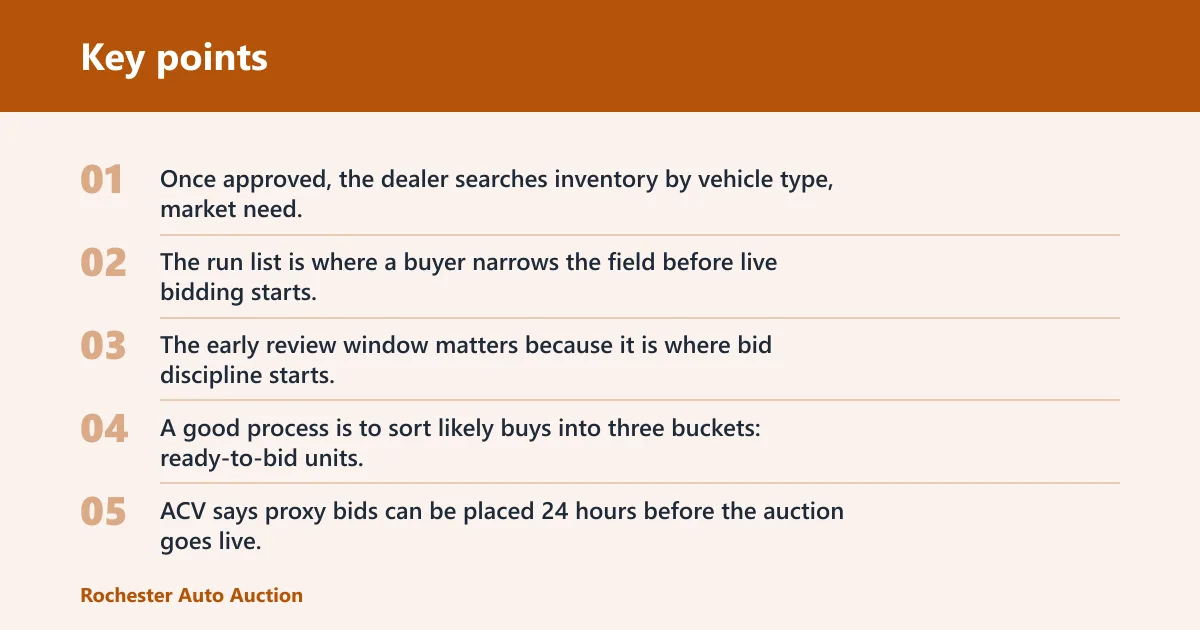
Once approved, the dealer searches inventory by vehicle type, market need, and report details. The run list is where a buyer narrows the field before live bidding starts.
The early review window matters because it is where bid discipline starts. A good process is to sort likely buys into three buckets: ready-to-bid units, units needing recon estimates, and units with title or ownership-risk concerns that may not fit current turn targets.
Proxy bidding and the live sale
ACV says proxy bids can be placed 24 hours before the auction goes live. That lets a dealer set a ceiling in advance instead of reacting in the moment.
During the live sale, the highest bid must meet the seller’s reserve for the vehicle to sell. ACV states that a vehicle sells when “the highest bid meets or exceeds the reserve.” That reserve structure is one reason a solid pre-bid worksheet matters. The dealer may need room to move during the live portion without crossing the real landed-cost limit.
Suppose a midsize SUV fits a current retail shortage and the report is clean except for moderate tire wear. If the bid ceiling already includes tires, freight, and carry cost, the live sale becomes a simple yes-or-no decision instead of a guess under time pressure.
Winning, payment, and title release
After a win, the workflow shifts from acquisition to execution. Payment must clear, paperwork must be accepted, title status must support transfer, and transport must be arranged or confirmed.
Those steps are where the cheap-looking purchase can change. A unit with a delayed title, a paperwork hold, or slower-than-expected pickup can tie up capital and age before it is frontline-ready.
What should you read in the condition report?
Start with the items that change ownership risk and recon cost: mileage, title status, photos, undercarriage views, and any mechanical media or comments. ACV says a condition report includes “mileage, title status, photos, undercarriage views, engine sound, and more.” Those details should set the bid ceiling before live action begins.
Core report fields that drive the buy decision
Mileage affects market positioning and service assumptions. Title status affects whether the deal can move quickly to resale. Photos and undercarriage views affect body, structural, rust, and corrosion assumptions that may not appear clearly in a short written note.
Engine sound and similar media do not replace a post-arrival inspection, but they can affect whether a vehicle looks like a normal recon candidate or a unit that needs more caution in the budget.
Turning report data into a bid ceiling
The clean way to use the report is to separate price from repair and from ownership risk. Start with the expected retail exit or wholesale fallback number, then subtract the total acquisition cost: hammer price, buyer fee, transport, recon, likely carrying cost, and a reserve for any issue the report suggests but does not fully quantify.
That last part matters. Cosmetic recon is a budget line. Title uncertainty is an ownership-risk flag. They should not sit in the same mental bucket.
Ownership-risk flags that should cut the ceiling
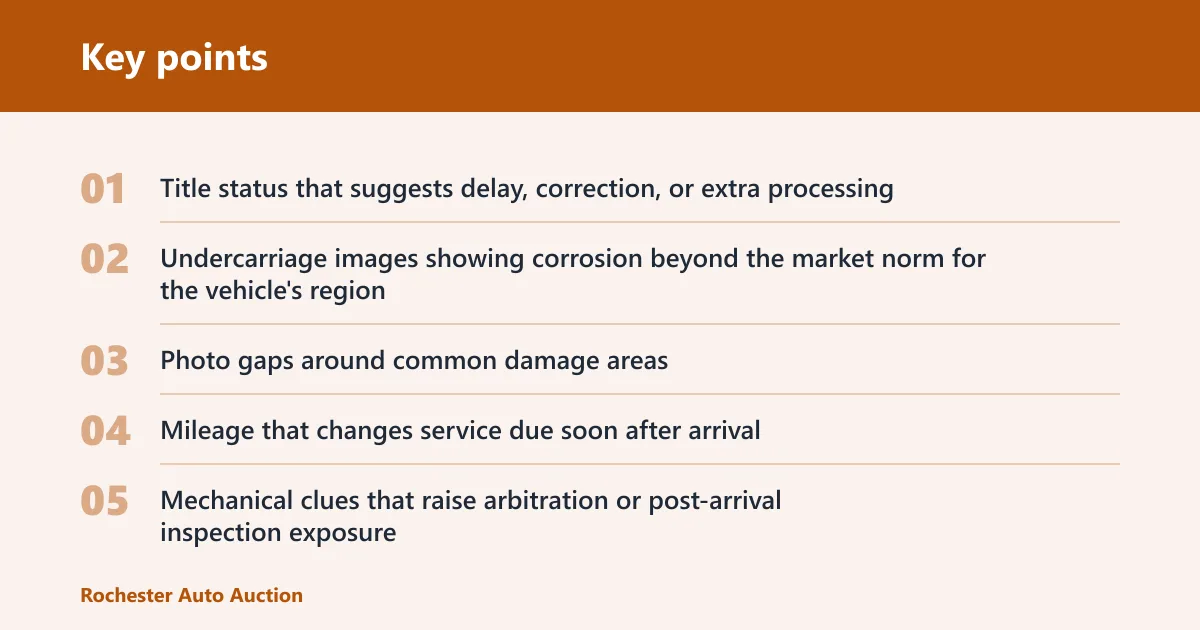
- Title status that suggests delay, correction, or extra processing
- Undercarriage images showing corrosion beyond the market norm for the vehicle’s region
- Photo gaps around common damage areas
- Mileage that changes service due soon after arrival
- Mechanical clues that raise arbitration or post-arrival inspection exposure
Picture a half-ton pickup that looks straight in exterior photos but shows heavy corrosion in the undercarriage views. Nothing else changed: same market, same trim, same target margin. That one report section alone should lower the bid ceiling because recon risk and resale objection risk both moved up.
What fees should dealers price in before bidding?
Dealers should price in more than the bid amount. The real budget includes the hammer price, the current buyer fee, transport, expected recon, possible arbitration exposure, and financing carry if floorplan money is used. Verify the current buyer-fee page before bidding; ACV Pricing states, “We have moved our fee schedule.”
Verify the buyer fee schedule every time
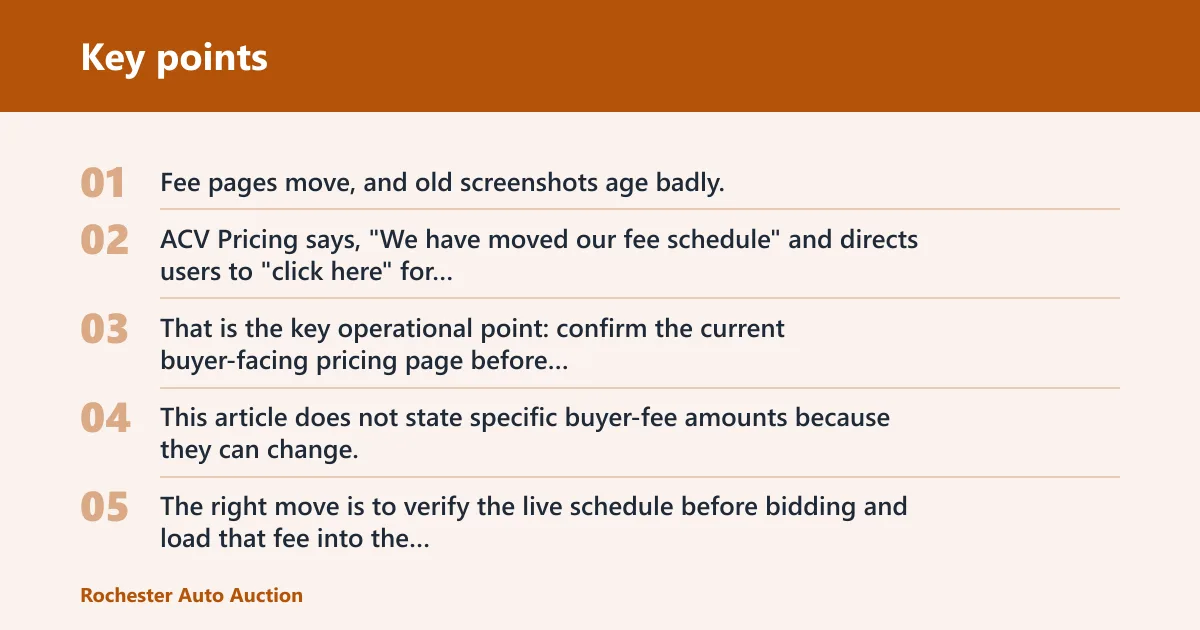
Fee pages move, and old screenshots age badly. ACV Pricing says, “We have moved our fee schedule” and directs users to “click here” for the full fee schedule. That is the key operational point: confirm the current buyer-facing pricing page before the sale, not after the invoice posts.
This article does not state specific buyer-fee amounts because they can change. The right move is to verify the live schedule before bidding and load that fee into the bid worksheet.
Fixed versus variable cost buckets
Usually fixed or known at award: hammer price once the auction closes, buyer fee based on the current schedule, and any immediately disclosed transaction-related charges.
Usually variable or decision-dependent: transport by route and timing, reconditioning after arrival, arbitration exposure if an issue arises, and financing carry based on cash source and time to title or sale.
That split matters because dealers often treat the buyer fee as the whole transaction cost. It is only one line item.
Financing carry is part of acquisition cost
ACV Capital is positioned as “Your floor financing provider” for inventory purchases. That can reduce upfront cash pressure, but financed inventory still has a holding cost. If transport or title delays add days before the unit can be merchandised or sold, that carry cost belongs in the landed number.
Say your store buys a late-model compact crossover on floorplan because cash is being held for payroll and service parts. The winning bid may fit the target, yet a title delay plus a slower ship can still raise holding cost enough to narrow a thin front-end deal.
Acv auctions table
| Checklist item | Type | Example value | Calculation or use | Condition-report ownership-risk flag |
|---|---|---|---|---|
| Hammer price | Fixed at win | $18,400 | Starting acquisition price | None by itself; compare with market exit plan |
| Buyer fee | Fixed by current schedule | $575 | Use the current ACV buyer-fee page before bidding | None, but a missed fee update changes margin immediately |
| Transport | Variable | $640 | Quote by route, vehicle, and timing after purchase planning | Long-distance move raises delay exposure if title release lags |
| Expected reconditioning | Variable | $1,250 | Tires $600 + PDR $250 + service $400 | Undercarriage corrosion or photo gaps can push this higher |
| Financing carry | Variable | $210 | Example: planned floor-cost reserve until title and sale | Delayed title status increases days outstanding |
| Arbitration reserve | Variable contingency | $150 | Internal reserve for a unit with limited mechanical certainty | Engine sound concern or unclear warning-light history |
| Total landed acquisition cost | Computed total | $21,225 | $18,400 + $575 + $640 + $1,250 + $210 + $150 | If risk flags are unresolved, lower bid ceiling before live sale |
This checklist is the practical proof point many fee summaries skip. The buyer fee is fixed once verified, but transport, recon, arbitration reserve, and carry can move enough to erase what looked like a cheap buy.
How do transportation and financing change the deal?
Transportation and financing change both cash flow and time to sale. After checkout, ACV Transportation can handle delivery through a nationwide carrier network, while ACV Capital can fund inventory purchases. ACV says its transport option uses “a nationwide network of over 5,000 active, safe and reliable carriers.”
Using ACV Transportation after checkout
ACV Transportation is the post-sale shipping path for dealers that want full-service delivery coordination. The benefit is workflow integration: the transport decision sits close to the purchase and paperwork process instead of becoming a separate vendor scramble.
That does not make transport a flat commodity cost. Route length, pickup timing, vehicle type, and title release timing can all affect when the vehicle actually moves.
How financing changes upfront cash needs
ACV Capital can help dealers know costs upfront and support inventory purchases. In practical terms, financing shifts the question from Can this unit be bought? to Can this unit be bought and turned fast enough to justify the carry?
That distinction matters most on moderate-margin units. A financed vehicle with a short recon path and clean title flow may fit. A similar unit with title friction and uncertain ship timing may not.
What happens after you win the vehicle?
After a win, the dealer still has to execute payment, paperwork, title transfer, and delivery without letting delays raise holding cost. The biggest post-sale bottlenecks are payment deadlines, document corrections, title release timing, and transport scheduling. Any one of those can change a good bid into a slower, costlier acquisition.
Payment and paperwork checkpoints
Winning the auction is the start of the back-half process. The dealership needs to complete payment according to the platform’s terms and make sure buyer information, tax details, and any transfer paperwork are accurate.
Small administrative misses matter here. A legal-name mismatch between the buying entity and submitted paperwork can hold the transfer even when funds are ready.
Title timing and release issues
Title status from the report should already be part of the buy decision, but post-sale timing still matters. If title release takes longer than expected, the vehicle may sit without a clear path to resale or final inventory processing.
That delay can hit in two ways: direct carry cost if financed, and lost turn opportunity if the store bought the unit to fill a near-term gap in a fast-moving segment.
Where delays erase margin
ACV says dealers report saving “20 hours per month on average.” Even if that operational claim proves directionally true for a store, time saved in sourcing can be offset by slow execution on a single problem unit.
The dealer’s real win is not merely securing the car. It is securing the car, funding it correctly, receiving it on time, clearing title, and getting it through recon without surprise cost growth.
Frequently asked questions
How does ACV Auctions work for dealers?
Approved dealers browse inventory, review condition reports, place proxy bids before live sale, and bid during the auction. If the highest bid meets the reserve, the dealer wins, pays the hammer price plus fees, then completes paperwork, title processing, and transport before the unit can be retailed or wholesaled.
What fees does ACV Auctions charge buyers?
Buyers should plan for the current buyer fee plus the hammer price, then add transport, expected reconditioning, financing carry, and any arbitration-related exposure. The buyer-fee page must be checked before bidding because ACV states that its fee schedule has moved and directs users to the current pricing location.
How does ACV transportation work after I win a car?
After purchase, the dealer can use ACV Transportation to arrange delivery through ACV’s full-service shipping workflow. ACV says transport is supported by a nationwide network of over 5,000 active, safe and reliable carriers. Delivery timing still depends on route, scheduling, paperwork completion, and title-release readiness.
What is included in an ACV condition report?
ACV says the report includes mileage, title status, photos, undercarriage views, engine sound, and more. For dealers, those items matter because they inform recon budgeting and ownership risk. The report should be used to set a bid ceiling, not merely to confirm that the vehicle looks acceptable in photos.