IAA Bidding: How It Works, Rules and Winning Tips
IAA bidding has three paths: use live bids for volatile auctions, proxy bids when you know your ceiling, and Buy Now when the posted price beats your all-in auction estimate. Pick the wrong path and you may run into title or license limits, pay more than expected after fees, or lose a vehicle you could have secured faster. This guide explains qualification rules, bid timing, fees, and when live, proxy, or Buy Now wins on price, speed, and risk.
What you’ll need
- An IAA account with any required approval and identity verification completed
- Bidding eligibility for the specific vehicle, branch, title type, and state involved
- Any required deposit, permissions, or buyer authorization already in place
- An additional bidder form, if you will bid under another approved account
- The vehicle listing details: condition report, damage type, run and drive status, odometer, notes, and title or salvage disclosure
- A written max-bid worksheet that includes buyer fees, branch fees, taxes, document charges, and transport
- A payment plan and pickup or transport plan for the post-win deadline window
Can the public bid on IAA or is it dealer only?
Public buyers can bid on some IAA inventory, but not every vehicle. Access can change by state law, branch rules, title type, seller restrictions, and account status, while licensed dealers usually have broader access. Before you target a vehicle, confirm that your account is eligible for that exact listing and branch.
Public access depends on the unit, not only the platform
IAA is an online auto auction marketplace with branch-based inventory, and the listing terms control who can buy. Some salvage and used vehicles are open to public buyers in certain states. Others require a dealer license, dismantler license, broker access, or a different buyer category tied to local title rules.
That is why two vehicles in the same sale can have different eligibility. One may be available to the public, while another at the same branch may be restricted by seller terms or title status.
What to verify before sale day
Check the vehicle page for sale format, title or salvage disclosure, and buyer eligibility notes. Then confirm your account approval, any required deposit or bidding permissions, and whether the branch allows your buyer type to complete the purchase.
If access is restricted, a public buyer may need a licensed broker, dealer partner, or another approved route rather than direct bidding.
What is the additional bidder form on IAA?
The additional bidder form is used when an authorized person bids under a primary account rather than their own separate buying account. It links the authorized bidder to the account holder and can be required when employees, assistants, or other approved users place bids on that account’s behalf.
If the authorization is missing, mismatched, or outdated, a bid can fail even when the account itself is approved. Names, permissions, and account linkage need to match before the sale opens.
How does IAA bidding work step by step?
IAA bidding starts before the auction clock. You need approval, eligibility for the unit, and a cost ceiling that includes fees and transport. Then you review the listing, choose live, proxy, or Buy Now, place the bid, and finish payment, documents, pickup, and title release within the stated deadlines.
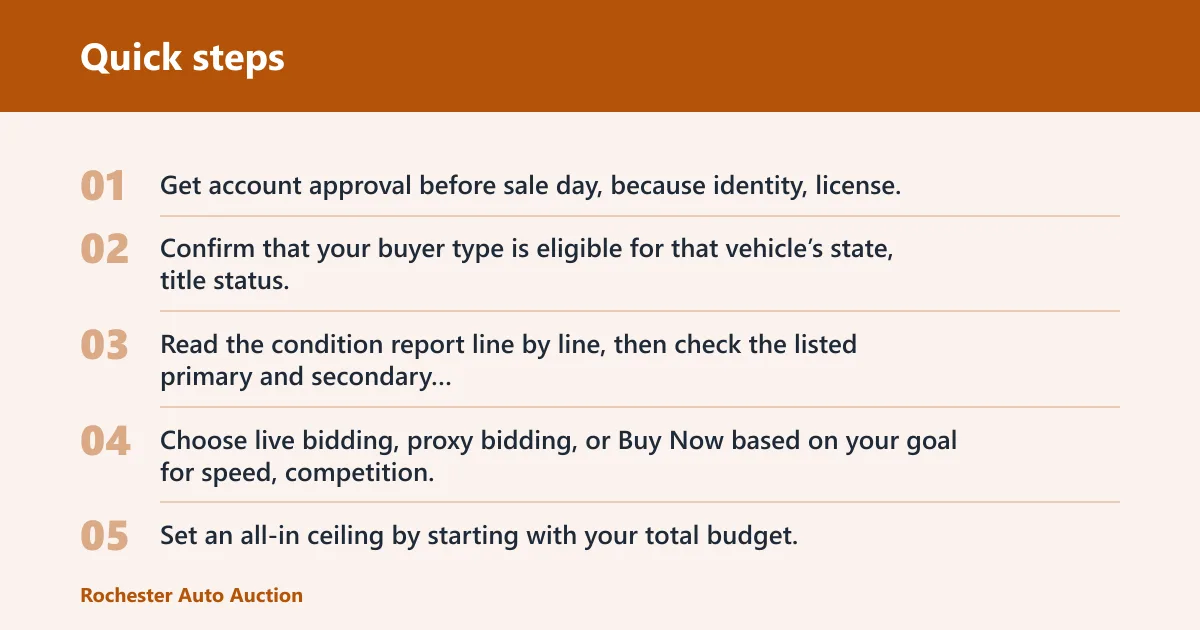
Bid flow
- Get account approval before sale day, because identity, license, or branch restrictions can block bidding at the last minute.
- Confirm that your buyer type is eligible for that vehicle’s state, title status, seller terms, and branch.
- Read the condition report line by line, then check the listed primary and secondary damage, run and drive status, odometer reading, notes, and title or document disclosure.
- Choose live bidding, proxy bidding, or Buy Now based on your goal for speed, competition, and price control.
- Set an all-in ceiling by starting with your total budget, then subtracting estimated buyer fees, branch fees, taxes, document charges, transport, and any immediate post-sale costs.
- Place the bid in the platform and watch for confirmation, competing offers, and any reserve or seller-response outcome shown for that listing.
- Pay within the stated deadline shown on the invoice or in the sale terms, because a win is not complete until payment clears.
- Submit any required buyer documents and ID details tied to the account and vehicle release.
- Arrange pickup or transport within the allowed window to avoid storage charges and release delays.
- Collect title or document release only after payment, documentation, and branch release requirements are satisfied.
What to look for in the listing before you bid
The condition report is where many avoidable mistakes start. Check the primary damage type, any secondary damage note, odometer status, keys information if shown, and seller comments.
Run and drive means the vehicle was able to start and move under its own power at the time noted in the listing. It does not promise roadworthiness, no warning lights, or no drivetrain damage. Salvage disclosure tells you the vehicle carries a title or damage status that changes registration, resale, repair, or export options.
Picture a public buyer chasing a clean-looking crossover with front-end damage. The photos look manageable, but the title disclosure limits who can register it in that state, and the branch terms require a buyer category the account does not have. The bid problem starts long before the hammer price.
What is the difference between live bidding, proxy bidding, and Buy Now on IAA?
Live bidding is best when you want to react in real time, proxy bidding is best when you already know your maximum, and Buy Now is best when speed matters more than auction upside. Each path trades screen time, price discipline, competition pressure, and the risk of paying more than planned.
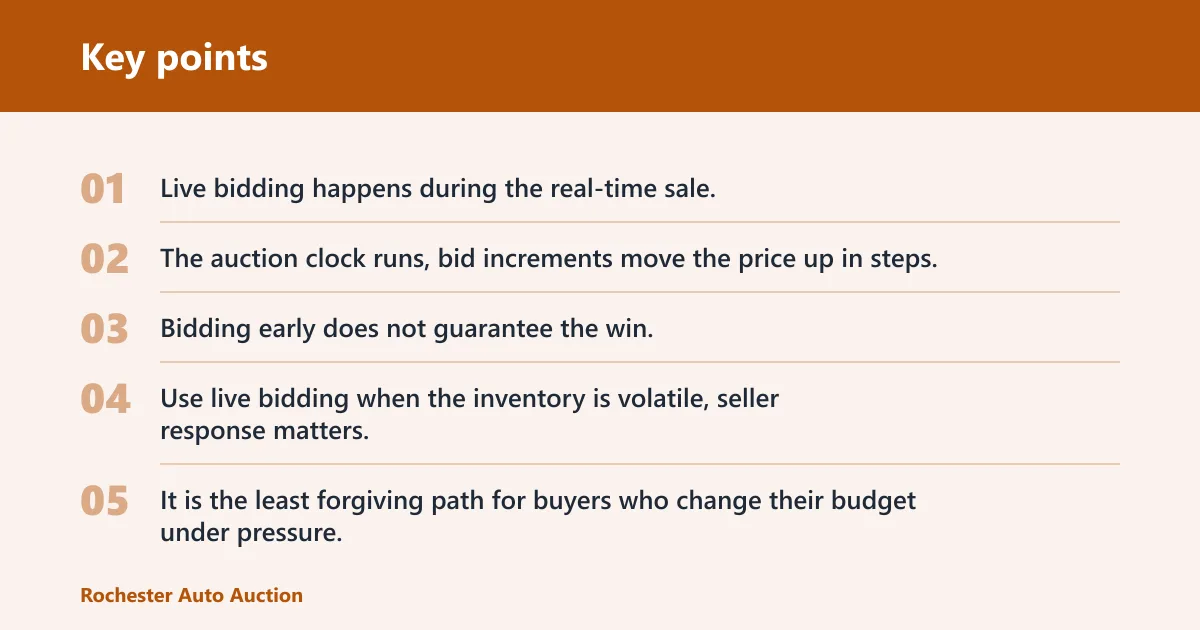
Live bidding
Live bidding happens during the real-time sale. The auction clock runs, bid increments move the price up in steps, and competing offers can appear fast. Bidding early does not guarantee the win, because another bidder can top your offer before the clock closes or automatic bids can outlast you.
Use live bidding when the inventory is volatile, seller response matters, or you need to read the room on an unusual unit. It is the least forgiving path for buyers who change their budget under pressure.
Proxy bidding
Proxy bidding lets you enter a maximum bid before the live sale. The platform then raises your offer automatically only as needed, up to that ceiling, against competing bids and increments.
This is usually the best fit when the vehicle has broad market comps, the damage profile is easy to price, and you want discipline. If the right number is already on paper, proxy bidding stops emotion from adding one more increment, then another.
Suppose a late-model sedan has moderate rear damage, a clear odometer note, and transport you can quote in advance. That is a stronger proxy-bid candidate than a flood unit with uncertain electrical risk, where real-time seller behavior and competition may change the decision.
Buy Now
Buy Now is a fixed-price purchase when that option is available on the listing. You do not participate in the live auction if you secure the vehicle at the posted price.
Buy Now wins when the listed price is below or close to your all-in auction estimate, especially if you value speed, want no auction-clock pressure, or need the unit secured before competitive bidding starts. It can also reduce time risk for inventory you already know you want.
How to choose the path
Choose live when the value range is wide and the sale may hinge on real-time competition. Choose proxy when the market value is narrow and discipline matters more than speed. Choose Buy Now when the posted price already clears your ceiling test and delay adds more risk than upside.
Bidding path decision matrix
Decision matrix
| Decision factor | Live bid | Proxy bid | Buy Now |
|---|---|---|---|
| Buyer goal | Win a contested vehicle by reacting in real time | Stick to a preset ceiling without screen pressure | Secure the unit immediately at a known posted price |
| Speed | Slowest path; you must wait for sale time | Moderate; bid can be set in the pre-live window | Fastest; instant purchase when available |
| Price control | Lowest unless you enter with a hard ceiling and stop | Highest for disciplined buyers because the cap is set first | High if the fixed price is below your all-in ceiling |
| Competition level | Best for heavy competition and changing bid behavior | Best for normal competition on easy-to-price units | Avoids live competition entirely if the option is still open |
| Fee risk | Higher overpay risk if you chase the hammer price and forget landed cost | Lower overpay risk because the maximum is set before pressure builds | Lower auction-pressure risk, but total cost still includes fees and transport |
| Best use case | Hard-to-source trucks, specialty units, or listings with uncertain bidding behavior | Mainstream sedans, crossovers, and repeatable inventory with clear market comps | Units priced fairly enough that waiting for the sale adds little value |
Iaa bidding checklist
| Checklist item | Example amount | How to use it |
|---|---|---|
| Total purchase budget | $5,500 | Start with the maximum amount you are willing to spend door to door. |
| Estimated buyer and branch fees | $725 | Use the current fee schedule and branch charges tied to the sale price band. |
| Taxes and document charges | $125 | Include state taxes if applicable, plus title or document fees. |
| Transport from branch | $450 | Quote the route before bidding, especially for non-running vehicles. |
| Immediate post-sale needs | $200 | Add battery, tire, key, or tow-off costs that must happen right away. |
| True hammer-price ceiling | $4,000 | Calculate about $5,500 minus $725 minus $125 minus $450 minus $200. |
That last number is the ceiling that matters. If bidding passes it by even one increment, the vehicle no longer fits the plan.
What rules can make an IAA bid invalid or rejected?
An IAA bid can fail when the account is not approved for that vehicle, the bidder lacks the right authorization, the branch or title type blocks that buyer category, or post-win deadlines are missed. Listing-specific terms can also override what you assume from another sale or another branch.
Eligibility failures
A buyer may have a valid account and still be unable to bid on a specific unit. Common blockers include incomplete identity verification, expired license status, missing deposit or permissions, branch restrictions, title restrictions, and public-versus-dealer limits.
IAA inventory is branch-based and rule sets can vary by seller terms, state paperwork, and title category. Do not assume access to one salvage unit means access to all salvage units.
Authorization failures
The additional bidder form matters when someone bids under a primary account. If the authorized person is not properly linked, or the names and permissions do not line up, the bid can be rejected or the post-sale file can stall.
A common first-timer mistake is letting an office manager or runner bid from a shared login without current authorization on file. The bid lands, the unit closes, and the problem appears only when payment or release documents are reviewed.
Bid, payment, and cancellation failures
Bids are binding within the platform rules and sale terms. If you win and do not pay within the stated deadline, the transaction can be canceled, penalties may apply, deposits may be affected, and bidding privileges can be reduced or suspended.
Cancellation limits also matter. Auction marketplaces do not treat a winning bid as a casual reservation. Once the lot closes in your favor, buyer obligations start immediately.
Listing terms can override assumptions
Some vehicles have seller conditions, reserve outcomes, document delays, or release terms that alter the process. Read those notes before the sale. A low bid that wins subject to later seller action is different from a simple no-reserve close.
What fees should you expect after winning an IAA bid?
Your final cost is usually much higher than the hammer price alone. Expect the sale price plus buyer fees, branch fees, taxes where applicable, title or document charges, payment-related timing exposure, and transport or storage costs if pickup is delayed.
Cost categories to include
Start with the hammer price, then add the buyer fee schedule that applies to that price level. Add branch fees or service charges shown for the transaction. Then add taxes if your buyer type and state require them, along with title or document charges.
Transport is often the number that turns a good-looking deal into an average one. Non-running vehicles can cost more to move, and remote branches can erase the auction discount fast.
Payment timing and pickup timing
Payment is due within the deadline stated for your sale and account terms. If payment is late, release can stop and penalties may begin. If pickup is late after payment, storage charges can apply and the branch may hold the unit until release conditions are fully met.
That is why the cheapest hammer price is not always the cheapest purchase. A slightly higher winning bid at a nearby branch can beat a lower hammer price once transport and storage exposure are counted.
Common mistakes
Mistakes that raise cost or block the sale
Bidding before confirming eligibility is the fastest way to waste time. Public access, dealer access, title restrictions, and branch rules do not always line up the way buyers expect.
Another common mistake is treating the hammer price as the deal price. Buyer fees, branch fees, taxes, documents, and transport need to be on paper before the first bid goes in.
Using live bidding for every vehicle is also a mistake. Proxy bidding is often stronger for mainstream inventory with predictable values, while Buy Now can be the better move when the listed price already fits the ceiling.
How to avoid them
- Verify buyer eligibility on the exact listing before sale day.
- Confirm that any authorized bidder is properly linked to the primary account.
- Build the all-in ceiling from total budget downward, not from hammer price upward.
- Increase a live ceiling only in fixed bid increments you chose in advance, such as one platform increment at a time, then stop and recheck the worksheet.
- Arrange payment and transport before the auction closes, not after.
Prevention
Keep a repeatable worksheet for each branch and vehicle type. One page with buyer category, title restrictions, estimated fees, and transport quotes helps stop the same mistake across multiple sales.
If that didn’t work, try this next
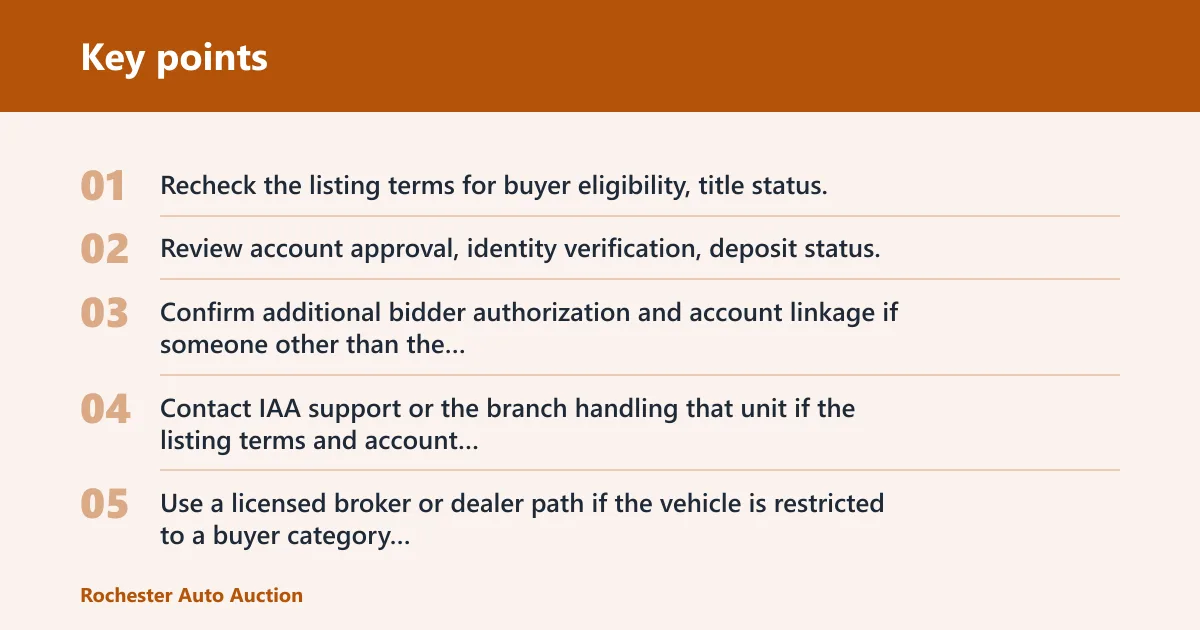
Escalate the issue in order
- Recheck the listing terms for buyer eligibility, title status, and sale format if the bid option is missing or blocked.
- Review account approval, identity verification, deposit status, and branch permissions if the account should qualify but cannot place the bid.
- Confirm additional bidder authorization and account linkage if someone other than the primary account holder is bidding.
- Contact IAA support or the branch handling that unit if the listing terms and account status still do not match the bidding result shown.
- Use a licensed broker or dealer path if the vehicle is restricted to a buyer category your account cannot hold.
If the problem appears after winning, move fast. Payment deadlines and pickup windows usually create the largest downstream cost.
Frequently asked questions
What do I need before I can place a bid on IAA?
You need an approved account, completed identity checks, eligibility for that specific vehicle and branch, and any required deposit or permissions. If someone will bid under another account, the additional bidder authorization must already be in place. A max-bid worksheet should be ready before the sale opens.
How do I set my max bid on IAA without overpaying?
Start with the total amount you can spend, then subtract estimated buyer fees, branch fees, taxes, title or document charges, transport, and immediate post-sale costs. The number left is your true hammer-price ceiling. Enter that as your proxy maximum or use it as your hard stop during live bidding.
What happens if I win an IAA bid but cannot pay right away?
The account can face cancellation, penalties, deposit impact, delayed release, or loss of bidding privileges if payment misses the stated deadline. The exact consequence depends on sale terms and account rules, but the practical answer is simple: treat the invoice deadline as binding the moment the lot closes.
How do I increase my chances of winning an IAA bid?
Match the bidding path to the vehicle. Use proxy bidding for predictable units where discipline matters, live bidding for contested or unusual inventory, and Buy Now when the fixed price already beats your all-in estimate. Winning odds also improve when approval, authorization, payment, and transport are solved before the auction starts.