How Does ACV Auctions Work From Sign-up to Vehicle Pickup?
ACV Auctions typically follows a sequence of dealer registration, account approval, bidding, payment, title review, then vehicle release and pickup. Delays usually start when verification, payment, or pickup authorization is missing. Bad paperwork, slow approvals, or unpaid invoices can hold a unit and add storage or transport costs. This guide maps the main steps, shows where ACV controls the process, and marks what you must complete before a vehicle can leave.
ACV pickup checklist

Use this checklist to track the handoff from registration through pickup. The main split is simple: ACV reviews eligibility, account access, payment status, title support, and release authorization; the dealer supplies documents, approved users, and pickup decisions. Transport only starts cleanly after the earlier steps are complete.
| Stage | Who acts | Required input | Typical blocker | Proof or status to confirm |
|---|---|---|---|---|
| Registration entry | Dealer | Dealer license, resale certificate, federal tax identification, AuctionAccess credentials | Missing or mismatched business documents | Submission received and account under review |
| Approval review | ACV | Completed online registration | Unclear ownership, incomplete records, or missing Power of Attorney | Approval notice and login credentials issued |
| Account access | Dealer | Unique username and password for each approved user | Shared login, inactive user, or wrong authorized representative | Each user can sign in with separate credentials |
| Condition review | Dealer | Vehicle condition report with photos, undercarriage views, engine sound, mileage, and title status | Report does not match the unit or the damage notes are unclear | Condition report viewed before bidding or purchase |
| Winning bid | Dealer | Bid confirmation and checkout action in the app | Payment method not selected or internal approval missing | Winning status and purchase record shown in the platform |
| Payment processing | Dealer, ACV | Payment selected in-app; floorplan approval if used | Invoice not processed or floorplan not cleared | Payment marked processed before release |
| Release authorization | ACV | Processed payment and any title or release requirements | Title hold, unpaid balance, or release not posted | Vehicle marked released |
| Carrier assignment | Dealer or carrier | Pickup choice, carrier details, dispatch instructions | Wrong carrier, missing contact, or no pickup appointment | Carrier assigned and pickup window confirmed |
| Pickup | Carrier | Vehicle location, release status, bill of lading | Vehicle not ready, document mismatch, or access issue | Pickup logged with photo and signature evidence |
Dealer registration documents and account entry
ACV is a business-to-business online marketplace, so dealers must register before buying. The registration flow can require a state issued dealer’s license, resale certificates, a federal tax identification number, and Power of Attorney where applicable. AuctionAccess credentials may be part of the seller entry path, depending on account type and current ACV requirements.
Customers must complete the online registration process to access services. ACV reviews the submitted business records before approval, so missing or inconsistent documents are a common source of delay. If the legal business name, tax record, and dealer license do not line up, the review usually stops until the file is corrected.
A common first-timer mistake is sending partial paperwork and expecting account access right away. That usually adds another review cycle. If the dealership uses a third-party office or a group of stores, make sure the authorized representative named for the account can answer follow-up questions quickly.
How do you sign up for ACV Auctions?
You sign up by completing ACV’s online registration and submitting the business documents that prove dealer eligibility. The platform is for licensed dealers, not retail buyers. Registration begins with account details, then moves to document review, then to approval and login setup if ACV accepts the file.
Dealer eligibility requirements
ACV expects dealer credentials that identify the business and its authority to buy and sell vehicles. Required registration documents can include a state issued dealer’s license, and ACV says registration may require resale certificates and a federal tax identification number. If the account will use Power of Attorney, that should be ready before review begins.
For seller access, AuctionAccess credentials are the usual entry point. For buyers, the same business verification sits behind the registration flow. The practical point is the same in both cases: no approved account means no active bidding or release access.
What ACV reviews before approval
ACV checks whether the dealer record is complete and whether the people listed to use the account are allowed to act for the business. That includes the registration details, identity of the dealership, and any authority documents tied to buying or selling. If the file is incomplete, approval slows until the missing item is provided.
Approval timing depends on document quality and response time. ACV does not promise a fixed turnaround, and the review can take longer when the license number, tax ID, or resale record needs correction. The dealer can speed the process by answering follow-up requests promptly.
What happens after approval?
After approval, users typically create their own names and passwords during account setup. Those credentials should be limited to authorized representatives only. That control matters because account actions can affect bids, payments, title work, and pickup authorization, all of which are tied to the same business profile.
What you can do inside the ACV platform
The ACV Platform is a business-to-business marketplace for buyers and sellers, with services that include inspection, storage, transport, and title support. Inside the account, a dealer can review listings, inspect condition reports, bid, manage purchases, choose payment, and select transport where needed. The app or login is the operating hub for those steps.
Inspection data matters before you bid. ACV’s condition reports include mileage, title status, photos, undercarriage views, and engine sound. Those details do not replace your own due diligence, but they do show the unit state ACV is presenting at sale.
Suppose a dealer sees a truck with clean photos but a title status note that indicates a hold. That is a different decision from a unit with clean title status and only cosmetic damage. The first one may move slowly after the sale even if the bid is accepted, while the second may be ready for release sooner depending on the sale terms and location.
How do bidding and payment work?
Once the dealer is approved, bidding works inside the platform, and a winning bid moves into checkout. ACV says payment is processed in-app before vehicle release. That means the bid win does not equal release; the invoice still has to clear before the vehicle can leave the lot.
Winning a vehicle and selecting payment in the app
After a win, the dealer selects payment in the app and follows the checkout steps. ACV says it accepts most major floorplans, so financed purchase methods may be available depending on the dealer’s setup and the transaction. The important point is that payment must be posted before release work can begin.
ACV’s buyer protection is tied to the sale after purchase. Buyers may receive 10-day arbitration protection at no charge, subject to sale terms, eligibility, and current policy offerings. Arbitration does not replace payment or title review. It is a post-sale protection, not a pre-release shortcut.
When release can begin
Release can begin after payment is processed and any required release or account issue is clear. Title delivery timing and lot release timing are not always the same thing, so a title record can still be in process even when the vehicle is available for pickup. If a payment is pending, if the floorplan has not been accepted, or if the release record is not posted, the vehicle stays put. This is one of the most common places where pickup gets delayed.
Say your store wins a sedan on Friday afternoon and submits payment through the app that same day. If the invoice is still pending on Saturday, a carrier may arrive too early and leave without the vehicle. The useful check is the release status, not the bid receipt alone.
How do titles, arbitration, and buyer protection work after purchase?
After purchase, ACV’s dedicated titles team helps process title transfers and chase down issues that can slow closeout. If a title is missing, delayed, or disputed, that can affect title delivery and later paperwork even when the sale itself is complete. Arbitration coverage sits alongside that process, not before it.
Title transfer support
ACV’s title support is meant to handle the administrative side of transfer work and follow-up. The key dealer task is to keep the account record accurate and respond fast if the titles team needs more information. When title work stalls, the vehicle may remain in limbo even though the buyer has already won it, but release timing can still vary by seller type, storage location, and sale terms.
That is why title review belongs in the same workflow as payment and pickup. A clean payment record with a title problem still blocks movement. A clean title with unpaid fees does the same.
Extended buyer assurance
ACV says buyers may receive 10-day arbitration protection at no charge. It also offers extensions with coverage offerings. That protection helps after purchase if the vehicle does not match the sale terms, but it is not a substitute for inspecting the report before bidding or confirming release status before dispatching a carrier.
How does ACV Transportation fit in?
ACV Transportation is an integrated checkout option for post-sale delivery. You can select it after a win if you want ACV to arrange shipping through its network rather than using your own hauler. ACV says the network offers real-time pricing and status updates.
When to select transport at checkout
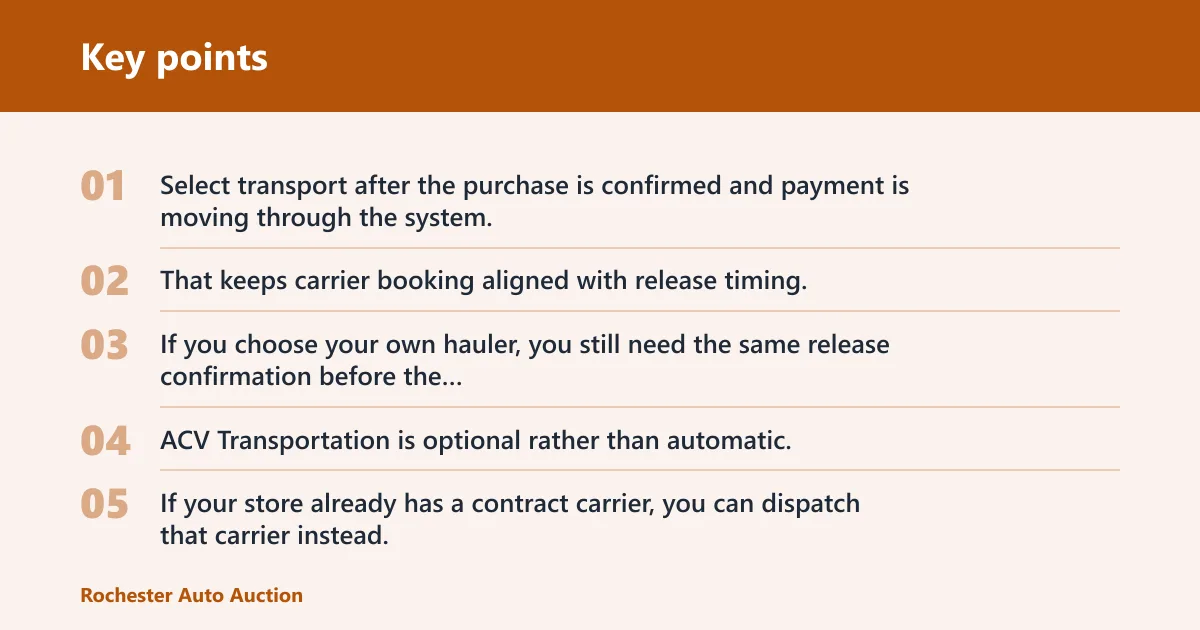
Select transport after the purchase is confirmed and payment is moving through the system. That keeps carrier booking aligned with release timing. If you choose your own hauler, you still need the same release confirmation before the truck can load.
ACV Transportation is optional rather than automatic. If your store already has a contract carrier, you can dispatch that carrier instead. If you want ACV to coordinate the move, select the transport option in the checkout flow and wait for the status updates.
Carrier by ACV Transportation app
Carrier by ACV Transportation includes a VIN scanner, an electronic bill of lading, and photo capture at pickup and drop-off. Those tools help document the handoff and create a clearer record of vehicle condition during transit. They also reduce disputes over where the damage occurred.
Picture a crossover with a scraped rear bumper being loaded at pickup. If the carrier app captures photos at pickup and drop-off, the record is easier to compare against the condition report. That comparison matters when a claim or arbitration question comes up later.
Pickup and drop-off proof
Before the carrier leaves, confirm the release status, the exact vehicle identity, and the pickup location. The driver should have the right VIN and the correct release paperwork. If any of those do not match, stop and fix the mismatch before loading starts.
Common blockers before pickup include missing documents, payment that has not posted, a title delay, unauthorized access, or a carrier mismatch. In each case, the fix is different, but the rule is the same: do not send a truck until the platform status and the lot staff agree on release.
What causes delays before vehicle pickup?
Delays usually come from incomplete registration, payment not yet processed, title problems, or pickup authorization issues that do not match the authorized user or carrier. Any one of those issues can slow release even after the dealer has won the vehicle. Most delays are operational, not mechanical.
Another frequent cause is a simple handoff gap. A dealership may assume the invoice cleared, while ACV still shows pending. Or the carrier may arrive before the vehicle is marked released. Those gaps are easy to prevent if the dealer checks the status before dispatch.
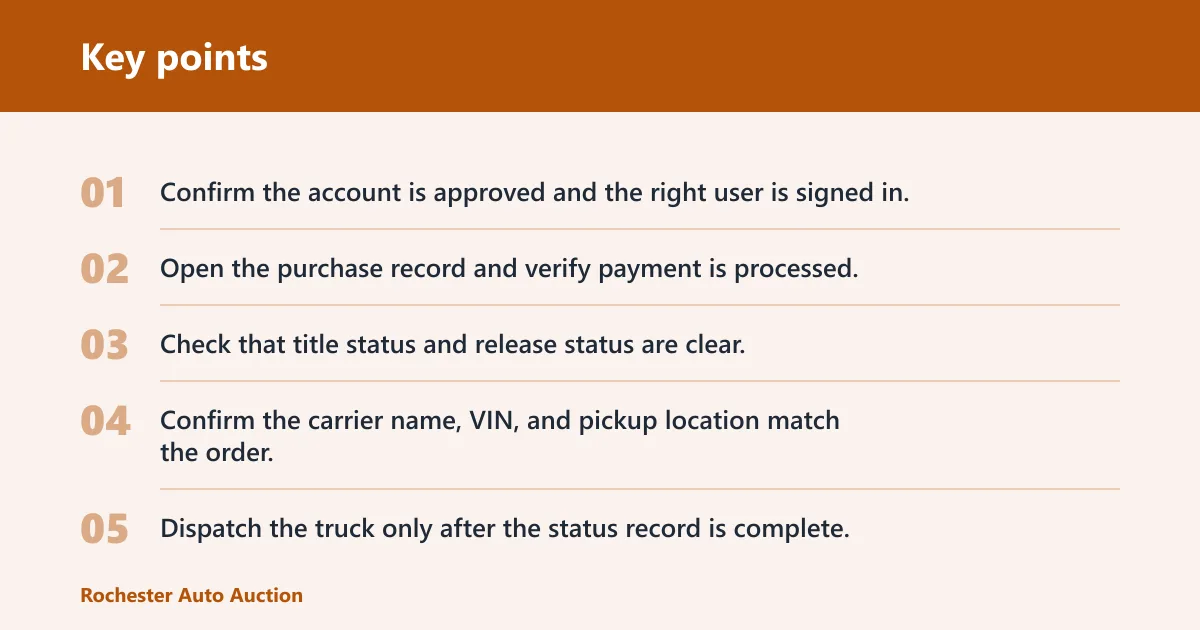
- Confirm the account is approved and the right user is signed in.
- Open the purchase record and verify payment is processed.
- Check that title status and release status are clear.
- Confirm the carrier name, VIN, and pickup location match the order.
- Dispatch the truck only after the status record is complete.
Frequently asked questions
How do I sign up for ACV Auctions as a dealer?
You sign up through ACV’s online registration flow, which starts with business details and document upload. ACV is a dealer-only B2B marketplace, so registration is required before bidding. AuctionAccess credentials may be part of the seller entry path, depending on account type and current ACV requirements.
What documents do I need to register on ACV?
ACV says registration can require a state issued dealer’s license, resale certificates, and a federal tax identification number. Power of Attorney may also be needed depending on who will act for the business. Keep the dealership name and tax record consistent, or the review can slow down.
How long does ACV approval usually take?
ACV does not publish a fixed approval time, and the timeline depends on document completeness and follow-up speed. Clean paperwork usually moves faster than a file that needs corrections. The best way to avoid delay is to answer any ACV request quickly and keep the authorized representative available.
What happens after I win a vehicle on ACV?
After you win, the next steps are checkout, payment selection in the app, title review, and then release. ACV says payment is processed in-app before vehicle release. Once the vehicle is marked released, you can arrange transport through ACV Transportation or your own carrier.
When can I pay for a winning bid and release the car?
You can pay as soon as checkout opens for the winning bid, but release does not start until payment is processed. If the invoice is still pending, the unit stays on hold. That is why the platform status matters more than the bid confirmation alone.
Does ACV arrange transportation or do I need my own hauler?
ACV can arrange transportation through ACV Transportation, or you can use your own hauler. The service is optional. If you choose ACV Transportation, it gives you pricing and status updates through a nationwide carrier network, which can simplify the dispatch step.