Is IAA a Public Auction or Dealer Only?
IAA appears to offer both public-access and dealer-facing inventory: some people may be able to bid without a dealer license, but buying rights can depend on buyer type, vehicle eligibility, and state rules. If you guess wrong, you can waste time on registration, miss a bid window, or get blocked at checkout. This guide explains who can buy, which lots are open, and how the rules change by location.
IAA at a glance
IAA is a salvage and auto auction platform with online bidding and a mix of public-facing and dealer-facing inventory. That mix causes the confusion. Some listings are open to public buyers, while others stay limited to dealers or approved business buyers.
The short answer is simple. IAA is not purely public, and it is not dealer only across the board. The lot label, your buyer type, and state licensing rules all matter before you bid.
Can the public bid on IAA vehicles?

Yes, the public can bid on some IAA vehicles, but only on inventory marked as available to the public. IAA says public buyers without a qualifying business license can bid on public vehicles, and it states that public buyers can bid on and buy vehicles available to the public.
That does not mean every listing is open. Many vehicles still require a licensed dealer or approved business account, and state rules can narrow access further. Read the lot label before you register or place a bid.
Public-eligible inventory
Public-eligible vehicle inventory is the part of the site a non-dealer buyer can pursue directly, if the listing and the state both allow it. This is the inventory you want if you do not have a dealer license and do not want to route the purchase through another business.
Common signals include public buyer wording, public sale access, or a listing that does not call for dealer-only credentials. If the lot page says the vehicle is open to public buyers, that is the clearest sign that you may bid after registration.
Dealer-only inventory
Dealer-only inventory is not open to the general public. It typically requires a qualifying business license and a dealer account. That is why a listing can appear online but still be off-limits unless you are registered as a dealer buyer.
Drive In Peace notes that dealer-only auctions require a dealer license, and it contrasts dealer-only auctions with IAA and Copart’s salvage-focused model. The practical point is this: a visible lot is not always a bid-eligible lot for a public user.
How lot labels affect bidding
Lot labels are the fastest way to sort access. If the listing points to public buyer access, you can usually move forward after account setup. If the listing points to dealer-only access, you need the right license, a broker, or a different vehicle.
Public-facing marketing can make the platform look open, but the lot label is the deciding detail. Treat the label as the gate, not the homepage.
IAA public buyers vs dealer buyers
Public buyers are people without a qualifying business license. Dealer buyers are users with dealer account access and the credentials needed for business-use inventory. Both can use IAA, but they do not always see the same inventory or have the same checkout path.
IAA also has a dealer-focused page specifically for car dealers, which is a clear signal that the platform is built for both buyer types. That split is why one person can browse a lot and another person can buy it.
What public buyers can do
Public buyers can bid on and buy vehicles that IAA makes available to the public. They may also need access to public-only inventory, depending on the market and the lot type. Buyer registration is still required before bidding, so access starts with an account, not with a guess.
Suppose a shopper wants a flood-damaged sedan listed as public-eligible in one state. That buyer may be able to bid directly if the listing and the state both allow it. If the same car is tagged differently elsewhere, the answer changes.
What dealer buyers can do
Dealer buyers can access dealer-oriented inventory and tools tied to business buying. That usually means broader access to listings that are not open to the general public, plus account features built for repeat buying and business use.
Dealer access does not remove every restriction. State rules can still limit a buyer, and some salvage lots still require specific credentials or a licensed intermediary.
Where account access differs
IAA buyer registration sets the starting point, but access tiering determines what you can see and buy. A public account and a dealer account generally do not carry the same permissions. That is why the login flow matters before you spend time on a lot.
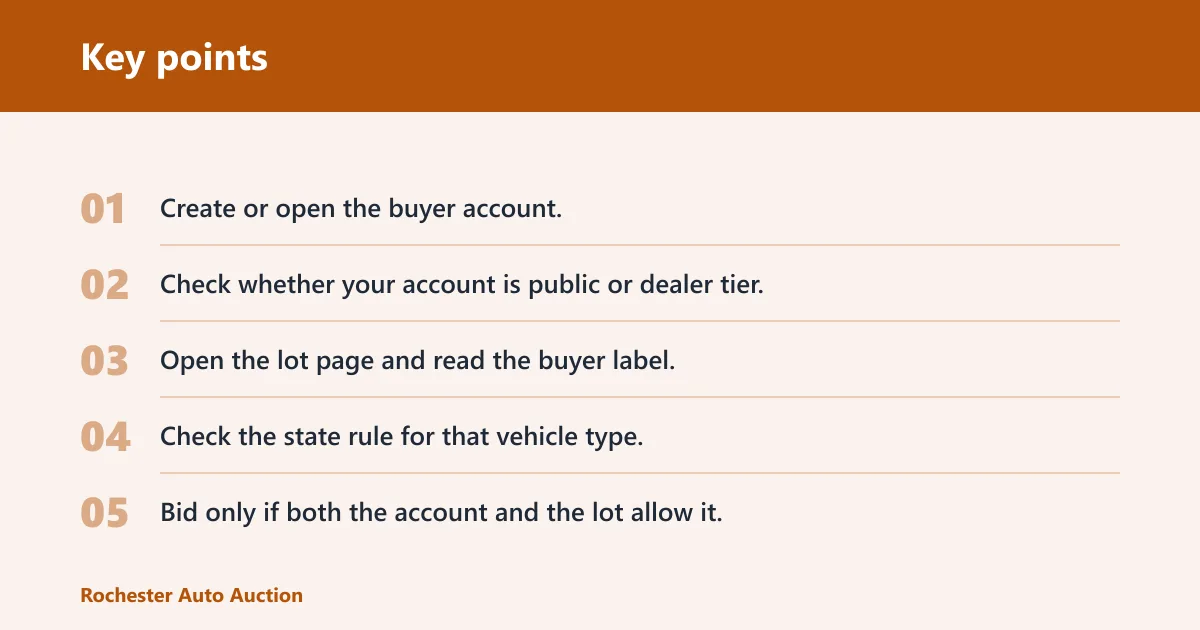
- Create or open the buyer account.
- Check whether your account is public or dealer tier.
- Open the lot page and read the buyer label.
- Check the state rule for that vehicle type.
- Bid only if both the account and the lot allow it.
Iaa a public auction or decision table
| Buyer type | Lot label | State license requirement | Broker needed | Likely next step |
|---|---|---|---|---|
| Public buyer | Public-eligible | No license required for that lot | No | Register, verify the lot, and bid directly |
| Public buyer | Dealer-only | Dealer or qualifying business license required | Yes | Use a licensed broker or choose another lot |
| Public buyer | Public-eligible | State requires a salvage or business license | Yes | Check whether a broker can bid for you |
| Dealer buyer | Public-eligible | No extra license beyond account qualification | No | Bid through the dealer account if the lot is open |
| Dealer buyer | Dealer-only | Dealer license required | No | Proceed through dealer access and review the sale terms |
| Public buyer | State-restricted salvage lot | Yes, state law limits purchase eligibility | Often yes | Confirm whether the state allows direct bidding or requires a broker |
This table answers the real question: can you buy this specific lot, not just can you browse the site. If any one of the three checks fails, the purchase may stop there.
Do you need a dealer license to buy from IAA?
Sometimes, yes. You need a dealer license for dealer-only inventory, and many states also require a license for certain salvage purchases. If the lot is public-eligible and your state does not add a restriction, a public buyer may not need a dealer license.
A broker can help when a public buyer wants access to restricted inventory or when state rules block direct buying. In plain language, the broker is the licensed intermediary who can handle the purchase path that the public account cannot use.
Say your public account finds a truck marked dealer-only in a state that also requires license-based salvage buying. That lot is not a direct buy. The realistic options are to use a broker, switch to a public-eligible lot, or wait until you have qualifying credentials.
When a broker can help
A broker is useful when the listing is restricted but the buyer still wants the vehicle. The broker’s role is to sit between the public buyer and the restricted lot, so the buyer can participate without holding the needed dealer or business license.
That does not remove every rule. If the state bars the transaction or the vehicle category is excluded, a broker cannot fix that. The broker only helps when the lot and the law still leave a legal path open.
When public access is enough
Public access is enough when the buyer account is allowed, the lot is labeled for public buyers, and the state does not add a separate license requirement. In that setup, a public buyer can bid directly after registration.
Check all three points before bidding. A public-friendly homepage does not override a restricted lot page.
How state rules change access
State licensing rules can override what you see on the platform. That is why the same vehicle type may feel open in one state and restricted in another. The same source notes that many states require a license to buy salvage vehicles, which is exactly where confusion starts.
The site may list a vehicle, but the state can still decide who may buy it. If the law requires a dealer or salvage license, public access is not enough by itself.
State licensing limits
State licensing limits can affect salvage titles, rebuilt vehicles, and other restricted sales categories. A lot can be visible online and still not be eligible for a public buyer in that state. That is why the title status matters as much as the auction label.
TheDailyAutomotive notes that public access is limited for many vehicle types and that most vehicles are sold to licensed businesses. That lines up with the practical rule here: more inventory may appear online than a public buyer can actually purchase.
Why the same lot can be open in one state and closed in another
The answer is the law, not the listing. One state may allow a public buyer to complete the sale, while another state may require a dealer license or a broker. The auction platform can only sell within those state rules.
Picture the same damaged SUV listed in two different locations. One location may allow public bidding, while the other blocks the same buyer because the title type or state rule triggers a license check.
What is IAA auction?

IAA is a salvage and auto auction platform with online bidding, dealer-facing tools, and public access on selected vehicles. Dealer101 describes it as focusing on salvage vehicle auctions and online bidding, and it also points to a diverse inventory of damaged cars and trucks.
For a buyer, that means the platform is a marketplace, not a single access lane. Some lots are public, some are dealer-only, and some are controlled by state rules.
Is IAA auction legitimate for public car buyers?
Yes, IAA is a legitimate auction platform for public car buyers when the listing is open to the public and the buyer follows the stated rules. The legitimacy question is usually less about the platform itself and more about whether the specific lot is available to that buyer.
That said, legitimacy does not mean universal access. A valid platform can still limit who may bid on a given vehicle, and state law can still close the door for some buyers.
Frequently asked questions
Is IAA a public auction or dealer only?
IAA is neither purely public nor purely dealer only. It has public-eligible vehicles, dealer-facing inventory, and state-based limits that can change who may buy a specific lot. The right answer is always tied to the buyer type and the lot label.
How does IAA public buyer access work?
Public buyer access starts with IAA buyer registration, then moves to account tiering, lot eligibility, and state rules. If the account is public, the lot is public-eligible, and the state allows the sale, the buyer can usually bid directly after registration.
Can I buy IAA vehicles directly or through a broker?
You can buy directly when the vehicle is public-eligible and state rules allow it. You may need a broker when the lot is restricted or when state law requires a licensed intermediary. The broker does not change the lot; it changes who may legally handle the purchase.