How to Get a Dealer License for Car Auctions
To buy at dealer-only auto auctions, you usually need a state dealer license, often a wholesale dealer license if you only buy and resell, or a retail license if you also sell to the public. Using the wrong license can lead to rejected auction access, fines, or a permit that does not fit your business model. This guide explains the license path for auction access first, then how it changes for wholesale buying, retail sales, and a no-lot setup.
Auction license basics

Dealer-only auction access starts with the state license, not the auction house badge. In the United States, each state sets its own dealer-auction rules, and dealer-only auctions usually verify a dealer license before allowing bidding or purchase. That is why the first question is not “Which auction?” but “Which dealer license does your state require?”
Dealer-only auction access rules
Dealer-only auctions are built for licensed businesses. The auction house may ask for your dealer number, business registration, tax ID details, or proof that the license type fits the kind of buying you plan to do. A wholesale license may be enough for dealer-to-dealer purchasing in some states, but the auction’s own access rules still control final approval.
Do not confuse dealer licensing with auctioneer licensing. They are separate issues. A person can be authorized to run or conduct an auction and still not have the dealer license needed to buy vehicles there.
Wholesale versus retail dealer licenses
A wholesale dealer license is limited to dealer-to-dealer transactions. That can be enough for dealer-only auctions in some states, especially if you are buying for resale through licensed channels. A retail dealer license allows sales to retail customers and often carries broader premises and compliance duties. For a general overview of dealer licensing, see (Wikihow)
Some articles describe special auction-license categories, but dealer licensing for auction access is still governed by the state license type and the auction house’s own rules. Those are not interchangeable. They match different business models and different state rules.
When a no-lot setup may apply
Some states allow no-lot or alternate-location dealer setups. Others require a physical office, signage, and zoning approval. A no-lot setup does not remove licensing duties. It only changes how the state reviews your premises, and only if your state allows that structure at all.
Say your state allows a home office for a wholesale dealer, but the auction requires dealer verification tied to an active state license. You still need the license path that matches wholesale buying. The office arrangement may change, but the dealer status still has to be real and current.
Do you need a dealer license to buy cars at auction?
Yes, if you want access to dealer-only auto auctions, you usually need a dealer license or another state-recognized business credential that the auction house accepts for that access tier. Public auctions are different. Dealer-only auctions verify whether you are legally allowed to participate, and a general business filing alone is usually not enough.
Public auctions versus dealer-only auctions
Public auctions may allow unlicensed buyers. Dealer-only auctions are different. They restrict access to licensed dealers or verified business buyers, and the auction house can set its own membership and verification steps on top of state law.
That is why “business registered” does not equal “auction ready.” A formed LLC or corporation may be required before you apply, but it is not the same thing as dealer access.
What auction verification usually requires
Expect the auction house to verify the dealer license, business name, tax registration, and sometimes the physical location or business type tied to the license. If your state issues a wholesale-only license, the auction may still want confirmation that wholesale access is enough for that lane or sale format.
A common first-timer mistake is assuming any dealer card works everywhere. Picture a buyer with a valid retail dealer license in one state trying to enter a wholesale-only lane in another state. The auction may reject the bid registration if the license type or state status does not match the auction’s rules.
When another permit is not enough
Business registration, a resale certificate, or a sales tax number can help with compliance, but they do not replace a dealer license where the state requires one. If the auction is dealer-only, the state dealer license is usually the gatekeeper.
Dealer license path by state
The state motor vehicle agency, or a similar licensing office, issues dealer licenses in most states. Application forms and procedures are state-specific, so the order of steps, required premises, and supporting documents can change from one state to another. That is why states such as California, Texas, Illinois, Pennsylvania, Florida, and Georgia do not follow one shared process.
Which state agency issues the license?
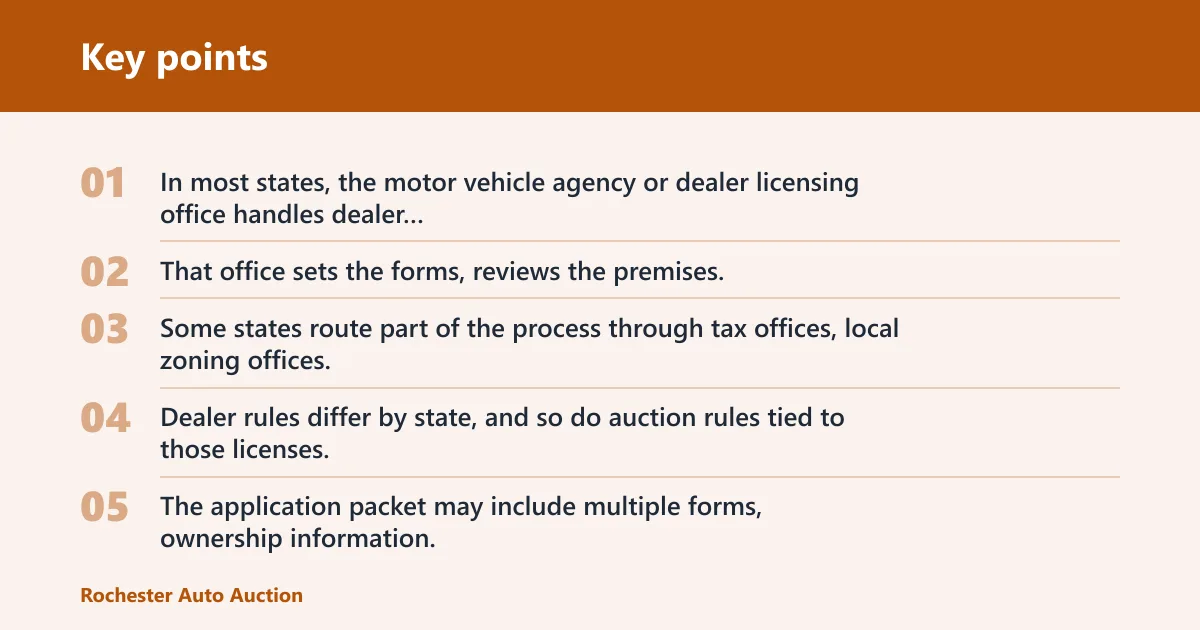
In most states, the motor vehicle agency or dealer licensing office handles dealer applications. That office sets the forms, reviews the premises, and decides whether your dealer type matches your planned business. Some states route part of the process through tax offices, local zoning offices, or background check systems as well.
Why forms and procedures change by state
Dealer rules differ by state, and so do auction rules tied to those licenses. The application packet may include multiple forms, ownership information, a premises inspection request, tax registration proof, and fee payments. The exact paperwork differs by state.
Source guidance used here points to the same sequence: check state auction license requirements first, register the business before applying, get a sales tax registration number, and complete any required state-specific steps. Those steps are common, but the exact paperwork differs by state.
Examples from key states
California, Texas, Illinois, Pennsylvania, Florida, and Georgia all have state-controlled licensing systems, but not the same forms, lot rules, or approval order. Some states are strict on premises. Others are more open to alternate-location setups. Pennsylvania is often cited as a state with separate state filings, which is a reminder that one submission packet may not be enough.
Dealer business setup before you apply
Before you apply, the business structure should already match the dealership plan. That means choosing the entity, lining up tax registration, and making sure the license type fits whether you want wholesale buying, retail sales, or both. If those pieces do not match, the application can stall or be denied.
Choose the business entity
Set up the business as an LLC, corporation, partnership, or sole proprietorship before the dealer application, if your state requires that order. The name and ownership details should match across the business filing, tax records, and dealer forms. A mismatch creates avoidable follow-up requests.
Register for sales tax
Sales tax registration is often separate from dealer licensing, but it is commonly required for compliance. The source guidance for auction licensing specifically calls for a sales tax registration number. That number can matter even if you only plan to buy wholesale, because the state may still want tax records aligned before approval.
Match the entity to your planned dealer type
If the plan is wholesale buying only, do not build a retail compliance structure by mistake. If the plan includes retail sales to the public, the entity, premises, insurance, and local approvals should all reflect that broader model.
Suppose you form an LLC for a wholesale-only dealer and then apply for a retail license without a proper lot, signage, or zoning approval. The state may reject the package because the business structure and the license request do not line up.
Wholesale or retail dealer license?
Choose the license based on the business you will actually run. Wholesale-only dealers buy and sell dealer-to-dealer. Retail dealers can sell to the public and usually face more premises, recordkeeping, and consumer compliance steps. The wrong choice can slow approval or limit auction access.
Wholesale-only buying at auctions
A wholesale dealer license may be enough for dealer-only auctions if the state and the auction house both allow it. The key point is that wholesale licensing is narrower. It is not the same thing as retail licensing, and it does not automatically authorize public sales.
Retail selling requirements
Retail dealer licensing usually adds more location and compliance work. States may require a permanent business location, signage, office space, zoning approval, and consumer-focused recordkeeping. If you plan to sell to the public, build for that standard from the start.
How the license choice changes paperwork and premises rules
Wholesale applications often focus on business registration, tax numbers, and proof that the dealer activity is legitimate. Retail applications more often test whether the site can support customer-facing operations. That difference affects both approval and audit risk later.
Dealer location and lot requirements
Lot rules are state-specific. Some states require a physical office, signage, and zoning approval. Others allow no-lot or alternative-location dealer setups. Before you commit to a lease or property purchase, confirm what your state accepts for your dealer type.
Physical premises rules
A physical premises rule may mean office access, storage space, a posted sign, and local zoning clearance. In retail licensing, this is more common. In wholesale licensing, some states permit lighter premises standards, but that is never something to assume.
Office, signage, and zoning checks
These checks are frequent rejection points. If the office is not in the right zoning district, if signage is missing, or if the location cannot be inspected, the application may stop there. The state cares about whether the location can support the licensed activity, not just whether an address exists.
No-lot or alternative-location options
Some states allow a home office, shared office, or alternate-location setup for certain dealer types. That can help a buyer who wants to operate without a traditional lot. It does not remove every requirement. It just changes the premises standard you must meet.
Dealer application checklist
The application packet is where many approvals fail. States may require multiple forms, business details, premises information, tax IDs, and background checks. If one part is missing, the state may pause or reject the file.
Forms and supporting documents
Gather the core documents before filing so the application packet is complete. Exact forms vary by state, but the file often includes ownership documents, business registration, tax registration, premises proof, and identification for control persons or owners.
Education, exam, and background checks
Some states may require training, an exam, or background checks as part of dealer approval. These are not optional extras in states that require them; they are approval conditions.
Common rejection reasons
Applications are often rejected for missing forms, incomplete premises documentation, tax registration gaps, zoning problems, or background issues. An application can also be rejected if the requested license type does not match the business model or the auction access plan.
Dealer auction decision table
| Decision point | Wholesale dealer license | Retail dealer license |
|---|---|---|
| Auction access | May be enough for dealer-only auctions if the state and auction accept wholesale access | Usually accepted where retail dealer status meets the auction’s dealer verification rules |
| Lot requirement | Some states allow no-lot or alternate-location setups | More likely to require a physical office, signage, or zoning approval |
| Typical state paperwork | Business registration, tax number, dealer forms, ownership details, possible background check | Business registration, tax number, premises proof, dealer forms, local approvals, possible background check |
| Exam or education | Required in some states | Required in some states, often with broader compliance content |
| Common rejection reasons | Missing forms, tax gap, business mismatch, invalid location proof, background issue | Missing forms, zoning problem, signage problem, tax gap, incomplete premises file, background issue |
Dealer license checklist
| Item | Done | Notes |
|---|---|---|
| Check your state dealer license rules | Confirm the agency, license type, and order of steps | |
| Form the business entity | LLC, corporation, partnership, or sole proprietorship as planned | |
| Register for sales tax | Keep the tax number with the application packet | |
| Confirm lot or office rules | Check zoning, signage, and inspection needs | |
| Complete required course or exam | Only if your state requires it | |
| Prepare supporting documents | Ownership, premises, identification, and any background forms | |
| Match the license type to auction access | Wholesale, retail, or another state-recognized dealer category |
Frequently asked questions
How to get a dealer license for car auctions in california
Start with California’s dealer licensing authority and confirm whether you need a wholesale or retail license for the auction access you want. Then form the business, secure tax registration, and check the premises and zoning rules before filing. California does not use the same process as every other state.
How to get a dealer license for car auctions in texas
Texas dealer licensing begins with the state agency that regulates motor vehicle dealers, then moves through business formation, tax registration, and location review if your license type needs it. The key is matching the license to dealer-only auction access. Do not assume a wholesale license and a retail license are treated the same.
How to get a dealer license for car auctions without a lot
If your state allows a no-lot or alternative-location setup, apply under that rule set and document the office or home-office arrangement exactly as required. Some states still want signage, zoning clearance, or a business location record. If your state does not allow no-lot licensing, you will need a physical premises.
How to get a dealer license to buy cars at auctions
First decide whether the auctions you want are dealer-only and whether wholesale access is enough in your state. Then register the business, get the sales tax number, prepare the required forms, and complete any state-specific steps. The auction house still has to verify that your license type fits its rules.
Do you need a dealer license to buy cars at auction: for dealer-only auctions, yes?
For dealer-only auctions, yes, you usually do. Public auctions may allow unlicensed buyers, but dealer-only sales are restricted to verified dealers or other approved business buyers. The auction’s access policy and your state license type both matter.
What paperwork do I need for a dealer license for auto auctions?
Expect business registration documents, tax registration, dealer application forms, ownership information, premises or office proof if required, and possibly background disclosures. Some states also ask for state-specific forms or other approval documents. Pennsylvania is one example where separate filings may be part of the process.