Can I Sell My Car at Auction Without a Dealer License?
You usually do not need a dealer license to sell a car at auction if the auction accepts private sellers, but dealer-only auctions require a licensed dealer or a licensed broker. Skip that rule and the auction can reject the car, cancel the listing, or void the sale. This guide separates private sale, consignment, and dealer-only access so you know which path needs a license.
Quick answer on license need
The answer depends on the sale path, not only on the word “auction.” A one-off private sale may fit your state’s private-seller limit, while repeated sales can cross into dealer activity. Consignment through a licensed dealer can be legal without your own license, but dealer-only auction access stays limited by auction rules and state law.
When a dealer license is needed
You need a dealer license when state law treats your activity as dealer business instead of a private sale. That risk rises if you sell beyond your state’s annual limit, buy cars to resell, or use dealer-only auction channels without eligibility. Selling at volume without a license can lead to fines, license denial, or criminal charges.
When a dealer license is not needed
You do not need your own dealer license if you are using a path that lawfully allows private sellers, or if a licensed dealer handles the sale for you. That includes some consignment setups and some public auction formats. Even then, the title, lien, and identity paperwork still has to clear before the sale closes.
Can you sell one car at auction without a dealer license?
Yes, in some cases. A single car sale may be legal without a dealer license if your state allows private sellers to sell that vehicle count and the auction accepts private consignments. The hard limit is state-specific, and intent matters: repeated selling can look like curbstoning, even if each car is listed as a separate private sale.
Private seller limits by state
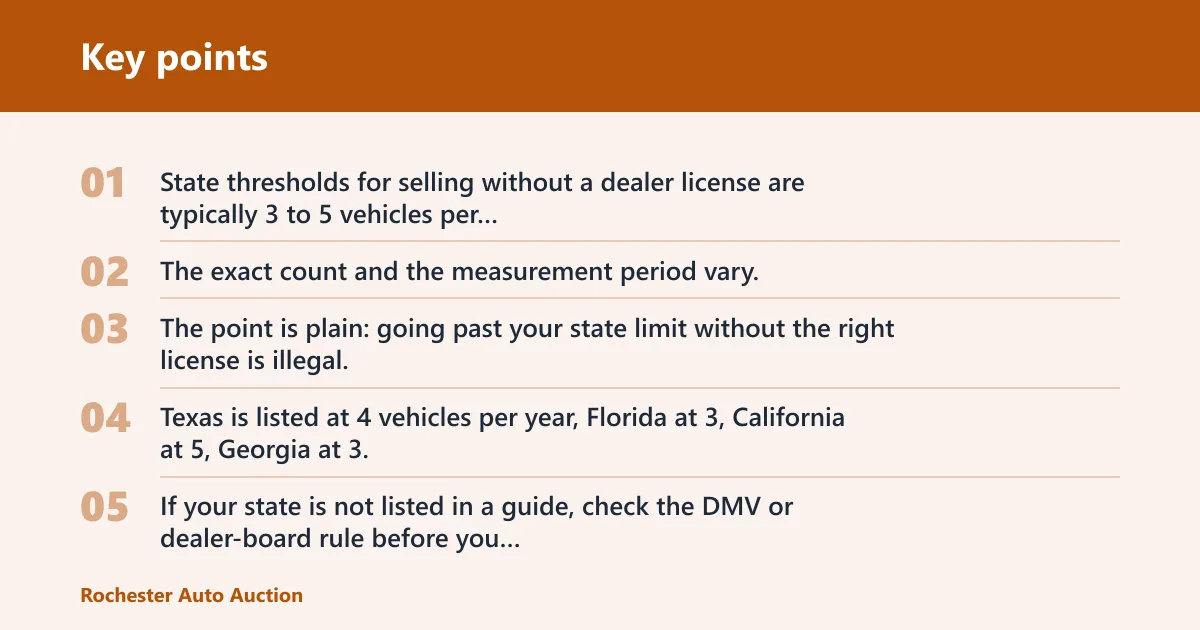
State thresholds for selling without a dealer license are typically 3 to 5 vehicles per year. The exact count and the measurement period vary, and many states look at a 12-month window rather than a calendar year. The point is plain: going past your state limit without the right license is illegal.
Examples show how much this varies. Texas is listed at 4 vehicles per year, Florida at 3, California at 5, Georgia at 3, Ohio at 5, Pennsylvania at 5, and Michigan at 5. If your state is not listed in a guide, check the DMV or dealer-board rule before you post the car.
How intent to resell changes the risk
State agencies and auction operators do not look only at the count. They also look for intent to resell. If you buy vehicles with the plan to flip them, or if your pattern of sales looks like dealer activity, you can get treated as an unlicensed dealer even before you hit a posted limit.
Say your name appears on four title transfers in ten months in a state with a 3-vehicle limit. Even if each car was sold separately, that pattern can draw scrutiny because it fits dealer-style activity, not ordinary personal use.
When one sale still needs a license
One sale can still need a license if the auction only accepts licensed dealers, if the vehicle is being sold through a dealer-only channel, or if the state’s paperwork rules place that transaction in a dealer category. A single sale does not override auction eligibility rules. It also does not fix a title problem or a lien that still sits on the vehicle.
Decision checklist for auction sales
Use this checklist to separate private sale, consignment, and dealer-only access. The goal is to match the sale path to the right paperwork before you transport the car or pay a fee.
| Sale path | Who can use it | License needed | Typical paperwork | Common blockers | Legal risk level |
|---|---|---|---|---|---|
| Private seller at a public auction that accepts individuals | Owners selling one vehicle or staying within state private-seller limits | No, if state limits and auction rules allow it | Title, ID, bill of sale, auction seller agreement | Missing title, lien still active, seller over state count limit | Low to moderate |
| Consignment through a licensed dealer or auction house | Private owners who want the dealer to handle the sale | No personal license needed | Consignment contract, title, payoff letter if financed, ID | Title mismatch, unpaid lien, auction eligibility rules | Low if paperwork is clean |
| Dealer-only auction access | Licensed dealers and approved brokers | Yes | Dealer license, tax ID, auction enrollment, title packet | Wrong license type, inactive license, seller not approved | Moderate if you try without access |
| Wholesale dealer license | Licensed businesses selling dealer-to-dealer | Yes | Wholesale dealer application, business records, title docs | No public retail rights, state setup rules, auction access limits | Moderate |
| Auction-only license | Businesses limited to authorized auction activity | Yes | Special license filing, auction registration, title documents | License-type restriction, state availability limits, nonauction sales barred | Moderate |
How consignment works at an auction house

Consignment means a licensed dealer or auction house sells the car for you while you remain the owner until sale. That makes it a legal path without your own dealer license. The dealer or auction usually handles listing, buyer screening, payment collection, and title transfer instructions, but you still need clean ownership documents.
What the licensed dealer or auction does
The licensed party controls the auction access and the sale process. That matters because a private seller cannot simply step into a dealer-only lane. The dealer may place the vehicle in a dealer channel, public sale lane, or online dealer-partner platform, depending on state rules and auction policy.
A common first-timer mistake is assuming “consignment” means the auction can ignore title problems. It does not. If the title name does not match the seller, or if a lender still holds the lien, the vehicle may not be listed until the paperwork is corrected.
Typical fee or split structures
Consignment is not free. The dealer or auction usually charges a fee or takes a split from the sale price, and the seller receives the net proceeds after deductions. The exact amount varies by house, state, and sale channel, so ask for the fee schedule before you sign.
What paperwork you still need
Even with consignment, you usually need the title, a valid ID, and a signed authorization or seller agreement. If the vehicle is financed, the payoff letter matters because the lien must be closed or accounted for before ownership changes. If the title is missing, the house may require a replacement title process first.
- Confirm whether the auction accepts private sellers or only licensed dealers.
- Check your state’s private-seller vehicle limit for the last 12 months.
- Gather the title, ID, and any lien payoff paperwork.
- Ask whether the auction needs a consignor agreement or dealer enrollment.
- Confirm how the title and payment will move after the sale.
What dealer-only, wholesale, and auction-only licenses allow
These licenses do not create public retail rights. They are channel-specific permissions. A wholesale dealer license is generally for dealer-to-dealer activity, while an auction-only license is limited to selling through authorized auction channels. If you want to sell directly to the public, those licenses may not solve the problem.
Dealer auction access and eligibility rules
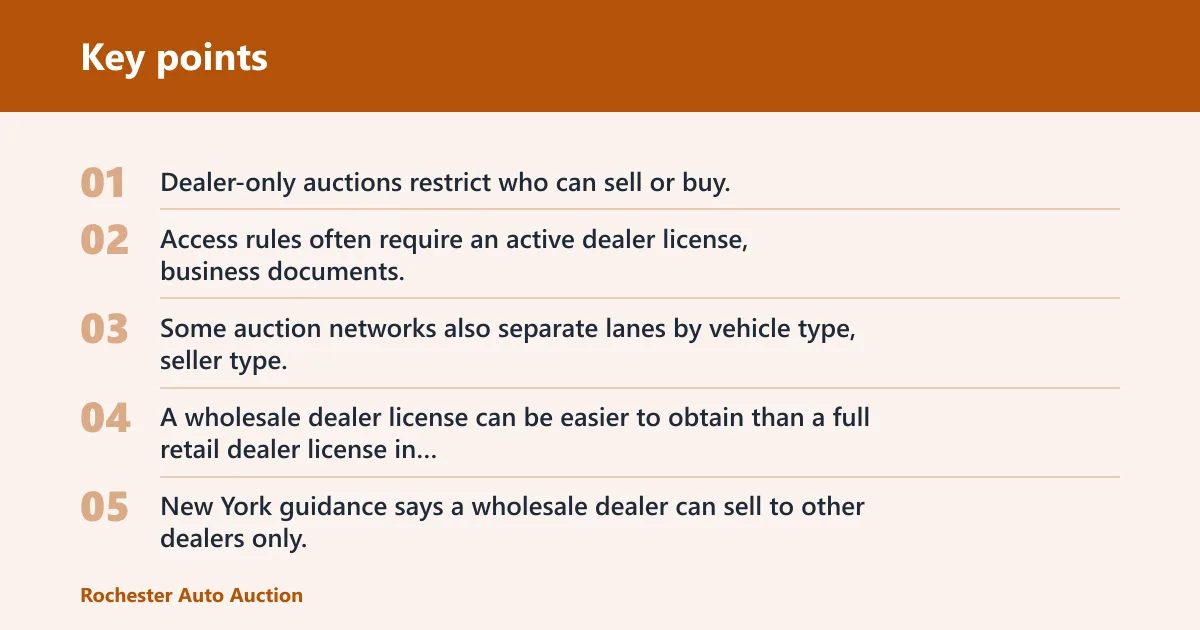
Dealer-only auctions restrict who can sell or buy. Access rules often require an active dealer license, business documents, and account approval. Some auction networks also separate lanes by vehicle type, seller type, or state compliance rules, so being a dealer in one state does not mean every auction accepts your vehicle or account.
Wholesale dealer license limits
A wholesale dealer license can be easier to obtain than a full retail dealer license in some states, but it is still a dealer license. New York guidance says a wholesale dealer can sell to other dealers only. That means no public retail sales, even if the license lets you move inventory through dealer channels.
Auction-only license restrictions
New York guidance also says an auction-only license is limited to selling via authorized auction. That kind of license can fit a business built around auction channels, but it does not open public retail selling. The same guide says the business address cannot be a home and permanent signage is required.
What can go wrong with title or lien issues?
Title problems can stop the sale before it starts. A missing title, a name mismatch, or an active lien can block listing, payment release, or ownership transfer. The auction may hold the vehicle, reject the consignment, or require extra documents before it accepts the car into sale.
Title transfer steps
At a basic level, the seller and buyer need a clean transfer record that the state DMV will accept. The auction may collect the title, fill in sale documents, and release the transfer packet after payment clears. If your state requires notarization, odometer disclosure, or a reassignment section, those forms must be correct before the sale closes.
Lien payoff timing
If the car is financed, the lender usually has to release its interest before the buyer gets clear title. That payoff timing matters because the auction may not release sale proceeds until the lien is satisfied. If the payoff amount is higher than the sale price, the sale can stall unless the difference is covered.
Picture a sedan with a $9,000 payoff and a bid that clears at $8,200. The sale can still be possible, but the gap has to be funded before title release. Without that, the buyer may be waiting on a title that cannot legally move yet.
What happens if you sell too often without a license?
Repeated selling without a dealer license can cross into curbstoning, which the guide describes as moving from private seller status into unlicensed dealer activity. That can lead to enforcement action, rejected titles, forced refunds, and state investigation. The risk is not limited to cars for sale on a lot; repeated auction use can also draw review.
Curbstoning enforcement
Curbstoning is the term for unlicensed dealer behavior. State enforcement can include fines, license denial if you later apply, and misdemeanor exposure in some jurisdictions. The exact penalty depends on the state, but the article warns fines can reach up to $25,000.
Fines and misdemeanor risk
That penalty range is why volume matters. If your sales pattern looks like a business, the state can treat it like one. The safest move is to stay within your private-seller threshold or move into a lawful licensed setup before the pattern becomes a problem.
State investigation triggers
Triggers often include repeated title transfers, multiple listings in a short period, or sales activity that looks like inventory turnover. Even a single complaint can start a review if the state sees a pattern. If you plan to sell more than a few vehicles in a year, dealer licensing is the scalable solution for growing beyond private-sale limits.
Frequently asked questions
Can I sell my car at auction without a dealer license?
Yes, if the auction accepts private sellers and your state’s private-seller limit allows the sale. You still need the right title and transfer documents. If the auction is dealer-only, or if your sales pattern looks like dealer activity, you will need a licensed path instead.
Do I need a dealer license to sell one car at auction?
Not always. One car may fit a private-seller exception, but the auction’s own rules control access. If the auction is restricted to dealers, your one-car status does not matter. Consignment through a licensed dealer can be the legal workaround when direct access is closed.
How many cars can I sell without a dealer license?
State thresholds for selling without a dealer license are typically 3 to 5 vehicles per year, and the measurement period can be 12 months. The exact limit changes by state, so check the rule before you list. Going past it without licensing is illegal.
What are the legal ways to sell a car at auction without a license?
The main legal paths are a private sale through an auction that accepts individuals, or consignment through a licensed dealer or auction house. Both depend on state limits, auction eligibility, and clean paperwork. If the vehicle is financed or the title is missing, those issues need to be fixed first.
Can a private seller use an auction or do I need a dealer to consignment it?
A private seller can sometimes use an auction directly, but only if that auction accepts private sellers and the state limit is not exceeded. If the auction is dealer-only, consignment through a licensed dealer is the usual legal route. The dealer then handles the auction access and sale processing.
What happens if I sell cars too often without a dealer license?
You can cross into curbstoning, which state agencies treat as unlicensed dealer activity. That can bring fines, misdemeanor risk, rejected transfers, and trouble if you later apply for a dealer license. The exact enforcement depends on the state, but the risk rises fast with repeated sales.
Can I sell my financed car at auction without a dealer license?
Sometimes, but the lien has to be handled correctly. The lender’s payoff amount, title release timing, and buyer transfer paperwork all matter. If the payoff cannot be completed, the auction may not release the title, which can stop the sale even when your seller status is otherwise legal.
Is consignment the same as selling at auction?
No. Consignment often means a licensed dealer or auction house sells the vehicle for you while you remain the owner until sale. The auction is the sales channel, but the licensed party manages access, paperwork, and the transaction. That is different from a private seller trying to enter a dealer-only sale lane directly.
What is the safest way to sell at auction legally?
The safest route is the one that matches your state limit, your title status, and the auction’s eligibility rules. For many owners, that means either a private sale through an auction that allows individuals, or consignment through a licensed dealer. If you plan to sell regularly, get the proper dealer license.
Do auction-only or wholesale licenses allow public sales?
No. Those licenses are channel-specific. A wholesale dealer license is for dealer-to-dealer activity, and an auction-only license is limited to authorized auction sales. Neither one automatically gives you public retail rights, so check the exact state license category before you assume you can sell to anyone.