Can Anyone Bid on Copart Without a Dealer License?
No. A non-dealer can bid on some Copart lots with a public member account, but many vehicles are dealer-only, and title or registration can still be limited by state rules. A bad bid can freeze fees, deposits, and time. This guide breaks down who can bid, who can buy, and when a broker or dealer license is required.
Copart access basics
Copart is an online auto auction marketplace with access rules that vary by account type, lot type, and title status. The key question is not only whether you can place a bid, but whether you can finish the purchase and later register the vehicle in your state.
A lot may accept public bids, dealer bids, or both. The title may also limit what happens after the sale. That is why a buyer should separate three checks before bidding: account eligibility, lot eligibility, and title eligibility.
Bid, buy, register
Placing a bid means your account or broker can enter an offer. Completing the purchase means you can pay, clear any required deposit, and take the vehicle under Copart’s sale terms. Registering the vehicle means your state DMV will accept the paperwork for road use, and that is often where title type matters most.
Those three actions do not always travel together. A buyer may be able to bid on an item that later cannot be registered in the home state because the title may be salvage, a certificate of destruction, or a bill of sale only.
Can anyone bid on Copart without a dealer license?
Yes, for some inventory. A non-dealer can bid on certain Copart vehicles through a public member account or through a broker, but dealer-only lots still exist, and some sales may be restricted by market, seller, or title type. The license question depends on the specific listing, not a single nationwide rule.
If you are not licensed, start by checking whether the lot is open to public buyers and whether your account tier allows bidding on that market. A public account can still face limits, and those limits may block a bid even when the vehicle looks visible online.
When a non-dealer can bid directly
Non-dealers can often bid on public-sale inventory that is open to public members. That usually requires an active Copart registration, identity verification, and an approved payment method. Some markets also ask for a deposit or higher verification before an account reaches full bidding access.
Live auction and pre-bid access can differ. Pre-bid may be open earlier, while live bidding can depend on account approval, location rules, and whether the lot is restricted to dealers or approved buyers only.
When a dealer license is still required
A dealer license is still required when the vehicle, seller, or local market marks the lot as dealer-only. That can happen with certain inventory types, export-controlled items, or listings that Copart or the seller limits to approved commercial accounts. The restriction is lot-specific, not universal.
Some buyers assume the site is open because the listing is online. That is not enough. Visibility on the site does not guarantee purchase eligibility, and it does not guarantee the right to register the vehicle afterward.
When broker-assisted bidding is the fallback
If you cannot bid directly, a broker or bidding service may place bids on your behalf. The broker’s account, not yours, is the one Copart recognizes for bidding, but you still carry the cost risk, the purchase obligation, and the paperwork burden unless the broker contract says otherwise.
Broker access can open more inventory, but it adds fees and can add time. It also does not change title limits or state registration rules.
Copart eligibility matrix
This matrix separates the most common buyer paths. It shows what usually comes from the account, what comes from the lot, and what comes from the title. Use it to screen a lot before you place any bid.
| Buyer type | License needed | Membership needed | Lot restrictions | Title limitations | Likely extra fees |
|---|---|---|---|---|---|
| Private buyer | Usually no dealer license for public lots; dealer-only lots still blocked | Yes, active Copart registration and approved identity/payment method | Public sale only on eligible lots; restricted, export-only, or dealer-only lots may be closed | Clean title may be registerable; salvage, certificate of destruction, or bill of sale may limit registration | Buyer fees, gate or storage charges, deposit hold, and possible payment processing fees |
| Dealer | Yes, when the lot or market requires dealer status | Yes, business account verification and credentials may be required | Usually broader access, but seller or title rules can still block specific vehicles | Title type still matters for export, rebuild, or registration | Buyer fees, tax handling based on state, transport, and storage if pickup is delayed |
| Broker-assisted buyer | No personal dealer license if the broker is bidding under its own eligible account | Yes, through the broker or service agreement | Broker must also be eligible for the lot and market | Title rules still apply to the end buyer; broker does not fix registration limits | Broker fee, Copart buyer fees, added admin charges, transport, and title handling costs |
| Out-of-state buyer | Maybe not, but state and market restrictions still apply | Yes, with verified account details | Some lots may be limited by location, export status, or regional rules | State DMV may reject certain documents even if the auction sale is valid | Transport, tax or paperwork fees, title transfer costs, and possible export documentation |
What Copart asks for before you bid

Before bidding, Copart commonly asks for a verified account, contact details, and a payment method. Some accounts also need business documents, a deposit, or additional approval before bidding limits rise. These are account rules, not vehicle rules, and they can stop a bid before a lot-specific restriction even appears.
That means the answer to “can I bid” can change because of the account itself. A fully verified buyer may still be blocked by a dealer-only lot, while an unverified buyer may be blocked even on a public lot.
Account verification and ID
Registration identity usually matters first. Expect to provide name, address, phone number, and some form of ID or business documentation if Copart requires it. The exact documents can vary by account type and market.
Membership and payment method
A Copart membership or registration is usually required before bidding. Guest viewing may let you search inventory, but it does not equal bidding access. Basic and Premier levels can differ in what they allow, and broker-assisted access depends on the broker’s account as well as the buyer agreement.
Payment method matters because purchase completion depends on more than the final bid. If the account cannot support payment terms, Copart may reject the sale or hold the vehicle until funds clear.
Deposits, approvals, and bid limits
Some accounts face a bid limit, which is the maximum amount the account is allowed to place. That ceiling can come from verification status, deposit level, or account approval. If a bid exceeds the limit, the system may reject it or return a limit error.
Suppose a public buyer is approved only for a $3,000 ceiling and enters a $4,200 bid on a sedan. The bid may fail even if the lot is open to the public. The problem is the account limit, not the car.
- Verify the account name and contact details.
- Confirm whether the lot is public, dealer-only, or restricted.
- Check the title type and whether your state can register it.
- Review deposits, payment methods, and bid limits before placing an offer.
- Use a broker only if direct access is not available or the lot requires it.
When do you need a broker?
You need a broker when your own account cannot legally or practically place the bid on the lot you want. That often happens with dealer-only inventory, approved-buyer inventory, or situations where the buyer wants an eligible intermediary to handle bidding and paperwork. A broker can open access, but not every restriction.
Proxy bidding works by having the broker submit bids under its own eligible account. The broker becomes the face of the auction transaction, while you remain the end buyer under the broker’s service terms. Responsibility does not disappear; it shifts into a contract.
Added fees and responsibility
Broker services add costs. Expect a broker fee on top of Copart buyer fees, and possibly extra charges for document handling, storage coordination, or transport. Those costs can erase any savings from a lower hammer price if you do not price the full purchase correctly.
Responsibility also matters. If the vehicle is a poor fit for your state’s title rules, the broker cannot fix that. If payment is late or paperwork is incomplete, the buyer usually bears the loss or delay under the broker agreement.
What a broker can and cannot change
A broker can change who is eligible to bid. A broker cannot change the title status of the vehicle, the seller’s restrictions, or your state’s registration rules. Those limits remain in place even if the broker wins the auction for you.
Which lots and titles can block you?
Lot rules and title rules are separate filters. A public lot can still be blocked by title status, and a title that seems usable can still be tied to a dealer-only or export-only lot. That is why you need to read both the sale type and the document type before bidding.
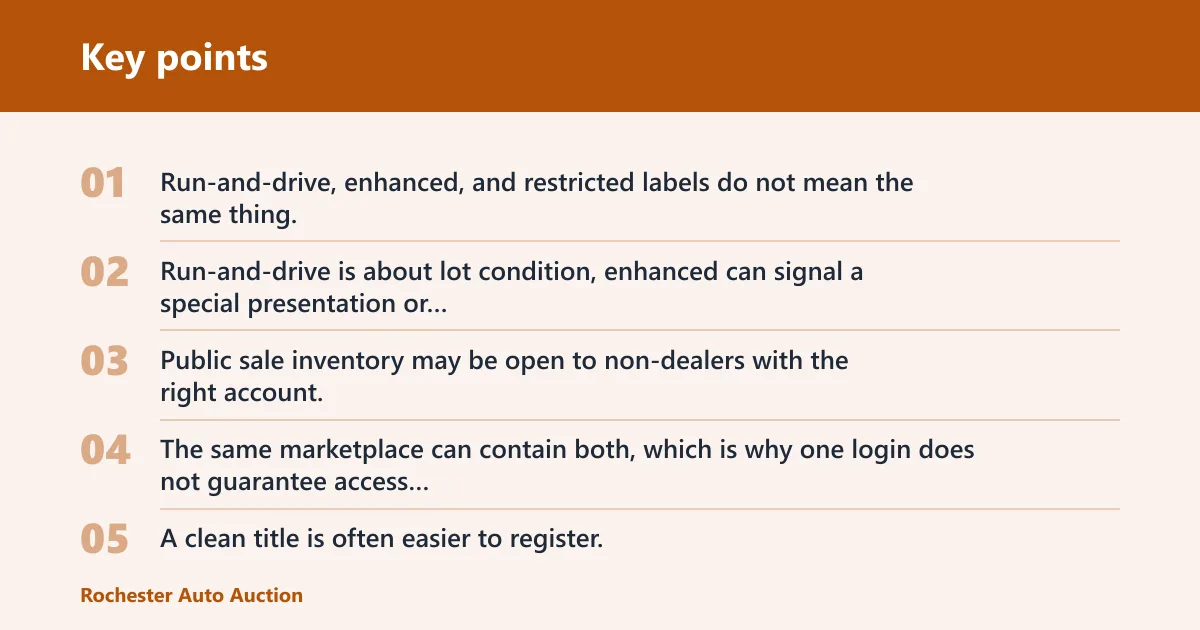
Run-and-drive, enhanced, and restricted labels do not mean the same thing. Run-and-drive is about lot condition, enhanced can signal a special presentation or inspection status, and restricted points to a bidding or purchase limit tied to the sale.
Public sale vs dealer-only sale
Public sale inventory may be open to non-dealers with the right account. Dealer-only sale inventory usually is not. The same marketplace can contain both, which is why one login does not guarantee access to every listing.
Clean title, salvage title, certificate of destruction, and bill of sale
A clean title is often easier to register, but it still depends on state rules and the specific vehicle record. Salvage titles may be accepted for purchase but require rebuild or inspection steps before registration. Certificates of destruction and bill of sale documents can block on-road registration in many states and are often better suited to export, parts use, or off-road applications.
Picture a buyer in one state winning a truck with a bill of sale only. The sale can close, but the DMV may refuse road registration. The auction win is real; the registration path is not.
Restricted, enhanced, and export-only inventory
Some lots are restricted because of seller instructions, export handling, or document limits. Others may be marked for enhanced review or special handling. Those flags can affect who may bid, how fast the sale closes, and whether the vehicle can leave the yard without extra paperwork.
Frequently asked questions
Do you need a dealer license for Copart?
Not for every vehicle. Some public inventory is open to non-dealers, while dealer-only or approved-buyer inventory requires commercial credentials or a broker. If your goal is to register the vehicle later, the dealer-license question is only one part of the decision.
Can you bid on Copart without a membership?
Usually no. A Copart membership or registration is generally required before bidding, even if the lot is open to the public. Guest browsing may let you view inventory, but it does not usually give bidding rights, payment approval, or access to every sale type.
What states can you bid on Copart without a license?
There is no single nationwide list that stays fixed. State rules, account type, and lot type all affect access, and Copart can change market rules. The safest approach is to check the current listing and your account approval before assuming your state allows direct bidding.
Do you need an auction license for Copart?
Not always. Some buyers can use a public account without a dealer or auction license, while restricted inventory may require one or a broker’s eligible account. The presence of the car online does not answer the license question by itself.
Do you need a bidding broker or bidding service for Copart?
Only if direct access is blocked or too limited for the lot you want. A broker can place bids for a non-licensed buyer, but that adds fees and does not remove title or registration limits. Use a broker when access is the problem, not as a shortcut around paperwork rules.