Do Auto Auctions Charge Sales Tax on the Buyer Fee?
Auto auction invoices often charge sales tax on the buyer fee, but the taxable base depends on the auction and state: it may be bid only, bid plus buyer fee, or bid plus fee plus local extras. Missing that line item can leave you short at payment time. The guide outlines the main invoice scenarios and how to verify the taxable base before bidding.
Buyer fee tax matrix
The buyer fee, often called a buyer’s premium, is a percentage of the winning bid paid to the auctioneer or platform. Some auctions add it to the taxable base, some do not, and some treat separate service charges differently from the premium itself. Check the sale terms and the invoice line by line before you assume the math.
| Fee type | When it is usually taxable | What to verify on the invoice |
|---|---|---|
| Buyer fee / buyer’s premium | Often taxable when state law treats it as part of the purchase price; some sales tax rules include it in the taxable base, while others tax only the hammer price. | Check whether the fee is shown as a percentage or flat charge, and whether tax is applied to the bid only or to the bid plus premium. |
| Internet fee | Often taxable when the auction treats it as part of the transaction total, especially for online bids. | Check whether the fee is separate from the buyer fee and whether tax is added on that line or only on the lot total. |
| Title fee | May be taxable or exempt depending on state title rules and whether the charge is a government pass-through or an auction admin charge. | Confirm whether it is labeled title processing, title transfer, or state filing, and whether the invoice applies tax to it. |
| Document fee | Often taxable if the state treats documentation or administrative charges as part of the taxable sale. | Check the wording: document fee, admin fee, or paperwork fee can be treated differently from the auction premium. |
| Gate fee | Often taxable when it is a service charge tied to the unit, but treatment varies by auction and jurisdiction. | Verify whether it is a flat per-unit charge and whether tax is listed on that same line. |
| Sales tax | Applied according to state and local rules; it may cover the winning bid alone or the bid plus buyer’s premium and other taxable charges. | Check the tax rate, the taxable subtotal, and whether local tax was added to the entire invoice or only part of it. |
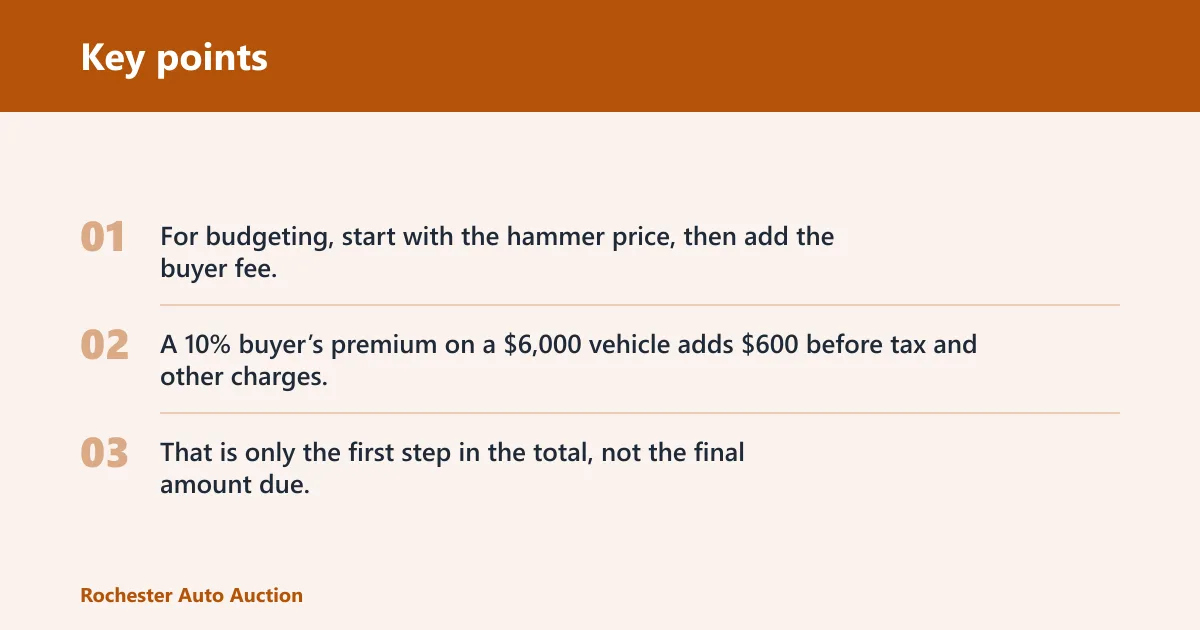
For budgeting, start with the hammer price, then add the buyer fee, then check which extra lines are taxed. A 10% buyer’s premium on a $6,000 vehicle adds $600 before tax and other charges. That is only the first step in the total, not the final amount due.
Do auto auctions charge sales tax on the buyer fee?
Yes, they often do, but not everywhere and not on every sale. Sales tax may apply to the buyer fee when state law treats the premium as part of the taxable purchase price, and some auction terms include the buyer’s premium in the total purchase price. The invoice must show the taxable base, not just the tax rate.
When the buyer fee is part of the taxable base
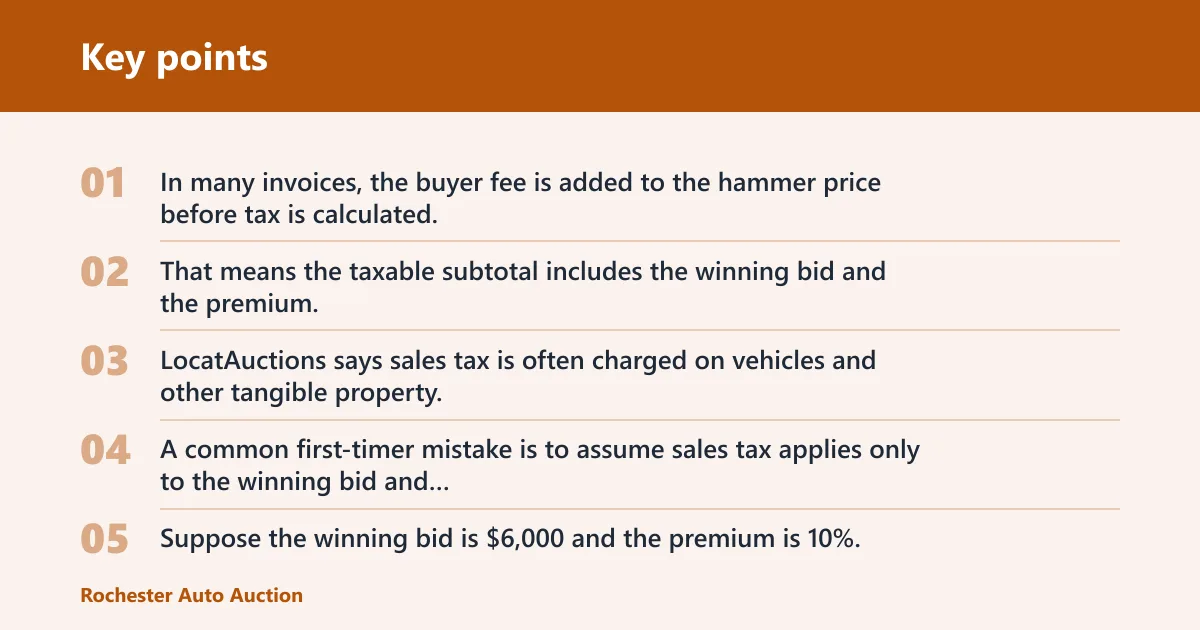
In many invoices, the buyer fee is added to the hammer price before tax is calculated. That means the taxable subtotal includes the winning bid and the premium, then tax is computed on that larger figure. LocatAuctions says sales tax is often charged on vehicles and other tangible property, and it also notes that auction terms control whether tax applies to the buyer’s premium.
A common first-timer mistake is to assume sales tax applies only to the winning bid and not the buyer fee. Suppose the winning bid is $6,000 and the premium is 10%. If the state taxes the combined subtotal, the tax base is about $6,600 before any other taxable fees are added.
When the buyer fee is separated from tax
Some auctions tax only the hammer price and list the buyer fee separately as a nontaxed charge. That split can happen only if the state rules and the auction terms allow it. The auction house cannot change state tax law by relabeling a line item, so the invoice wording must be checked against the sale terms and the local rule.
Motorious notes that the winning bid often does not match what leaves the buyer’s bank account. That gap is usually where the premium, tax, processing, and title lines show up. If the invoice does not say what is taxed, ask before paying.
Why state law controls the answer
State and local rules decide whether the buyer fee counts as taxable purchase price. The auction’s terms control how the auction house collects tax, but the tax authority controls what can be taxed. That is why the same fee can be taxed at one sale and exempt at another, even within the same auction company.
State tax treatment also changes with resale certificates, out-of-state purchases, and use tax. If you buy for resale and the auction accepts your resale certificate, the auction may not collect sales tax at checkout. That does not erase later use-tax or title-office obligations where they apply.
What is the hammer price tax base?
The hammer price is the winning bid before fees, and it is the starting point for tax math. In some sales, tax applies to that amount alone. In others, the taxable base becomes the hammer price plus the buyer fee, or the hammer price plus fee plus local extras such as document or internet charges.
Hammer price only
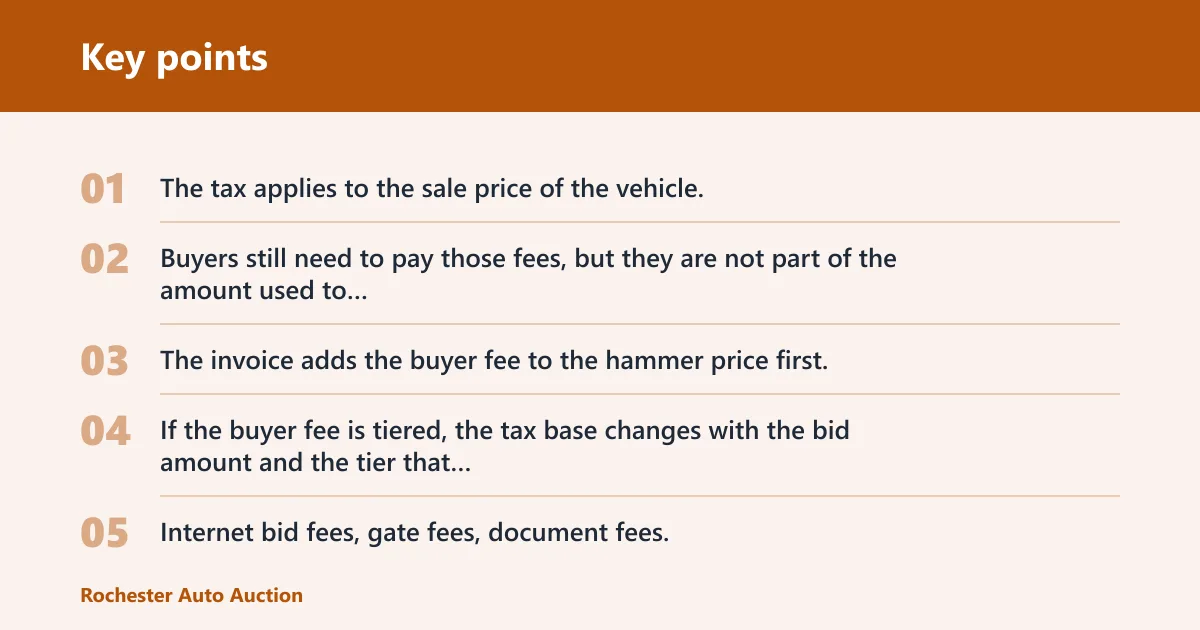
This is the narrowest base. The tax applies to the sale price of the vehicle, while the buyer fee and other charges remain outside the taxable subtotal. Buyers still need to pay those fees, but they are not part of the amount used to calculate sales tax in that scenario.
Hammer price plus buyer fee
This is the common middle case. The invoice adds the buyer fee to the hammer price first, then applies sales tax to that combined subtotal. If the buyer fee is tiered, the tax base changes with the bid amount and the tier that applies to that lot.
Hammer price plus fee plus local extras
Some invoices add more than the premium. Internet bid fees, gate fees, document fees, and similar charges can be folded into the taxable subtotal if state law and auction terms treat them as part of the transaction. That is why the same vehicle can carry different tax totals across different sales channels.
When are auction fees taxable?
Auction fees are taxable when the fee is part of the sale price under the applicable state rule, or when the terms say the charge is included in the taxable purchase price. Premiums and commissions are the most likely to be included. Service, processing, and document-type charges need a closer look because their treatment can differ by sale and location.
Premiums and commissions
Buyer’s premiums are percentage charges added on top of the hammer price, and they may be tiered or different by auction type. Sales tax may apply to the premium when the state treats it as part of the purchase price. Because the premium is commonly included in the total purchase price, many invoices tax it unless the local rule says otherwise.
Say your invoice shows a flat hammer price, a 10% buyer’s premium, and sales tax on the combined subtotal. The premium is not a separate afterthought; it is part of the taxed total in that scenario.
Service and processing fees
Service or gate fees are often flat per-unit charges, and they can apply regardless of lot price. Title-processing and document fees are separate from the auction fee and may be flat admin charges or state-specific processing costs. Credit card payments may carry a processing charge at some auctions, and that charge may or may not be taxed depending on the invoice and local rule.
Vehicle auctions may include title-processing, document, or administrative fees. Autowalk’s calculator includes buyer fee, internet bid fee, gate fee, environmental fee, title processing, transport, reconditioning, and documentation fee, which shows how many add-ons can sit beside the hammer price on one invoice.
Document and title-related charges
Title fees need extra care because they may be pass-through charges, state filing costs, or auction admin fees. A title fee may be excluded from tax in one state and included in another. The same is true for document fees, which can be taxable if the state treats them as part of the transaction rather than a separate government charge.
Sample invoice tax scenarios
The same vehicle can produce different tax totals depending on auction type and invoice structure. The table below shows three common scenarios. It is a budgeting tool, not a universal rule, because state law, sale terms, and fee wording still control the actual tax treatment.
| Scenario | Where tax is commonly applied | Where tax is commonly not applied |
|---|---|---|
| Public auction | Hammer price plus buyer fee when the auction terms say the premium is included in the taxable purchase price. | Separate shipping, tow, or storage charges that are billed after the sale may fall outside the invoice tax base, depending on local rules. |
| Dealer-only auction | Hammer price, buyer fee, and sometimes internet or processing fees when the auction collects tax on the full sale subtotal. | Government filing charges or non-taxable resale transactions when the buyer presents a valid resale certificate and the auction accepts it. |
| Salvage auction | Hammer price plus buyer fee, and sometimes title, document, or gate fees if the sale terms and state rules treat them as taxable charges. | Later DMV taxes, title-office taxes, or county fees paid outside the auction invoice are separate from auction-collected sales tax. |
CarFlip IQ says IAAI adds a tiered buyer fee, an internet bid fee, a service fee, an environmental fee, and a title fee. It also says a $5,000 IAAI bid costs about $5,729 before transport and sales tax. That kind of example is useful only when the invoice details and tax basis are clear.
How to verify tax before you bid
Read the sale terms first, then inspect the invoice model the auction uses, then confirm the state and local rule that applies to your purchase. The tax treatment of a buyer fee can change with auction type, location, and item classification. If anything is unclear, ask for the tax basis in writing before you bid.
- Read the terms and conditions for that exact sale.
- Check whether the buyer fee, internet fee, and document fee are listed as taxable.
- Confirm whether the auction tax basis is hammer price only or hammer price plus fees.
- Ask whether the sale is public, dealer-only, salvage, or government, because the fee structure can differ.
- Verify whether your resale certificate, out-of-state status, or use-tax position changes the collection rule.
- Get the tax treatment in writing if the invoice language is unclear.
Do not rely on the line item name alone. A fee called a service charge may still be taxable, while a fee labeled documentation may be treated differently under state law. The invoice wording matters, but it does not override the tax rule that controls the sale.
Extra costs that can change the total
Pickup deadlines, storage charges, and towing can change the final bill even after tax is settled. Many auctions set free pickup windows, then start daily storage if the vehicle sits past the deadline. Those charges can change the true total cost and, in some cases, the taxable base if they are billed on the same invoice.
Credit card payment can add a processing charge at some auctions. That fee is separate from the buyer fee and separate from sales tax, but it still affects the amount due. Review the payment rules before bidding so the checkout total does not surprise you.
Also confirm whether transport is part of the auction invoice or a separate bill from the carrier. Auction-collected tax and later DMV or title-office taxes are different obligations. Keep those lines apart when you budget.
Frequently asked questions
Is sales tax added to the buyer’s premium at auction?
It can be. The buyer’s premium is a percentage of the winning bid paid to the auctioneer or platform, and many auctions include it in the taxable subtotal. Whether that happens depends on the state rule and the sale terms. Check the invoice to see whether tax is applied to the premium line.
Do you pay tax on the hammer price plus buyer fee?
Sometimes. That is one of the three common invoice bases: hammer price only, hammer price plus buyer fee, or hammer price plus fee plus local extras. If the auction taxes the combined subtotal, the buyer fee is part of the amount used to calculate sales tax.
When do auctions charge tax on fees and commissions?
Auctions charge tax on fees and commissions when the local rule treats those charges as part of the sale price, or when the auction terms say the charge is taxable. Premiums, commissions, document fees, and some processing charges may be included. The sale terms and invoice wording should match the tax treatment.
Can sales tax be charged on the full auction invoice?
Yes, if the invoice contains only taxable items or if the state rule treats the listed charges as part of the taxable purchase price. That can include the hammer price, buyer fee, and certain service charges. It does not automatically include later DMV taxes or separate post-sale bills.
Does sales tax apply differently by state or auction type?
Yes. State and local rules control the answer, and auction type can change the fee structure that feeds the tax base. Public, dealer-only, salvage, and government auctions may label charges differently and collect tax differently. Always check the terms for the exact sale, not a generic rule.