What Does IF Bid Mean on IAAI Listings?
On IAAI, an “IF bid” is generally a seller-negotiation offer rather than a live win. Seller approval is generally required before the sale moves forward. Miss that status and you can misread the lot, waste bidding time, or think you own a vehicle you do not. This guide explains what IF bid means, how the outcome changes after seller review, and what to do next in each case.
IF bid means the listing is still in negotiation
An IF bid is a conditional offer on a vehicle listing. It shows that the bidder has made an offer, but the seller still has to approve it before the deal is final. It is not a confirmed sale, and it should never be treated as a guaranteed win.
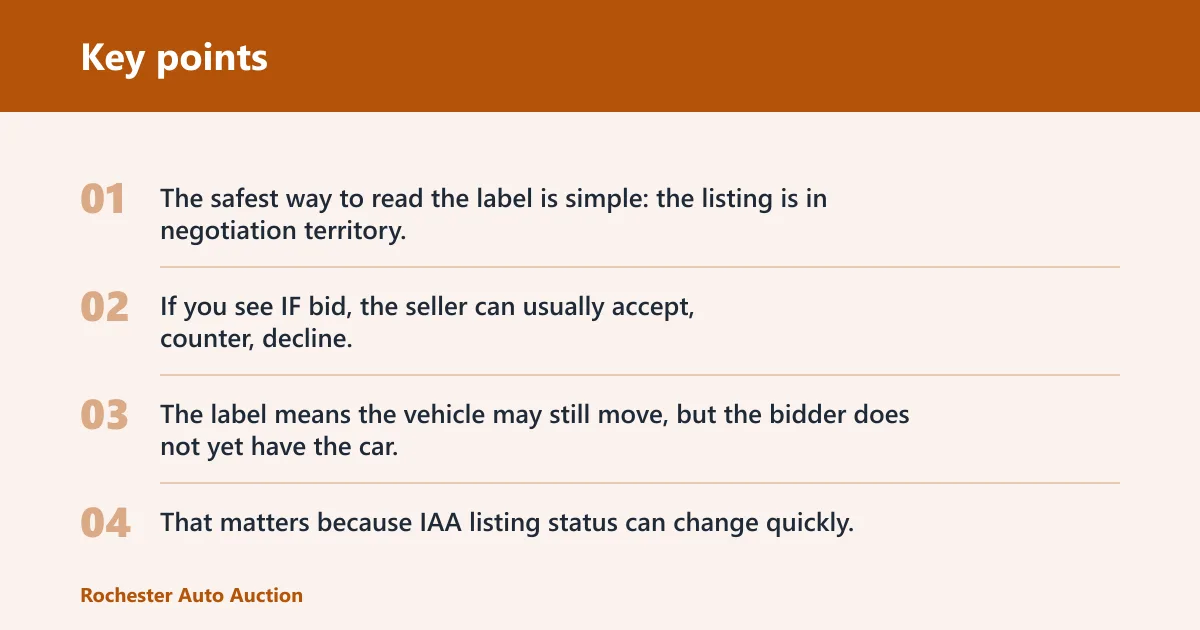
The safest way to read the label is simple: the listing is in negotiation territory, not finished territory. If you see IF bid, the seller can usually accept, counter, decline, or hold the offer while review is pending.
Why it is not a confirmed win
The label means the vehicle may still move, but the bidder does not yet have the car. That matters because IAA listing status can change quickly, and the lot can shift from auction activity into negotiation after the vehicle comes off the block. Check the status before you act.
How IF bid works on IAAI?
IF bid works as a handoff between auction flow and seller review. Before the vehicle comes off the block, the listing may still be in live auction or timed auction mode. After it comes off the block, IAA Manage Offers is an online negotiation tool that lets bidders and sellers exchange offers.
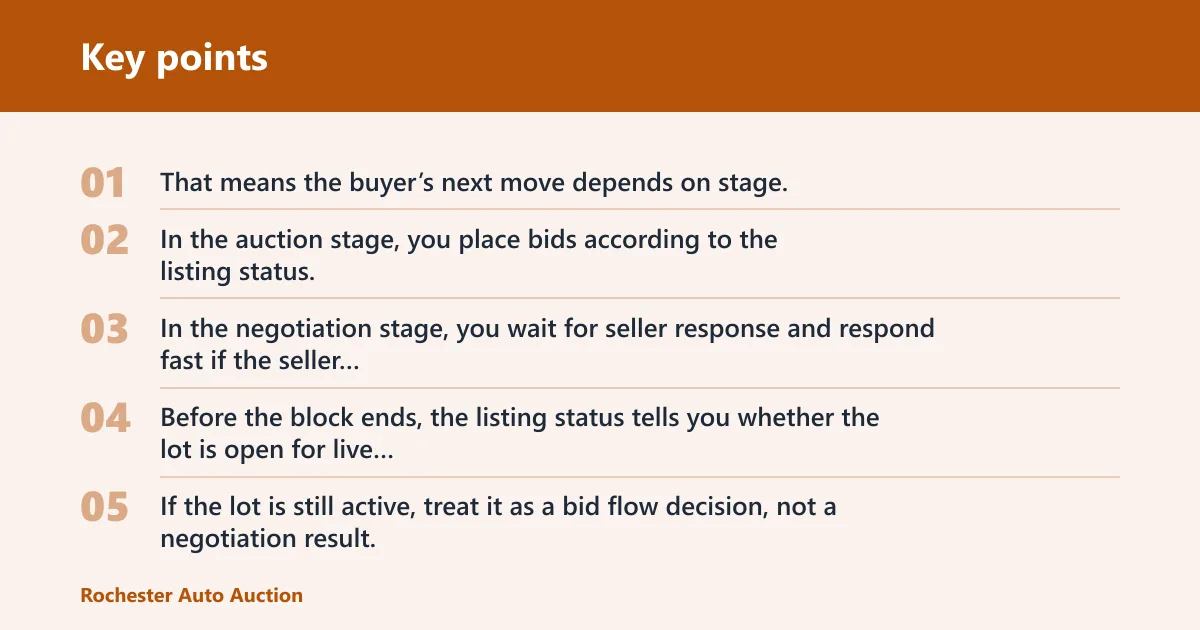
That means the buyer’s next move depends on stage. In the auction stage, you place bids according to the listing status. In the negotiation stage, you wait for seller response and respond fast if the seller counters.
Before the vehicle comes off the block
Before the block ends, the listing status tells you whether the lot is open for live bidding, timed auction activity, or another purchase path. If the lot is still active, treat it as a bid flow decision, not a negotiation result. Do not assume an IF label means the lot is already secured.
After the vehicle comes off the block
After the vehicle comes off the block, the process can move into Manage Offers. That is where the seller reviews the offer and decides whether to accept, counter, decline, or hold. The bidder may need to respond quickly if a counteroffer appears.
Picture a sedan that leaves the block with an IF bid status. The bidder should not walk away thinking the vehicle is won. The correct next step is to watch Manage Offers and be ready to answer a counter or revise the offer if the seller asks for more.
Where the seller responds
The seller controls the response path. A seller can accept the offer, send back a counter, decline it, or leave it pending for a period while reviewing terms. That makes IF bid a negotiation state, not a final purchase result.
IAA listing status and offer flow
IAA listing status tells you whether a vehicle is open for live bidding, timed auction activity, or post-block negotiation. Read the label first. Then choose the right tool, because the wrong move can send you to bidding when the lot is already in offer management.
IAA includes Live Auctions, Timed Auctions, Buy Now, and Public Auctions as buying paths. Those paths are not interchangeable. Buy Now is a separate purchase route, while IF bid points to a conditional offer that still needs seller approval.
Live auction status
Live auction status means the lot is in active bidding flow. If the vehicle is still on the block, a bidder should follow the live auction rules shown on the listing. Once the vehicle comes off the block, the status can shift.
Timed auction status
Timed Auctions are another buying path on IAA. They also depend on reading the listing carefully before you act. The important point is not the label alone, but whether the current stage allows bidding or sends the lot into negotiation.
Negotiation status
Negotiation status means the listing has moved into offer exchange. That is where IAA Manage Offers comes in. The seller can review incoming offers and respond, and the bidder may need to move fast if the seller counters.
IF bid decision table
This table translates the IF bid label into next steps. Read it from left to right. The safest move depends on the seller response and the current auction stage.
| Listed IF bid state | Likely seller response | What the buyer should do next | Common mistake to avoid |
|---|---|---|---|
| IF bid shown while the lot is still active | Seller review is still pending | Check the listing status and wait for the next update | Assuming the vehicle is already won |
| IF bid shown after the vehicle comes off the block | Accept or counter through Manage Offers | Watch for a counter and respond quickly if needed | Leaving the offer unattended |
| IF bid followed by a seller decline | Declined | Decide whether to place a new offer or move on | Keeping the original offer in mind as if it still stands |
| IF bid held without a final response yet | Held or still under review | Check Manage Offers and your bidder dashboard for changes | Assuming silence means approval |
A common first-timer mistake is to treat every IF bid as a closed deal. It is better to read it as a waiting state. If the seller has not accepted, the sale is still moving through review.
IF bid versus other paths
IF bid is not the same as Buy Now, live bid, or pre-bid. Each one puts you in a different part of the process. The label matters because the buyer’s next action changes with the path.
| Path | What it means | Buyer action |
|---|---|---|
| IF bid | Conditional offer waiting on seller approval | Watch for accept, counter, decline, or hold |
| Buy Now | Separate purchase path from bidding | Follow the buy-now process if the listing allows it |
| Live bid | Active bidding while the lot is on the block | Bid according to the live auction status |
| Pre-bid | Bid placed before the live auction stage | Track whether it wins or loses when the lot runs |
Lost Pre-Bids in My Auction Center help explain what did not win. If your pre-bid loses, that section gives you a place to review the result instead of guessing. It does not turn an IF bid into a win, but it does help you track what happened.
Suppose a pickup truck shows a pre-bid result in Lost Pre-Bids, then later appears with an IF bid after the block. Those are different events. One says the earlier pre-bid did not win; the other says a new offer still needs seller approval.
What to do next
Start with the current listing status. Then move into the correct IAA path. If the lot is still in live auction or timed auction status, bid according to that stage. If the vehicle has come off the block, use Manage Offers and watch the seller’s response.
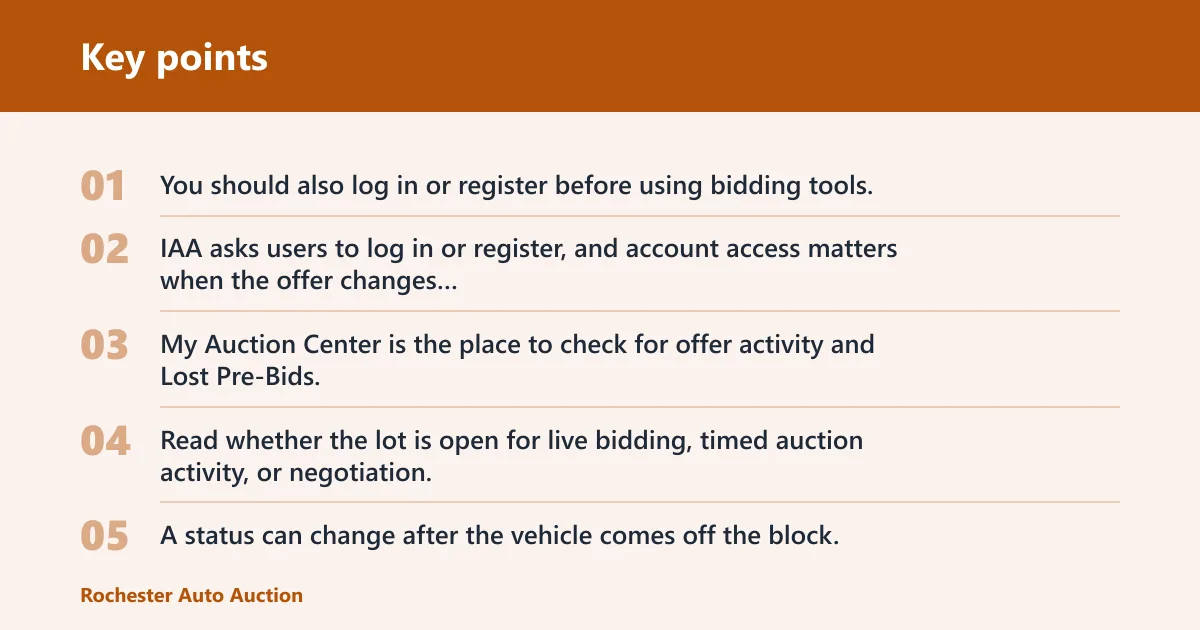
You should also log in or register before using bidding tools. IAA asks users to log in or register, and account access matters when the offer changes fast. My Auction Center is the place to check for offer activity and Lost Pre-Bids.
Check the listing status first
Read whether the lot is open for live bidding, timed auction activity, or negotiation. That one check prevents most errors. A status can change after the vehicle comes off the block, so do not rely on what you saw earlier in the day.
Use Manage Offers after the block
Once the vehicle leaves the block, IAA Manage Offers becomes the negotiation tool to watch. It lets bidders and sellers exchange offers after the auction stage ends. If a seller counters, the buyer may need to answer fast.
Watch for seller counters or declines
A counter means the seller wants a different number or term. A decline means the offer did not move forward. A hold means the offer may still be under review. Each outcome requires a different next move, so do not treat them the same.
Move quickly when the status changes
IF bid is a time-sensitive state. If the status changes, the buyer should act on the new label instead of the old one. That is the cleanest way to avoid missed offers, stale bids, and false assumptions about ownership.
Frequently asked questions
What does IF bid mean IAAI?
On IAAI, IF bid means a bidder has made a conditional offer, but seller approval is still required. It is not a final win. The listing is still in a response state, and the seller can accept, counter, decline, or hold the offer.
How does an IF bid work on IAAI listings?
An IF bid starts as an offer tied to a listing status, then moves into seller review. If the vehicle is still in auction flow, the bid sits alongside that status. If it comes off the block, the offer can move into IAA Manage Offers for response.
Is an IF bid the same as Buy Now on IAAI?
No. IF bid is a conditional offer that still needs seller approval. Buy Now is a separate purchase path listed with IAA’s other buying paths. One depends on negotiation, while the other follows the buy-now process if the listing allows it.
Can I still bid after an IF bid is shown?
Sometimes, but the answer depends on the listing status. If the lot is still active, bidding may continue under the auction rules shown. If the vehicle has come off the block, the process usually shifts to Manage Offers and seller response.
What happens when a seller rejects my offer on IAAI?
If the seller rejects the offer, the conditional path ends unless the seller later reopens terms or the bidder submits a new offer. The key mistake is to keep treating the rejected amount as live. Check My Auction Center and Manage Offers for the current result.
How long does IAA Manage Offers stay open?
Do not assume a fixed timing rule unless the listing or platform message gives one. The safer approach is to monitor the offer status closely after the vehicle comes off the block. If the seller has not responded, the offer may still be pending or held.