How to Bid at an Online Car Auction Without Overpaying
Set a hard ceiling bid by taking verified market value and subtracting repairs, buyer’s fee, taxes, title, transport, and a 5% buffer. Without that cap, auction pressure can push you past retail on a car that still needs work. This guide shows how to find market value, estimate costs, and stop bidding before you overpay.
What do you need before bidding on an online car auction?
Before you bid, confirm that the auction accepts your buyer type, that your account is approved, and that you understand the deposit and fee rules. A public buyer may be able to participate on some platforms, but access can still depend on membership tier, verification, or a refundable security deposit. Start with the platform’s registration page and fee schedule.
- An account with completed identity verification
- Proof of payment method for deposit or buying power
- A list of fees shown by the auction platform
- Transport quotes for pickup or delivery
- A way to compare retail and wholesale comps
- A notes sheet for condition, repairs, and ceiling bid
Some platforms are open to the public and still use tiers. For example, A Better Bid says its auctions are “100% online,” offers “Over 150 weekly live auctions open to the public,” and lets bidders choose a membership type: “Standard, Premium, or Pro.” HiBid lists a “Cars & Vehicles” category and shows an example auction entry titled “Topeka, KS Online Car Auction.”
How do you check whether the platform allows public buyers?
Public access is not automatic. Read the registration page for membership type, approval requirements, and any security deposit before you spend time on a lot. If the platform requires dealer status or a higher tier, that changes what you can bid and when you can bid.
What should you confirm about deposit, approval, and buying-power rules?
Look for the exact account steps: create profile, verify identity, submit deposit, and wait for approval. A Better Bid says registration includes a “fully refundable security deposit,” which means the deposit may be held to secure bidding rights. Treat that amount as tied-up cash until the auction releases it.
How do you review the listing before you bid?
Start with the condition report, not the photos. The report should tell you the damage type, whether the car is drivable or non-drivable, title status, odometer reading, and any repair estimate clues. Those details change the risk level and the most you should pay.
What should you look for in the vehicle condition report?
Focus on what is stated, not what the photos suggest. Damage type matters because a front-end hit, flood history, frame note, or airbag deployment can move repair cost far above surface damage. Odometer reading also matters because mileage affects resale value and can change whether the vehicle is a sensible buy.
How should you use photos, run number, title status, and odometer details?
Photos can hide panel gaps, tire wear, missing trim, and warning lights. Compare the run list entry against the lot photos and title notes. If the title is salvage, rebuilt, branded, or otherwise restricted, add the cost and time of title work before you decide on a bid.
When should you ask for inspection or preview access?
If the auction offers in-person preview, use it. If it does not, ask whether a third-party inspection is allowed. That matters most on repairable, salvage, or non-drivable vehicles, where hidden damage can turn a fair price into an expensive mistake.
Suppose a sedan is listed as drivable with moderate rear damage, 92,000 miles, and a clean title. The photos may look acceptable, but the condition report and title status still set the real risk. If the report also mentions suspension damage, your repair estimate should rise before you place a bid.
How do you calculate your ceiling bid?
Your ceiling bid is the highest all-in number you can defend after every expected cost is added and every likely risk is discounted. Use market value first, then subtract repairs, fees, transport, title work, and a contingency buffer. If the total exceeds your use-value or profit threshold, walk away.
How do you use market value, repair cost, and fee math?
Check retail comps and wholesale comps for similar year, trim, mileage, title status, and damage level. Retail comps show what a repaired vehicle might sell for. Wholesale comps show what dealers are paying in the current market. For a public buyer, the ceiling should usually sit below retail comp value unless the car has clear personal use value.
For market-value references, use a reputable pricing source such as Kelley Blue Book, J.D. Power, or Edmunds, and compare those figures with auction comps where possible. If the auction platform provides a comparable-sold or market estimate tool, cross-check it against those public valuation sources before you set your cap.
What auction fees, transport, taxes, and title costs should you add?
Auction fees change the true ceiling bid because the hammer price is only part of the total. Add the buyer premium, administrative charges, transport or delivery costs, and taxes and title/registration costs. Then reserve about 5% of the expected repair total for surprises. That buffer matters when hidden damage appears after pickup.
If the listing mentions a buyer premium, storage charge, gate fee, internet fee, or title-processing fee, include it in the worksheet before you bid. For public buyers, the exact fee stack can vary by platform, so the posted fee schedule—not a guess—should drive the ceiling.
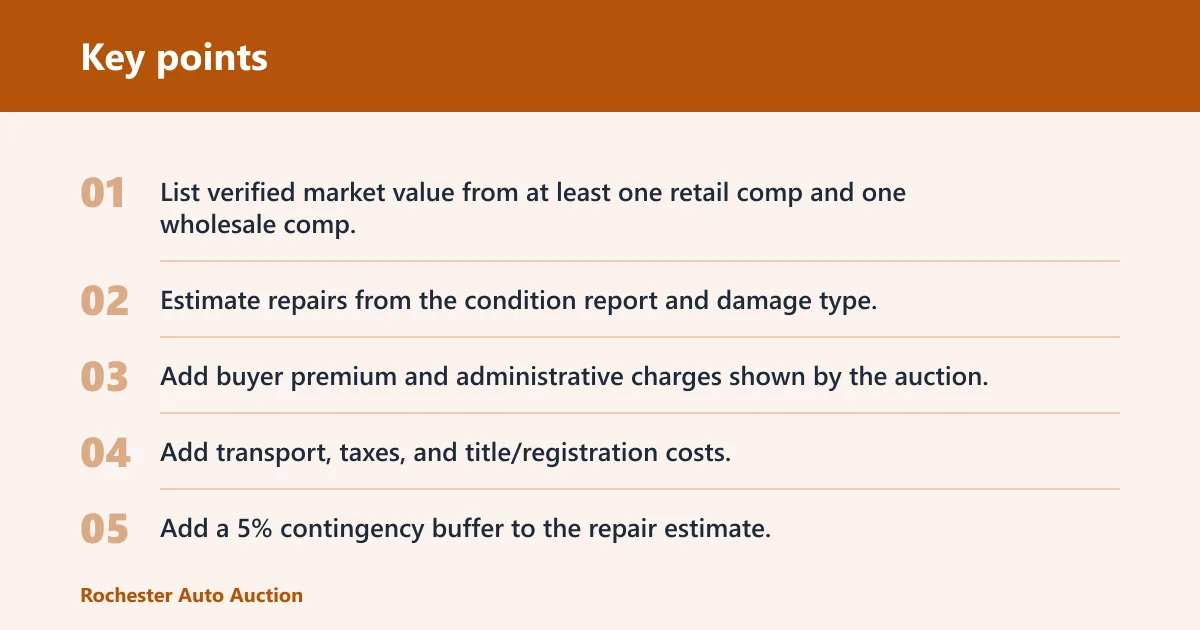
- List verified market value from at least one retail comp and one wholesale comp.
- Estimate repairs from the condition report and damage type.
- Add buyer premium and administrative charges shown by the auction.
- Add transport, taxes, and title/registration costs.
- Add a 5% contingency buffer to the repair estimate.
- Subtract every cost from market value to get the walk-away bid.
What does a maximum bid worksheet look like?
Use this worksheet before the auction starts. It turns separate costs into one all-in cap, which is easier to defend in a live auction or proxy bid setting. The final walk-away bid is the most you should enter, even if the lot feels cheap in the moment.
| Estimated market value | Expected repairs | Auction fees | Transport | Title/registration | Contingency buffer | Final walk-away bid |
|---|---|---|---|---|---|---|
| $12,000 | $3,200 | $1,050 | $650 | $275 | $160 | $6,665 |
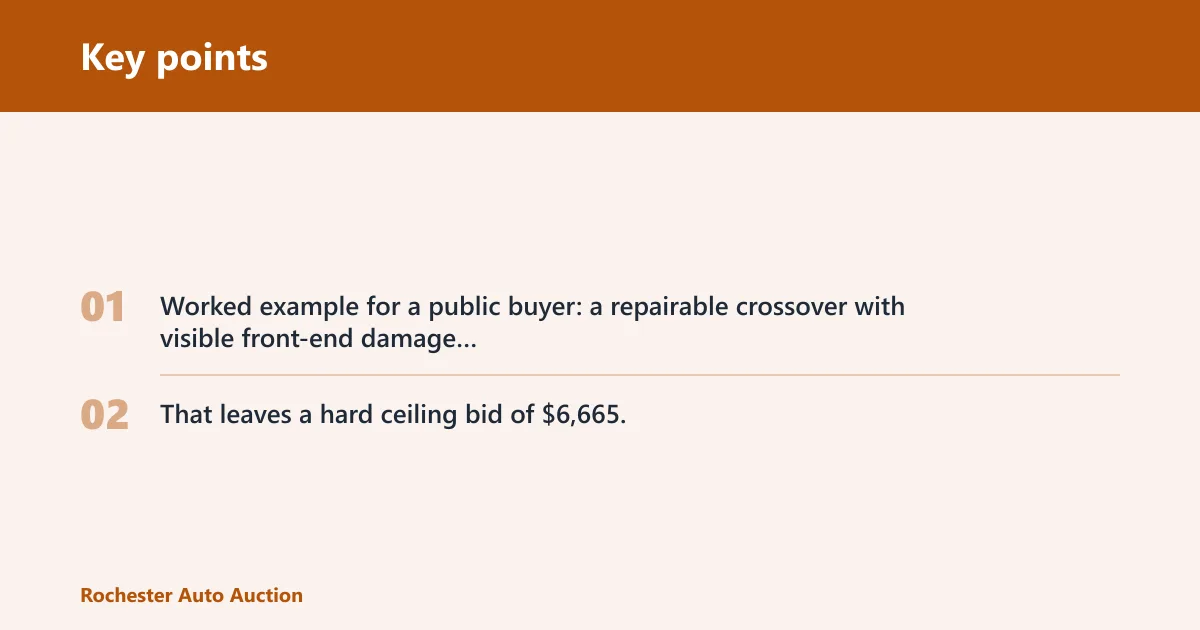
Worked example for a public buyer: a repairable crossover with visible front-end damage is valued at $12,000, expected repairs are $3,200, auction fees are $1,050, transport is $650, title work is $275, and the contingency buffer is 5% of repairs, or $160. That leaves a hard ceiling bid of $6,665.
How should you bid with the right format?
Choose the bidding format that matches the car and your risk tolerance. Live auction bidding can move fast. Pre-bid and proxy bidding reduce the chance of a late surprise, but they can also push you upward if you do not set your limit in advance. Buy It Now can be useful if the price already fits your worksheet.
When should you bid early and when should you wait?
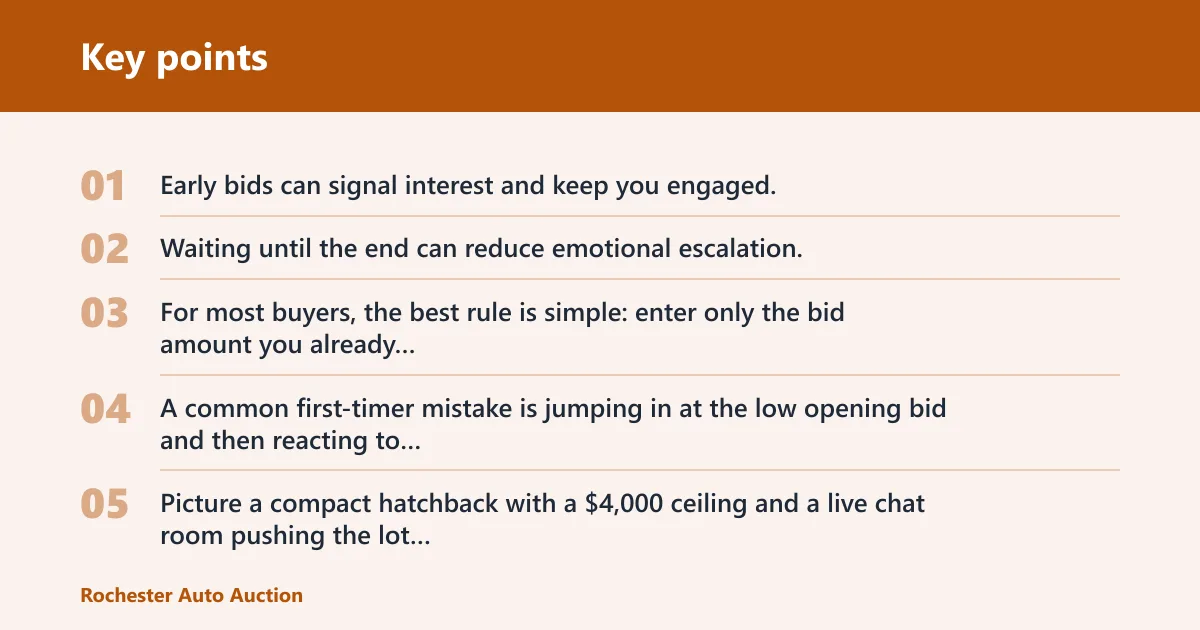
Early bids can signal interest and keep you engaged, but they also make it easier to chase the lot. Waiting until the end can reduce emotional escalation, especially in a live online auction. For most buyers, the best rule is simple: enter only the bid amount you already calculated.
A common first-timer mistake is jumping in at the low opening bid and then reacting to each new increment. Picture a compact hatchback with a $4,000 ceiling and a live chat room pushing the lot higher. If the next increment would put the car over your worksheet total, stop immediately.
How do you use your stop point before the auction starts?
Set the maximum all-in price in writing and do not revise it during bidding. If the platform has preliminary bids before the live auction, treat those bids as part of the same limit. A Better Bid says live auctions can include “preliminary bids before the live auction,” so the number you choose early should still be your final stop.
When does Buy It Now fit your plan?
Buy It Now can save time when the listed price is already below your ceiling. It can also remove the pressure of a live auction. If the total after fees and transport still fits your worksheet, Buy It Now may be the cleanest option. If not, skip it.
What should make you walk away from a vehicle?
Walk away when the listing creates uncertainty that your budget cannot absorb. A bad title note, incomplete odometer history, non-drivable status without a clear tow plan, or repair damage that exceeds your estimate are all reasons to stop. You need a profit or use-value threshold, not a hopeful guess.
What red flags should you spot in damage, title status, and odometer history?
Red flags include inconsistent photos, missing airbags, flood wording, frame or structural notes, title problems, and mileage that does not match the vehicle’s age or wear. If the report is unclear, assume the repair and resale risk is worse than stated. A vague listing is not a bargain signal.
What are the risks of shipping delays, storage charges, and hidden repair exposure?
Shipping can change the total after you win. Ask for the pickup window and a door-to-door shipping quote before you bid, because storage fees can start if the car sits too long after the sale. A Better Bid says it offers “door-to-door shipping,” which can help, but the quote still belongs in your ceiling calculation.
Which vehicles should you skip if they break your threshold?
If the total cost pushes past your use-value or profit threshold, stop. That is the point of the worksheet. The best auction win is the lot you can pass on without regret.
What are the most common auction mistakes?
Most overpayments come from missing one cost or ignoring one risk. Use this short list to avoid the most common failure points before the lot opens. A disciplined buyer protects the budget better than a fast bidder does.
- Bidding on hammer price alone and forgetting buyer premium, administrative charges, taxes, and title work.
- Trusting photos without reading the condition report for damage type, title status, and odometer reading.
- Skipping transport quotes and discovering the delivery cost after the win.
- Chasing a lot past your ceiling bid because the room feels competitive.
- Ignoring pickup timing and storage risk when the vehicle is not drivable.
- Using only retail comps and not checking wholesale comps for a realistic ceiling.
Write the all-in maximum bid on paper or in a notes app before the auction begins, then do not change it during bidding.
Do you need a dealer license to buy from online car auctions?
Sometimes. Many auctions accept public buyers, but others are dealer-only or offer mixed access based on tier, verification, or account type. If the registration page says dealer-only, you cannot bid as a retail customer. Always read the participation rules before you invest time in a listing.
How do dealer-license requirements differ by platform?
Dealer requirements are platform-specific. Some marketplaces are open to the public with a verified account, while others restrict bidding to licensed dealers, wholesalers, or approved business accounts. If the auction separates public bidders from dealer bidders, the title access, fees, and vehicle mix may differ too.
What should public buyers confirm before registering?
Public buyers should confirm whether the site offers public access, what identity checks are required, whether a deposit is refundable, whether bidding is live or proxy, and whether title transfer support is included. If the rules are unclear, treat that uncertainty as part of your cost.
What should you know about registration rules and platform examples?
Registration rules can control who may bid, when payment is due, and how much money must be tied up before the auction. A Better Bid says it offers auctions “open to the public,” while some other platforms use account tiers, security deposits, or approval steps. Read the posted rules before you register.
Where can public buyers register?
Some platforms explicitly allow public access and still set conditions on account approval or deposit. See the public-buyer pages here: public buyer and public buyers. Use the registration page to confirm the current entry rules, not a listing or a forum post.
Why do platform fee pages matter before you bid?
Fee pages define the real floor under your ceiling bid. If the auction charges a buyer premium, internet fee, gate fee, title fee, or storage fee, each item lowers the price you can safely pay for the vehicle itself. If the platform publishes a fee calculator, use it before entering a proxy bid.
Frequently asked questions
How do I bid on an online car auction without overpaying?
Calculate a hard ceiling from verified market value, then subtract repairs, buyer fees, transport, title costs, taxes, and a 5% contingency buffer. Enter that number before bidding starts and do not go higher, even if the lot looks cheap in the moment.
What should I check before placing a bid on a used car auction?
Review the condition report, photos, title status, odometer reading, and damage type first. Then check whether the car is drivable or non-drivable, whether inspection is available, and whether pickup or shipping fits your schedule and budget.
How do auction fees affect my maximum bid?
Fees reduce what you can safely pay for the vehicle itself. Buyer premium, admin charges, title work, taxes, and delivery costs all come off the same ceiling, so a higher-fee platform should produce a lower hammer-price limit.
What is a realistic budget for an online car auction car?
A realistic budget is the all-in number you can pay after repair, fees, and transport are included. For a public buyer, that should usually sit below verified retail value unless the vehicle has strong personal use value or unusually light repair needs.
Should I bid early or wait until the end of the auction?
Wait if early bidding tends to push you past your plan. Bidding near the end reduces the chance of emotional escalation, but only if your maximum is already set. Use proxy or auto-bid only when the cap is locked in.
Can I buy from online car auctions as a public buyer?
Yes, on platforms that accept public buyers, but access is not universal. Some sites require approval, a membership tier, identity verification, or a refundable security deposit before you can bid. Read the registration rules before you start.
Sources
- Kelley Blue Book
- J.D. Power Cars
- Edmunds Car Appraisal
- Manheim
- IAAI
- Copart