How Much Does a Dealer License for Auto Auctions Cost?
A dealer license for auto auctions usually involves filing fees of roughly a few hundred to a few thousand dollars, but the first-year budget is often higher once lot, bond, insurance, business registration, and state-specific requirements are included. Miss one item and you can pay for a license you still cannot use at dealer-only auctions. This guide breaks down license fees, hidden startup costs, and the state factors that change auction access.
Dealer license auction access worksheet
Use this worksheet as a first-pass budget before you file anywhere. The application fee is usually the smallest line item; the bond, insurance, lot, and setup costs usually decide whether you can actually qualify for dealer-only auction access.
| Cost bucket | Low estimate | Mid estimate | High estimate | Required for auction access in many states? |
|---|---|---|---|---|
| State fee | $75 | $300 | $1,500 | Yes |
| Bond premium | 1% of bond amount | 2% of bond amount | 3% of bond amount | Yes, in many states |
| Insurance | $2,400 per year | $4,200 per year | $6,000 per year | Often |
| Facility and lot | $6,000 per year | $21,000 per year | $36,000 per year | Yes, in many states |
| Compliance and setup | $500 | $1,500 | $5,000+ | Yes |
That table is not a quote. It is a planning frame. The state fee can be tiny next to zoning changes, lease deposits, signage, office furniture, local registration, and the time lost when an application gets sent back for corrections.
What does the application fee cover?
The application fee pays for the state or local filing process, not for the full right to buy at dealer-only auctions. It is usually set by a DMV, motor vehicle department, or, in some places, a city business-licensing portal. Many guides place application fees at $100 to $1,500, though some state lists fall outside that band.
State or local filing authority
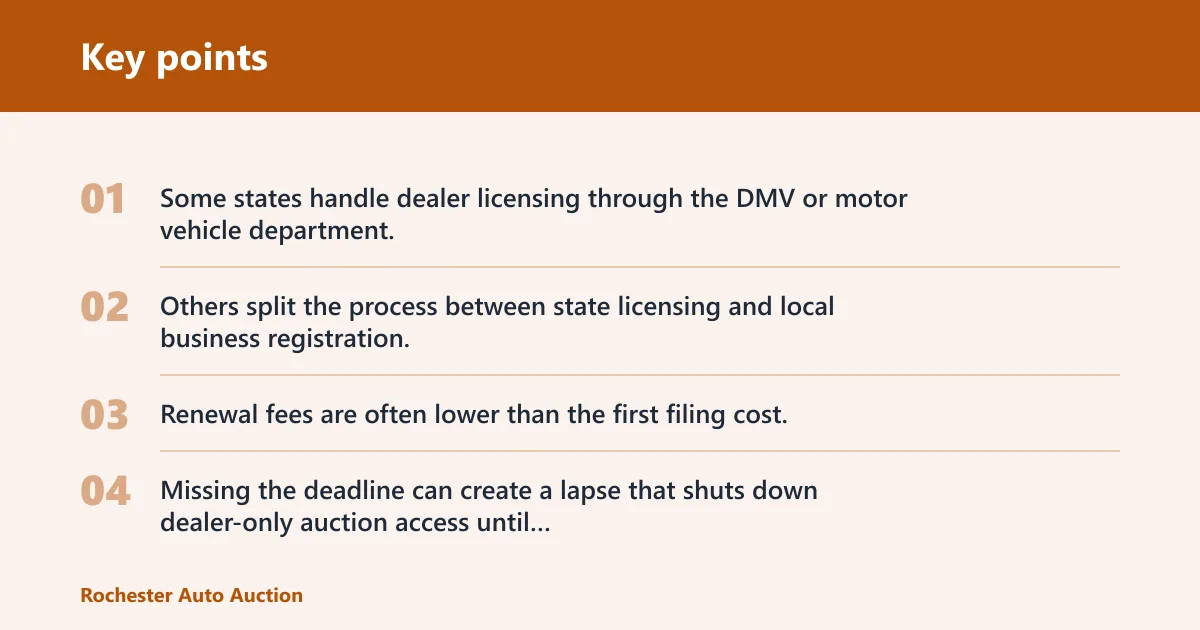
The filing office depends on jurisdiction. Some states handle dealer licensing through the DMV or motor vehicle department. Others split the process between state licensing and local business registration, which can add separate filings, local fees, and extra review steps before auction access is approved.
Initial filing versus later renewals
The initial fee is only the first gate. Renewal fees are often lower than the first filing cost, but the renewal cycle and deadline are state-specific. Missing the deadline can create a lapse that shuts down dealer-only auction access until the license is restored.
How much does the bond and insurance add?
The bond and insurance can cost far more than the application itself. Surety bonds can range from $5,000 to $100,000 in bond amount, and the annual premium is often 1% to 3% for strong credit. Garage liability insurance is another recurring cost and is commonly required for dealer licensing.
Bond amount and premium basics
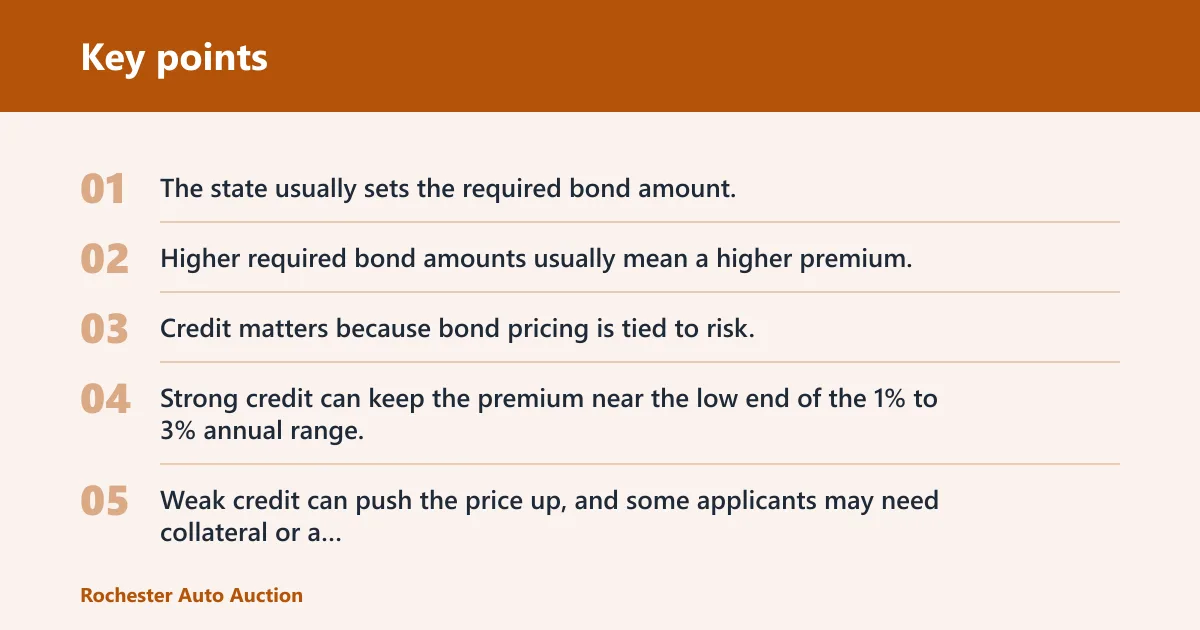
A bond is not the same thing as a fee. The state usually sets the required bond amount, and the dealer pays only the premium to the surety company. Higher required bond amounts usually mean a higher premium, even when the percentage stays modest.
Credit effects on bond pricing
Credit matters because bond pricing is tied to risk. Strong credit can keep the premium near the low end of the 1% to 3% annual range. Weak credit can push the price up, and some applicants may need collateral or a co-signer before the bond is issued.
Garage liability insurance and state differences
Insurance is a recurring expense that often surprises first-time applicants. A common planning range is $2,400 to $6,000 per year, but the real price depends on the dealer class, the vehicles handled, location, and state rules. High-litigation states and broader coverage requirements usually push premiums higher.
Say your state wants a $25,000 bond and the surety quotes a 2% premium. The bond cost alone is $500 per year before insurance, lot costs, office setup, or filing fees. That is why a “cheap” license can still feel expensive in the first year.
Do you need a lot to get auction access?
In many states, yes. A commercial lot, leased site, or owned property may be required before the license is issued. The lot is often one of the biggest startup costs because it can bring zoning, signage, office, parking, and inspection rules that must be met before dealer-only auction access is granted.
Commercial lot, lease, or owned property
Some jurisdictions want proof of a real business location, not a home address or mailbox. That means a lease, ownership documents, or other site control paperwork. If the property does not meet the dealer rules, the application may stall even after the fee and bond are paid.
Zoning, signage, and office requirements
Zoning approval can multiply costs quickly. A location that seems affordable can fail dealer rules because of use restrictions, setback rules, signage visibility, or office layout. Those fixes can mean a larger lease payment, building changes, or a longer approval timeline.
How facility rules can delay approval
Facility problems delay more than opening day. They can force a second inspection, a new lease, revised signage, or a fresh application packet. Every correction adds cost, and every delay can push auction access back by weeks.
Picture a small operator renting a 900-square-foot office suite with no display lot. The fee is easy to pay, but the application can still fail if the state requires outdoor space, dealer signage, and a designated office area. The cheapest filing route is not always the cheapest way to qualify.
What does the first year usually cost?
The first-year total can run from $5,000 to $50,000+ once you include filing, bond premium, insurance, lot costs, signage, office setup, and compliance items. That total excludes inventory. For many applicants, the lot and insurance matter more than the dealer license fee itself.
Build a first-year budget without inventory
- Start with the state fee.
- Add the bond premium for the required bond amount.
- Include garage liability insurance for the year.
- Estimate lease, lot, zoning, signage, and office costs.
- Add local registration, entity setup, and inspection-related expenses.
That budget is the real auction-access number. A low state fee can still lead to a high first-year bill if the location needs work or the local market has expensive commercial space. Direct dealer licensing may still be the right path, but only if the full setup cost fits your plan.
Direct dealer licensing versus other access paths
Dealer-only auctions usually require proof of dealer status, but not every buyer needs a full dealership model. In some markets, broker access, public auctions, or auction-specific accounts can be a lower-cost path when the goal is wholesale buying rather than operating a retail lot. The right route depends on your state rules and the auction’s own eligibility policy.
How much does it cost to renew a dealer license?
Renewal costs are usually lower than the first filing cost, but the exact amount depends on state rules, the license class, and any local business requirements. The renewal cycle is not universal. Timing matters because a missed deadline can interrupt auction access even if the business is otherwise active.
What renewal usually includes
Renewal often means another state filing fee, updated insurance proof, an active bond, and current business records. Some states also require updated inspections, tax records, or local permits. The fee may be modest, but the compliance work can still cost time and money.
Why deadline compliance matters
A license that lapses can block auction access immediately, especially at dealer-only sales that verify credentials before entry. A late renewal may also trigger extra paperwork or penalties. The safest plan is to track the renewal date as a hard deadline, not a loose reminder.
Which states have the lowest dealer license costs?
The lowest-cost states are not fixed in a way that stays true everywhere, because fees, bonds, and facility rules change by state and sometimes by city. Mississippi is listed with a $75 application fee, while Texas is listed with a $700 application fee and a $25,000 bond, California with a $225 application fee and a $50,000 bond, Florida with a $300 application fee and a $25,000 bond, and Washington with a $750 application fee.
Why a low fee does not always mean a low start
A small application fee can hide expensive approval rules. A state with a modest filing fee may still require a large bond, a commercial lot, signage, and insurance before auction access is allowed. That is why the cheapest filing fee is not the same thing as the cheapest licensing path.
How long does it take to get an auto dealer license?
Processing typically takes 4 to 10 weeks, but that range assumes a complete application and no major corrections. Missing documents, zoning issues, inspection failures, or bond delays can stretch the timeline. If you need auction access by a specific date, build in extra time.
Common delay points
Most delays come from incomplete paperwork, facility problems, and insurance or bond documents that do not match the application. Business formation, tax registration, and local approval can also slow things down. A clean file moves faster than a file that needs revisions.
What to prepare before filing
Before you file, confirm the license class you need, the state or local authority, the bond amount, the lot requirement, and the insurance standard. That prep work reduces the odds of a returned application and keeps the auction timeline closer to the original plan.
Can I buy from dealer-only auctions without a dealer license?
Usually not at dealer-only sales. Those auctions check dealer credentials and often require proof of the right license class, tax status, or membership rules before bidding.
Wholesale versus retail eligibility
Dealer-only auctions are built for licensed buyers, not general consumers. Some auctions allow wholesale access through dealers, brokers, or registered business accounts, while others keep public buyers out entirely. The license fee alone does not grant access if the auction’s own rules are stricter.
When a broker may make more sense
If you only want occasional wholesale purchases, a broker can cost less than setting up a full dealership. That can be the smarter path when lot costs, insurance, and zoning rules would make a dealer license too expensive for the volume you plan to buy.
Frequently asked questions
How much does a dealer license for auto auctions cost?
The first-year total cost of an auto dealer license in 2026 ranges from $5,000 to $50,000+ when you include filing, bond, insurance, lot, and setup costs. The state fee alone is usually much smaller. The true answer depends on the state, the license class, and the facility rules tied to auction access.
What fees are included in a dealer license besides the application fee?
Besides the filing fee, many applicants need a surety bond, garage liability insurance, a commercial lot, zoning or signage compliance, office setup, and local registration costs. Those items are often what make the first year expensive. The license fee is only the entry point.
How much is a surety bond for a dealer license?
The required bond amount can range from $5,000 to $100,000, depending on the state. The dealer usually pays a premium rather than the full amount, and the annual premium is often 1% to 3% for strong credit. Poor credit can push the price higher.
Do I need a lot to get a dealer license for auctions?
Many states require a commercial lot, lease, or owned property before issuing the license. That site often has to meet zoning, signage, and office standards, which can raise startup cost and slow approval. Without the required facility, auction access may not be granted even if the fee is paid.