Can You Start or Test Drive a Car During Auction Inspection?
At many auction sites, a car may be started during inspection if staff allows it and the keys are available, but a test drive should not be assumed. That distinction matters because a brief start can reveal a no-start issue, a brake problem, or a transmission fault that changes your bid. This guide explains what inspection usually allows, how test drives differ, and what to do when a car starts, moves, or will not start.
What auction inspection usually allows
An auction inspection is a pre-bid window, not a blank check. The rules depend on the facility, the event, the lane policy, and the staff instructions posted that day. Some sites allow limited starting or light function checks. Others allow no key access at all.
The safest assumption is simple: if the policy does not say you can do it, do not do it. A car may be open to visual inspection, but that does not mean you may open it, start it, shift it, or move it under its own power. Site rules override general advice every time.
Why rules differ by location
Auctions manage traffic, liability, insurance, theft risk, and damage risk. A vehicle moving through a lane is under staff control in one setting and under buyer control in another. That is why one house may allow a brief start check while another allows only a walk-around with no key use.
Posted policies, lane signage, and staff directions are the final rule. If any of those conflict with a general expectation, the local rule wins.
What to record before you touch the car
Before you check anything, note the posted policy, whether keys are present, and whether staff has allowed only a visual look or a limited operational check. That record matters if a seller description, lane note, or condition report later conflicts with what you were permitted to verify.
Can you start a car during inspection?
You can sometimes start a car during auction inspection if the auction house allows it and the keys, battery, and access conditions make it possible. Starting the engine is separate from driving the car. A successful start only confirms that the engine ran at that moment; it does not prove roadworthiness or road-test permission.
A permitted start can help you check whether the battery cranks the engine, whether the idle is steady, whether warning lights stay on, and whether the transmission engages when staff allows a short move. If the car will not start, record that as a no-start and stop before you keep trying.
What a permitted start lets you confirm
Use the allowed start to verify the basics: key access, starter function, battery condition, idle quality, accessory power, and visible warning lights. If the car starts but runs roughly, stalls, or shows serious warning lights, that matters before bidding. A car that starts may still have engine, electrical, or transmission faults.
Say your auction lane allows one ignition cycle and a brief idle check. If the engine starts, then shakes at idle and the battery light stays on, that is useful evidence. It is not a reason to keep revving the engine or to assume the problem is minor.
When a no-start means you stop
If the engine will not start, stop once the permitted checks are done. Repeated cranking can drain the battery, overheat the starter, or blur the line between a battery issue, a key issue, and a starting-system fault. Document the failure and ask staff what, if anything, you may check next.
Do not treat a no-start as a small issue. It can point to a dead battery, missing key access, a starter fault, fuel delivery trouble, or a deeper mechanical problem that affects your bid.
What to record if it starts, stalls, or fails
Write down whether the car started immediately, started only after a delay, idled unevenly, stalled, or did not start. If the dash lights stayed on after the allowed check, include that too. Keep the note factual and short so the inspection sheet shows what happened, not what you hoped happened.
Can you test drive a car at auction?
Usually, not by default. A test drive requires permission, and auction houses often restrict it because moving a car off-lane raises theft, loss, insurance, and liability concerns. In many settings, the limit is staff-only movement or no-road-use at all. Never assume a casual drive is allowed because the car starts and rolls.
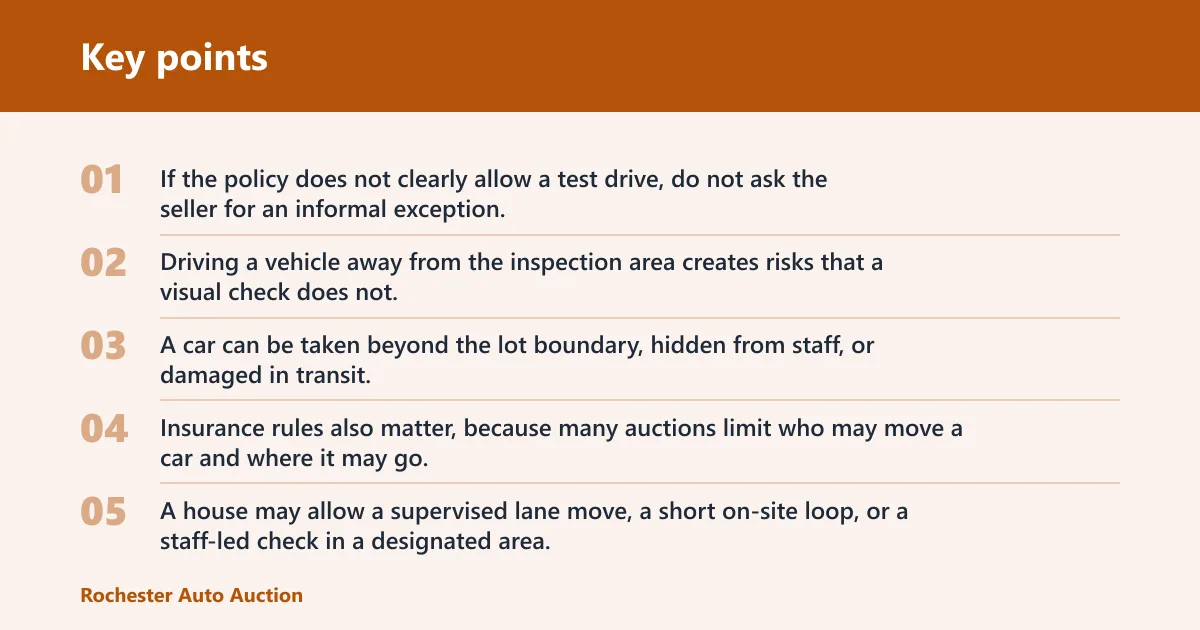
Some houses allow only controlled movement within the inspection lane, with staff supervising the car and the buyer staying within the site rules. That is not the same as a road test. If the policy does not clearly allow a test drive, do not ask the seller for an informal exception.
Why test drives are often restricted
Driving a vehicle away from the inspection area creates risks that a visual check does not. A car can be taken beyond the lot boundary, hidden from staff, or damaged in transit. Insurance rules also matter, because many auctions limit who may move a car and where it may go.
Those limits protect the facility, the seller, and the buyer. They also explain why a quick spin around the lot is still not a full road test.
Are auction test drives ever allowed by the auction house?
Yes, sometimes. A house may allow a supervised lane move, a short on-site loop, or a staff-led check in a designated area. The permission is narrow, and the details matter: where you can drive, who must be present, whether the route is paved, and whether the vehicle must return immediately.
If the policy says staff-only, that means staff-only. If it says no road use, that means no road use.
What to record if movement is allowed
If staff allows movement, record whether the car engaged reverse and drive, whether it moved cleanly, whether the brakes felt normal, and whether any warning lights changed during the check. The goal is to document the limited movement the auction permitted, not to treat that movement as a full road test.
Run and drive vs road-test permission
Run and drive status means the engine starts and the vehicle moves under its own power. That status does not guarantee roadworthiness, and it does not grant permission for a test drive. A car can run and drive while still having bad brakes, poor alignment, warning lights, or shifting problems.
This is the distinction many buyers miss. “Run and drive” describes movement. It does not describe legal permission, staff supervision, or the quality of the vehicle’s mechanical condition.
What run and drive actually means
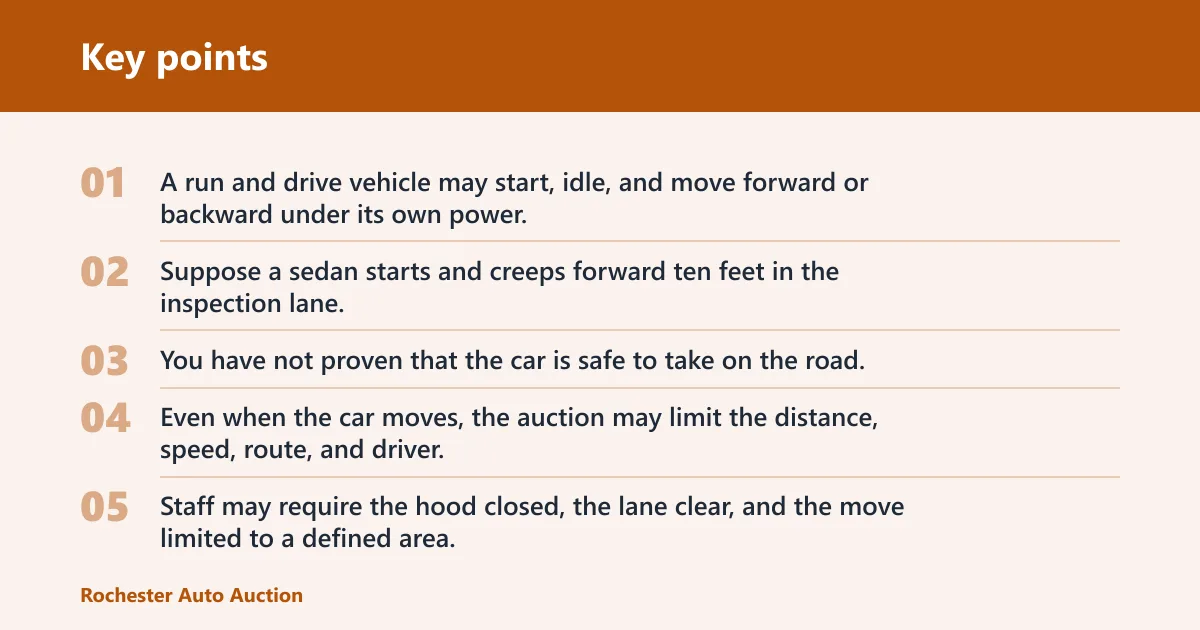
A run and drive vehicle may start, idle, and move forward or backward under its own power. It may still have serious issues that only show up under load, at speed, or after a longer drive. That is why a brief movement inside the lane is not the same as a road test.
Suppose a sedan starts and creeps forward ten feet in the inspection lane. If the brake pedal feels soft and the transmission hesitates when shifted into Drive, you have learned something important. You have not proven that the car is safe to take on the road.
Why moving under power is still limited
Even when the car moves, the auction may limit the distance, speed, route, and driver. Staff may require the hood closed, the lane clear, and the move limited to a defined area. Those controls reduce risk and help keep traffic orderly.
A short lane movement should be treated as a check of basic operation, not as a substitute for a full mechanical inspection.
What to note if the car moves but does not drive well
Document hesitation, clunks, delayed engagement, weak braking, pulling, or any dashboard warning that appears during movement. If the car only creeps, lurches, or fails to stop cleanly, that should be written down exactly as observed so the bid reflects the auction-floor evidence.
Start, shift, move, or no-Start?
This checklist is the for the inspection floor. Use it to separate what you may check from what you must stop and ask about, and use it only within the auction house policy and staff instructions for that specific event.
| Permission status | What you may check | What to record on the inspection sheet | When to stop and ask staff |
|---|---|---|---|
| Engine start allowed | Cranking, idle quality, accessory power, warning lights | Start/no-start, idle note, battery weakness, warning lights seen | If the engine stalls, cranks slowly, or rattles severely |
| Idle only | Steady idle, exhaust smell, cluster lights, basic electrical functions | Idle speed note, smoke, shaking, dash warnings | If you need to rev the engine to get it to stay running |
| Reverse/Drive engagement allowed | Transmission engagement, creep, engagement delay, shifting feel | Run/drives note, gear engagement delay, harsh shift feel | If the car will not select gears or lurches unexpectedly |
| Brake movement allowed | Very short controlled movement, pedal feel, stopping response | Brake feel, pull, stopping note, visible brake warning light | If the pedal sinks, the car rolls when stopped, or staff says no more movement |
| Warning lights check only | Dash lights after key-on and after start | ABS, check engine, airbag, oil, battery, or other lit warnings | If the same warning stays lit after the allowed check |
| Test drive permission | Only the route, speed, and distance staff approves | Permission granted, who supervised, where it was driven, and for how long | If permission is unclear, limited, or denied |
How to use the checklist in real time
- Check the policy first, then check the keys, then check the car.
- Mark only what the auction allowed you to confirm.
- Stop at the first sign of a rule limit, a safety concern, or a no-start condition.
What to record on the inspection sheet
The inspection sheet should show what happened, not what you hope happened. Record the start or no-start result, any run and drive notes, the odometer reading if visible, and any visible damage. If the car could not be started, write that clearly instead of leaving it implied.
Also note missing keys, weak battery behavior, warning lights, smoke, fluid leaks, and body damage. Those details matter because they help you compare the car against the auction listing and any report or sticker attached to it. Do not rely only on the report or sticker.
-
Note the key status.
Write down whether keys were present, missing, or limited by staff. If the key was unavailable, that fact alone can explain why the car could not be started. -
Record start or no-start.
Mark whether the engine started on the first try, after a permitted retry, or not at all. If the car starts and then dies, note both events. -
Write the run note.
If the vehicle moved, record whether it went forward, reversed, hesitated, or failed to engage. A short lane move is still worth documenting. -
Log warning lights.
Note any lights that stayed on after start, including battery, oil, check engine, ABS, or airbag indicators. A light that remains on after the allowed check is useful bid information. -
Capture the odometer.
Record the displayed mileage if it is visible and accessible. If the display is missing or unreadable, write that down rather than guessing. -
List visible damage.
Write down dents, broken glass, missing trim, tire damage, or fluid on the ground. Visible damage should be documented before bidding, not after pickup.
What should you do if the car will not start?
If the engine will not start during inspection, document the failure and check only the items the auction staff allows. The first questions are practical: are the keys present, is the battery alive, does the starter click, and is accessory power available? If the site limits what you may do, stop there.
Do not keep cycling the key in the hope that the car will wake up. Ask staff what the local procedure allows, because repeated attempts can create damage or blur the evidence you need for bidding.
Battery, key access, and basic checks
Begin with the simplest allowed checks. If the battery is weak, the dash may light up but the engine may not crank. If the key is missing or the fob battery is dead, the no-start note should reflect that. If accessories work but the starter does not, that is a separate clue.
A common first-timer mistake is to treat all no-start problems as the same. A dead battery, a missing key, and a failed starter do not mean the same thing, and the inspection sheet should not blur them together.
When to ask staff instead of trying again
Ask staff as soon as the permitted check is complete or the car behaves unpredictably. If the lane rules say only one start attempt, follow that. If the auction says no hood opening, no shifting, or no movement, respect that limit even if the car seems almost ready to run.
That caution matters because a partial start can still point to a major issue. A car that starts may still have hidden problems, and a car that does not start may still be bid on only after the failure is clearly recorded.
Frequently asked questions
Can you start a car during an auction inspection?
Usually, yes if the auction house allows it, the keys are available, and staff instructions permit a start. Starting is separate from test driving. A permitted start lets you check basic operation, but it does not mean the car is roadworthy or approved for road use.
Can you test drive a car at auction before bidding?
Sometimes, but not by default. Many auctions restrict test drives because of insurance, liability, and theft concerns. If the house allows any movement, it is often staff-supervised and limited to a designated area, not a full road test.
What does an auction inspection let you check on a car?
An inspection may let you look at visible damage, odometer reading, keys, battery condition, accessory power, start/no-start behavior, warning lights, and limited movement if permitted. The exact list depends on the facility and the event rules, so posted policy and staff instructions control what you may do.
What should you do if the engine won’t start during inspection?
Record the no-start result, note whether keys were present, and check only the items the staff allows, such as battery condition or accessory power. If the site limits further checks, stop and ask staff. Repeated cranking can create new problems and muddle the evidence.
How do you inspect a car if test drives are not allowed?
Focus on the allowed checks: exterior condition, interior wear, odometer, warning lights, fluids on the ground, tire condition, key access, start behavior, idle quality, and any approved lane movement. A short check is not a full guarantee, so document concerns before bidding and do not rely only on a report or sticker.
What are the risks of driving a car during a test drive?
The main risks are auction-rule violations, liability disputes, damage, and loss of control over where the car goes. In an auction setting, moving a vehicle outside the approved area can also create insurance and custody problems. Keep the question tied to auction procedure: if the house did not authorize movement, the safest answer is no.
What should I check if I cannot start the car at auction?
Check the key status, battery condition, starter response, accessory power, visible warning lights, and any allowed under-hood or dash evidence. If the auction limits further checks, stop there. The goal is to record a clear no-start note and the conditions around it, not to force the vehicle into running.