Do Auto Auctions Charge Payment or Credit Card Processing Fees?
Many auto auctions accept credit cards, though they often add a processing fee of about 2% to 4%. Buyer fees are separate, and deposits can follow their own rules. Miss that split and you can pay far more than the hammer price, or pick a payment method that adds avoidable charges. This guide breaks down buyer fees, deposits, and card-processing fees so you can choose the lowest-cost legal payment option.
Buyer fees vs payment fees

A buyer fee covers the auction’s sale charges tied to the vehicle purchase. A payment fee is different: the auction adds it because of how you pay, such as a card deposit, card final payment, or an online convenience charge. Read the fee schedule and the terms and conditions before you bid.
That split matters because a low hammer price can still end up costly after the buyer fee, a card fee, and a towing or gate-out charge. Some auctions also use different rules for deposits and the final balance, so the cheapest method at signup may not be the cheapest method after the sale.
What a buyer fee covers
Buyer fees are usually tied to the auction sale itself. They are not the same thing as a processor’s charge for taking a card payment. A buyer can owe both at once.
Do not assume a fee listed in the bidder agreement covers every checkout cost. A separate towing fee, storage charge, or card-processing fee can still appear after the sale.
When a payment fee is added
A payment fee shows up when the auction or its payment processor charges extra for using a debit or credit card, or for paying through an online gateway. The fee may be a percentage of the amount charged, a flat dollar amount, or both. It can also differ between a deposit and the final balance.
Some auctions disclose the charge in terms and conditions; others place it on the checkout screen or payment link. If you do not check both places, you can miss the fee until the last screen.
Why deposits are treated differently
Deposits often have their own rules because they secure bidder access or show that you are a serious buyer. A deposit may be applied to the final purchase, refunded if no vehicle is bought, or forfeited if you default. The payment method for the deposit can carry a separate fee even when the final balance does not.
Skipco, for example, requires a $400 deposit to receive a bidder badge and says customers without a deposit will not receive an access code. It also says refunds are automatically processed on the Tuesday prior to the next auction. Those are auction-specific rules, not universal ones.
Do auto auctions charge card fees?
Yes, many do. A credit card processing fee can be a percentage-based charge or a flat fee, and some auctions apply it to both debit and credit transactions. The charge may be non-refundable, and it can apply to a deposit, the final payment, or both depending on the auction’s rules.
Skipco states that debit and credit card transactions carry a non-refundable $20 convenience fee. That is separate from the buyer fee and separate from any towing or storage charge. AuctionMethod, by contrast, says it charges no additional processing fees and processes payments through the buyer’s own merchant account, not the platform.
Credit card processing fee basics
A card-processing fee usually appears as a percentage of the amount charged, a flat amount, or a mix of the two. The auction may set one rate for deposits and another for final settlement. Some auctions also make clear that card fees are not refundable even if the underlying deposit is later returned.
That last point matters. If the deposit comes back, the processing fee may still stay with the processor or auction unless the terms say otherwise.
Convenience fees on online deposits
A convenience fee is a separate flat dollar amount tied to online card deposit or payment activity. It often appears on a secure payment link or in the checkout rules for online bidding access. It is not the same as the buyer fee.
The same source says its online deposit payment can be made through a secure payment link. If you pay that way, check whether the site adds a convenience fee in addition to any card-processing charge.
Debit card versus credit card treatment
Do not assume debit is free. Some auctions treat debit cards the same as credit cards for processing and convenience-fee purposes. Others accept debit only for certain transactions or only through a specific payment link.
A common first-timer mistake is to choose debit expecting a lower cost, then find the same card fee on the receipt. Ask whether the auction separates debit from credit before you submit payment details.
When deposits cost extra
Deposits can cost extra when they are required for bidder access or online bidding privileges. They may be refundable if you do not buy a vehicle, but the payment fee attached to the deposit may still be non-refundable. Some auctions also require the deposit before they issue an online bidding access code.
Some auctions say a deposit of about $400 is required before an online bidding access code is issued. It also says in-person deposit payment must be made in cash. That makes the deposit rule a gatekeeping issue, not just a checkout issue.
Online bidding access deposits
Online access often depends on an active deposit. Some auctions require you to request the access code by a deadline, and the code may be regenerated weekly or by sale cycle. If the deposit is missing or expired, you may lose bidding access even before settlement day arrives.
Check whether the access code follows the deposit, the bidder badge, or a specific sale cycle. A missed deadline can block bidding without changing the auction’s buyer fee schedule.
In-person deposit methods
In-person deposit rules are often narrower than online rules. The same source says in-person deposit payment must be made in cash. That means a card may be accepted online for the deposit but not at the counter.
If the auction accepts cash only for a walk-in deposit, bring the exact amount if possible. That avoids last-minute card charges that may be non-refundable.
Refunds, reversals, and non-refundable fees
Refund timing can lag behind the sale. Several business days is common, and the auction may use its own refund cycle or a scheduled processing day. Even when the deposit is returned, the card-processing fee may not be.
The same source says refunds are automatically processed on the Tuesday prior to the next auction. That means your bank may still take additional time to post the credit after the auction releases it.
Payment fee decision table
Use this table to compare the payment method with the likely fee risk. Exact charges vary by auction, but the fee pattern often tells you which method deserves a follow-up question before you bid.
| Payment method | When it’s used | Typical fee risk | Questions to ask before bidding |
|---|---|---|---|
| Online card deposit | To activate bidder access or hold a spot in the sale cycle | Processing fee, often plus a flat convenience fee; may be non-refundable even if the deposit is later returned | Is the deposit required for access? Is the card fee percentage-based or flat? Is the fee refundable if I do not buy? |
| In-person cash deposit | At the auction office or counter before bidding | Usually lower card-fee risk because no card is used; cash handling rules still apply | Is cash the only accepted method? Does the deposit apply to the purchase? What deadline controls bidder access? |
| Card final payment | To pay the remaining balance after a win | Processing fee may apply to debit and credit cards; can differ from the deposit fee | Do you charge the same fee on final payment as on deposits? Is there a cap? Is it non-refundable? |
| Cashier’s check | To settle the remaining balance within the auction’s payment window | Often fee-free from the auction itself, but your bank or issuer may charge to obtain it | Is it accepted for final balance? What name must appear on it? What is the payment deadline? |
| Certified funds | For post-sale payment when the auction requires guaranteed funds | Usually no auction processing fee, but the sender may still pay bank charges | What counts as certified funds here? Can it cover the full balance? Is a partial card payment allowed? |
| Wire transfer | For final balance at auctions that accept electronic settlement | May avoid card fees, but bank wire charges and auction cutoff timing can add cost | What is the wire cutoff? Is the wire accepted in lieu of card payment? Who pays the incoming wire fee? |
Cheapest path checklist:
- Ask whether the deposit is required for bidding access or only for purchase completion.
- Check whether a card fee applies to the deposit, the final payment, or both.
- Compare card fees against cashier’s check, certified funds, and wire transfer charges.
- Confirm whether the deposit fee is refundable if you do not win a vehicle.
- Ask if towing, gate-out, or storage charges are billed separately after payment.
What payment methods do auctions accept?
Many auctions accept cashier’s check, certified funds, credit card, or wire transfer for the balance due, but the menu is auction-specific. Some methods are accepted only within a short payment window, and some auctions limit cards to deposits rather than final settlement. Read the sale terms before bidding.
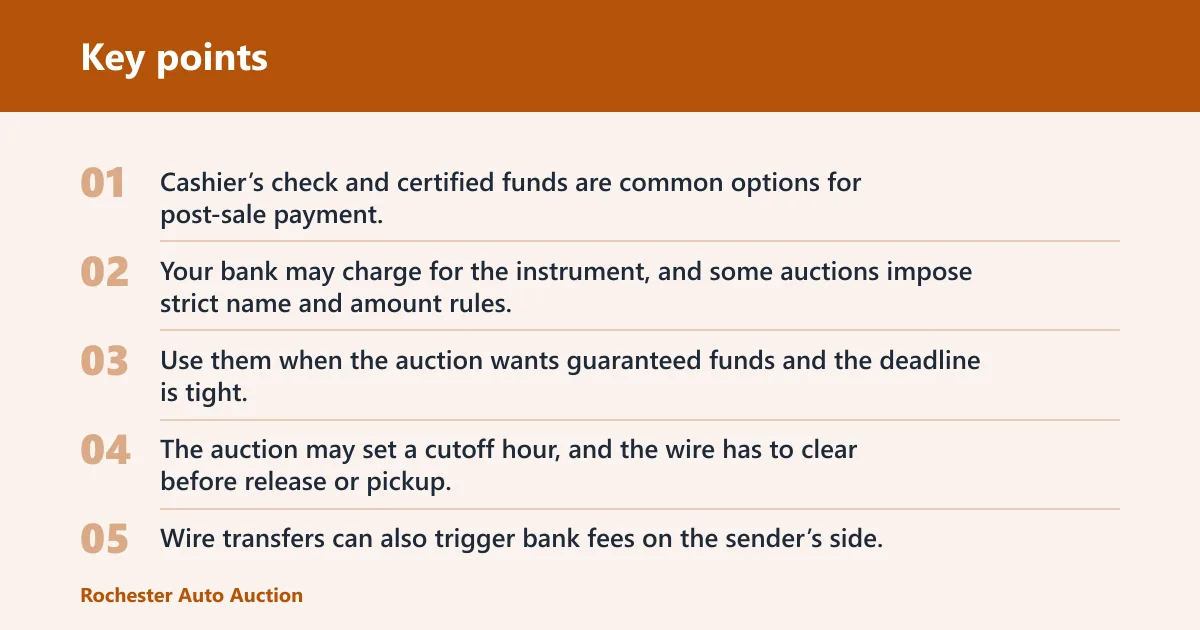
The same source says the purchaser has two business days to remit the remaining balance and accepts cashier’s check, certified funds, credit card, or wire transfer for the balance. That is a useful example of how the accepted method and the payment deadline can work together.
Cashier’s check and certified funds
Cashier’s check and certified funds are common options for post-sale payment. They are often accepted without an auction’s own processing fee, but that does not mean they are free in the broader sense. Your bank may charge for the instrument, and some auctions impose strict name and amount rules.
Use them when the auction wants guaranteed funds and the deadline is tight. If the auction requires both certified funds and a separate pickup document, ask for that requirement before you leave the office.
Wire transfer rules
Wire transfer can work well for final balance payment at some auctions, especially when a buyer cannot get to the site in time. The catch is timing. The auction may set a cutoff hour, and the wire has to clear before release or pickup.
Wire transfers can also trigger bank fees on the sender’s side. Even when the auction adds no fee, the total cost can still be higher than a cashier’s check if your bank charges for outgoing wires.
Card payment limits at settlement
Some auctions let you use a card for the balance due. Others restrict cards to deposits only, or only up to a certain dollar amount. That difference changes the cheapest legal option and can affect whether you can pick up the vehicle the same day.
A common example is that if your winning bid is about $8,000 and the auction accepts credit cards for the balance, a 3% fee would add about $240. That adds $240 before you pay for towing or gate-out, so a cashier’s check may be cheaper if the auction accepts it and your bank does not charge to issue one.
What happens if you default?
If you win and do not pay, the auction can treat the sale as a default. The most common result is deposit forfeiture, but the consequences can go further. An account may be suspended, bidding privileges can be revoked, and future access can disappear until the auction clears the issue.
The same source says a defaulting buyer forfeits the $400 deposit. That is the clearest example of why payment timing matters as much as payment method.
Deposit forfeiture
Deposit forfeiture is one of the fastest ways to turn a missed deadline into a real cost. If the auction’s terms say the deposit backs your bidding privilege, failing to pay the balance can cause that money to stay with the auction.
Check whether the forfeiture applies only after a win or also after a no-show at pickup. The wording matters.
Account suspension
Some auctions suspend accounts after a default. That can block future bids, prevent online access, or require extra approval before the next sale. Suspension policies differ, so the safest move is to ask before you bid if you are unsure about your funding timeline.
If your payment source is not ready, do not bid as though the settlement window is flexible. It often is not.
Loss of bidding privileges
Loss of bidding privileges is the practical consequence that hurts most buyers. Once the account is blocked, you may lose access code eligibility, bidder badge renewal, or the ability to bid in a future sale cycle. The auction’s payment rules become part of your bidding risk.
That is why the cheapest payment method is not always the best one. The method has to clear on time and match the auction’s terms.
How do you avoid surprise fees?
Ask about the deposit, the final balance, the payment deadline, and any post-sale removal charge before you bid. The cheapest path is usually the one that avoids card fees, avoids late-payment penalties, and keeps towing or gate-out charges from appearing after settlement. Read the terms and conditions closely.
Picture a buyer who wins a compact sedan and plans to pay with a card at pickup. The auction allows cards, but the balance is due in two business days and towing outside the gate adds $20 per unit. The “easy” payment option now costs more than the bidder expected.
-
Ask for the full fee list. Request the buyer fee, deposit rule, card-processing rule, and any convenience fee before the sale starts. The office should be able to tell you whether the card fee applies to deposits, final payment, or both.
-
Confirm the payment window. Get the exact deadline for the balance due, such as same day, next business day, or two business days. Timing rules matter because a late wire or a missed check deadline can trigger default.
-
Ask what counts as certified funds. Some auctions accept cashier’s checks, certified funds, credit cards, or wire transfers, but the exact list can change by sale. Confirm whether the auction accepts one method for deposit and another for final settlement.
-
Check removal charges. Ask whether towing, gate-out, or storage fees apply after payment. Skipco, for example, says towing outside the gate costs an additional $20 per unit and that any tow left on lot after 14 days is subject to storage charges.
A buyer who skips these questions can make the wrong cost comparison. A fee-free cashier’s check is only cheaper if the auction accepts it, the deadline is realistic, and the removal charges do not erase the savings.
Frequently asked questions
Do auto auctions charge a fee if I pay by credit card?
Often, yes. Many auctions add a separate card-processing fee, and it may be percentage-based or flat. Some auctions apply it to both debit and credit cards, and some charge a different amount for the deposit than for the final balance. Check the terms before you bid.
Can I pay an auction bill with a debit card?
Sometimes, but do not assume debit is cheaper. Some auctions treat debit and credit the same for processing-fee purposes, while others limit debit use to specific transactions. If the auction uses a payment gateway, the card may still trigger a convenience fee.
Are card processing fees refundable if my deposit is returned?
Not always. A deposit can be refunded while the card-processing fee stays non-refundable, especially when the fee is tied to the transaction rather than the vehicle purchase. Ask whether the auction reverses only the deposit amount or the full charged amount, including fees.
Do online auction deposits have convenience fees?
They can. Online deposits are a common place for a flat convenience fee to appear, especially when you use a secure payment link or card gateway. That fee is separate from the buyer fee and may also be separate from any percentage-based processing charge.
What payment methods do auto auctions accept for the balance due?
Common options include cashier’s check, certified funds, credit card, and wire transfer, but the accepted list is auction-specific. Some auctions give only a short payment window, such as two business days, and may limit which methods are accepted for final settlement.
Can an auction charge more if I need the car towed out?
Yes. Towing, gate-out, and storage are often billed separately from the vehicle price and buyer fee. The same source says towing outside the gate costs an additional $20 per unit and that any tow left on lot after 14 days is subject to storage charges.