Dealer License vs Business License: What Is the Difference?
A business license lets a company operate. A dealer license lets you legally buy, sell, or auction vehicles as a dealer, and you usually need the business license first. Skip the wrong one and you can face fines, denied auction access, or a forced shutdown. This guide explains who needs each license, how they differ, and what auction and state rules usually require.
| Decision factor | Dealer license | Business license | Winner |
|---|---|---|---|
| What it authorizes | Vehicle-dealer activity, including buying and selling vehicles as a dealer | General or specified business activity in a jurisdiction | Dealer license |
| Issuing authority | State dealer regulator or a state agency that regulates dealer activity | City, county, state, or federal licensing office | Dealer license |
| Auction access value | Often required for dealer-only auto auctions | Not enough on its own for dealer-only auction access | Dealer license |
| Business existence proof | Does not create the company itself | Does not create the company itself | Tie |
| Local operating permission | May not satisfy local business rules | Can satisfy local or sector-specific operating rules | Business license |
What is the difference between a dealer license and a business license?
A dealer license authorizes vehicle-dealer activity. A business license may authorize business activity in a city, county, state, or federal jurisdiction, but it does not automatically allow you to sell cars as a dealer or bid at dealer-only auctions.
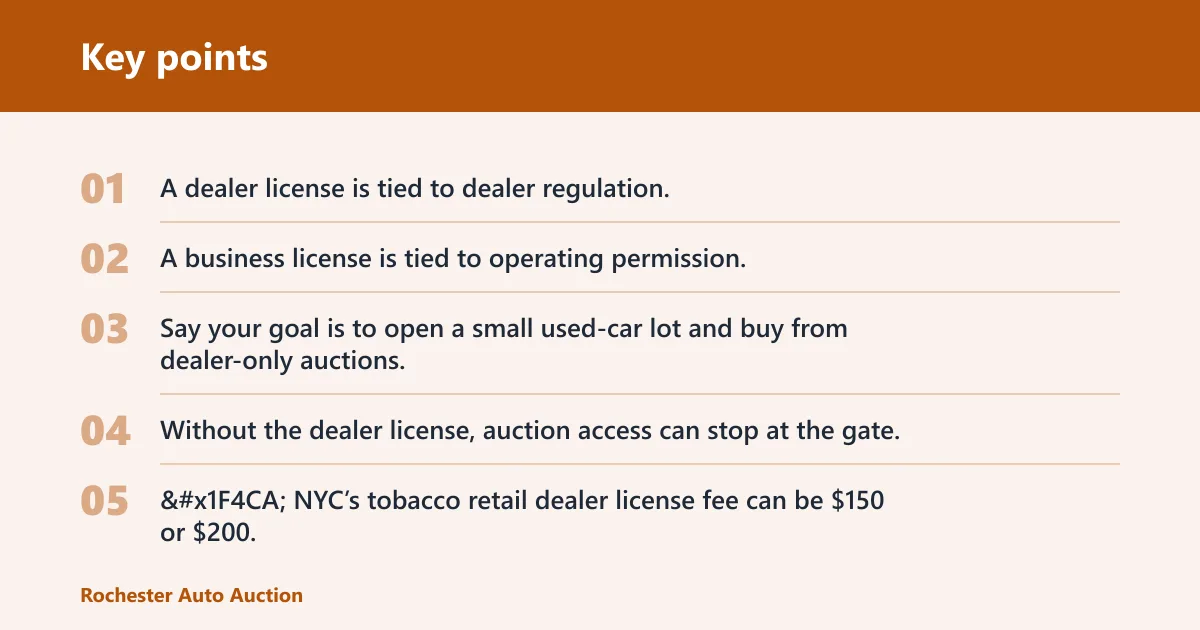
That difference matters quickly in car sales. A dealer license is tied to dealer regulation. A business license is tied to operating permission. One helps prove you can run the business; the other helps prove you can conduct dealer activity under the rules that apply to vehicle sales.
Why car sellers often need both
Many first-time dealers need a formation filing, a local business license, and dealer authorization before they can operate cleanly. A business may need one, both, or neither depending on structure and location, so the safest workflow is to confirm each requirement separately instead of treating one document as a substitute for the other.
Say your goal is to open a small used-car lot and buy from dealer-only auctions. A state filing for an LLC may create the entity, but that still leaves local business permission and dealer credentialing. Without the dealer license, auction access can stop at the gate.
📊 NYC’s tobacco retail dealer license fee can be $150 or $200. Source: NYC.
Who issues each document?
Dealer licenses usually come from a state agency or state dealer regulator. Business licenses can come from city, county, state, or federal offices, depending on the activity and location. Entity formation is different again: the Secretary of State or an equivalent office handles the business structure filing.
State dealer regulators
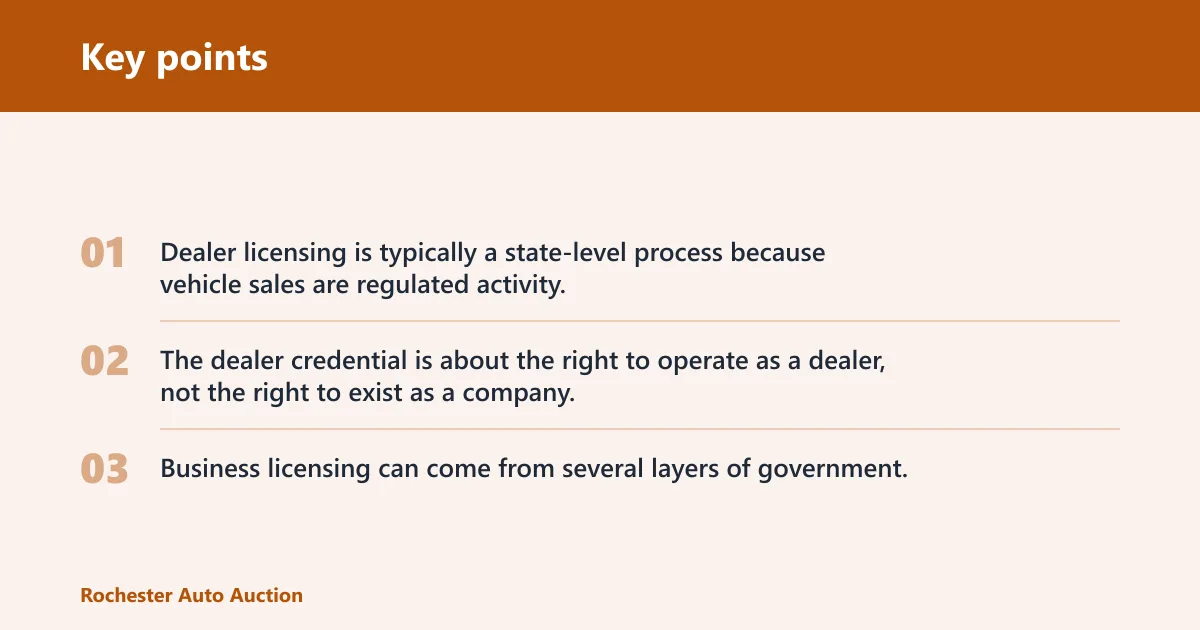
Dealer licensing is typically a state-level process because vehicle sales are regulated activity. That is why a dealer license can be required even when a business already exists under state law. The dealer credential is about the right to operate as a dealer, not the right to exist as a company.
Local and other licensing offices
Business licensing can come from several layers of government. A city may require a local operating license, a county may require registration, and certain activities may also trigger state or federal rules. That is why a state entity search alone does not prove you have every permit you need.
| Which document do you need for each step? | Dealer license | Business license |
|---|---|---|
| Forming an LLC | Not enough on its own | Not enough on its own |
| Obtaining a local business license | Optional | Required |
| Applying for a dealer license | Required | Not enough on its own |
| Buying at a dealer-only auction | Usually required | Not enough on its own |
| Registering with tax authorities | Optional | Often required, depending on structure and activity |
Does an LLC replace either license?

No. An LLC creates a legal business entity, not operating permission. Articles of Organization create or confirm an LLC, but they are not a business license. A state may send an acknowledgment or certificate after approving the LLC, and that still does not replace dealer authorization or local business permission.
That is the most common failure case for new sellers. The LLC may exist in the state database, yet the owner still cannot legally operate as a dealer or access dealer-only inventory. Entity formation, business licensing, and dealer licensing are separate steps.
Business certificate and assumed-name filings
Some businesses also need a business certificate, assumed-name filing, or a state registration tied to structure or naming rules. These records may be requested with a license application, but they are not the same thing as a dealer license. They help show who is operating, under what name, and under what structure.
For example, New York City’s tobacco retail dealer license requires a business certificate based on legal structure, and NYC says corporations and LLCs must register with the state Division of Corporations. That is a reminder that local licensing can depend on formation paperwork without replacing it.
Do you need both to sell cars?
Often, yes, both licenses are needed to sell vehicles as a dealer. If you are selling vehicles as a dealer, the dealer license is the document that authorizes the activity, while the business license covers the local or general right to operate the business. The exact mix depends on your state, your city, and the way you structure the business.
Selling under a business name
Suppose you form an LLC and register a trade name, then place ads for used cars under that name. The business still may need local permission before it can open doors or display inventory. The LLC and naming paperwork do not, by themselves, prove dealer authority.
Buying at dealer-only auto auctions
Dealer-only auto auction access often depends on dealer credentialing, which usually means more than a business license. Auction operators may ask for proof of business status plus the dealer license, and a business license alone is not guaranteed entry. A local permit does not replace dealer authority.
Which document comes first?
Usually the entity filing comes first, then local business licensing, then dealer licensing. If you are forming a dealership from scratch, you often need the business structure in place before you apply for dealer authorization, because the application may ask for business records, addresses, and registration details.
-
Form the entity first. File the LLC or other formation documents with the state if you want a separate legal business structure. Articles of Organization create or confirm an LLC, and that filing is not a license.
-
Check local licensing rules next. Ask the city or county whether a business license, certificate, zoning clearance, or assumed-name filing is required for your location. Some places require this even if the company already exists on paper.
-
Apply for dealer authorization last. File the dealer application with the state regulator once the business records are ready. That step is what can open the door to dealer-only inventory and dealer-related vehicle activity.
Choose Dealer license if… / Choose business license if…
Choose the dealer license if your plan includes buying, selling, or auctioning vehicles as a dealer, especially if you want dealer-only auto auction access. Choose the business license if your goal is to satisfy local or general operating rules for the company, retail space, or tax registration, but not dealer authority by itself.
Choose Dealer license if…
- You want to buy vehicles at a dealer-only auction.
- You plan to sell cars as a dealer rather than as a private seller.
- Your state dealer regulator requires proof before you can operate.
- You already have the entity paperwork and now need dealer authority.
Choose business license if…
- You need permission to operate a business in a city or county.
- You are opening a non-dealer business activity that still needs local approval.
- You need to satisfy a local filing before a dealer application.
- You are checking tax or registration rules tied to your structure or location.
A common first-timer mistake is assuming that an LLC plus a local business certificate is enough to bid at a dealer auction. If the auction requires dealer credentialing, the bid gate stays closed until the dealer license is approved.
Frequently asked questions
Do I need both a dealer license and a business license to sell cars?
Often you do, but not always in the same form or from the same office. A dealer license covers the vehicle-dealer side, while a business license may cover the local operating side. Whether you need both depends on state rules, city rules, and how your business is set up.
Does an LLC replace a dealer license or business license?
No. An LLC is a legal business structure created by state filing, not a license. Articles of Organization create or confirm the LLC, but they do not replace dealer permission or local business licensing. The LLC can hold the business, but it does not authorize the activity by itself.
Which license do I need first for a car dealership?
Usually, form the entity first, then handle any local business license, then apply for dealer licensing. The dealer application may ask for the company’s registered name, address, and formation records. If the entity is not ready, the dealer filing can stall or be rejected.
Is a business license enough to buy vehicles at auction?
Usually not for dealer-only auto auctions. Auction access often depends on dealer credentialing, and a business license alone does not prove that you can operate as a dealer. Some auctions also ask for business records, but the dealer license is the document that usually matters for entry.
Who issues a dealer license versus a business license?
A state agency or state dealer regulator usually issues the dealer license. A business license can come from a city, county, state, or federal office depending on the activity. Entity formation is separate again and is usually handled by the Secretary of State or an equivalent office.
Do dealer license rules vary by state?
Yes. Dealer licensing rules vary by state, and local business licensing rules can vary by city or county too. That is why a process that works in one place may not work in another. Check the exact jurisdiction tied to your business address and your vehicle activity.
What paperwork is not the same as a dealer license?
Articles of Organization, an LLC approval, a business certificate, an assumed-name filing, and a state registration are not the same as a dealer license. They may be useful or required, but they do not replace dealer authorization. Treat each document as its own requirement until the regulator says otherwise.
How do I know if my business needs a local license too?
Check the city and county rules where the business will operate, not just the state entity database. A business may need one, both, or neither depending on structure and location. If you have a showroom, office, or lot, local licensing is often part of the workflow before you open.