Why Is My Auto Auction Invoice Higher Than My Winning Bid?
Your auto auction invoice can run higher than your winning bid because buyer fees, arbitration or gate charges, taxes, title work, and storage can be added after the sale. If the total jumps after posting, check for timing-based reposts or billing errors. Miss this, and you can overpay, miss an arbitration deadline, or accept a charge you could have disputed. This guide breaks down each invoice line, shows which fees are normal, which are avoidable, and when a higher bill points to a mistake.
Normal vs avoidable vs possible mistake: Buyer’s premium, state tax, title/document work, and event-set fees are usually normal. Storage and late-payment charges are often avoidable if you missed a deadline. Duplicate fees, a tax charge on the wrong base, or a fee tied to the wrong buyer profile are possible invoice mistakes and should be disputed with the sale paperwork.
Winning bid versus final invoice
The winning bid is the hammer price, the accepted bid at the sale. It is the starting point, not the all-in price. After that, the auction may add buyer’s premium, tax, title work, payment charges, storage, and late-payment penalties, depending on the event rules and your timing. For buyer-fundamentals context, see buyer’s premium, auction terms, sales tax, title transfer, and storage.
Where added charges enter the total
Some charges appear at registration, before you ever bid. Others appear at settlement, when you pay the invoice. A few only appear later, after missed payment deadlines or delayed pickup. That is why two buyers can win the same vehicle and still receive different invoices.
On many sales, the delivered cost can land 15% to 25% above hammer price before transport or delay penalties, but the exact spread varies by auction house, channel, and state tax rules. For example, that range can be lower or higher depending on premium rate, tax base, and whether the buyer pays on time.
Why is my invoice higher?
Your invoice is usually higher because the auction adds fixed or percentage-based fees after the hammer price. The biggest drivers are buyer’s premium, sales tax, title and document charges, payment processing, and time-based fees. If the total rose after posting, check whether the invoice was reissued after a deadline, release event, or title adjustment.
Common line items that add cost
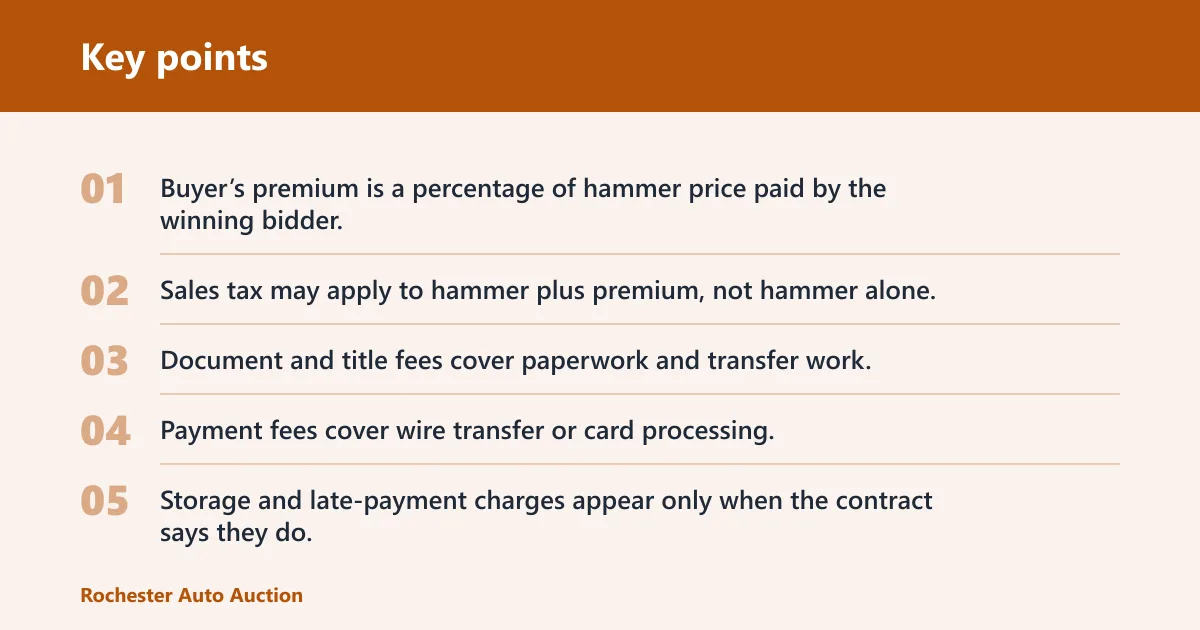
Buyer’s premium is a percentage of hammer price paid by the winning bidder. Sales tax may apply to hammer plus premium, not hammer alone, depending on state rules and the sale structure. Document and title fees cover paperwork and transfer work. Payment fees cover wire transfer or card processing. Storage and late-payment charges appear only when the contract says they do.
Suppose a dealer wins a truck on Friday but does not pay until Monday. The sale may still be valid, but the invoice can gain a late fee, a storage charge, and a new settlement charge before pickup is allowed. The final bill changes because the deadline changed, not because the bid was wrong.
Which charges can be disputed?
Charges tied to a clear contract, published fee schedule, or missed deadline are harder to dispute than a duplicated line, a wrong tax calculation, or a fee charged under the wrong buyer profile. If a charge does not match the conditions of sale, the payment receipt, or the title paperwork, ask for a line-by-line review.
A common mistake is assuming the invoice should match the hammer price without accounting for buyer fees, title processing, or transport. Some are normal auction charges. Others are timing problems, including a late payment, a delayed pickup, or a reposted invoice after the sale. The fastest path is to compare each line to the event rules and the invoice date.
Winning bid to final invoice audit table
| Fee name | When it is added | Percentage or flat | Who sets it | Usually taxable? | What document to check | Avoidable vs unavoidable |
|---|---|---|---|---|---|---|
| Hammer price | At the sale | Bid amount | Winning bidder and auctioneer | No, by itself | Bid confirmation or sale result | Unavoidable if you win; the final price driver you control most |
| Buyer’s premium | At settlement, after the sale | Percentage | Auction house; bid channel may change the rate | Often yes, depending on state rules | Conditions of sale and invoice | Usually unavoidable once you bid; avoidable only by knowing the premium before bidding or choosing a lower-premium channel |
| Sales tax | At settlement or title time | Percentage | State and local tax rules | Yes | Invoice and tax paperwork | Usually unavoidable if the vehicle is taxable; possible mistake if taxed on the wrong base or wrong jurisdiction |
| Document and title fees | After the sale | Usually flat | Auction house, state filing rules, or title agent | Sometimes | Invoice and title packet | Usually unavoidable if the sale requires filing; possible mistake if duplicated or charged for the wrong title path |
| Payment fees | At settlement | Flat or percentage | Auction house or payment processor | Usually no | Invoice and payment receipt | Often avoidable by using an approved payment method; possible mistake if charged twice or on the wrong method |
| Bidder registration fee | At registration, before or after sale depending on event | Flat | Auction house | Usually no | Registration terms | Usually unavoidable if the event requires registration; possible mistake if charged under the wrong buyer profile or after a waived-registration offer |
| Storage fee | After missed pickup deadline | Flat per day or time block | Auction house or storage vendor | Usually no | Pickup deadline notice and invoice | Avoidable if the vehicle is removed on time; possible mistake if the clock started before the release notice allowed pickup |
| Late-payment fee | After missed settlement deadline | Flat or percentage | Auction house | Usually no | Conditions of sale and invoice | Avoidable if payment is made on time; possible mistake if charged after a documented extension or dispute hold |
Invoice audit checklist:
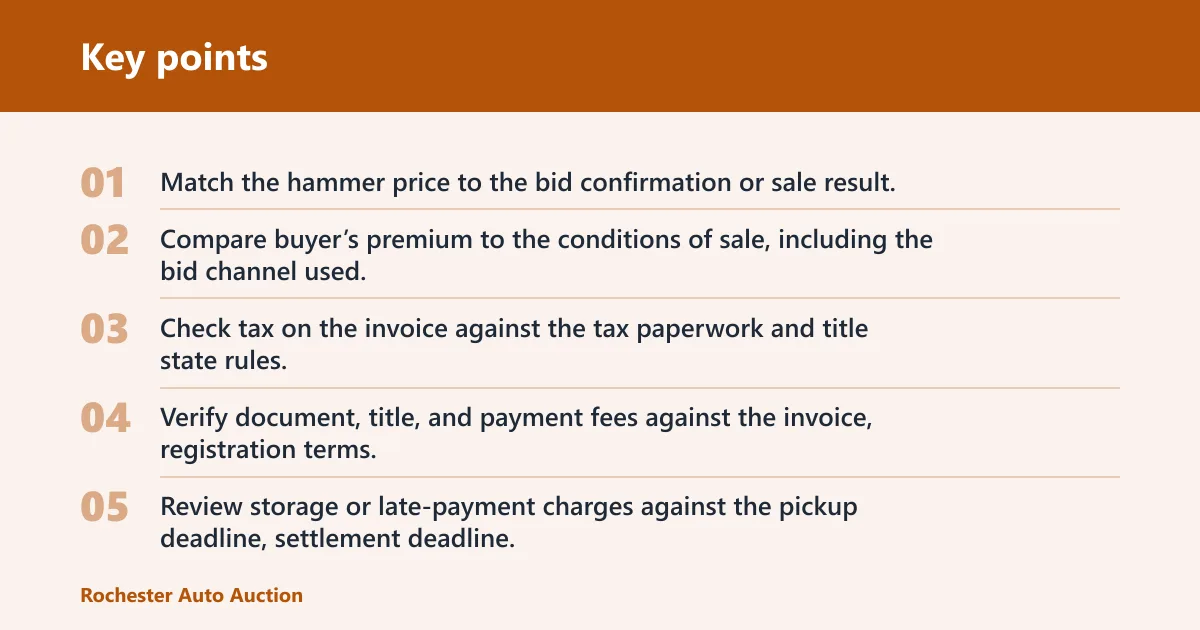
- Match the hammer price to the bid confirmation or sale result.
- Compare buyer’s premium to the conditions of sale, including the bid channel used.
- Check tax on the invoice against the tax paperwork and title state rules.
- Verify document, title, and payment fees against the invoice, registration terms, and receipt.
- Review storage or late-payment charges against the pickup deadline, settlement deadline, and any written extension.
Buyer’s premium and taxes
The buyer’s premium is usually added on top of the hammer price, then tax may be calculated on that larger subtotal. That means the invoice can rise twice: once for the premium, and again for tax. The exact tax treatment depends on the sale state, title state, and the event rules.
How the premium is calculated
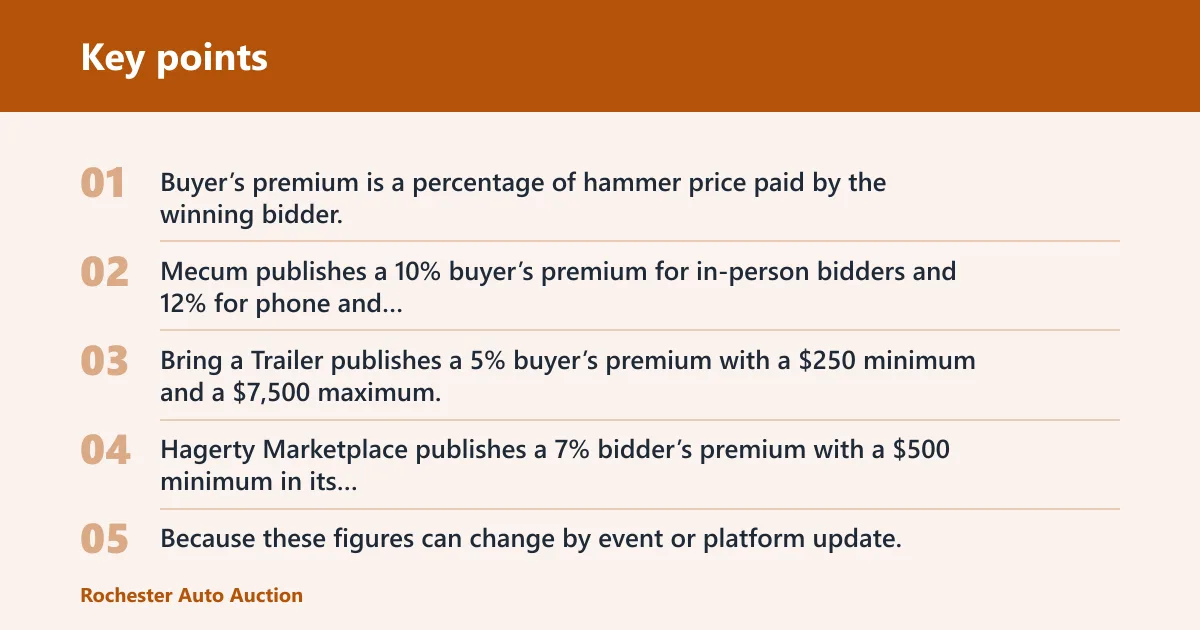
Buyer’s premium is a percentage of hammer price paid by the winning bidder. Mecum publishes a 10% buyer’s premium for in-person bidders and 12% for phone and internet bidders, with a $1,000 minimum buyer premium on vehicles, according to its published fee schedule. Bring a Trailer publishes a 5% buyer’s premium with a $250 minimum and a $7,500 maximum, and Cars & Bids publishes the same 5% buyer fee with a $250 minimum and a $7,500 maximum, each in its current buyer-fee terms. Hagerty Marketplace publishes a 7% bidder’s premium with a $500 minimum in its marketplace terms. Because these figures can change by event or platform update, confirm the live fee schedule before bidding.
Some auction houses publish sold prices with the premium already included. Others list hammer price first and show the premium as a separate line. If you compare listings across houses, make sure you know which format you are reading before you judge which sale was cheaper.
Whether tax applies to the premium
Tax is often calculated on hammer plus premium, not hammer alone, but the exact rule depends on state law and the sale structure. Live auctions may collect tax on site when required, while some online platforms leave final tax handling to the buyer’s title or registration process. The invoice math changes even when the winning bid is identical, so do not assume the same tax timing across channels.
Do car auctions charge sales tax on the buyer’s premium? Often yes, but only when state rules and the sale structure call for it. If the vehicle is titled in a different state, or the sale is processed through a different location, the tax result can change. Exemption paperwork can also change the bill.
What fees are added at settlement?
Settlement is where many invoices grow. The auction may add document fees, title fees, and payment processing charges after the sale closes. Bidder registration may also appear here if the event charges a separate bidder fee or if the registration terms split pre-sale and post-sale pricing.
Document and title fees
Document and title fees are administrative charges for paperwork and transfer work. They may cover reassignment, title application, clerical handling, or state filing steps. These fees are usually added after the sale, and the amount can vary by auction house and state. Check the invoice, title packet, and conditions of sale.
Payment fees
Payment fees can appear when the buyer pays by wire transfer, card, or another processed method. They may be small individually and still matter when added to premium, tax, and title charges. If the invoice includes a payment fee, look for the matching receipt so you can tell processing costs from sale charges.
Bidder registration fees
Bidder registration is not the same thing as buyer’s premium. Registration is charged to participate in some sales, and it can differ before versus after the sale. On Mecum Kissimmee, bidder registration can cost $100 before the sale and $200 after, according to the event registration terms. Check the event registration terms before assuming a fee is refundable or credited.
Can storage or late fees raise the total?
Yes. Storage and late-payment charges can be added after the sale if pickup or payment misses the deadline in the conditions of sale. These charges are timing-based, and they can rise quickly. A short delay can turn into a much larger invoice if the contract allows daily storage or a missed-payment penalty.
Pickup deadlines
Pickup deadlines tell you when the vehicle must leave the yard. If you miss that release window, storage can start, often by day or by a defined time block. Read the release notice and the event rules together. The pickup clock can start before the invoice is fully paid if the auction uses a separate storage policy.
Late-payment consequences
Some auction houses require an immediate deposit after the win, but the amount and timing vary by event and buyer type, so the rules must be checked before bidding. Missing the payment deadline can forfeit the deposit and void the sale if the conditions of sale say so. Some houses also add a late-payment fee on top of that. If a buyer is disputing a line item, that dispute does not pause the deadline unless the auction confirms it in writing.
Picture a salvage buyer who wins a sedan on Thursday, then waits until the following week to send payment. The invoice may add a late fee first, then a storage fee, then a release delay. The extra cost comes from the missed deadline and the time the car stayed in the lot.
Why do online and live invoices differ?
Online and live invoices differ because the bid channel can change the premium rate, the tax handling, the registration fee, and the timing of payment or title work. The vehicle is the same, but the contract path is not. That is why the bid screen, the invoice, and the release form may not match line for line.
Bid channel fee differences
Some auction houses charge different buyer’s premium rates for in-person, phone, and internet bidders. Mecum’s published rates show that split clearly: 10% for in-person bidders and 12% for phone and internet bidders, with the minimum premium also applying according to its fee schedule. An online invoice can also carry platform-specific fees that a live sale does not show in the same place.
Registration timing differences
Online buyers often register earlier, then pay later at title time or settlement. Live buyers may register on site and pay tax immediately. That changes the invoice sequence. A fee that appears before the sale in one channel may appear after the sale in another, even if the amount is the same.
Pickup and release timing
Release timing matters more in live and dealer lanes than many first-time buyers expect. If the auction releases vehicles only after payment clears, the storage clock may start later. If the vehicle can be picked up sooner, the storage clock may start sooner. Read the release terms before assuming the same pickup window applies everywhere.
How much higher than the hammer price is a typical auction invoice?
A typical invoice can land well above the hammer price once premium, tax, and paperwork are added. A 15% to 25% increase is a useful planning range for many sales, but it is only an estimate because the real total depends on premium rate, tax base, title work, and any missed-deadline charges. Use the conditions of sale to calculate the exact total.
- Start with the hammer price.
- Add the buyer’s premium from the event rules.
- Apply sales tax if the sale or title state requires it.
- Add title, document, and payment fees from the invoice.
- Check for storage or late-payment charges if pickup or payment was late.
- Compare every line to the conditions of sale and the settlement notice.
Set your maximum all-in number first, then work backward to the highest hammer price you can afford. That keeps you from winning a car that fits the bid limit but breaks the total-cost limit.
Why is my auto auction invoice higher than my winning bid?
Your auto auction invoice is higher than your winning bid because the bid is only the hammer price. The final bill can include buyer’s premium, tax, title work, payment fees, registration charges, storage, and late-payment penalties. If the increase appears after posting, check the timing of each line and the contract terms.
The fastest audit is simple: match each charge to the moment it was added, then compare it with the conditions of sale and the title paperwork. If a line does not fit the published rules, ask the auction for clarification before you pay a disputed amount.
Frequently asked questions
What fees are added after the hammer price at a car auction?
The most common additions are buyer’s premium, sales tax, document and title fees, payment fees, registration charges, storage, and late-payment penalties. The exact mix depends on the auction house, the event, and the bid channel. Read the conditions of sale and compare them to the invoice line by line.
Is buyer’s premium included in the winning bid or added later?
Buyer’s premium is commonly added after the hammer price as a separate line item, though some listings may instead publish an all-in sold price that already includes it. The premium is a percentage of the hammer price, and the rate can change by auction house or bid channel.
Do car auctions charge sales tax on the buyer’s premium?
Often yes, because tax is commonly calculated on hammer plus premium rather than hammer alone. Whether that happens depends on state rules, the title state, and the event structure. Live auctions may collect tax on site when required, while some online platforms handle it later through title or registration processing.
What document and title fees can raise my final auction invoice?
Document and title fees can cover paperwork handling, reassignment, title application, and state filing work. They are usually added after the sale and may vary by auction house and state. Check the invoice, title packet, and conditions of sale to confirm what each fee covers.
Can storage or late-payment fees be added after the sale?
Yes. If pickup or payment misses the contract deadline, storage or late-payment charges can be added after the sale. Some auctions also allow the deposit to be forfeited if payment is late. These are timing-based charges, so the invoice can rise quickly once the deadline passes.
Sources
Mecum fee schedule and registration terms; Bring a Trailer buyer fee terms; Cars & Bids buyer fee terms; Hagerty Marketplace terms; state sales tax and title rules; auction conditions of sale and settlement notices.