What Fees Are Charged If a Car Does Not Meet Reserve?
A reserve miss can affect whether fees apply, but the exact charges for Rochester Auto Auction must come from its current fee schedule and auction terms. If a bid does not meet reserve, the vehicle usually does not sell at auction. The point is simple: the reserve keeps the seller from taking less than a set floor, but it also changes what happens next when the hammer does not fall.
Reserve fee table
| Scenario | Who pays | Likely fee types |
|---|---|---|
| Reserve not met | Usually the seller, if Rochester Auto Auction’s written terms assign a no-sale charge; the buyer typically owes nothing unless a bid becomes binding. | No-sale fee, seller fee, listing fee, administrative fee |
| Post-auction acceptance | Both parties, if the post-sale deal closes under the auction’s contract rules. | Buyer premium, seller commission, administrative fee, title or paperwork charges |
| Relisted no-sale | Often the seller; a relist charge can appear when the vehicle is entered into a later sale. | Relisting fee, reinspection fee, remarketing fee, no-sale fee |
| Seller withdraws the car | Usually the seller, if the withdrawal happens after intake or after the car has been cataloged. | Withdrawal fee, administrative fee, storage fee, transport charge |
| Vehicle stored after no-sale | Usually the seller, if the contract places storage responsibility on the consignor after the sale ends. | Storage fee, gate fee, transport fee, condition report fee |
What reserve price means
A reserve price is the seller’s minimum acceptable sale price. If bidding stops below reserve, the vehicle usually does not sell at auction. The point is simple: the reserve keeps the seller from taking less than a set floor, but it also changes what happens next when the hammer does not fall.
That missed reserve is not the same as a closed sale. The vehicle remains unsold unless the seller accepts a later offer, lowers the reserve, or removes the unit from the sale flow.
How a reserve protects the seller
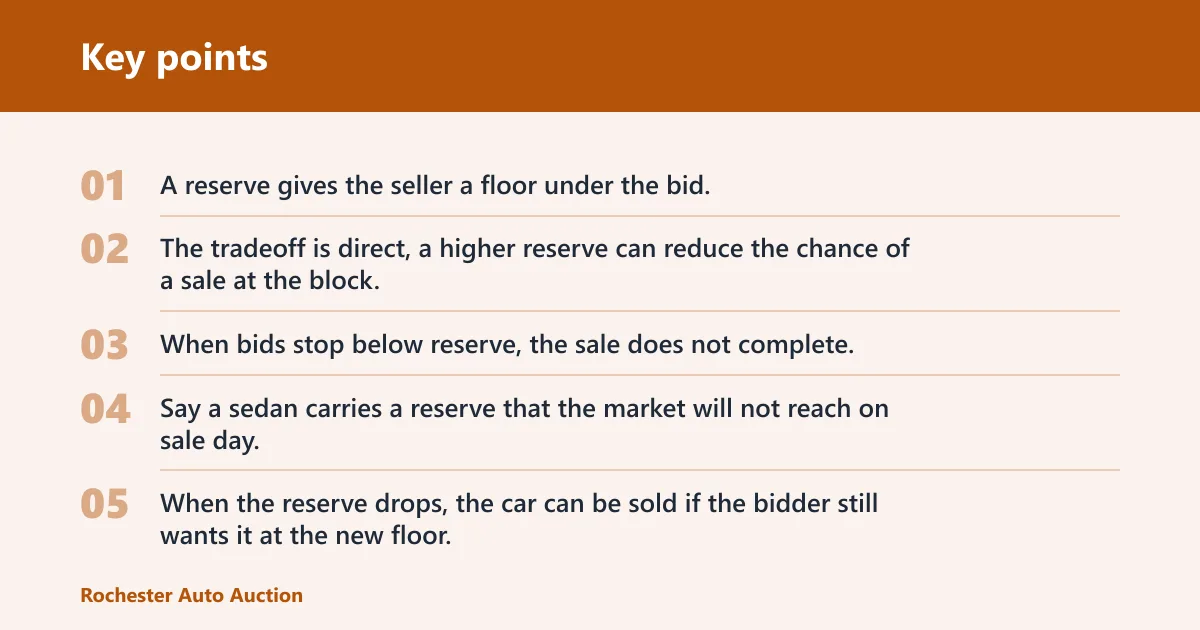
A reserve gives the seller a floor under the bid. It guards against underpricing, especially when market demand is uncertain or the vehicle has a condition issue that can depress bidding. The tradeoff is direct, a higher reserve can reduce the chance of a sale at the block.
That tradeoff affects total cost. If a car misses reserve once, the seller may still pay for the first run and then face a second round of charges if the vehicle is relisted or stored.
Why a vehicle can pass through without selling
When bids stop below reserve, the sale does not complete. The auctioneer may note that the unit is “no sale,” “reserve not met,” or “pass.” That outcome leaves the vehicle in the auction’s control until the seller decides what happens next.
Say a sedan carries a reserve that the market will not reach on sale day. The car may still draw real interest, but if the top bid stays short, the seller has to choose among lowering the reserve, taking a post-auction offer, or pulling the car. Each choice changes the fee chain.
When the reserve may be lowered or removed
The seller can sometimes lower the reserve after bidding closes, but that is not automatic and it is not free by default. Auction staff may suggest a reserve adjustment when bidding is close, because a small change can turn a no-sale into a completed sale and avoid extra carrying time.
When the reserve drops, the car can be sold if the bidder still wants it at the new floor. The key question is whether the auction’s rules treat that as a completed auction sale or as a separate post-auction deal.
Who pays when reserve is not met?
When reserve is not met, the buyer usually does not owe purchase-side fees for a transaction that never closed. The seller is the party most likely to face a no-sale charge.
Do not assume “no sale” means “no fees.” It often means the opposite for the consignor. The auction may still assess charges if the car took up space or had to be handled after the sale ended.
Buyer-side fees at no-sale
If the vehicle does not sell, the buyer usually owes nothing because there is no completed purchase. That changes if the buyer and seller reach a post-auction agreement. In that case, a binding sale can trigger the usual buyer premium and any other buyer-side charges that the auction contract attaches to a completed transaction.
A common first-timer mistake is assuming the highest bid creates a sale even when reserve stays unmet. It does not, unless the auction’s rules say the bidder remains bound after post-sale acceptance or reserve release.
Seller-side no-sale charges
The seller may be charged a no-sale fee when reserve is not met. Depending on the auction house and market, that fee may cover handling costs. Some auctions also split those costs into separate line items, which is why a single “no-sale” label can hide more than one charge.
That is the main cost chain to watch. A seller can start with one missed reserve, then face a no-sale fee and later storage costs if the car stays on site. Those charges stack only if the contract says they do.
What the auction terms control
Auction terms and conditions generally define the fee allocation. They spell out what counts as no-sale, when a reserve miss becomes a withdrawal, whether storage begins immediately, and whether a relisting fee is charged for the next sale date. Without that text, no one should guess at the bill.
For Rochester Auto Auction, the exact fee answer should come from the current seller agreement and buyer terms before bidding or consigning.
Can the seller accept a lower offer after the sale?
Yes, a seller can accept a lower post-auction offer after reserve is missed if the auction permits post-auction negotiation. When that happens, the no-sale turns into a completed sale at an agreed lower price. Once the deal closes, normal auction fees can apply even though the car did not sell at the block.
This is the area most guides skip. A reserve miss is not always the end of the transaction. It can be the start of a negotiated sale, and that switch can bring buyer premium and seller-side charges back into play under the auction contract.
Post-auction negotiation
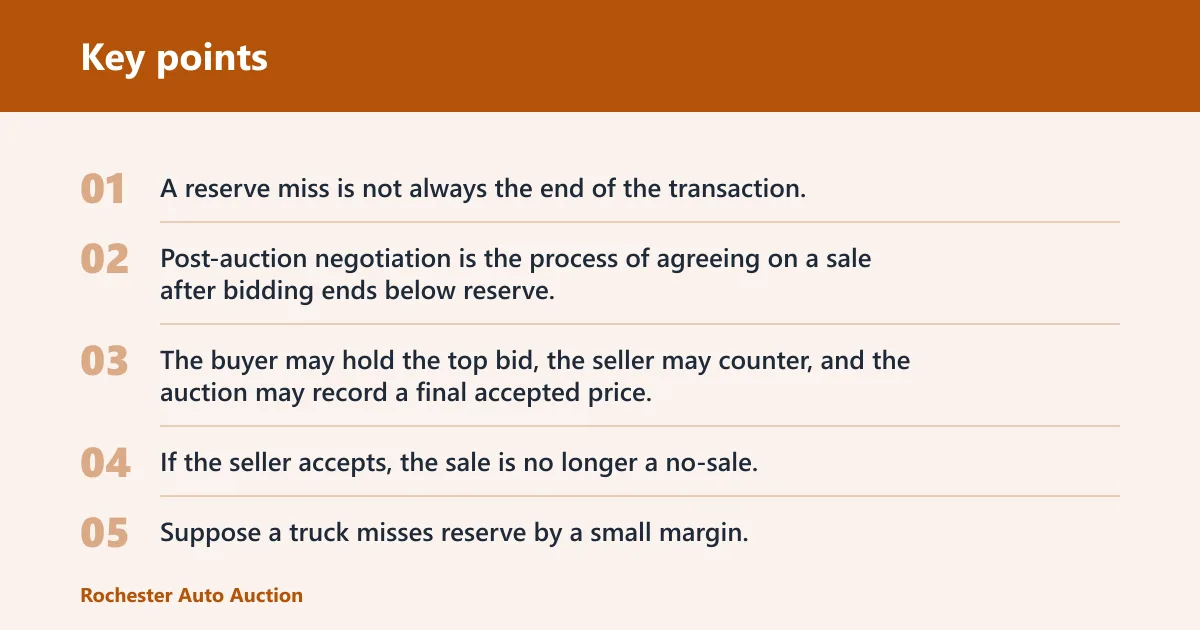
Post-auction negotiation is the process of agreeing on a sale after bidding ends below reserve. The buyer may hold the top bid, the seller may counter, and the auction may record a final accepted price. If the seller accepts, the sale is no longer a no-sale.
Suppose a truck misses reserve by a small margin. The auctioneer gets the seller’s approval to contact the high bidder, and both sides settle on a lower price. That deal can trigger the same buyer premium that would have applied during the live sale, plus any seller-side commission the terms require.
Which fees can still apply after acceptance?
Once the seller accepts a post-auction offer, the completed sale can carry normal buyer and seller fees. The buyer premium is the clearest example. Seller-side charges can also remain in force if the agreement treats the deal as a completed auction sale rather than a special exception.
The exact mix depends on the house rules. Some terms separate the original no-sale event from the later accepted offer. Others treat the accepted offer as if it had cleared the block.
When a no-sale becomes a completed sale
A no-sale becomes a completed sale when the seller accepts the price and the auction finalizes the transaction under its rules. At that point, the car is no longer sitting in reserve limbo. It is sold, and the fee structure shifts from no-sale handling to sale completion.
That shift matters for timing too. If the car sat on site after the block, storage may already have started. If transport or reconditioning was needed while the car waited, those charges may also appear. The contract should say when each clock starts.
Relisting and storage fees
Relisting fees and storage fees are separate charges. A relisting fee applies when the car returns to a later sale. A storage fee applies when the vehicle remains on site after the auction ends or after the agreed pickup window closes. They often appear together, but they are not the same charge.
This is where no-sale costs grow. A car that misses reserve on one day may look cheap on paper, then become more expensive once the seller keeps it in inventory for another cycle.
When a relisting fee appears
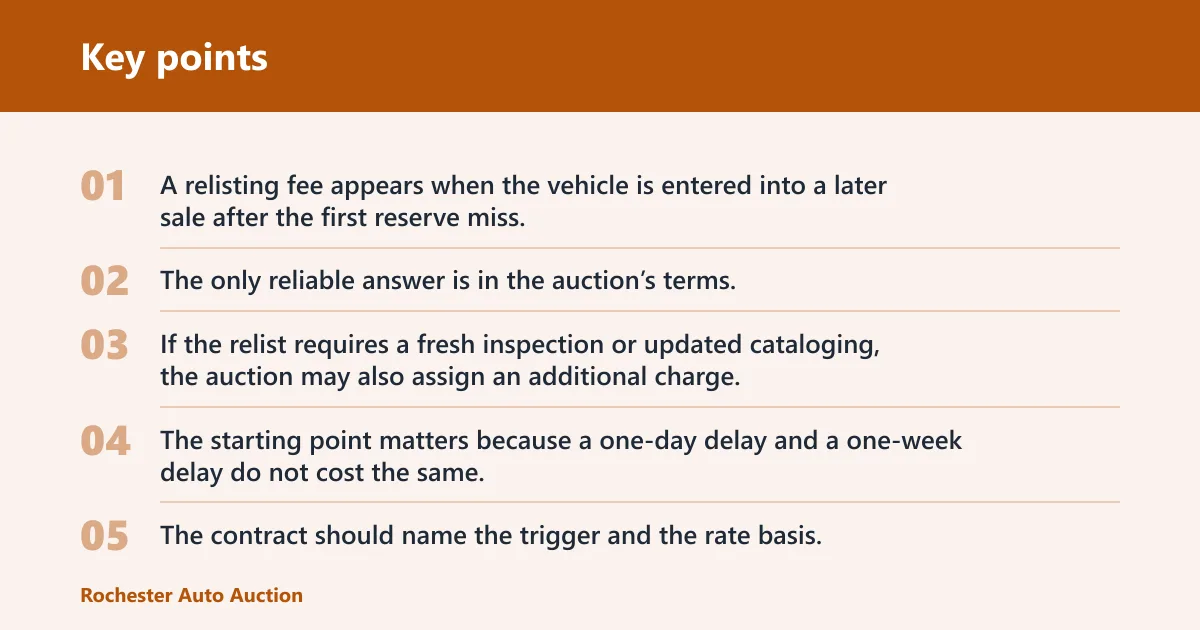
A relisting fee appears when the vehicle is entered into a later sale after the first reserve miss. Some auctions waive the first no-sale relist for certain consignments, while others charge a set fee every time the vehicle is run again. The only reliable answer is in the auction’s terms.
If the relist requires a fresh inspection or updated cataloging, the auction may also assign an additional charge. Those are distinct from the original no-sale fee. Ask for each line item separately.
How storage charges start
Storage charges start when the vehicle remains on site after the sale process ends and the auction’s free-hold period expires, if one exists. The starting point matters because a one-day delay and a one-week delay do not cost the same. The contract should name the trigger and the rate basis.
A vehicle stored after no-sale can also pick up handling fees if the auction has to process movements, keys, or paperwork around the hold. These are not universal charges. They are contract items.
How transport responsibility can shift
After a no-sale, transport responsibility can shift back to the seller if the vehicle stays on site and is not sold immediately. If the seller withdraws the car or leaves it in inventory, the auction may require the consignor to arrange pickup or pay transport handling under the contract.
That shift matters because a no-sale is not always the end of the cost chain. If the car sits longer than planned, the owner may be paying to store a vehicle that did not sell and still paying to move it out later.
How reserve strategy affects total cost
A high reserve can protect against underpricing, but it can also reduce sale probability. That raises the chance of no-sale charges, a relist charge, and storage costs if the vehicle stays on the floor. The cheapest reserve strategy is the one that matches market demand closely enough to avoid multiple cycles.
A reserve set too high can cost more than a lower reserve that clears on the first run. That is especially true when time on site has a cost. The right reserve is not the highest safe number. It is the number that balances price protection against carrying cost.
High reserve and sale probability
A higher reserve narrows the pool of winning bids. If the market does not reach that floor, the vehicle stays unsold and may require another round of marketing. Each round adds risk of extra fees if the car remains in inventory or has to be processed again.
Carrying cost after a no-sale
Carrying cost includes whatever the contract assigns after the car does not sell: no-sale fee, storage, relist, and transport handling. The longer the vehicle stays with the auction, the more likely those charges become. That is why timing matters as much as price.
Picture a crossover that misses reserve on Friday and is relisted for the next sale. If it sits through the weekend, then remains on site for another week, the seller may owe more than the original no-sale charge. The total depends on the auction rules and how fast the vehicle moves.
When lowering reserve may cost less than relisting
Lowering reserve after bidding closes may cost less than pulling the vehicle, relisting it, and storing it for another cycle. That is especially true when the top bid is close to the reserve and the buyer remains ready to close. A quick acceptance can stop the fee chain from growing.
The decision is practical. Compare the likely accepted price with the combined cost of no-sale, relist, and storage. If the second path adds more than the price gap, lowering reserve can be the cleaner financial move.
How to avoid surprise fees
The best way to avoid surprise fees is to read the seller agreement and buyer terms before the car hits the lane. Check the rules on no-sale fees, relisting, storage, withdrawal, and post-auction acceptance. If a charge is not named in writing, do not assume it is waived.
Auction terms are contract-specific. That means another auction house’s reserve rules are not proof of Rochester Auto Auction’s policy.
-
Read the seller agreement.
Check the no-sale, relist, storage, and withdrawal language before consigning the car. Look for who pays each fee, when a charge starts, and whether the auction can deduct it from proceeds or invoice it later. -
Check buyer terms before bidding.
Confirm whether a post-auction acceptance triggers a buyer premium or other completed-sale fees. If the terms say a bid becomes binding after acceptance, the buyer can owe normal purchase charges even though reserve was missed initially. -
Confirm the hold window.
Ask when storage begins and whether there is any free hold after a no-sale. That timing controls whether a car can sit for a short period without charges or whether the clock starts as soon as the auction ends. -
Get withdrawal rules in writing.
If the seller may pull the car after reserve is missed, confirm whether a withdrawal fee applies. Some contracts also assign costs when the vehicle leaves the sale stream after intake.
Frequently asked questions
What fees are charged if a car does not meet reserve?
Exact fees come from Rochester Auto Auction’s current fee schedule and terms, not from generic auction practice. In a reserve miss, the buyer usually owes nothing unless a later deal is accepted. The seller may owe no-sale, storage, or other handling charges if the contract assigns them.
Do I pay anything if the car fails to sell at auction?
If you are the buyer and the car simply misses reserve, you usually do not owe purchase-side fees because no sale was completed. If you are the seller, the auction may still charge a no-sale fee or related handling costs. The contract controls which charges apply and when.
Who pays the reserve-not-met fee, the buyer or seller?
The reserve-not-met fee is usually a seller-side charge if the auction uses one, because the seller chose the reserve and sent the car to sale. The buyer typically does not pay that fee unless the auction later completes a sale through post-auction acceptance, which can trigger normal buyer charges.
Can the seller lower the reserve after bidding closes?
Yes, if the auction allows it and the seller agrees to the change. A lower reserve can turn a no-sale into a sale if the bidder stays engaged. Once the price is accepted and the auction finalizes the transaction, normal buyer and seller fees may apply under the terms.
What happens to the car if reserve isn’t met?
The car remains unsold until the seller chooses the next step. Common outcomes are relisting, accepting a post-auction offer, withdrawing the vehicle, or leaving it in inventory for later handling. Each option can trigger different fees, especially if storage starts or the car is cataloged again.
Is there a relisting fee when a reserve price is not reached?
Often there is, but the exact rule depends on Rochester Auto Auction’s terms. A relisting fee can apply when the car returns to a later sale. Do not assume the first no-sale includes a free rerun.
Does a no-sale mean the buyer owes auction fees?
Usually no, because no purchase was completed at the block. The exception is a post-auction acceptance, where the buyer may still owe the normal buyer premium and related sale charges. The buyer should check the auction terms before bidding, since binding rules can change that answer.
How can I avoid surprise fees on a reserve-not-met car?
Read the seller agreement and buyer terms before bidding or consigning, and ask where no-sale, relist, storage, withdrawal, and post-auction fees appear in writing. That is the only reliable way to see who pays what, when the clock starts, and whether a reserve adjustment changes the cost.