What Does a Rebuilt Title Mean on a Car?
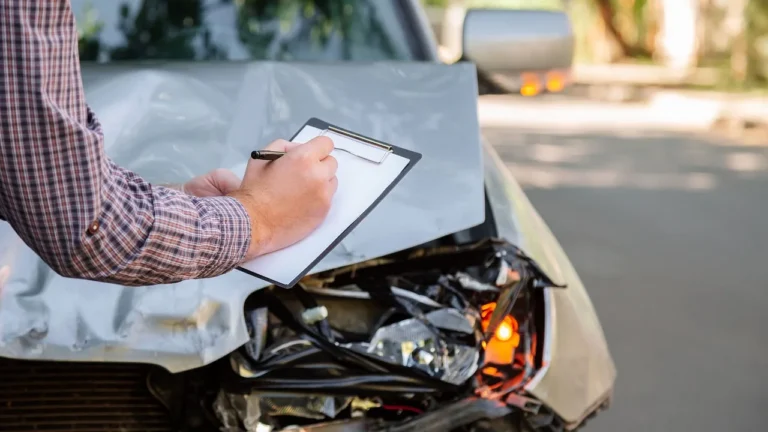
A rebuilt title generally means a vehicle was once declared a total loss and later repaired enough to pass a required state inspection, so it is mainly a paperwork status rather than a quality rating. Treat that status as a warning, because hidden flood, frame, airbag, or wiring damage can turn a cheap car into an expensive problem. This guide explains the documents to ask for, the inspection gaps to watch, and the failure modes that should make you walk away.
What a rebuilt title represents
A rebuilt title is a road-legal title brand a vehicle can receive after a salvage or similarly branded vehicle is repaired and passes the required state process. It signals prior significant damage, not clean history, and the exact wording can vary by state or jurisdiction. A rebuilt title does not prove the repairs were done well.
How the title changes after repair
A common sequence is damage, salvage branding, repair, inspection, and then a rebuilt-style title application. In some states, the paperwork may read reconstructed or use another variation, so the label on the title matters as much as the word a seller uses in an ad. That sequence is why you should ask for the actual title, not just a summary.
Why wording differs by state
Rebuilt, reconstructed, and rebuilt salvage are not always interchangeable. Some states use one term for a vehicle that has passed inspection after a total-loss event, while another state uses a different brand for the same broad situation. If the title wording does not match the seller’s explanation, treat that as a documentation problem until proven otherwise.
What a rebuilt title does not prove
The brand does not prove structural soundness, airbag integrity, flood resistance, or clean wiring. It also does not confirm that replacement parts were installed correctly or that fault codes have stayed away. The title tells you the car cleared a government process. It does not tell you the repair quality.
What is the difference between a rebuilt title and a salvage title?
A salvage title is the pre-repair status after a major damage event or total loss, while a rebuilt title is the later road-legal status after repairs and inspection. That difference matters because salvage usually means the vehicle is still outside normal road use, while rebuilt means it has cleared the state process that allows registration.
Salvage is the pre-repair status
Salvage is the warning flag that comes before repair work is accepted by the state. Vehicles with salvage branding often have major damage histories, and F8 notes that rebuilt vehicles were once declared a total loss. If a seller says the car was “just fixed,” ask whether the title actually moved from salvage to rebuilt through the proper process.
Rebuilt is the post-inspection status
Rebuilt means the vehicle was repaired and then accepted for road use through the required paperwork and inspection chain. Some states require a rebuilder license for the work, and the local DMV or similar authority usually confirms the vehicle is safe to drive before the title changes. That makes rebuilt a legal status, not a quality certificate.
Why the difference matters to buyers
A salvage title and a rebuilt title can look similar in a listing, but they do not mean the same thing to insurers, lenders, or future owners. A salvage-branded car that never completed the process may not be legal for ordinary road use. A rebuilt car may be legal to register, yet still carry repair risks that need proof.
What does a rebuilt title mean on a used car?
On a used car, a rebuilt title means you are weighing a vehicle with a known damage past against its current condition, asking price, and documentation. It can still be a workable buy, but the title lowers buyer confidence and usually lowers market value because the damage history stays attached.
Value and buyer confidence
Rebuilt vehicles have a lower market value because of their damage history. That lower price is the main reason some shoppers consider them. It is also why the paperwork has to be strong. If the documents are thin, the discount may not be enough to offset the risk of hidden repairs.
Financing and insurance friction
Insurance can be harder to get, or cost more, on rebuilt-title cars, and comprehensive and collision coverage may also be harder to obtain. Lenders may also hesitate because resale value is harder to predict. If you cannot get a quote before purchase, you may be buying a car that is difficult to protect or finance on normal terms.
What clean title tells you by comparison
A clean title is the baseline for buyer confidence because it means there is no salvage or rebuilt brand on the title. That does not guarantee the car has never been damaged, but it removes the branded-title warning that comes with prior total loss or major damage. For value, clean title still leads the market.
What a rebuilt title does not guarantee
A rebuilt title does not guarantee that the frame is straight, the airbags work, or that flood water never reached the cabin. It does not prove the seller replaced every damaged part, and it does not rule out electrical issues or hidden corrosion. That is why the title should lead to document review, then inspection.
Structural repair quality
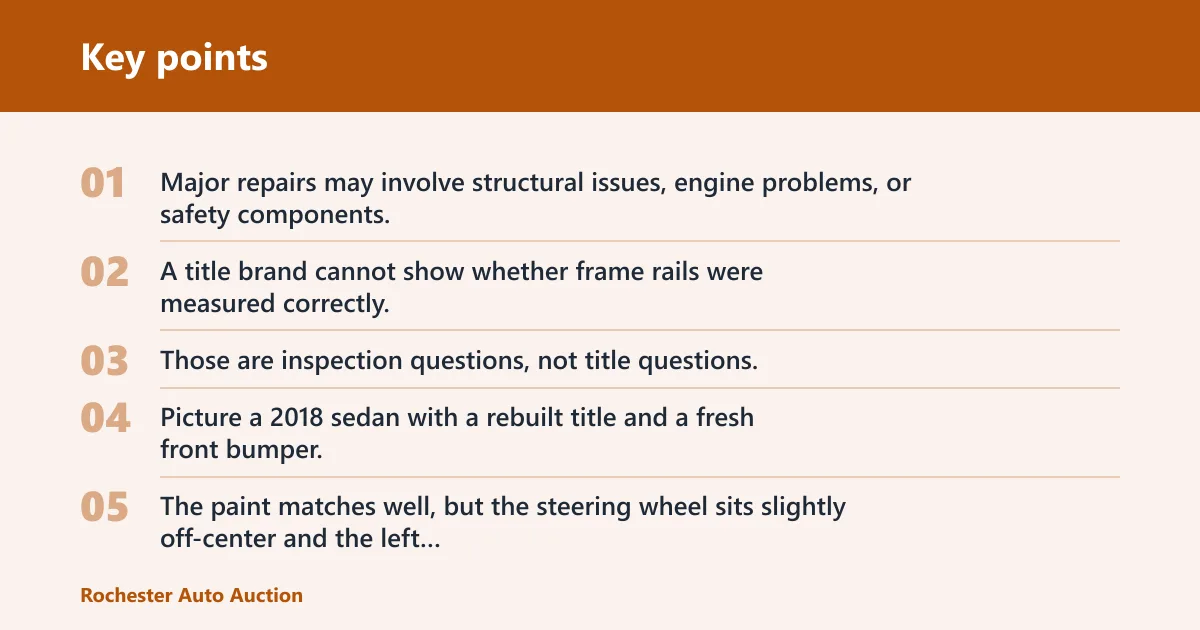
Major repairs may involve structural issues, engine problems, or safety components. A title brand cannot show whether frame rails were measured correctly, whether suspension pickup points were repaired to spec, or whether alignment was set after the work. Those are inspection questions, not title questions.
Picture a 2018 sedan with a rebuilt title and a fresh front bumper. The paint matches well, but the steering wheel sits slightly off-center and the left front tire wears faster than the right. That is the kind of mismatch that calls for frame rail and alignment checks, not a glance at the exterior.
Airbag and restraint system condition
Airbag deployment evidence matters because a deployed system can be replaced poorly or with missing parts. Check for warning lights, mismatched dash panels, steering wheel differences, and missing labels or covers around the restraints. A rebuilt title does not confirm that every airbag, pretensioner, and sensor was restored correctly.
Flood or electrical damage history
Flood residue can hide under carpets, in seat tracks, inside connectors, and around fuse boxes. A car can pass a title process and still have corrosion, intermittent electronics, or repeated sensor faults. That is why a history report and a physical inspection need to agree before you trust the listing.
Rebuilt title buyer checklist
Ask for the title brand, repair records, inspection proof, and history reports before you pay. The goal is to see whether the car has completed the rebuilt path cleanly and whether the seller can support the story with documents. Missing paperwork is a warning sign, especially when the price seems unusually low.
| Document | What it proves | Red flags | Should it be present before purchase? |
|---|---|---|---|
| Title brand | The legal status currently attached to the vehicle, including salvage, rebuilt, reconstructed, or another state-specific brand | Seller description does not match the title; brand has been “lost” or is hard to read; title wording differs from the ad without explanation | Yes |
| Repair invoices | What was repaired, which systems were touched, and when the work occurred | Vague labor-only line items; no body, frame, airbag, or electrical details; dates that do not line up with the title timeline | Yes |
| Parts receipts | Which replacement parts were purchased and whether they appear consistent with the damage story | No receipts for major parts; reused safety parts; generic descriptions that do not identify the parts installed | Yes |
| State inspection certificate | The vehicle passed the required rebuilt or title inspection process | Missing certificate; expired paperwork; certificate number that cannot be tied to the car | Yes |
| VIN history report | Title changes, accident history, mileage events, auction activity, and gaps in the story | Salvage event absent from seller disclosure; mileage jump; auction record that does not match the seller’s timeline | Yes |
| Odometer history | Whether mileage readings moved in a believable pattern | Rollback, inconsistency, or a long gap in mileage reporting | Yes |
| Airbag deployment evidence | Whether airbags, pretensioners, or related parts were triggered and replaced | Missing disclosure after front-end damage; new interior parts with no explanation; warning light behavior that changed recently | Yes |
| Lender or insurer quote notes | Whether financing or coverage is available for that exact VIN | Seller says “insurance is no problem” but has no quote; only liability is available; lender will not finance the VIN | Strongly recommended |
How to read the paper trail
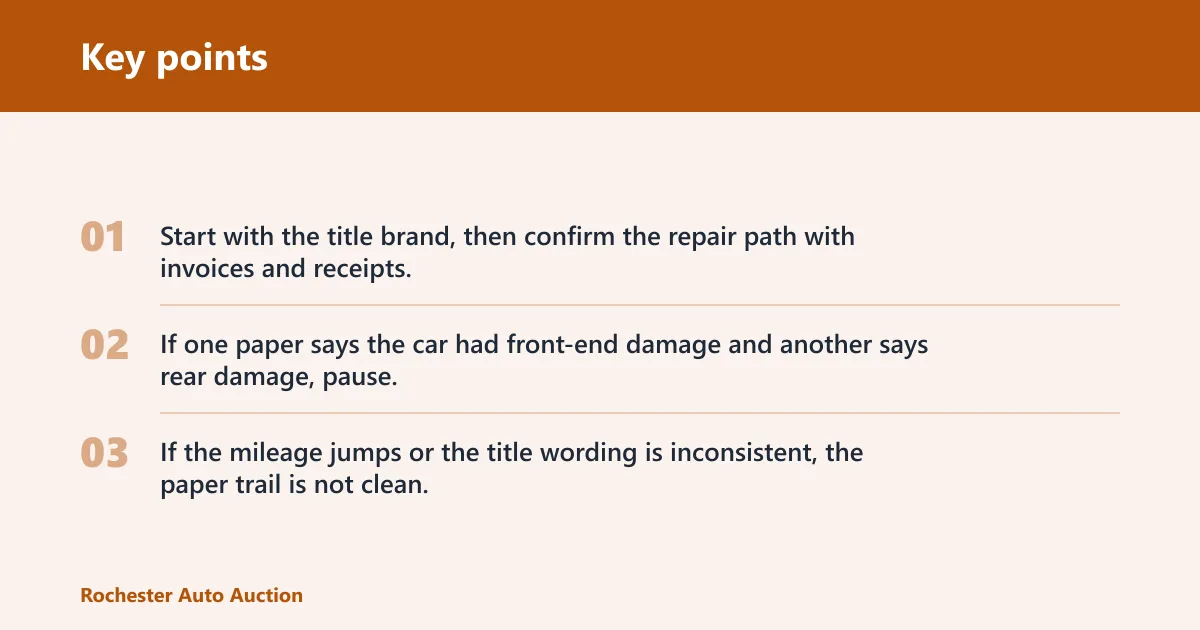
Start with the title brand, then confirm the repair path with invoices and receipts, then match that story to the inspection certificate and history reports. If one paper says the car had front-end damage and another says rear damage, pause. If the mileage jumps or the title wording is inconsistent, the paper trail is not clean.
What should you inspect before buying a rebuilt title car?
Focus on failure modes that branded-title cars hide most often: frame damage, suspension problems, airbags, scan-tool faults, flood residue, and poor fitment. A proper pre-purchase inspection should include a test drive plus internal and external assessment, ideally by a qualified body shop or inspection provider.
Frame rails, suspension, and alignment
Check frame rails for bends, fresh welding, rippled metal, or uneven seam sealer. Look at tire wear, steering pull, and crooked wheels, since these often point to alignment or suspension issues after a crash. F12 notes frame rails and wheel alignment as inspection examples for a reason.
Say your compact SUV has a rebuilt title and a shiny front fascia. During the test drive, it tracks slightly left on a flat road and the steering wheel sits a few degrees off-center. That is a clue to inspect the suspension and frame structure before you talk yourself into the cosmetic finish.
Scan-tool codes and warning lights
Use a scan tool and check for stored, pending, or recently cleared codes. A seller can clear a dashboard light, but many modules keep evidence of prior faults. Watch for airbag, stability control, ABS, and engine codes, since they can point to incomplete repairs or hidden electrical damage.
Flood residue and airbag clues
Look for silt under carpets, moisture smell, stained seat tracks, oxidation on fasteners, and water lines in the spare tire well. For airbags, check the dash, steering wheel, seat bolsters, and headliner for mismatched materials or disturbed trim. A rebuilt title does not rule out flood exposure, and a clean-looking cabin can still hide corrosion.
Can you register and insure a rebuilt title car?
In many places, yes, a rebuilt vehicle can be registered and used on the road after the required state process is complete. Insurance is the harder part. Coverage for comprehensive and collision can be limited, and lenders may be cautious because the car’s value and repair history are harder to judge.
State title and inspection steps
Registration usually depends on the car completing the state’s title process, which may include documentation, VIN verification, and safety confirmation. Requirements vary by state, and some jurisdictions use different title wording. Before purchase, confirm that the current paperwork is sufficient for your state, not just the seller’s state.
Insurance quote checks before purchase
Do not assume a rebuilt title car will qualify for the same policy setup as a clean-title vehicle. Ask for quote notes tied to the exact VIN, and check whether comprehensive and collision are available. If only bare-bones coverage is possible, the purchase math changes fast.
Why lenders may be cautious
Lenders care about resale value, and rebuilt vehicles usually bring less at resale than clean-title vehicles. That matters if the car is totaled again, because the payout and collateral value may be lower. If you need financing, get approval tied to the VIN before you commit.
Frequently asked questions
What does a rebuilt title mean on a car for sale?
It means the vehicle was once branded for major damage or total loss and later repaired enough to pass the required state process. For a listing, that should trigger document review, a VIN-based history check, and a hands-on inspection. It is a legal status, not a quality stamp.
What does a salvage title mean on a car?
A salvage title means the car was declared a total loss or had damage severe enough to receive salvage branding before repair. In many states, a salvage car is not ready for ordinary road use until it completes the rebuilt or similar title process. Treat it as pre-repair status.
What does a reconstructed title mean on a car?
Reconstructed is a state-dependent label that can function like rebuilt in another jurisdiction. It usually means the vehicle was repaired after a major loss event and then inspected before road use was allowed. Always read the actual title wording, because the brand name can vary by state.
What should you check before buying a rebuilt title car?
Check the title brand, repair invoices, parts receipts, inspection certificate, VIN history report, odometer history, airbag evidence, and insurance quotes. Then inspect frame rails, alignment, suspension, warning lights, flood residue, and fitment. If those items do not line up, the price is not the only thing that changed.